Photopolarimetric monitoring of 41 blazars in optical and - - PowerPoint PPT Presentation

photopolarimetric monitoring of 41 blazars in optical and
SMART_READER_LITE
LIVE PREVIEW

Photopolarimetric monitoring of 41 blazars in optical and - - PowerPoint PPT Presentation

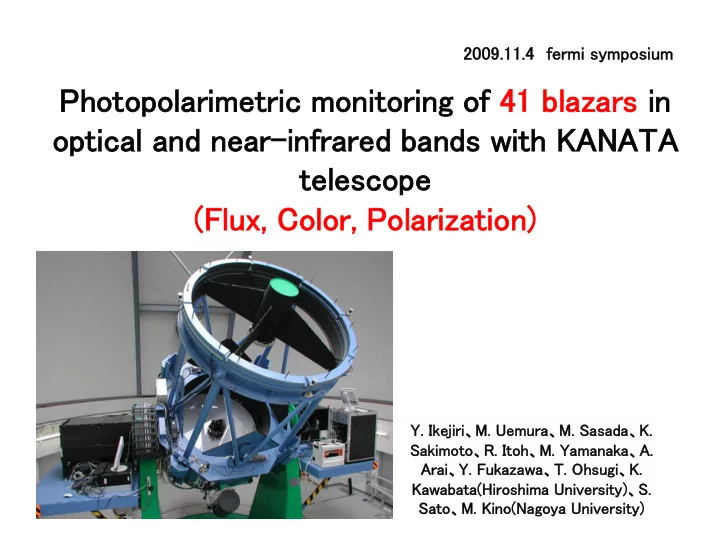
2009.11.4 fermi symposium Photopolarimetric monitoring of 41 blazars in optical and near-infrared bands with KANATA telescope (Flux, Color, Polarization) Y. IkejiriM. UemuraM. SasadaK. SakimotoR. ItohM. YamanakaA.


slide-1
SLIDE 1

Photopolarimetric monitoring of 41 blazars in

  • ptical and near-infrared bands with KANATA

telescope
 (Flux, Color, Polarization)

2009.11.4 fermi symposium

  • Y. Ikejiri、M. Uemura、M. Sasada、K.

Sakimoto、R. Itoh、M. Yamanaka、A. Arai、Y. Fukazawa、T. Ohsugi、K. Kawabata(Hiroshima University)、S. Sato、M. Kino(Nagoya University)

slide-2
SLIDE 2

Class of Blazars

Inoue et al. 2009

LBL IBL HBL

  • ptical band

The peak energy of synchrotron emission :

Lower than optical region Optical region Higher than optical region ⇒ LBL (Low-energy peaked BL Lac object) ⇒ IBL (Intermediate-energy peaked BL Lac object) ⇒ HBL (High-energy peaked BL Lac object)

We discuss the characteristics of each class.

slide-3
SLIDE 3

Relationship between flux & color Relationship between flux & Polarization Degree (P.D.)

Some of blazars tend to be bluer-when-brighter.

The Flux varies by injection of high energy electron?

Erratic or Systematic???

⇒Poorly studied in optical ⇒Common feature in ALL blazars???

Previous works about color and polarization

Flux & Color of 3C 273 magnitude in V Color (V-R)

Dai et al. 2009

We investigated the correlation of Flux, Color and Polarization, using the KANATA telescope.

Yu et al. 2002

P.D magnitude in R Flux & P.D. of OJ 287

bluer brighter

slide-4
SLIDE 4

KANATA telescope

  • TRISPEC can do simultaneous photopolarimetory in

the Optical (V) and near-infrared (J) bands.

KANATA and TRISPEC are good tools for the observation of blazars.

  • KANATA of Hiroshima-Univ.

⇒We can perform observations Flexibly, Frequently and for a Long period. KANATA 1.5m Optical and near-infrared telescope in Higashi-Hiroshima Observatory

We performed follow up observation with Fermi!!

slide-5
SLIDE 5

Monitoring list

1ES 0323+022 1ES 0647+250 1ES 0806+524 1ES 1959+650 1ES 2344+514 3C 371 3C 454.3 3C 66A 3C 273 3C 279 AO 0235+164 BL Lac H 1722+119

Total : 41

MisV 1436 Mrk 421 Mrk 501 OJ 287 OJ 49 ON 231 ON 325 OQ 530 PG 1553+113 PKS 0048-097 PKS 0215+015 PKS 0422+004 PKS 0754+100 PKS 1222+216 PKS 1502+106 PKS 1510-089 PKS 1749+096 PKS 2155-304 QSO 0454-234 QSO 0948+002 QSO 1239+044 RX J1542.8+612 S2 0109+22 S4 0954+65 S5 0716+7143 S5 1803+78 3EG 1052+571 QSO 0324+341

Detected by Fermi

Monitoring observations started on May 2008.

Some results : Sasada+08, Sasada+09

slide-6
SLIDE 6

Correlation of Flux and Color (V-J)

slide-7
SLIDE 7

Examples of light curves

3C 454.3 3C 371

bluer-when-brighter

bluer

redder-when-brighter

The objects showing a redder-when-brighter trend. ・3C 454.3 ・PKS 1510-089 ・QSO 0454-234

Flux & Color of 3C 454.3

The thermal emission of an accretion disk can be seen when the emission of the jet becomes weak.

bluer brighter brighter

slide-8
SLIDE 8

Correlation of Flux & Color

The number of objects which have ・・・ ・significant correlation : 24 (83%).

  • bluer-when-brighter 21
  • (redder+bluer)-when-brighter 3

・no correlation : 5 (17%).

The “bluer-when-brighter” feature is common observed in 83% blazars.

Objects observed in more than 10 nights: Nobs > 10 ⇒ 29/41

bluer brighter

Absolute mag. in V Color (V-J) Bluer-when-brighter

slide-9
SLIDE 9

steeper Absolute mag. (average) brighter Gradient ⊿Flux/⊿Color

Luminosity & Color(V-J)

・HBLs tend to be faint and have small gradient. ・The variation amplitudes of color are also small in HBLs, too.

redder brighter

Absolute mag. in V Color (V-J)

Absolute magnitudes and Color of all objects “bluer-when-brighter” objects

The faint blazars (=HBLs) show less variability than LBLs.

steep shallow

slide-10
SLIDE 10

Correlation of Flux and Polarization Degree (P.D.)

slide-11
SLIDE 11

Correlation of Flux & P.D.

The number of objects which have ・・・ ・significant correlation: 14 (48%). (4 objects show negative correlation.) ・no correlation: 15 (52%).

Poor correlation of Flux & P.D., compared with that of Flux & Color

Nobs > 10 ⇒ 29/41 Objects observed for more than 10 nights: magnitude in V P.D. [%]

AO0235+164

slide-12
SLIDE 12

brighter Absolute mag. in V P.D. [%] higher

Luminosity & P.D.

absolute magnitudes and P.D. about all blazars

・There are two type of LBL: ・large variation amplitude ・small variaion amplitude ・The P.D. of faint blazars (=HBLs) are always low.

The faint blazars (=HBLs) have low P.D. and show small amplitudes of P.D..

There is no objects.

slide-13
SLIDE 13

Implication of the observations

In blazars, most of flare is caused by the injection of high energy electrons.

ν νFν LBL: observed above cut off of synchrotron emission HBL: below

variable The results of the observations ・“Bluer-when-brighter” : common feature in blazars ・The faint blazars (=HBLs) have the small variation amplitudes

  • f Flux, Color and P.D..

LBL HBL

In the case of

  • ptical band

less variable Injection of high energy electrons Variation of beaming factor variable

slide-14
SLIDE 14
  • Correlation
  • The correlation of the Flux and the Color

⇒ 24/29 (83%)

  • The correlation of the Flux and the P.D.

⇒ 14/29 (48%) (positive correlation: 10 (34%), negative correlation: 4 (14%))

  • Variability in each class
  • The faint blazars (=HBLs) have the small amplitudes of Flux,

Color and P.D..

Summary

Latest observations can been in “KANATA Obslog” http://kanatatmp.q.atena.ne.jp/kanataobslog/

Future works

・More detailed analysis of Polarization ・The correlation of the gamma and the optical ⇒ under investigation