Objective Girls and Womens Career Explore socio cultural norms and - - PDF document

objective
SMART_READER_LITE
LIVE PREVIEW

Objective Girls and Womens Career Explore socio cultural norms and - - PDF document

12/15/2013 Objective Girls and Womens Career Explore socio cultural norms and attitude Perspectives & Choices in the Asia- associated with men and womens career Pacific Region: Case of Nepal choice. Sushan Acharya 13-12-2013


slide-1
SLIDE 1

12/15/2013 1

Girls’ and Women’s Career Perspectives & Choices in the Asia- Pacific Region: Case of Nepal

Sushan Acharya 13-12-2013

Objective

  • Explore socio cultural norms and attitude

associated with men and women’s career choice.

  • Map the link among labour market, education

and grade 10 students’ career choices

Methodology

  • The overall approach of the study has been

exploratory, aiming to map educational

  • ptions, how young and adult view careers

related to their appropriateness to women and men, and to what extent labour market correlates with these different aspects.

  • Location, Participants & Size

Location:

  • Eight districts: Kailali, Baglung,

Bhaktapur, Dhanusa Ilam, Kathmandu, Lalitpur and Solukhumbu

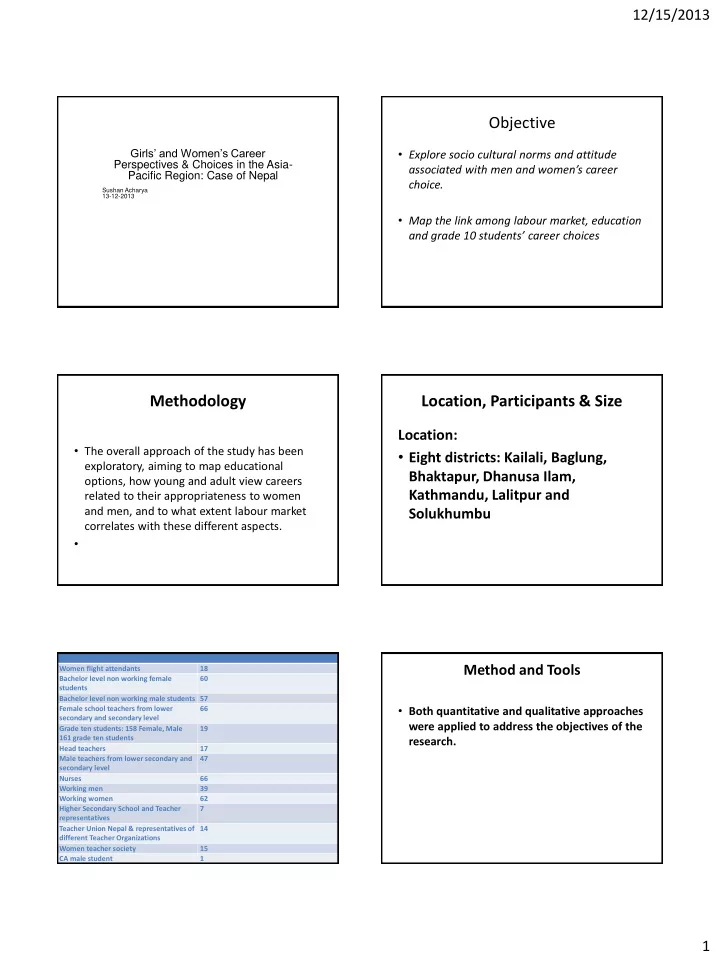
Participants and Size Women flight attendants 18 Bachelor level non working female students 60 Bachelor level non working male students 57 Female school teachers from lower secondary and secondary level 66 Grade ten students: 158 Female, Male 161 grade ten students 19 Head teachers 17 Male teachers from lower secondary and secondary level 47 Nurses 66 Working men 39 Working women 62 Higher Secondary School and Teacher representatives 7 Teacher Union Nepal & representatives of different Teacher Organizations 14 Women teacher society 15 CA male student 1 MBBS entrance exam preparing male: 1

Method and Tools

  • Both quantitative and qualitative approaches

were applied to address the objectives of the research.

slide-2
SLIDE 2

12/15/2013 2 Quantitative approach

  • Five point rating scale:
  • Survey: Two sets of questionnaires were

prepared for adult men and women. One set was for those already employed and another for unemployed Bachelor level students.

Qualitative approach

Focus group discussion (FGD): Thirty two FGDs with grade ten girls and boys from 8 districts. Main purposes: to collect information about their families' and their own perceptions about suitable careers for female and male; their wishes related to

  • ccupations;
  • rientation that they receive from teachers'

regarding career choice and plan about their higher education.

  • Group discussion: Three separate group

discussions were organized- representatives of Higher secondary school association Nepal, Higher secondary school teacher association Nepal; Higher secondary public school teacher; Teacher Union of Nepal and different teacher

  • rganizations; and Women Teacher Society.

Interview:

  • officials of National center for Educational

Development;

  • Higher Secondary School Principle from public

school in Bardiya district who serves as a trainer for TPD Curriculum Development Center officials;

  • Madhesi women working in public sector
  • Women government officers,
  • One Woman Development Officer (WDO) who

is not Madhesi but working in the district for long.

Document Review

  • Nepal Demographic Health Survey (NDHS)

2011,

  • Nepal Labour Force Survey (NLFS) 2008
  • School statistical reports produced by DOE

(Department of Education).

  • Academic study and commissioned research

reports.

slide-3
SLIDE 3

12/15/2013 3 Delimitation

  • Short time period therefore it was decided to

use quantitative approach more than qualitative approach.

  • Formally educated and those involved in

workforce with certain level of education were only selected.

  • Due to unavailability of human resource at

local level district from Mid Western region could not be selected.

Limitations

  • Summer vacation scheduled at different

periods during May and June

  • Closing of fiscal year in mid July
  • Literature related to some of the research

areas was not available. Therefore extensive empirical work.

  • More ambitious and laborious than expected

Areas that the research attempted to capture

  • Role of men and women in the workplace
  • Statutory provisions related to women's

employment

  • Norms and attitudes related to the types of

careers/professions suited for men and women

  • Overall structure of the labour market
  • Structure of the education system
  • Current concerns in terms of gender

disparity in the education system

  • Enrolment in school, tertiary level and

TEVT

  • Policies, initiatives and programmes to

address gender issues in education

  • Female teachers at lower and upper

secondary levels

  • Teacher training on the use of gender

sensitive language and pedagogy

  • Primary/secondary level curricula and

textbooks from a gender perspective

  • Approach to career counseling
  • Extra-curricular activities in school
  • Infrastructure and resources in schools
  • Grade ten male and female's plan to enter

the labour market

  • Grade 10 male and female students' plan to

pursue tertiary education

  • Job that grade ten male and female expect to

have in about 30 years old

slide-4
SLIDE 4

12/15/2013 4

  • Careers/occupations perceived suitable for

female and male

  • Correlation between career choice of girls

and the education system context and policies, factors

  • Correlation between career orientation of

girls and the overall structure of the labour market

  • Correlation between the education system

context and policies/factors and the structure of the labour market

Norms and attitudes related to the types of careers/professions suited for men and women

  • Main observation: socio cultural norms

regarding jobs suitable for women and men have been steadily changing.

  • Increased number of women in work force

(e.g. in financial sectors, government

  • ffices, hospitals, etc.) has played a

significant role in creating role model- contributing to the changing norms and attitude of families and individuals.

  • However, because of the perceived

roles and responsibilities of men and women, and hesitation to invest in girls' education families and individuals seemed to be more cautious in selecting jobs for boys and girls.

Voices of grade 10 female students

  • Ilam: Families prefer nursing because there is

a trend of only girls pursing this profession; teaching because it does not require much investment and is hassle-free.

  • Kailali: parents want them to take such
  • ccupation that does not require high

investment and it reaps benefits; and teaching because it does not require field visits for work purposes. Girls also added that daughters should not be allowed to make all choices by themselves, some restrictions are necessary.

slide-5
SLIDE 5

12/15/2013 5 Voices of grade 10 female students contd…

  • Kathmandu: parents allow and encourage to

pursue their interests.

  • Baglung: parents want them to carefully look

into what they would like to do so that they keep away from anything that would make them behave in a manner the society does not approve of.

  • Boys should opt for certain fields that can

earn a good income, and share their experiences and knowledge with other people, and with the help of such

  • ccupations they can create further job
  • pportunities in their villages too.
  • Boys have more freedom and opportunity

in society, boys are more active; physically stronger; more confident; society revere boys more than girls;

  • For security reasons and family restrictions

girls have less freedom and cannot make independent decision; society puts more restriction on girls;

  • Women have been doing certain works for

many years. For example air hostess in their view helps in revealing some qualities in women like patience and responsiveness according to the situations.

  • Men prefer women who give more time to

family

Voices of grade 10 male students

  • Since girls have to take care of children and

household, and cannot travel suitable jobs for them are those that consume less time such as teaching, tailoring, private tutoring, beautician and small home based business.

  • Girls are more skillful in such works and

these job require less physical labor.

  • Girls have to perform household duties and first

make their in-laws happy, then in the spare time whatever is feasible they have to do.

  • Boys are physically stronger and bold; can do

hard labor; have leadership quality, families support their decision; families support their education; responsible for family's sustenance; should have capacity to sustain family; do not have to do household chores and they prefer

  • utdoors;
slide-6
SLIDE 6

12/15/2013 6

  • Girls prefer to do works that do not require

much movement and they are less strong therefore certain jobs are more suitable for boys and certain jobs for girls

  • Men are the ones who come forward to

fulfill society's demands and take challenges therefore certain jobs are more suitable for them;

  • Men and women should take jobs

according to their social, biological and psychological situations, and cultural norms of society

Indications

  • Primarily girls' socio cultural

environment and family economy drive both the family and themselves when it comes to the selection of career as well as area of study.

  • The world view guides boys' and girls'

socialization differently and thereby influences the working world.

  • Young girls and boys still seemed to

take the gender stereotypes and roles as granted. Result:

  • More challenging jobs are given to male

employees on one hand and women are not keen on taking more challenging jobs on the other.

Employment by

  • ccupation and sector
slide-7
SLIDE 7

12/15/2013 7

Armed forces 0.1% Clerks or office assistants 1.8% Craft and related trades workers 11.6% Elementary occupation 12.2% Legislators, senior officials 1.1% Market agriculture 2.7% Plant and machine operators 2.7% Professionals 2.8% Service workers 9.3% Subsistence agriculture 52.9% Technician and assoc. profess. 2.7%

15 yrs and above Male Employment Status (CBS 2009)

Armed forces 0% Clerks or office assistants 0.3% Craft and related trades workers 5.5% Elementary occupation 9.1% Legislators, senior officials 0.2% Market agriculture 3.5% Plant and machine operators 0.2% Professionals 0.8% Service workers 5.5% Subsistence agriculture 73.7% Technician and assoc. profess. 1.3%

15 yrs and above Female Employment Status (CBS, 2009)

Approaches to career counseling

  • Formal career counseling does not exist in any

type of schools in Nepal

  • Suggestion to students is based only on their

academic

  • Not been able to tell students about different

subjects, areas and sectors

  • "in any case, study science in higher secondary

level and get through it then you can go to any stream".

  • Most parents or families still orient

girls for marriage.

  • By Bachelor level 3rd year they are

married,

  • They do not refuse or resist because

they are already oriented towards it.

  • "Because of this most female students

show no high aspirations. They are happy to get engaged in small scale

  • work. However men/boys usually say

that they will not work until they get a good degree/education".

slide-8
SLIDE 8

12/15/2013 8

  • Mostly girls show interest in teaching,

dancing and nursing but while delivering curriculum teachers do not discuss about such interests of students.

  • "Concern is to overcome the hurdle (exam)

which is right in front of them; occupation is a far away thing".

  • Teachers are concerned about finishing

curriculum on time and getting students through the exams.

  • The education where rigid student

evaluation system is followed examinations scores are highly valued and

  • ther things become less important to talk

about or discuss.

Major determinants of career/education related decision

  • SLC score or percentage;
  • Practices observed in their close circle (family

members, neighbors and peers);

  • Teachers' suggestion;
  • Market trend

Social cultural norms and attitude and family economic condition cross cut all 4 trends

Why grade ten female's plan to enter labour market?

YES

  • For girls the reason is more personal:
  • For independence;
  • Fulfill basic needs
  • Not like to be dependent on their in-laws

and husbands

  • Standing on one's own feet is important

because even if husbands left them they would be able to live on their own.

slide-9
SLIDE 9

12/15/2013 9

  • Marriage is taken for granted but not sure

what kind of people or family or situation they end up with.

  • Husbands respect the earning wives

In general for most girls paid employment is linked with security in life, security against unknown future.

Why grade ten male's plan to enter the labour market?

YES

  • Paid employment is mandatory
  • Earn their living and become self reliant,
  • Meet family needs
  • Raise living standard of oneself and family,

and for society and country's development.

  • Keep one's life active and fulfill one's wishes

and desires

  • Traditional masculinity which expects men to

be bread winners and to contribute to the welfare of societies was reflected in boys' responses. Grade 10 male and female students' plan to pursue tertiary education

Almost all have plan to continue their education Girls:

  • Not sure how far they can go in terms of their study.
  • Four determining factors: SLC score; families' financial

capacity; parents or families' wish; and marital status and after marriage situation Boys:

  • SLC score was the number
  • Family financial situation- go for less costly filed like

humanities

Careers/occupations perceived suitable for female and male

slide-10
SLIDE 10

12/15/2013 10

  • Boys' and girls' opinion did not differ

much

  • Farming, army, business, driving,

engineering, scientist, pilot, police and sports as more suitable for men

  • Nurse, airhostess/flight attendant,

beautician, and tailoring/knitting are suitable for only women in the perception of both boys and girls.

  • For boys civil service is equally suitable

for both girl and boy, whereas for girls it is more suitable for men.

  • Perceptions tilted towards traditionally

and socially accepted norms and

  • attitude. For example service oriented
  • r those requiring care and nurturing

are identified as more suitable work for women by both girls and boys.

Correlation between career choice

  • f girls and the education system
  • Nepali school education is more

academic and meritocratic

  • Focus is thus given to academic courses
  • Priority is given to summative evaluation

than formative. Scores and percentages

  • btained in final examinations are highly

valued than other social and vocational skills Curriculums and teachers who are accustomed and guided by certain kind

  • f

system hardly construct different kind of learning environment and expectations for students in general and girls in particular

slide-11
SLIDE 11

12/15/2013 11

  • Parents are also very conscious of the

social dignity and respect that academic degree and certain vocations

  • Family and society have their own

expectations from girls, which eventually contribute to girls' disposition, schooling and career choice

  • Socio-cultural norms and attitude that

venerate boy's success more than girls; and family economy

  • In this situation girls' interests and

aptitude gets little to no attention in their school and home.

  • All of the above create barriers for girls

to select subjects and careers that they wish to peruse despite government provisions

  • Existing initiatives so far do not

necessarily help cultivate girls' interest and aptitude or help them academically because the incentives and interventions are not linked with quality education.

  • Implementing level is either not ready or

indifferent

  • Internalization of the issues and

commitment to address the issues are

  • ften lacking at school level
  • Fewer women in Higher Education is

reflected in their insignificant participation in professional jobs

  • Positive relationship between women's

education and their participation in labour market is observed

Concluding cursory observation

slide-12
SLIDE 12

12/15/2013 12 Education system's success lies on linkages among education practices (curriculum delivery, student assessment, learning environment); labour market; society's expectations; girls' own expectations; girls' socialization processes; etc. This is a very challenging task requiring multi sector and multi layer interventions

  • Women and girls' educational

attainment, labour market and socio cultural norms, attitude and practices are interlinked

  • The inter linkage has helped form girls'

and boys' perceptions related to careers suited for women and men.

  • Community and family are crucial for a

woman to live a respectful and secured life therefore socio cultural norms and practices of the close circle eventually influence girls' and boys' career

  • rientation and selection
  • There is ideological gap between school

and community. School has not been able to reorient family and community regarding gender equity and equality

  • Program implementation level is very

weak

  • In this situation intervention at one

level shall not yield benefit

  • A multi-pronged and multilevel

intervention is necessary

Dhanyabad!