Ob je c tive s He a lth Ca re During a nd Afte r I nc a rc e ra - - PDF document

ob je c tive s
SMART_READER_LITE
LIVE PREVIEW

Ob je c tive s He a lth Ca re During a nd Afte r I nc a rc e ra - - PDF document

2/10/2020 Ob je c tive s He a lth Ca re During a nd Afte r I nc a rc e ra tio n 1) R e vie w tr e nds of inc ar c e r ation in the US. L isa Pra tt MD 2) Re c o g nize the me dic a l risks o f a n Jo a nie Adding to


slide-1
SLIDE 1

2/10/2020 1

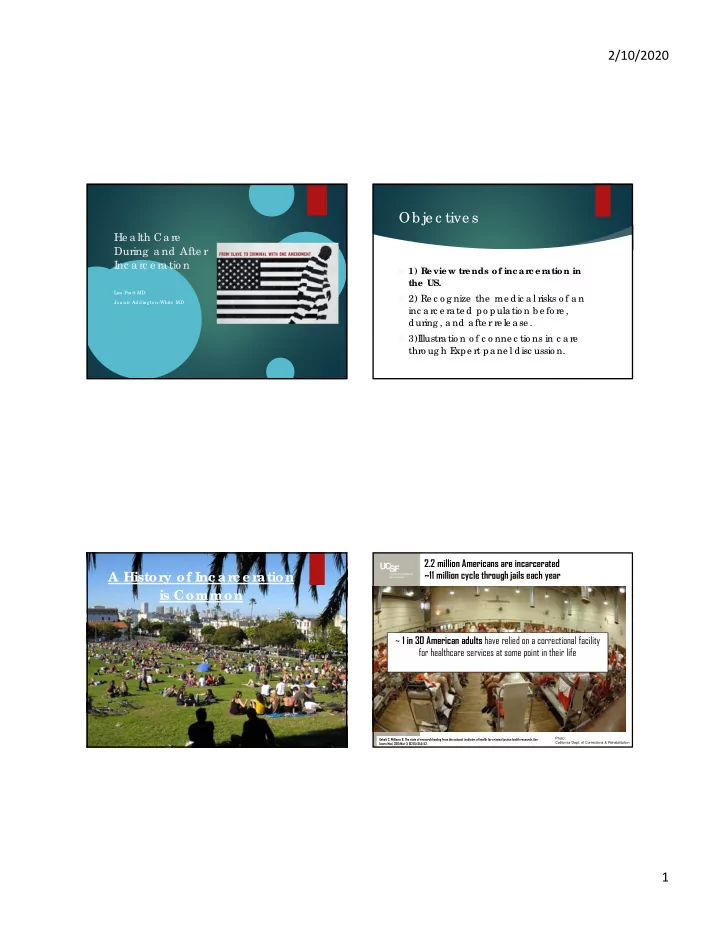
He a lth Ca re During a nd Afte r I nc a rc e ra tio n

vide o L isa Pra tt MD Jo a nie Adding to n-White MD

Ob je c tive s

 1) R

e vie w tr e nds of inc ar c e r ation in the US.

 2) Re c o g nize the me dic a l risks o f a n

inc a rc e ra te d po pula tio n b e fo re , during , a nd a fte r re le a se .

 3)Illustra tio n o f c o nne c tio ns in c a re

thro ug h E xpe rt pa ne l disc ussio n.

A Histor y of Inc ar c e r ation is Common

Photo: California Dept. of Corrections & Rehabilitation

~ 1 in 30 American adults have relied on a correctional facility for healthcare services at some point in their life

Anhalt C, Williams B. The state of research funding from the national institutes of health for criminal justice health research.Ann Intern Med. 2015 Mar 3; 162(5):345-52.

2.2 million Americans are incarcerated ~11 million cycle through jails each year

slide-2
SLIDE 2

2/10/2020 2

T his Pho to b y Unkno wn Autho r is lic e nse d und e r CC BY-SA

And inc re a sing … De spite simila r ra te s o f drug use :

Dispr

  • por

tionate ly Affe c ts Me n

  • f Color
slide-3
SLIDE 3

2/10/2020 3

A rapidly aging prison population

2007  2012

  • 9.6% decrease in

total arrests across the US

  • 27% increase in

arrests aged 55 or

  • lder

Se sa me Stre e t Muppe t Ale x

 2.7 millio n

c hildre n ha ve a pa re nt in ja il.

 Co nc e ntra te d

numb e rs fro m impo ve rishe d ne ig hb o rho o ds.

R isk to He alth of our Community

slide-4
SLIDE 4

2/10/2020 4

3000 juve nile s ha ve b e e n se nte nc e d to die in priso n. We a re the o nly c o untry tha t c o nde mns c hildre n to life witho ut pa ro le .

Ob je c tive s

 1) Re vie w tre nds o f inc a rc e ra tio n in

the US.

 2) R

e c ognize the me dic al r isks of an inc ar c e r ate d population be for e , dur ing, and afte r r e le ase .

 3)Illustra tio n o f c o nne c tio ns in c a re

thro ug h E xpe rt pa ne l disc ussio n.

Risks fo r inc a rc e ra tio n a nd me dic a l pro b le ms

slide-5
SLIDE 5

2/10/2020 5 Chro nic dise a se

Ma rsc hke , L . M., Bro dsky, M., & Una ng 's, J. (2015). Me dic al pro ble ms o f state and fe de ral priso ne rs and jail inmate s, 2011-12. Wa shing to n, D.C.: U.S. De pa rtme nt o f Justic e , Offic e o f Justic e Pro g ra ms, Bure a u o f Justic e Sta tistic s., R ic h JD e t al. N E ngle J Me d 2011;364:2081- 2083.

Prevalence of Medical Conditions among Federal and State Prisoners, Jail Inmates, and the Noninstitutionalized U.S. Population.

Drug a b use

 T

ho usa nds o f no nvio le nt o ffe nde rs' de c a de s in priso n.

 65% me e t c rite ria fo r a ddic tio n.  11% re c e ive a ny type o f a ddic tio n

tre a tme nt.

 Hig h ra te o f a ddic tio n=hig h ra te o f

re c idivism.

Na tio na l Ce nte r o n Addic tio n a nd Sub sta nc e Ab use (CASA)

He a lth risks o f inc a rc e ra tio n

 Risky se x pra c tic e s a nd ra pe  I

VDA a nd ta tto o ing

 Vio le nc e  PT

SD fro m vio le nc e while inc a rc e ra te d (Po st-inc a rc e ra tio n syndro me )

 So lita ry Co nfine me nt  L

a c k o f se lf-ma na g e me nt o f c hro nic illne sse s

slide-6
SLIDE 6

2/10/2020 6 Re le a se a nd Risk

 Ove r 50% o f SF

Ja il inma te s ho me le ss o n re le a se .

 E

D is use d fo r he a lth c a re .

 ”Co lla te ra l Co nse q ue nc e s”  Diffic ulty e mplo yme nt  Pro hib ite d fro m a c c e ssing ma ny pub lic

suppo rts: fo o d sta mps; ho using / se c tio n 8; vo ting

Anna ls o f inte rna l me dic ine Mo rta lity a fte r re le a se : No v 5, 2013

Our Pa ne l

 L

isa Pra tt MD Dire c to r o f Sa n F ra nc isc o Ja il

 Ja ke Ise nb e rg MD  Nic ho le Pe ttwa y