T T R I TT TR RI I T T ra ining fo r T o wnship Re ne w - - PowerPoint PPT Presentation

t t r i tt tr ri i t
SMART_READER_LITE
LIVE PREVIEW

T T R I TT TR RI I T T ra ining fo r T o wnship Re ne w - - PowerPoint PPT Presentation

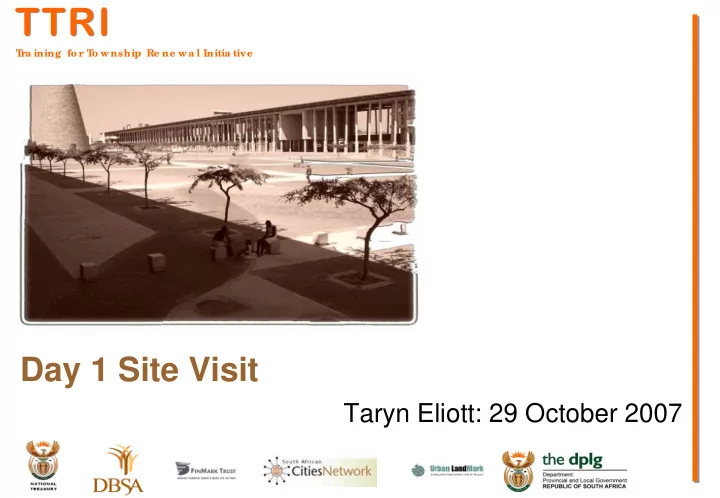
T T R I TT TR RI I T T ra ining fo r T o wnship Re ne w a l Initia tive Day 1 Site Visit Taryn Eliott: 29 October 2007 T T R I TT TR RI I T T ra ining fo r T o wnship Re ne w a l Initia tive Regional Context T T R I


slide-1
SLIDE 1

T

T TT T TR R RI I I

T ra ining fo r T

  • wnship Re ne w a l Initia tive

Day 1 Site Visit

Taryn Eliott: 29 October 2007

slide-2
SLIDE 2

T

T TT T TR R RI I I

T ra ining fo r T

  • wnship Re ne w a l Initia tive

Regional Context

slide-3
SLIDE 3

T

T TT T TR R RI I I

T ra ining fo r T

  • wnship Re ne w a l Initia tive

Greater Mamelodi

  • Land Use
  • Residential land use in

Mamelodi is characterised by the replication of single dwelling units at a relatively low density. The housing differs dramatically across Mamelodi:

  • Mamelodi West is characterised

hostels and informal units,

  • Mamelodi Central, North and

South is characterised by informal settlements, and

  • Mamelodi East, is characterised

by growing informal settlements.

slide-4
SLIDE 4

T

T TT T TR R RI I I

T ra ining fo r T

  • wnship Re ne w a l Initia tive

Greater Mamelodi

slide-5
SLIDE 5

T

T TT T TR R RI I I

T ra ining fo r T

  • wnship Re ne w a l Initia tive

stormwater drainage tarring of roads housing. upgrading and provision of sidewalks. traffic calming, social facilities stormwater drainage

Greater Mamelodi –Challenges & Issues

slide-6
SLIDE 6

T

T TT T TR R RI I I

T ra ining fo r T

  • wnship Re ne w a l Initia tive

Section T

  • Issues and challenges

– Lack of ownership, resulting in municipal

  • wnership of commercial

properties – Non-payment of rates and services – Deterioration of business infrastructure – Identification of legal tenants

slide-7
SLIDE 7

T

T TT T TR R RI I I

T ra ining fo r T

  • wnship Re ne w a l Initia tive

Movement Networks

  • pedestrian linkages
  • continuous movement routes
  • regional and district roads
slide-8
SLIDE 8

T

T TT T TR R RI I I

T ra ining fo r T

  • wnship Re ne w a l Initia tive

Social Facilities and Services

  • facilities
  • cluster
slide-9
SLIDE 9

T

T TT T TR R RI I I

T ra ining fo r T

  • wnship Re ne w a l Initia tive

Public Space

  • public space and landscaping
slide-10
SLIDE 10

T

T TT T TR R RI I I

T ra ining fo r T

  • wnship Re ne w a l Initia tive

Housing

  • type of housing (type and density)
slide-11
SLIDE 11

T

T TT T TR R RI I I

T ra ining fo r T

  • wnship Re ne w a l Initia tive

Private Sector Investment

slide-12
SLIDE 12

T

T TT T TR R RI I I

T ra ining fo r T

  • wnship Re ne w a l Initia tive

Eerste Fabrieke

  • The Eerste Fabrieke area is identified as a

new Urban Core/Metropolitan Activity Node and has been declared a Mayoral project.

  • A Metropolitan Activity Node is the highest
  • rder activity node and should comprise of

a high concentration of mixed use, commercial, residential, social and cultural, and other urban activities. These nodes should be integrated with or around major railway stations/ transport infrastructure.

  • Land Use
  • 34 hectares vacant land
  • 1870 dwelling units at a gross density of 55

du/ha

  • Informal business (10 businesses)
  • Proposed metropolitan activity node
  • Proposed industrial development focus
slide-13
SLIDE 13

T

T TT T TR R RI I I

T ra ining fo r T

  • wnship Re ne w a l Initia tive

Movement Networks

  • pedestrian

linkages

  • continuous

movement routes

  • regional and

district roads

slide-14
SLIDE 14

T

T TT T TR R RI I I

T ra ining fo r T

  • wnship Re ne w a l Initia tive

Social Facilities and Services

  • facilities
  • cluster
slide-15
SLIDE 15

T

T TT T TR R RI I I

T ra ining fo r T

  • wnship Re ne w a l Initia tive

Public Space

  • public space
  • landscaping
slide-16
SLIDE 16

T

T TT T TR R RI I I

T ra ining fo r T

  • wnship Re ne w a l Initia tive

Housing

  • type of housing (type and density)
slide-17
SLIDE 17

T

T TT T TR R RI I I

T ra ining fo r T

  • wnship Re ne w a l Initia tive

Private Sector Investment

slide-18
SLIDE 18

T

T TT T TR R RI I I

T ra ining fo r T

  • wnship Re ne w a l Initia tive

Denneboom

  • Denneboom station is the first and largest

railway station in Mamelodi

  • Land Use:
  • Denneboom Station; taxi Rank and Retail

Complex

  • Bus Station and Trading Site
  • Mini Munitoria Offices
  • Mamelodi Hostels
  • Solomon Mahlangu Freedom Square
  • Mamelodi Crossing Shopping Complex

(supermarkets, retails, restaurants, Doctor’s offices, pharmacies)

  • Sun Valley
  • HM Pitje Sport Grounds
  • Informal trade (accessible via Tsamaya

Road only), home to approximately 627

slide-19
SLIDE 19

T

T TT T TR R RI I I

T ra ining fo r T

  • wnship Re ne w a l Initia tive

Movement Networks

  • pedestrian linkages
  • continuous movement

routes

  • regional and district roads
slide-20
SLIDE 20

T

T TT T TR R RI I I

T ra ining fo r T

  • wnship Re ne w a l Initia tive

Social Facilities and Services

  • facilities
  • cluster
slide-21
SLIDE 21

T

T TT T TR R RI I I

T ra ining fo r T

  • wnship Re ne w a l Initia tive

Public Space

  • public space and landscaping
slide-22
SLIDE 22

T

T TT T TR R RI I I

T ra ining fo r T

  • wnship Re ne w a l Initia tive

Housing

  • type of housing (type

and density)

slide-23
SLIDE 23

T

T TT T TR R RI I I

T ra ining fo r T

  • wnship Re ne w a l Initia tive

Private Sector Investment

slide-24
SLIDE 24

T

T TT T TR R RI I I

T ra ining fo r T

  • wnship Re ne w a l Initia tive

Namapius

  • Nellmapius is a state subsidized

housing development located to the south of the Mamelodi and the Eerset Fabrieke railway station.

  • Land Use
  • Nellmapius is characterized by low

density, single residential housing development and vacant land set aside for commercial and social facilities that have yet to be developed.

slide-25
SLIDE 25

T

T TT T TR R RI I I

T ra ining fo r T

  • wnship Re ne w a l Initia tive

Movement Networks

  • pedestrian linkages
  • continuous movement routes
  • regional and district roads
slide-26
SLIDE 26

T

T TT T TR R RI I I

T ra ining fo r T

  • wnship Re ne w a l Initia tive

Social Facilities and Services

  • facilities
  • cluster
slide-27
SLIDE 27

T

T TT T TR R RI I I

T ra ining fo r T

  • wnship Re ne w a l Initia tive

Public Space

  • public space and

landscaping

slide-28
SLIDE 28

T

T TT T TR R RI I I

T ra ining fo r T

  • wnship Re ne w a l Initia tive

Housing

  • type of housing (type and density)
slide-29
SLIDE 29

T

T TT T TR R RI I I

T ra ining fo r T

  • wnship Re ne w a l Initia tive

Private Sector Investment

slide-30
SLIDE 30

T

T TT T TR R RI I I

T ra ining fo r T

  • wnship Re ne w a l Initia tive

Interventions

  • What interventions would you make?
  • Think about design guidelines (to improve the

public environment)

  • Think about the kinds of future public and

private sector investment that would be appropriate.

slide-31
SLIDE 31

T

T TT T TR R RI I I

T ra ining fo r T

  • wnship Re ne w a l Initia tive

Group Work - Programme

  • Break into groups

– 5 groups (response groups?) – 1 regional context – 4 nodes

  • Brainstorm - Questions
  • Report back
slide-32
SLIDE 32

T

T TT T TR R RI I I

T ra ining fo r T

  • wnship Re ne w a l Initia tive

Day 2: Group Work Structure

  • 14h30 – 15h00

– Briefing – Assignment of Group

  • 15h00 – 16h30

– 15h00 - 15h15: Review questions and context – 15h15 – 16h00: Address questions – 16h00 – 16h30: Address phasing and report-back

  • 16h30 – 17h00

– Report backs (5 minutes per group)

  • 17h00 – 17h30

– Responses, discussion and issues for day 3,4 and 5

slide-33
SLIDE 33

T

T TT T TR R RI I I

T ra ining fo r T

  • wnship Re ne w a l Initia tive

Day 2: Group Organisation

  • Identify chair
  • Identify recorder
  • Use flip charts to make notes
  • Use aerial photos and show proposals using

whiteboard marker and/or overlay tracing sheets

  • Responder groups make notes on A4 paper to be

handed to MC

slide-34
SLIDE 34

T

T TT T TR R RI I I

T ra ining fo r T

  • wnship Re ne w a l Initia tive

Group Work - Resources

  • Each group will receive:

– a large laminated map of the area that they will be dealing with – a set of pens – the lecture notes from this mornings session – social facilities and estimated construction costs – the information and notes taken from yesterday’s site visit.

slide-35
SLIDE 35

T

T TT T TR R RI I I

T ra ining fo r T

  • wnship Re ne w a l Initia tive

Group Work Questions – E.g. Section T

  • Identify existing and potential pedestrian linkages (mark these on your

map).

  • Identify existing and potential continuous movement routes running

through the site (mark these on your map).

  • Identify regional and district roads in your node (mark these on your

map).

  • Drawing on this morning’s lecture (titled: Theoretical and policy content:

Settlement making and township development: Performance qualities of integrated human settlements) is this node a neighbourhood, district or regional node? Rank section T in comparison to the other three nodes (Nellmapius, Denneboom and Eerste Fabrieke)

  • In line with the position of Section T in the nodal hierarchy, what facilities

would be appropriate in this node? (refer to the social facilities primer contained in this morning lecture paper)

  • Which facilities would you cluster together? Where would you place this

cluster in the node? Mark this on you map.

slide-36
SLIDE 36

T

T TT T TR R RI I I

T ra ining fo r T

  • wnship Re ne w a l Initia tive

Group Work Questions – E.g. Section T

  • What public space and landscaping interventions would you make to improve the

quality of the public environment in this node? If possible, mark these on your map.

  • What type of housing (type and density) would you locate in this node? (refer to

the housing primer contain in this morning’s lecture paper).

  • Where would you locate this housing? If possible, mark these on your map.
  • Can you think of any design guidelines you would put in place to guide future

public and private sector investment in this area?

  • Is there any particular type of private sector investment that you would like to see

located in this area?

  • You have been allocated R10 million to spend on one or more public sector

investments into this node. What public sector physical infrastructure/facility would you spend this money on?

  • You have been allocated R100 million to spend on one or more public sector

investments into this node. What public sector physical infrastructure/facility would you spend this money on? What would you develop first? Develop a phasing plan. Motivate why you would spend the money in this order.

slide-37
SLIDE 37

T

T TT T TR R RI I I

T ra ining fo r T

  • wnship Re ne w a l Initia tive

Social Facilities Primer - Costs

slide-38
SLIDE 38

T

T TT T TR R RI I I

T ra ining fo r T

  • wnship Re ne w a l Initia tive

Question

  • Take the single, ONE most important

intervention your group has identified, now:

– Who are the four most important actors/ constituencies that will make or break this intervention? – What factors typically prevent these actors/ constituencies working together to implement this intervention?