April 25, 2016 Via email to director@ fasb.org S usan M. Cosper - - PDF document

april 25 2016 via email to director fasb org s usan m
SMART_READER_LITE
LIVE PREVIEW

April 25, 2016 Via email to director@ fasb.org S usan M. Cosper - - PDF document

Tel: 312-856-9100 330 North Wabash, S uite 3200 Fax: 312-856-1379 Chicago, IL 60611 www.bdo.com April 25, 2016 Via email to director@ fasb.org S usan M. Cosper Technical Director Financial Accounting S tandards Board 401 Merritt 7


slide-1
SLIDE 1

BDO US A, LLP, a Delaware limited liability partnership, is the U.S . member of BDO International Limited, a UK company limited by guarantee, and forms part of the international BDO network of independent member firms. BDO is the brand name for the BDO network and for each of the BDO Member Firms.

Tel: 312-856-9100 Fax: 312-856-1379 www.bdo.com 330 North Wabash, S uite 3200 Chicago, IL 60611

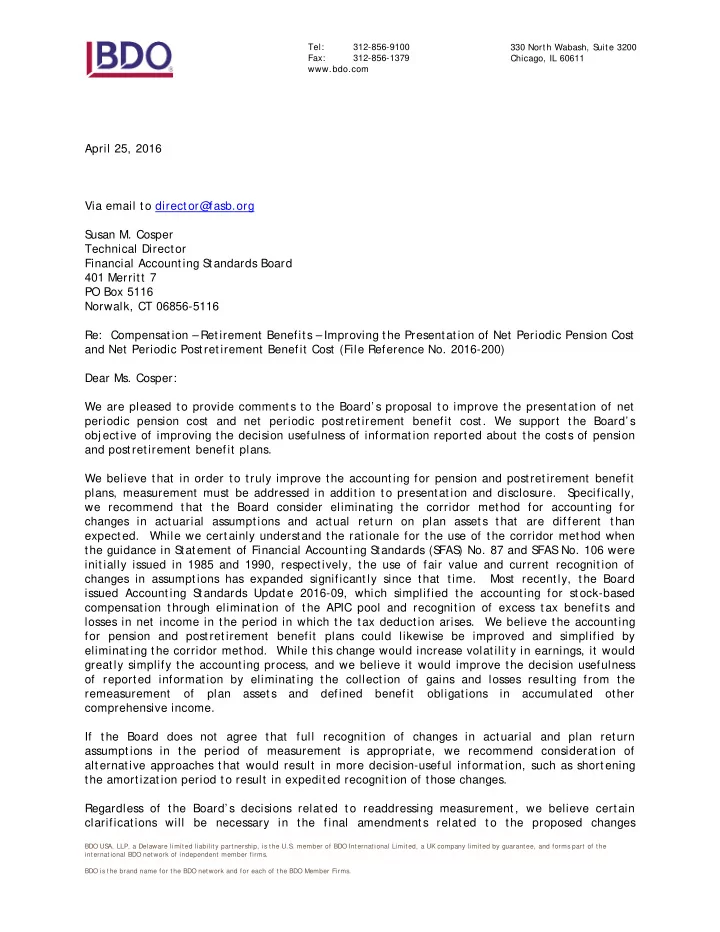
April 25, 2016 Via email to director@ fasb.org S usan M. Cosper Technical Director Financial Accounting S tandards Board 401 Merritt 7 PO Box 5116 Norwalk, CT 06856-5116 Re: Compensation – Retirement Benefits – Improving the Presentation of Net Periodic Pension Cost and Net Periodic Postretirement Benefit Cost (File Reference No. 2016-200) Dear Ms. Cosper: We are pleased to provide comments to the Board’ s proposal to improve the presentation of net periodic pension cost and net periodic postretirement benefit cost. We support the Board’ s

  • bj ective of improving the decision usefulness of information reported about the costs of pension

and postretirement benefit plans. We believe that in order to truly improve the accounting for pension and postretirement benefit plans, measurement must be addressed in addition to presentation and disclosure. S pecifically, we recommend that the Board consider eliminating the corridor method for accounting for changes in actuarial assumptions and actual return on plan assets that are different than

  • expected. While we certainly understand the rationale for the use of the corridor method when

the guidance in S tatement of Financial Accounting S tandards (S FAS ) No. 87 and S FAS

  • No. 106 were

initially issued in 1985 and 1990, respectively, the use of fair value and current recognition of changes in assumptions has expanded significantly since that time. Most recently, the Board issued Accounting S tandards Update 2016-09, which simplified the accounting for stock-based compensation through elimination of the APIC pool and recognition of excess tax benefits and losses in net income in the period in which the tax deduction arises. We believe the accounting for pension and postretirement benefit plans could likewise be improved and simplified by eliminating the corridor method. While this change would increase volatility in earnings, it would greatly simplify the accounting process, and we believe it would improve the decision usefulness

  • f reported information by eliminating the collection of gains and losses resulting from the

remeasurement of plan assets and defined benefit obligations in accumulated other comprehensive income. If the Board does not agree that full recognition of changes in actuarial and plan return assumptions in the period of measurement is appropriate, we recommend consideration of alternative approaches that would result in more decision-useful information, such as shortening the amortization period to result in expedited recognition of those changes. Regardless of the Board’ s decisions related to readdressing measurement, we believe certain clarifications will be necessary in the final amendments related to the proposed changes

slide-2
SLIDE 2

Technical Director Financial Accounting S tandards Board Page 2 of 5 concerning presentation. We believe certain changes would enhance and simplify the guidance for pension and postretirement benefits, as elaborated in the Appendix to this letter. We would be pleased to discuss our comments with the FAS B staff. Please direct questions to Angela Newell at (214) 689-5669 or Liza Prossnitz at (312) 233-1818. Very truly yours, BDO US A, LLP

slide-3
SLIDE 3

Technical Director Financial Accounting S tandards Board Page 3 of 5 Appendix Question 1: Should the service cost component be reported in the income statement apart from the other components of net benefit cost as defined in paragraphs 715-30-35-4 and 715-60-35-9 and be the only component eligible to be capitalized in assets? Why or why not? Because the components of net benefit cost are already disaggregated and reported in the footnotes to the financial statements, we do not believe that separately reporting the service cost component will improve the decision usefulness of the information available to financial statement users. In addition, we recommend considering the potential impacts this change might have on other areas of accounting where interest and time value elements are combined with

  • ther elements and reported as one amount. While the Board noted in BC7 that disaggregation

would improve consistency with the reporting practice for many other parts of an entity’ s

  • perations, other areas will continue to aggregate disparate components. For example, changes

in the values of derivatives and changes in the value of contingent consideration in business combinations both combine an interest component with other components that result in a single element of income or expense. Without a strong rationale articulated in the basis for conclusions about why bifurcation of the various components of net periodic pension cost and net periodic postretirement benefit cost provide more decision-useful information, preparers may inappropriately analogize to this guidance in other areas in which the literature is silent. Assuming the Board would not welcome such an analogy, we recommend that the Board articulate the concept underpinning bifurcation in this situat ion, and why it does not impact other areas of accounting. Although we do not agree that separate presentation of service cost improves financial reporting, we would not obj ect to reporting components of net benefit cost as compensation expense within

  • perating income and components related to interest expense and investment returns outside of
  • perating income. However, we note that the service cost component is not the only component
  • f net periodic benefit pension cost and net periodic postretirement benefit cost that relate to
  • compensation. S

pecifically, we believe that the proposals would be enhanced by including the prior service cost or credit component with service cost in operating income. We note the Board’ s comments in BC8 that this component is not exclusively related to the current period’ s employee services and is not expected to arise frequently in the future. However, generally accepted accounting principles often require recognition of costs within operating income that may not relate solely to the current period nor are expect ed to recur in the future. Impairment losses are

  • ne such example. We do not believe that the fact that prior service cost does not exclusively

relate to the current period and is not expected to arise frequently in the future outweighs the concept that costs associated with compensation should be accounted for in a like manner. We agree that the items reported in operating income should be the only components eligible to be capitalized in assets. We agree that the interest cost component reflects an accounting convention resulting from the requirement to present pension and postretirement benefit liabilities on a discounted basis, rather than a borrowing cost incurred for the qualifying asset. Question 2: Would it be useful to require presentation of the prior service cost or credit component separately from the other components? Should all of the components of net benefit cost other than the service cost component (for example, the prior service cost or credit component) be presented outside a subtotal of income from operations, if one is presented? Why or why not?

slide-4
SLIDE 4

Technical Director Financial Accounting S tandards Board Page 4 of 5 As noted above, we believe that prior service cost should be reported within income from

  • perations with service cost. We agree that the other components of net benefit cost should be

presented outside a subtotal of income from operations. We agree that the other components primarily represent financing activities, which are historically presented below operating income. Question 3: Would it be useful to require presentation of the net amount of the interest cost component and expected return on plan assets separately from the other components of net benefit cost to improve convergence with International Financial Reporting Standards (IFRS)

  • r for other purposes?

Why or why not? We do not believe that separate presentation of the interest cost component and expected return

  • n plan assets separately from the other components of net benefit cost would provide a

significant benefit to users of the financial statements. While we would not obj ect to separate presentation with the goal of improving convergence with IFRS , we would obj ect to a requirement to present the interest cost component in a single financial statement caption with other interest

  • expense. As noted above, we do not believe that the interest cost component represents a

borrowing cost, and thus should not be reported with interest expense related to borrowing. Question 4: Would the proposed amendments improve the usefulness of financial information provided to users? Why or why not? As noted above in response to question 1, we do not agree that the proposed amendments improve the usefulness of financial information provided to users, primarily because the proposed amendments do not provide incremental information beyond what is already available to a user in the footnotes to the financial statements. Question 5: Should the proposed amendments be different for rate-regulated entities? Why

  • r why not?

We do not believe that the proposed amendments should be different for rate-regulated entities. In many cases, existing accounting requirements for net periodic pension cost and net periodic postretirement benefit cost are already different than the methods required by regulatory bodies for rate-making and other purposes. In those instances, the rate-regulated entities account for the difference through the recognition of a regulatory asset or liability. We believe that any additional differences caused by the proposed amendments would be treated in the same manner. Question 6: Would the proposed amendments be operable without incurring significant incremental costs by entities (such as not-for-profit entities, entities that enter into cost- plus contracts or government contracts including but not limited to contracts under Cost Accounting Standards Board regulations, and entities that allocate cost from cost pools)? Why or why not? We do not believe that the proposed amendments would result in significant incremental costs. Question 7: How much time would be necessary to adopt the proposed amendments? Should early adoption be permitted? Would the amount of time needed to apply the proposed amendments by entities other than public business entities be different from the amount of time needed by public business entities? Why or why not?

slide-5
SLIDE 5

Technical Director Financial Accounting S tandards Board Page 5 of 5 Given the limited amount of incremental informat ion required by the proposed amendments, and the limited cost of complying as noted above in response to question 6, we believe that the amount of time needed for public entities to implement the proposed amendments should be

  • minimal. In addition, because almost all companies with significant pension and postretirement

benefit plans already engage the services of actuaries in order to comply with the existing accounting and disclosure requirements, we do not believe that nonpublic entities will require incremental time to implement the proposed amendments, although we would not obj ect to an additional year being provided. We agree that early adoption should be permitted for both public and nonpublic entities. Question 8: Should the proposed amendments be applied retrospectively for the presentation of the service cost component and other components of net benefit cost in the income statement and prospectively, on and after the effective date, for the capitalization

  • f the service cost component of net benefit cost in assets when applicable?

We agree with the proposed transition guidance. Question 9: Should the disclosures of the nature of and reason for the change in accounting principle be required in the first interim and annual reporting periods of adoption? Why or why not? We agree with the proposed disclosure.