Navigating FASB's New Pushdown Rules for Acquired Entities - - PowerPoint PPT Presentation

navigating fasb s new pushdown rules for acquired entities
SMART_READER_LITE
LIVE PREVIEW

Navigating FASB's New Pushdown Rules for Acquired Entities - - PowerPoint PPT Presentation

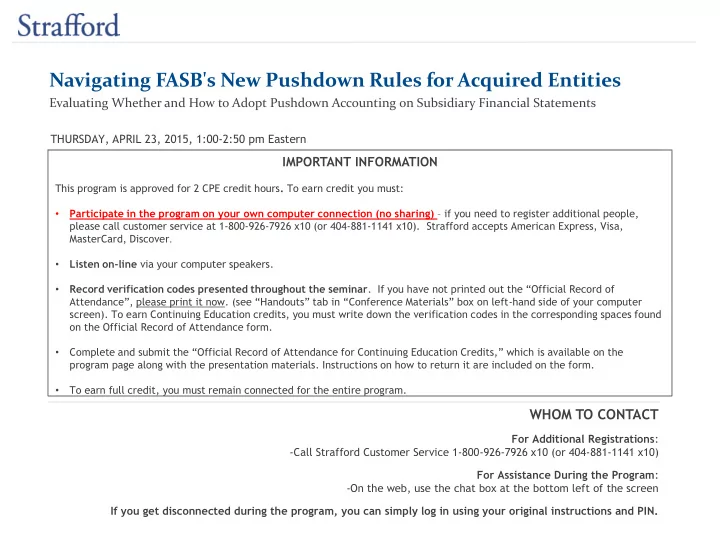
Navigating FASB's New Pushdown Rules for Acquired Entities Evaluating Whether and How to Adopt Pushdown Accounting on Subsidiary Financial Statements THURSDAY, APRIL 23, 2015, 1:00-2:50 pm Eastern IMPORTANT INFORMATION This program is approved


slide-1
SLIDE 1

Navigating FASB's New Pushdown Rules for Acquired Entities

Evaluating Whether and How to Adopt Pushdown Accounting on Subsidiary Financial Statements

THURSDAY, APRIL 23, 2015, 1:00-2:50 pm Eastern

WHOM TO CONTACT

For Additional Registrations:

  • Call Strafford Customer Service 1-800-926-7926 x10 (or 404-881-1141 x10)

For Assistance During the Program:

  • On the web, use the chat box at the bottom left of the screen

If you get disconnected during the program, you can simply log in using your original instructions and PIN.

IMPORTANT INFORMATION

This program is approved for 2 CPE credit hours. To earn credit you must:

  • Participate in the program on your own computer connection (no sharing) – if you need to register additional people,

please call customer service at 1-800-926-7926 x10 (or 404-881-1141 x10). Strafford accepts American Express, Visa, MasterCard, Discover.

  • Listen on-line via your computer speakers.
  • Record verification codes presented throughout the seminar. If you have not printed out the “Official Record of

Attendance”, please print it now. (see “Handouts” tab in “Conference Materials” box on left-hand side of your computer screen). To earn Continuing Education credits, you must write down the verification codes in the corresponding spaces found

  • n the Official Record of Attendance form.
  • Complete and submit the “Official Record of Attendance for Continuing Education Credits,” which is available on the

program page along with the presentation materials. Instructions on how to return it are included on the form.

  • To earn full credit, you must remain connected for the entire program.
slide-2
SLIDE 2

Tips for Optimal Quality

Sound Quality When listening via your computer speakers, please note that the quality

  • f your sound will vary depending on the speed and quality of your internet

connection. If the sound quality is not satisfactory, please e-mail sound@straffordpub.com immediately so we can address the problem. Viewing Quality To maximize your screen, press the F11 key on your keyboard. To exit full screen, press the F11 key again.

FOR LIVE EVENT ONLY

slide-3
SLIDE 3

Program Materials

If you have not printed the conference materials for this program, please complete the following steps:

  • Click on the ^ symbol next to “Conference Materials” in the middle of the left-

hand column on your screen.

  • Click on the tab labeled “Handouts” that appears, and there you will see a

PDF of the slides and the Official Record of Attendance for today's program.

  • Double-click on the PDF and a separate page will open.
  • Print the slides by clicking on the printer icon.

FOR LIVE EVENT ONLY

slide-4
SLIDE 4

Navigating FASB's New Pushdown Rules for Acquired Entities

April 23, 2015 David A. Augustyn KPMG daugustyn@kpmg.com Christopher Pisciotta PricewaterhouseCoopers christopher.g.pisciotta@us.pwc.com

slide-5
SLIDE 5

Notice

ANY TAX ADVICE IN THIS COMMUNICATION IS NOT INTENDED OR WRITTEN BY THE SPEAKERS’ FIRMS TO BE USED, AND CANNOT BE USED, BY A CLIENT OR ANY OTHER PERSON OR ENTITY FOR THE PURPOSE OF (i) AVOIDING PENALTIES THAT MAY BE IMPOSED ON ANY TAXPAYER OR (ii) PROMOTING, MARKETING OR RECOMMENDING TO ANOTHER PARTY ANY MATTERS ADDRESSED HEREIN.

You (and your employees, representatives, or agents) may disclose to any and all persons, without limitation, the tax treatment or tax structure, or both, of any transaction described in the associated materials we provide to you, including, but not limited to, any tax opinions, memoranda, or other tax analyses contained in those materials. The information contained herein is of a general nature and based on authorities that are subject to change. Applicability of the information to specific situations should be determined through consultation with your tax adviser.

5

slide-6
SLIDE 6

Navigating FASB’s New Pushdown Rules for Acquired Entities

Pushdown Accounting

April 23, 2015

David Augustyn, KPMG & Christopher Pisciotta, PwC

slide-7
SLIDE 7

Agenda

  • Threshold for adopting pushdown accounting
  • Measurement and disclosure of adoption of pushdown accounting
  • Basis adjustments if acquirer does not adopt ASC Topic 805
  • Application of new standard and financial statement presentation
  • Pushdown treatment of acquisition-related goodwill, debt and

costs

  • Subsequent adoption of pushdown and change in accounting

method application

  • Other
  • Question & Answer

7

slide-8
SLIDE 8

Background

  • Pushdown accounting is adjusting the financial statements of an

acquired entity (the “acquiree”) to reflect the accounting basis of the acquirer.

  • New basis is typically the fair value of the identifiable assets acquired

and liabilities assumed.

  • Previously, under U.S. GAAP there was limited guidance for

determining when, if ever, pushdown accounting should be applied.

  • The SEC provided guidance applicable for SEC registrants, most of

which has been rescinded.

  • I. Threshold for adopting pushdown accounting

8

slide-9
SLIDE 9

Effective Date and Transition

The new standard may be applied to change-in-control events

  • ccurring:
  • On or after November 18, 2014; or
  • Before November 18, 2014 if financial statements for the period of the

change-in-control event have not been issued or available to be issued.

  • I. Threshold for adopting pushdown accounting

9

slide-10
SLIDE 10

New pushdown guidance

10

Addresses the scope and threshold for applying pushdown accounting in a subsidiary’s financial statements.

What you need to know

  • Pushdown accounting optional

upon a change in control

  • No circumstances would require or

preclude pushdown accounting

  • Each change-in-control event

considered separately (not an accounting policy)

  • When pushdown is elected it is

irrevocable

  • Pushdown can be elected in a

subsequent period as a change in accounting policy

Provides guidance for both public and private companies.

  • I. Threshold for adopting pushdown accounting
slide-11
SLIDE 11

Public companies

  • Required > 95% of ownership
  • Optional between 80% and 95%
  • f ownership
  • Prohibited < 80% of ownership
  • Optional at change in control
  • >51% for voting interest entities,
  • r
  • Change in primary beneficiary

for variable interest entities

Private companies

  • Not required
  • Analogize to SEC staff guidance

(SAB Topic 5J)

  • Same as public companies

Original guidance (SEC staff guidance) New guidance (US GAAP)

Prior vs. new guidance

11

  • I. Threshold for adopting pushdown accounting
slide-12
SLIDE 12

Recognition

  • An acquired entity has the option to apply pushdown accounting

upon being acquired by a new controlling parent

  • An acquirer might obtain control in a number of ways including:
  • Transferring cash or other assets;
  • Incurring liabilities;
  • Issuing equity interests;
  • Providing more than one type of consideration; and
  • Without transferring consideration, including by contract alone as

discussed in ASC Topic 805.

  • Acquired entity may make the election to apply pushdown each

time it is acquired by a new controlling parent

  • II. Measurement and disclosure of adoption of pushdown

accounting

12

slide-13
SLIDE 13

Recognition (cont.)

  • Each subsidiary of an acquired parent also has the option to apply

pushdown accounting, irrespective of the election of the acquired parent.

Entity A (Acquirer) Entity B (Acquired Parent) Entity C (Acquired Subsidiary) ~Differing elections made by acquired subsidiaries may cause additional accounting complexities.

  • II. Measurement and disclosure of adoption of pushdown

accounting

13

slide-14
SLIDE 14

Example

  • Assume Purchase Co. acquires 70% of the voting stock of

Little Co. from an unrelated third-party for consideration equal to $50 million and the acquisition results in the generation of goodwill (Little Co.’s fair value is $72 million).

  • Little Co.’s book equity was $10 million prior to the

acquisition and Little Co. will continue to issue separate stand-alone financial statements following the acquisition.

  • If pushdown accounting is applied upon the change of

control, Little Co. would establish a new basis for its net assets and liabilities within its own separate standalone financial statements at $72 million.

  • II. Measurement and disclosure of adoption of pushdown

accounting

14

slide-15
SLIDE 15

Initial and Subsequent Measurement

  • The new basis recognized by the acquired entity should be consistent with the

acquirer’s basis after the application of ASC Topic 805

  • The standard also provides specific guidance on how to treat
  • Transaction costs incurred by the acquirer are not part of the new basis of the

acquired entity

  • If pushdown accounting is applied, the acquired entity would follow the

subsequent measurement guidance in ASC Topic 805 and other applicable topics

  • Acquisition-related goodwill
  • Bargain purchase gains
  • Acquisition-related debt
  • II. Measurement and disclosure of adoption of pushdown

accounting

15

slide-16
SLIDE 16

Disclosure

  • - If pushdown accounting is applied, acquiree must disclose sufficient

information to enable financial statement users to evaluate the effect of applying pushdown accounting.

  • - Consider disclosure requirements in other subtopics of Topic 805.
  • - Acquiree is not required to disclosure any information about its decision not to

apply pushdown accounting. As a minimum (not all-inclusive):

  • Name and a description of the acquirer and how acquirer obtained control
  • Acquisition date
  • Acquisition-date fair value of the total consideration transferred by the acquirer
  • Amounts recognized for each major class of assets and liabilities as a result of applying pushdown

accounting

  • Qualitative description of the factors that make up the goodwill recognized, intangibles that do not

qualify for separate recognition, or other factors

  • Information to evaluate the financial effects of adjustments to current reporting period relative to

pushdown accounting that occurred in the current or previous reporting periods

  • II. Measurement and disclosure of adoption of pushdown

accounting

16

slide-17
SLIDE 17

17

  • III. Basis adjustments if acquirer does not adopt ASC Topic

805

If acquirer does not apply ASC Topic 805 for the assets and liabilities of the acquiree (e.g. if the acquirer is an individual or an investment company) Acquiree may still elect pushdown accounting by applying the new basis in its separate financial statements (as if ASC Topic 805 had been applied

slide-18
SLIDE 18

Slide Intentionally Left Blank

slide-19
SLIDE 19

Presentation

Pushdown accounting represents a termination of one basis of accounting and creation of a new basis. A line generally separates the periods prior to and subsequent to the date pushdown accounting is applied. The following illustrates the format of columns for acquiree’s statement of income assuming April 1st acquisition date.

Successor April 1 – Dec 31, 20X5 Predecessor Jan 1 - March 31, 20X5 Predecessor 20X4 Net income (loss) $XX $XX $XX

  • IV. Application of new standard and financial statement

presentation

19

slide-20
SLIDE 20

Acquisition-Related Goodwill

If pushdown accounting is applied, all goodwill related to the acquisition is pushed down to the acquiree’s separate financial statements

Practical considerations:

Impairments at a subsidiary Assignment of goodwill to reporting units Private company alternatives

  • V. Pushdown treatment of acquisition-related goodwill, debt

and costs

20

slide-21
SLIDE 21

Acquisition-Related Debt

Acquisition-related liabilities incurred by acquirer are recognized by the acquiree if it is required to do so under other U.S. GAAP.

The SEC’s previous guidance about when the acquiring entity’s debt, interest expense and debt issuance costs should be pushed down to the acquiree was rescinded.

Practical considerations:

Debt not pushed down Pushdown not applied Pledged assets

  • V. Pushdown treatment of acquisition-related goodwill, debt

and costs

21

slide-22
SLIDE 22

Issue Consideration Acquisition Costs of the Acquirer Not part of the new basis of the entity and is not pushed down Contingent Consideration

  • Under ASC Topic 805, the acquirer

recognizes fair value of the contingent consideration issued by acquirer

  • Consider which entity is legally obligated

to pay

  • V. Pushdown treatment of acquisition-related goodwill, debt

and costs

22

slide-23
SLIDE 23

Slide Intentionally Left Blank

slide-24
SLIDE 24

Pushdown elected in subsequent period

24

  • Demonstrate preferability
  • Pushdown as of most recent change-in-control date
  • Retrospectively determine fair value of assets and

liabilities

  • Roll-forward accounting
  • Depreciation and amortization
  • Goodwill impairment testing
  • Long-lived and indefinite-lived asset impairment testing
  • VI. Subsequent adoption of pushdown and change in

accounting method application

slide-25
SLIDE 25

To pushdown or not to pushdown?

25

  • Consider user needs
  • Stepped-up basis vs. historical cost
  • Operational efficiencies
  • One set of books vs. two
  • Tax considerations
  • Regulatory requirements
  • VI. Subsequent adoption of pushdown and change in

accounting method application

slide-26
SLIDE 26

Forgoing the Election to Apply Pushdown Accounting

26

Be aware of practical challenges:

  • Maintaining 2 sets of records
  • Impairment analyses
  • Depreciation and amortization tracking
  • Tax balances
  • Gains/losses on sales of assets
  • VI. Subsequent adoption of pushdown and change in

accounting method application

slide-27
SLIDE 27

Slide Intentionally Left Blank

slide-28
SLIDE 28

New standard does not change other US GAAP

28

  • FIRST – Identify accounting acquirer
  • Common control transactions
  • Expenses incurred by a parent on behalf of a subsidiary
  • Foreign entity translation
  • Tax basis of acquired company
  • VII. Other
slide-29
SLIDE 29

Identify accounting acquirer

29

After

Parent NewCo. Target Seller Target

Before

Parent NewCo.

Shares in Target Cash

  • VII. Other
slide-30
SLIDE 30

Common control transaction

30

After

Parent

  • Sub. A
  • Sub. B

Parent

  • Sub. A
  • Sub. B

Before

  • VII. Other
slide-31
SLIDE 31

31

Question and Answer Session

slide-32
SLIDE 32

32

Thank you for joining us

The information contained herein is of a general nature and is not intended to address the circumstances of any particular individual or entity. Although we endeavor to provide accurate and timely information, there can be no guarantee that such information is accurate as of the date it is received or that it will continue to be accurate in the future. No one should act on such information without appropriate professional advice after a thorough examination

  • f the particular situation.