New FASB ASU 2016-14 on Not-For-Profit Financial Reporting and - - PowerPoint PPT Presentation

new fasb asu 2016 14 on not for profit financial
SMART_READER_LITE
LIVE PREVIEW

New FASB ASU 2016-14 on Not-For-Profit Financial Reporting and - - PowerPoint PPT Presentation

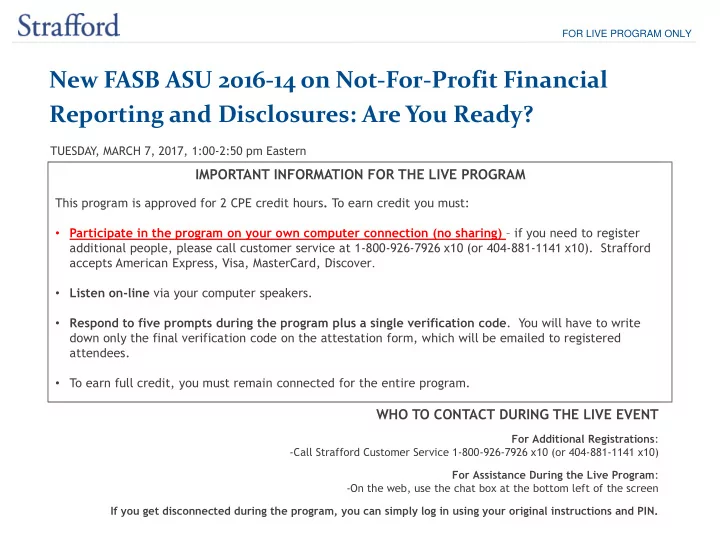
FOR LIVE PROGRAM ONLY New FASB ASU 2016-14 on Not-For-Profit Financial Reporting and Disclosures: Are You Ready? TUESDAY , MARCH 7, 2017, 1:00-2:50 pm Eastern IMPORTANT INFORMATION FOR THE LIVE PROGRAM This program is approved for 2 CPE credit


slide-1
SLIDE 1

WHO TO CONTACT DURING THE LIVE EVENT

For Additional Registrations:

  • Call Strafford Customer Service 1-800-926-7926 x10 (or 404-881-1141 x10)

For Assistance During the Live Program:

  • On the web, use the chat box at the bottom left of the screen

If you get disconnected during the program, you can simply log in using your original instructions and PIN.

IMPORTANT INFORMATION FOR THE LIVE PROGRAM

This program is approved for 2 CPE credit hours. To earn credit you must:

  • Participate in the program on your own computer connection (no sharing) – if you need to register

additional people, please call customer service at 1-800-926-7926 x10 (or 404-881-1141 x10). Strafford accepts American Express, Visa, MasterCard, Discover.

  • Listen on-line via your computer speakers.
  • Respond to five prompts during the program plus a single verification code. You will have to write

down only the final verification code on the attestation form, which will be emailed to registered attendees.

  • To earn full credit, you must remain connected for the entire program.

New FASB ASU 2016-14 on Not-For-Profit Financial Reporting and Disclosures: Are You Ready?

TUESDAY , MARCH 7, 2017, 1:00-2:50 pm Eastern

FOR LIVE PROGRAM ONLY

slide-2
SLIDE 2

Tips for Optimal Quality

Sound Quality When listening via your computer speakers, please note that the quality

  • f your sound will vary depending on the speed and quality of your internet

connection. If the sound quality is not satisfactory, please e-mail sound@straffordpub.com immediately so we can address the problem.

FOR LIVE PROGRAM ONLY

slide-3
SLIDE 3

Notice

ANY TAX ADVICE IN THIS COMMUNICATION IS NOT INTENDED OR WRITTEN BY THE SPEAKERS’ FIRMS TO BE USED, AND CANNOT BE USED, BY A CLIENT OR ANY OTHER PERSON OR ENTITY FOR THE PURPOSE OF (i) AVOIDING PENALTIES THAT MAY BE IMPOSED ON ANY TAXPAYER OR (ii) PROMOTING, MARKETING OR RECOMMENDING TO ANOTHER PARTY ANY MATTERS ADDRESSED HEREIN.

You (and your employees, representatives, or agents) may disclose to any and all persons, without limitation, the tax treatment or tax structure, or both, of any transaction described in the associated materials we provide to you, including, but not limited to, any tax opinions, memoranda, or other tax analyses contained in those materials. The information contained herein is of a general nature and based on authorities that are subject to change. Applicability of the information to specific situations should be determined through consultation with your tax adviser.

slide-4
SLIDE 4

ASU 2016-14

NOT

  • FOR-PROFIT FINANCIAL REPORTING AND

DISCLOSURES

MARCH 7, 2017

slide-5
SLIDE 5

TODAY’S PRESENTERS

5

Amy Altholz, CPA Partner, RubinBrown, LLP amy.altholz@rubinbrown.com William Epstein, CPA Director, Eisner Amper william.epstein@eisneramper.com Kelly Thompson, CPA Principal, Bonadio & Co., LLP kthompson@Bonadio.com

slide-6
SLIDE 6

KEY OBJECTIVE OF THE FASB PROJECT

 Update, not overhaul, the current Not-For-Profit financial

statement reporting model

 Improve net asset classification presentation  Improve information in financial statements and notes about:

 Financial performance  Cash flows  Liquidity

 Better enable NFP’s to “tell their story”

6

slide-7
SLIDE 7

KEY AREAS DISCUSSED IN THE ASU

7 Net Asset Classification Liquidity Financial Performance: Operating Measure/ Activities

  • Stmt. Format

Reporting of Expenses Financial Performance: Cash Flow Statement NFP Note Disclosures

slide-8
SLIDE 8

FINANCIAL STATEMENTS OF NOT

  • FOR-PROFIT

ENTITIES PROJECT

Status: After Exposure Draft Issued in April 2015, Divided Into 2 Phases

Phase I – Of the eight topics, those topics where there was consensus from stakeholders and FASB Board members were included as part of the ASU issued in August 2016. Phase II – Complex areas where there seemed to be less agreement were delayed as a future project (date to be determined). These areas include: operating measures (whether to require intermediate measures), realignment of certain items within the statement of cash flows (related to adoption of operating measure), and option of segment reporting.

8

slide-9
SLIDE 9

KEY PHASE I DECISIONS (AMENDMENTS TO CURRENT GAAP)

 Changes to classification scheme and improving disclosures for net

asset classes (“with donor restrictions” vs. “without donor restrictions”)

 Enhancing disclosures about underwater endowments  New disclosures about the liquidity and availability of financial

resources

 Reporting of investment return net of investment expenses  Presenting expenses by nature and function and description of

expense allocation methodology

 Allowing free choice between direct method and indirect method in

presenting operating cash flows (no change to existing GAAP)

9

slide-10
SLIDE 10

PHASE II OF FINANCIAL STATEMENTS PROJECT TOPICS

 Requirement and definition of an intermediate measure of

  • perations for all NFPs

 Realignment of certain line items on Statement of Cash Flows  Exploring option of segment reporting

10

slide-11
SLIDE 11

NET ASSET CLASSES

11

slide-12
SLIDE 12

NET ASSET CLASSIFICATION - DEFINITIONS

Net Assets With Donor Restrictions: The part of net assets of a not-for-profit entity that is subject to donor-imposed restrictions (the term “donors” includes other types of contributors, including makers of certain grants)

Net Assets Without Donor Restrictions: The part of net assets of a not-for-profit entity that is not subject to donor-imposed restrictions (the term “donors” includes

  • ther

types

  • f

contributors, including makers of certain grants)

These terms are gone: Temporarily restricted Permanently restricted

12

slide-13
SLIDE 13

PRESENTATION ON THE STATEMENT OF FINANCIAL POSITION

13

Assets 20xx 20xx Cash and cash equivalents $ 4,575 $ 4,960 Accounts and interest receivable 2,130 1,670 Inventories and prepaid expenses 610 1,000 Contributions receivable 3,025 2,700 Short-term investments 1,400 1,000 Assets restricted to investment in land, buildings, and equipment 5,210 4,560 Land, buildings, and equipment 61,700 63,590 Long-term investments 218,070 203,500 Total assets $ 296,720 $ 282,980 Liabilities and net assets: Accounts payable $ 2,570 $ 1,050 Refundable advance

  • 650

Grants payable 875 1,300 Notes payable

  • 1,140

Annuity obligations 1,685 1,700 Long-term debt 5,500 6,500 Total liabilities $ 10,630 $ 12,340 Net assets: Without donor restrictions 92,677 73,619 With donor restrictions 193,413 197,021 Total net assets 286,090 270,640 Total liabilities and net assets $ 296,720 $ 282,980

slide-14
SLIDE 14

NET ASSET BREAKDOWN

14

With donor restrictions: Perpetual in nature $ 174,382 Purpose restricted 10,601 Unappropriated earnings 8,430 $ 193,413 Without donor restrictions: Designated by the Board for endowment $ 34,628 Undesignated 58,049 $ 92,677 Net assets $ 286,090

slide-15
SLIDE 15

EXAMPLE FOOTNOTE DISCLOSURE: COMPOSITION OF NET ASSETS WITH DONOR RESTRICTIONS

15

20xx Subject to expenditure for specified purpose: Program A Activities: Purchase of equipment 1,530 $ Research 2,128 Educational seminars and publications 760 Program B Activities: Disaster relief 1,120 Educational seminars and publications 1,079 Program C Activities: General 1,484 Buildings and equipment 1,075 Annuity trust agreements for research 1,425 10,601 Subject to passage of time 3,140 Subject to NFP spending policy and appropriation: Investment in perpetuity, the income from which is expendable to support: Program A activities 27,524 Program B activities 13,662 Program C activities 13,662 Any activities of the organization 119,534 174,382 Subject to appropriation and expenditure when a specified event occurs: Endowment requiring income to be added to original gift until fund's value is $2,500 2,210 Paid up life insurance policy that will provide proceeds upon death

  • f insured for an endowment to support general activities

80 2,290 Not subject to appropriation or expenditure: Land required to be used as a recreation area 3,000 193,413 $

slide-16
SLIDE 16
slide-17
SLIDE 17

NET ASSET CLASSIFICATION – BENEFITS FROM CHANGES

 Reduces the complexity in financial

reporting

 Increases the understandability of the

information provided

 Enhanced disclosures provide information

about the limits placed on net assets by governing boards and donors

17

slide-18
SLIDE 18

NET ASSET CLASSIFICATION (CONTINUED)

 Example disclosure for net assets without donor restrictions:

 Amount and purpose of board designations

Sample Disclosure Under New Guidance: Note C: The Organization’s governing board has designated $92,600 of net assets without donor restrictions of $92,600 for the following purposes as of June 30, 2019: Board-designated endowment $ 31,000 Capital projects reserve 6,000 $ 37,000

18

slide-19
SLIDE 19

UNDERWATER ENDOWMENTS

 FASB has now provided an official definition of underwater

endowment: A donor-restricted endowment fund for which the fair value of the fund at the reporting date is less than either the original gift amount or the amount required to be maintained by the donor or by law that extends donor restrictions.

19

slide-20
SLIDE 20

UNDERWATER ENDOWMENTS (CONTINUED)

 Underwater endowments are now to be recorded in net

assets with donor restrictions rather than in net assets without donor restrictions

 Enhanced disclosure requirements include:

 Aggregate amounts by which funds are underwater  Aggregate of original gift amounts or level required by law  Fair value of underwater endowments  Board policy to spend or not to spend funds

20

slide-21
SLIDE 21

UNDERWATER ENDOWMENTS (CONTINUED)

 Example Disclosures: Spending Policy and How the Investment

Objectives Relate to Spending Policy

NFP B has a policy of appropriating for distribution each year 5% of its endowment fund’s average fair value of the prior 12 quarters through the calendar year-end in which the distribution is planned. NFP B considered the long-term expected return on its endowment. Accordingly, over the long-term, NFP B expects the current spending policy to allow its endowment to grow an average of 3% annually. NFP B has a policy that permits spending from underwater endowment funds depending on the degree to which the fund is underwater, unless otherwise precluded by donor intent or relevant laws and regulations. The governing board appropriated for expenditure $75 from underwater endowment funds during the year, which represents 3% of the 12-quarter moving average, not the 5% it generally draws from its endowment.

21

slide-22
SLIDE 22

UNDERWATER ENDOWMENTS (CONTINUED)

 Example Disclosures: Underwater Endowment Funds

From time to time, the fair value of assets associated with individual donor- restricted endowment funds may fall below the level that the donor or UPMIFA requires NFP B to retain as a fund of perpetual duration. Deficiencies of this nature exist in 3 donor-restricted endowment funds, which together have an original gift value of $3,500, a current fair value of $3,300, and a deficiency of $200 as of December 31, 2015. These deficiencies resulted from unfavorable market fluctuations that occurred shortly after the investment of new contributions for donor-restricted endowment funds and continued appropriation for certain programs that was deemed prudent by the Board of Trustees.

22

slide-23
SLIDE 23

GIFTS FOR CAPITAL PURPOSES “PLACED-IN-SERVICE” APPROACH

 Without donor restrictions:

 Recorded within operations when received

 With donor restrictions:

 Recorded as revenue with donor

restrictions

 Release donor restrictions when

assets are placed into service

 No longer released over

depreciable life

23

slide-24
SLIDE 24

REPORTING OF EXPENSES – KEY CHANGES

 Operating expenses shown by both nature and function

 Nonoperating expenses do not have to be shown by function  Expenses included in other line items should be included

 Disclosure of allocation methodology  Investment expenses now shown net

24

slide-25
SLIDE 25

REPORTING OF EXPENSES – EXAMPLE PRESENTATION

25

Program A Program B Program C Program M&G Fundraising Total Expenses Salaries 502,000 $ 447,000 $ 224,291 $ 1,173,291 $ 204,255 $ 50,000 $ 1,427,546 $ Fringe benefits 82,000 71,000 31,205 184,205 30,542 10,000 224,747 Total Personnel 584,000 518,000 255,496 1,357,496 234,797 60,000 1,652,293 Rent 60,000 350 — 60,350 — — 60,350 Contracted services 16,034 10,067 74,525 100,626 55,588 — 156,214 Utilities 11,634 26,702 — 38,336 3,634 1,000 42,970 Interest and mortgage fees — — — — 3,514 — 3,514 Supplies 32,088 12,963 986 46,037 8,112 2,000 56,149 Food 1,094 62,155 466 63,715 1,144 500 65,359 Insurance 8,273 19,689 — 27,962 1,256 — 29,218 Repairs and maintenance 6,221 2,357 — 8,578 — — 8,578 Telephone 1,115 1,978 1,369 4,462 2,414 — 6,876 Depreciation 46,250 39,575 15,600 101,425 12,570 — 113,995 766,709 $ 693,836 $ 348,442 $ 1,808,987 $ 323,029 $ 63,500 $ 2,195,516 $

slide-26
SLIDE 26

REPORTING OF EXPENSES – ADDITIONAL GUIDANCE

 Enhanced guidance on allocations of management and general

expenses

 Management and general activities include the following: a) oversight, b)

business management, c) general recordkeeping and payroll, d) budgeting, e) financing (including unallocated interest costs), f) soliciting funds other than contributions and membership dues, g)administrating government, foundation, and similar customer-sponsored contracts, including billing and collecting fees and grant and contract financial reporting, h)disseminating information to inform the public of the NFP’s stewardship of contributed funds, i) making announcements concerning appointments, j)producing and disseminating the annual report, k) employee benefits management and oversight (human resources and l) all

  • ther management and administration except for direct conduct of

program services.

 Key concept: direct conduct or direct supervision

26

slide-27
SLIDE 27

REPORTING OF EXPENSES – EXAMPLE FOOTNOTE DISCLOSURE

 Per ASC 958-720-55-176:

The financial statements report certain categories of expenses that are attributable to one or more program or supporting functions of the Organization. Those expenses include depreciation and amortization, the president’s office, communications department, and information technology

  • department. Depreciation is allocated based on a square footage basis, the

president’s office is allocated based on a time and cost study of where efforts are made, certain costs of the communications department are allocated based on the benefit received, and the information technology department is allocated based on a cost study of specific technology utilized.

27

slide-28
SLIDE 28

REPORTING OF EXPENSES - BENEFITS FROM CHANGES

 Adds information useful to donors, grantors,

creditors and others in assessing the degree to which a not-for-profit’s expenses are fixed

  • r discretionary, how the related resources

are being allocated, and the costs of the services provided

28

slide-29
SLIDE 29

INVESTMENT RETURN – KEY CHANGES

 Investment return will be reported net of external and direct

internal investment expenses.

 May report net return in multiple, appropriately labeled lines (e.g.,

from different portfolios, in different net asset classes, or in

  • perating versus nonoperating)

 Netted expenses are no longer required to be disclosed.

 If reported, carefully label and don’t include in expense analysis.

 Components of investment return are no longer required to

be disclosed.

29

slide-30
SLIDE 30

INVESTMENT RETURN - BENEFITS FROM CHANGES

 Provides a more comparable measure of

investment return across all not-for-profits, regardless of whether their investment activities are managed internally or externally

 Eliminates the difficulties in identifying

embedded fees in the investment return of certain investment vehicles and the resulting inconsistencies in the reported amounts of investment expenses

30

slide-31
SLIDE 31
slide-32
SLIDE 32

LIQUIDITY – KEY CHANGES

 Required to provide:

 Qualitative information on how a NFP manages its liquid

available resources and its liquidity risk (in the notes)

 Quantitative information that communicates the availability of a

NFP’s financial assets at the balance sheet date to meet cash needs for general expenditures within one year (on the face and/or in the notes)

32

slide-33
SLIDE 33

LIQUIDITY – QUALITATIVE DISCLOSURE

 Qualitative information that communicates how a NFP

manages its liquid resources available to meet cash needs for general expenditure within one year of the balance sheet date.

 NFP will be required to disclose qualitative information, such

as:

 Its strategy for addressing entity-wide risks affecting liquidity,

including lines of credit

 Its policy for establishing reserves

33

slide-34
SLIDE 34

LIQUIDITY – EXAMPLE QUALITATIVE DISCLOSURE

Not-for-Profit Entity A is substantially supported by restricted contributions. Because a donor's restriction requires resources to be used in a particular manner or in a future period, Not-for-Profit Entity A must maintain sufficient resources to meet those responsibilities to its donors. Thus, financial assets may not be available for general expenditure within one year. As part of Not for-Profit Entity A's liquidity management, it has a policy to structure its financial assets to be available as its general expenditures, liabilities, and other obligations come due. In addition, Not-for-Profit Entity A invests cash in excess of daily requirements in short-term investments. Occasionally, the board designates a portion of any operating surplus to its liquidity reserve, which was $1,300 as of June 30, 20X1. There is a fund established by the governing board that may be drawn upon in the event of financial distress or an immediate liquidity need resulting from events outside the typical life cycle of converting financial assets to cash or settling financial liabilities. In the event of an unanticipated liquidity need, Not-for-Profit Entity A also could draw upon $10,000 of available lines of credit (as further discussed in Note XX) or its quasi-endowment fund.

34

slide-35
SLIDE 35

LIQUIDITY – QUANTITATIVE DISCLOSURE

 NFP will be required to disclose the following quantitative

information:

 Total amount of financial assets

 Total assets, less nonfinancial assets (e.g. PP&E, inventory, prepaids)

 Amount unavailable within one year due to external limits  Amount unavailable within one year due to board action

35

slide-36
SLIDE 36

LIQUIDITY – EXAMPLE QUANTITATIVE DISCLOSURE

36

Financial assets, at year end* 234,410 $ Less: Financial assets unavailable for general expenditures within one year, due to: Contractual or donor-imposed restrictions: Restricted by donor with time or purpose restrictions (11,940) Subject to appropriate and satisfaction of donor restrictions** (144,500) Investment held in annuity trust (4,500) Amounts held by bond trustees (30,200) Board designations: Quasi-endowment fund, primarily for long-term investing** (36,600) Amounts set aside for liquidity reserve (1,300) Financial assets available to meet cash needs for general expenditures within one year 5,370 $ * Total assets, less nonfinancial assets (e.g. PP&E, inventory, prepaids) ** Excludes amounts that have been appropraited for next 12 months that do not have purpose restrictions

slide-37
SLIDE 37

LIQUIDITY - BENEFITS FROM CHANGES

 Provides more transparent information that

will enable financial statement users to have a better understanding of how a not-for-profit entity manages its liquid available resources and its liquidity risks

37

slide-38
SLIDE 38

OPERATING MEASURE – KEY CHANGES

 Reinforces current GAAP requirement about transparency of

components of any operating measures presented:

 NFPs utilizing an operating measure that reflects governing board

designations, appropriations, and similar actions (internal transfers) must report these types of internal transfers appropriately disaggregated and described by type (either on the face of the statement of activities or in the notes)

38

slide-39
SLIDE 39

OPERATING MEASURE – DETERMINING WHAT TO DISCLOSE

 Two approaches

 Define specifically what is in the operating measure OR  Start with the change in net assets without donor restrictions

(previously unrestricted) and say what is not included in the

  • perating measure

"Operating results in the consolidated statements of activities reflect all transactions increasing or decreasing unrestricted net assets except those items associated with long-term investment, actuarial adjustments to self- insurance liabilities, changes in postretirement benefit obligations, changes in the fair value of the derivative instruments, and other infrequent gains and losses."

39

slide-40
SLIDE 40

OPERATING MEASURE – EXAMPLE DISCLOSURE

NFP A’s operating revenues in excess of expenses and transfers include all operating revenues and expenses that are an integral part of its programs and supporting activities, net assets released from donor restrictions to support operating expenditures, and transfers from Board-designated and other nonoperating funds to support current

  • perating activities. The measure of operations includes support for operating activities

from both donor-restricted net assets and net assets without donor restrictions designated for long-term investment (the donor-restricted and quasi –endowment) according to NFP A’s spending policy, which is detailed in Note X. The measure of

  • perations excludes investment return in excess of (less than) amounts made available

for current support, gains and losses on extinguishment of debt, and changes in fair value

  • f the interest rate swap. Included in the line items net transfer of funds to operations

and net transfer of funds from operations is investment return appropriated from the quasi-endowment to operations of $1,025, contributions designated by the Board of Trustees for capital projects from operations of $3,000, and contributions and bequests designated by the Board of Trustees for quasi-endowment from operations of $5,000.

40

slide-41
SLIDE 41

CASH FLOW STATEMENT – KEY CHANGES

 Allows free choice between the Direct Method and the

Indirect Method in presenting operating cash flows

 Indirect reconciliation no longer required for Direct Method

41

slide-42
SLIDE 42

EFFECTIVE DATE, ADOPTION AND TRANSITION

 Effective Date: For fiscal years beginning after December 15,

2017 (i.e. 2018 calendar year ends and 2019 fiscal year ends)

 Interim financials the following year

 Early Adoption: Permitted, but must apply the regular

transition provisions

42

slide-43
SLIDE 43

EFFECTIVE DATE, ADOPTION AND TRANSITION (CONTINUED)

 Transition:

 In the year of adoption, apply all the provisions.  For comparative years presented: apply all provisions, except can

choose not to present:

 Analysis of expenses by nature and function, and/or  Disclosures around liquidity and availability of resources

43

slide-44
SLIDE 44

EFFECTIVE DATE, ADOPTION AND TRANSITION (CONTINUED)

 Considerations:

 NFPs are already permitted to incorporate many of the changes in the ASU  The changes that cannot be done without formally adopting the ASU are:

 Presenting one class of restricted net assets (consolidating temporarily and

permanently restricted)

 Underwater endowment accounting  Eliminated disclosures of investment return components and netted expenses  Eliminated requirement to provide indirect reconciliation if using direct method

for operating cash flows

44

slide-45
SLIDE 45

EFFECTIVE DATE - TIMELINE

***Early adoption is permitted, this timeline is for those organizations who choose NOT to early adopt.

45

ASU Released August 18, 2016 9/16 – 12/17 Hold discussions with Board,

management, donors, etc. about the forthcoming changes, prepare accounting systems to provide necessary information for both functional expense and liquidity disclosures

Calendar Year-ends must begin reporting using new ASU (effective for 12/31/18)

January 1, 2018 July 1, 2018

June fiscal-year ends must begin reporting using the new ASU (effective for June 30, 2019)

Reports applying the ASU are issued 2019

slide-46
SLIDE 46

BEGIN PREPARING!

 Identify provisions that will take some effort  Gather information for new disclosures

 Board-designated funds  Spending policy for underwater funds  Direct internal investment expenses  Review expense allocations  Review (prepare) liquidity policies

 Review accounting systems to ensure information required under new

ASU is readily available

 Determine possible effects on covenants and ratios

46