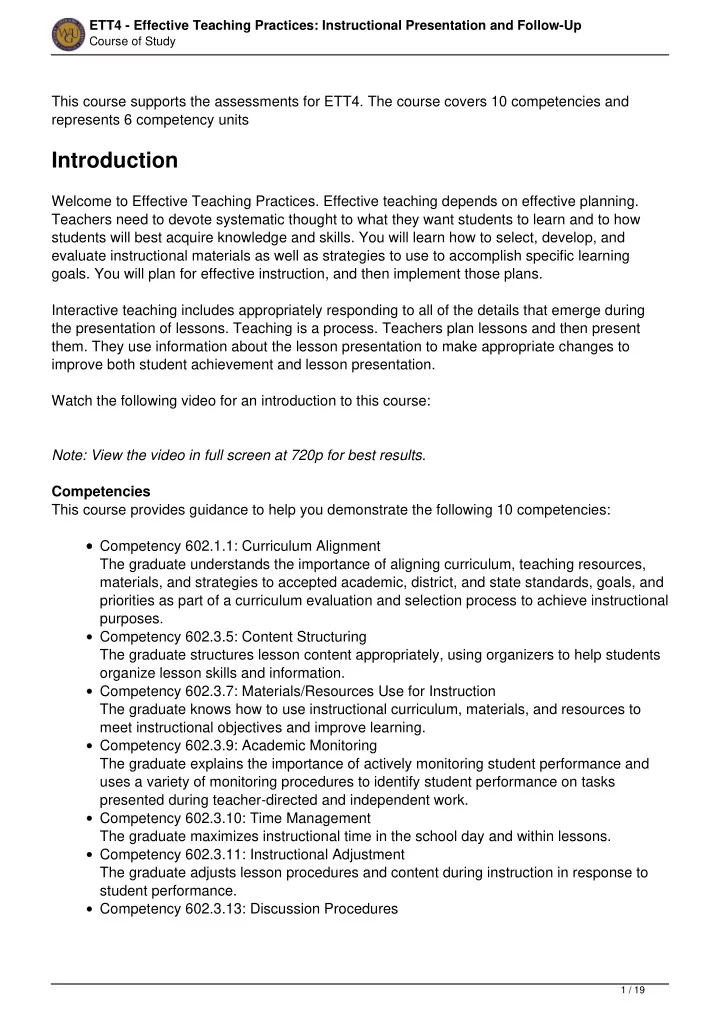
Introduction Welcome to Effective Teaching Practices. Effective - - PDF document

introduction
SMART_READER_LITE
LIVE PREVIEW

Introduction Welcome to Effective Teaching Practices. Effective - - PDF document

ETT4 - Effective Teaching Practices: Instructional Presentation and Follow-Up Course of Study This course supports the assessments for ETT4. The course covers 10 competencies and represents 6 competency units Introduction Welcome to Effective


slide-1
SLIDE 1

ETT4 - Effective Teaching Practices: Instructional Presentation and Follow-Up

Course of Study

This course supports the assessments for ETT4. The course covers 10 competencies and represents 6 competency units

Introduction

Welcome to Effective Teaching Practices. Effective teaching depends on effective planning. Teachers need to devote systematic thought to what they want students to learn and to how students will best acquire knowledge and skills. You will learn how to select, develop, and evaluate instructional materials as well as strategies to use to accomplish specific learning

  • goals. You will plan for effective instruction, and then implement those plans.

Interactive teaching includes appropriately responding to all of the details that emerge during the presentation of lessons. Teaching is a process. Teachers plan lessons and then present

  • them. They use information about the lesson presentation to make appropriate changes to

improve both student achievement and lesson presentation. Watch the following video for an introduction to this course: Note: View the video in full screen at 720p for best results. Competencies This course provides guidance to help you demonstrate the following 10 competencies: Competency 602.1.1: Curriculum Alignment The graduate understands the importance of aligning curriculum, teaching resources, materials, and strategies to accepted academic, district, and state standards, goals, and priorities as part of a curriculum evaluation and selection process to achieve instructional purposes. Competency 602.3.5: Content Structuring The graduate structures lesson content appropriately, using organizers to help students

  • rganize lesson skills and information.

Competency 602.3.7: Materials/Resources Use for Instruction The graduate knows how to use instructional curriculum, materials, and resources to meet instructional objectives and improve learning. Competency 602.3.9: Academic Monitoring The graduate explains the importance of actively monitoring student performance and uses a variety of monitoring procedures to identify student performance on tasks presented during teacher-directed and independent work. Competency 602.3.10: Time Management The graduate maximizes instructional time in the school day and within lessons. Competency 602.3.11: Instructional Adjustment The graduate adjusts lesson procedures and content during instruction in response to student performance. Competency 602.3.13: Discussion Procedures

1 / 19

slide-2
SLIDE 2

ETT4 - Effective Teaching Practices: Instructional Presentation and Follow-Up

Course of Study

The graduate is able to lead discussions that engage all students in exploring important questions and connections among content and ideas. Competency 602.3.14: Connections The graduate connects: concepts within and across subjects; to student characteristics; and to student experiences. Competency 602.3.19: Analysis of Student Work The graduate analyzes student work to determine mastery. Competency 602.3.21: Assessment Interpretation and Dissemination The graduate interprets the information from assessments to understand student performance and disseminates the results to students' parents and school staff. Teaching Dispositions Statement Please review the Statement of Teaching Dispositions. Course Instructor Assistance As you prepare to successfully demonstrate competency in this subject, remember that course instructors stand ready to help you reach your educational goals. As subject matter experts, mentors enjoy and take pride in helping students become reflective learners, problem solvers, and critical thinkers. Course instructors are excited to hear from you and eager to work with you. Successful students report that working with a course instructor is the key to their success. Course instructors are able to share tips on approaches, tools, and skills that can help you apply the content you're studying. They also provide guidance in assessment preparation strategies and troubleshoot areas of deficiency. Even if things don’t work out on your first try, course instructors act as a support system to guide you through the revision process. You should expect to work with course instructors for the duration of your coursework, so you are welcome to contact them as soon as you begin. Course instructors are fully committed to your success!

Preparing for Success

The information in this section is provided to detail the resources available for you to use as you complete this course.

Learning Resources

The learning resources listed in this section are required to complete the activities in this course. For many resources, WGU has provided automatic access through the course. However, you may need to manually enroll in or independently acquire other resources. Read the full instructions provided to ensure that you have access to all of your resources in a timely manner. Automatically Enrolled Learning Resources You will be automatically enrolled at the activity level for the following learning resources. Simply click on the links provided in the activities to access the learning materials. VitalSource E-Texts The following textbooks are available to you as e-texts within this course. You will be directly linked to the specific readings required within the activities that follow. Note: These e-texts are

2 / 19

slide-3
SLIDE 3

ETT4 - Effective Teaching Practices: Instructional Presentation and Follow-Up

Course of Study

available to you as part of your program tuition and fees, but you may purchase hard copies at your own expense through a retailer of your choice. If you choose to do so, please use the ISBN listed to ensure that you receive the correct edition. Borich, G. (2007). Effective teaching methods: Research-based practice ( 7th ed.). Upper Saddle River, NJ: Pearson. ISBN: 9780131714960 Linn, R., Miller, M., & Gronlund, N. (2009). Measurement and assessment in teaching. (10th ed.). Upper Saddle River, NJ: Pearson. ISBN: 9780132408936 Slavin, R. (2009). Educational psychology: Theory and practice (9th ed.) Boston, MA:

  • Pearson. ISBN-13: 9780205616121

Note: The e-text includes references to supplemental material in the MyEducationLab environment, however access to this resource is not included. If these resources are required, they have been supplied at the activity level within the course. ASCD You will access ASCD materials at the activity level within this course. These courses are an

  • nline independent study learning resource provided by the Association for Supervision and

Curriculum Development (ASCD). Teachscape You will access video modules from Teachscape at the activity level within this course. The Teachscape modules include video lectures, exercises, and interactive elements. Educational Impact Educational Impact is an online resource of video training and related worksheets. Educational Impact’s videos and worksheets provide students with an opportunity for learning about several important facets of modern education and observing classrooms where specific practices are implemented and problems are addressed. You will access Educational Impact modules at the activity level within this course. Other Learning Resources You will use the following learning resources for this course. Lesson Planning Best Practices For this course, you will submit lesson plans to Taskstream. The Lesson Planning Best Practices resource is available to assist you in developing this important skill. Please use this resource for this course and throughout the remainder of the program. Additional Preparation Important Note California candidates entering WGU on or after July 1, 2008 should review the California Teaching Performance Assessments (CalTPA) Requirements for California Students document.

Pacing Guide

3 / 19

slide-4
SLIDE 4

ETT4 - Effective Teaching Practices: Instructional Presentation and Follow-Up

Course of Study

The pacing guide suggests a weekly structure to pace your completion of learning activities. It is provided as a suggestion and does not represent a mandatory schedule. Follow the pacing guide carefully to complete the course in the suggested timeframe. Pacing Guide: Effective Teaching Practices: Instructional Presentation and Follow-Up Note: This pacing guide does not replace the course. Please continue to refer to the course for a comprehensive list of the resources and activities.

Content Structuring

In this section, teacher candidates will learn strategies to present information and concepts that meet the lesson plan objectives. What are the key elements of effective lesson presentation? How is questioning used in the classroom as an important instructional strategy? How can graphic organizers be used to structure content and enhance student learning? How do teachers identify and review appropriate instructional resources?

Content Structuring

You will learn fundamentals about presenting content and gain skills in presenting lessons in ways that engage students and enhance student learning. Once students have been introduced to lessons, teachers implement instructional strategies (e.g., questioning, short interactive lectures, compare and contrast) to present information and concepts that meet the learning outcomes. In addition to the instructional strategies that teachers select to present content, instructional materials and resources enhance the instructional and learning processes. Materials developed and selected during the planning process are incorporated during various phases of instruction, such as presenting content and guided practice. This topic addresses the following competencies: Competency 602.3.5: Content Structuring The graduate structures lesson content appropriately, using organizers to help students

  • rganize lesson skills and information.

Competency 602.3.7: Materials/Resources Use for Instruction The graduate knows how to use instructional curriculum, materials, and resources to meet instructional objectives and improve learning. Textbook Reading: Instruction Basics Read the following chapters in Effective Teaching Methods: Research-Based Practice: chapter 1 ("The Effective Teacher") chapter 4 ("Unit and Lesson Planning") chapter 8 ("Teaching Strategies for Indirect Instruction")

4 / 19

slide-5
SLIDE 5

ETT4 - Effective Teaching Practices: Instructional Presentation and Follow-Up

Course of Study

Then read the following chapter in Educational Psychology: Theory and Practice: chapter 7 ("The Effective Lesson") Concept Attainment Strategy (1) Read or review the following article: "The Concept Attainment Strategy" Concept Attainment Strategy Read the following article: "What Is Concept Attainment?". Try discussing what you just learned about this strategy with a friend. Can you name three aspects of the strategy? Visual Representations Access the following Teachscape module: Nonlinguistic Representations In this module, view at least two video clips from grades K–2 and 3–5 under the following heading: Seeing the Strategies in Action Learning Activity: Concept Attainment Review the following web page on the development of effective graphic organizers from the Center for Applied Special Technology (CAST) website: Graphic Organizers and Implications for Universal Design for Learning 602.3.5-01 Performance Task Complete the following task in Taskstream: Instr Pres & Follow-up: 602.3.5-01 For details about this performance assessment, see the "Assessment" tab in this course.

Materials and Resources for Instruction

Teachers must know how to identify and select materials and resources that are appropriate for all students in their classroom, regardless of performance level. As you study this topic section, reflect on the following questions:

5 / 19

slide-6
SLIDE 6

ETT4 - Effective Teaching Practices: Instructional Presentation and Follow-Up

Course of Study

How do teachers access instructional materials and resources that are appropriate for a wide range of students and learning needs? How do teachers determine if a particular resource is appropriate for the needs of different groups of students including those who are English Language Learners, hearing impaired, learning disabled (e.g., reading-dyslexia, writing dysgraphia, language disabled, or physically disabled), and/or gifted/accelerated learners? For this topic, you will review resources that may be used to support instruction. This topic addresses the following competencies: Competency 602.3.5: Content Structuring The graduate structures lesson content appropriately, using organizers to help students

  • rganize lesson skills and information.

Competency 602.3.7: Materials/Resources Use for Instruction The graduate knows how to use instructional curriculum, materials, and resources to meet instructional objectives and improve learning. Textbook Reading: Materials and Resources for Instruction Read or review the following chapters in Effective Teaching Methods: Research-Based Practice: chapter 2 ("Understanding Your Students") chapter 4 ("Unit and Lesson Planning"), emphasis on pages 132-136 Read the following chapter in Educational Psychology: Theory and Practice: chapter 4 ("Student Diversity") Differentiating Instruction Through Materials and Resources Read or review the following article: "Differentiating Instruction" "Differentiating the Core Curriculum and Instruction To Provide Advanced Learning Opportunities" Compile Lists of Resources Look at a number of online classroom resources sites and become familiar with the range of resources that are available for teachers to access. Examples of resource sites you can review include the following: Classroom Resources California Academy of Sciences Experience Learning Community Consult with Teachers about Resources

6 / 19

slide-7
SLIDE 7

ETT4 - Effective Teaching Practices: Instructional Presentation and Follow-Up

Course of Study

Talk with educators that you know and discuss where they obtain their classroom resources (including maps, photos, books, and other instructional materials). You may wish to ask questions such as the following: Do you buy the materials yourself? Do you borrow from a public or school library? What other organizations or sites do you use to obtain resources and materials for your classroom? Consider what should be taken into consideration when choosing instructional resources and materials for students with special needs, including English Language Learner (ELL) students and students with learning disabilities. Instr Pres & Follow-up Performance Assessment Complete the following task in Taskstream: Instr Pres & Follow-up: 602.3.7-04 For details about this performance assessment, see the "Assessment" tab in this course.

Discussion Procedures

Classroom discussions and interactions through questioning can be powerful teaching and learning tools. Learners gain more understanding when they talk about key concepts and terms. Reflect on the following questions as you study this section: What have your own personal experiences been with discussions and questioning as a teaching and learning strategy? Do you believe that questioning is an effective teaching strategy?

Discussion and Questioning Strategies

In this topic, you should gain skills and knowledge on a wide range of discussion and questioning strategies to support and enhance student learning. This topic addresses the following competency: Competency 602.3.13: Discussion Procedures The graduate is able to lead discussions that engage all students in exploring important questions and connections among content and ideas. Textbook Reading: Discussion and Questioning Strategies Read the following chapter in Effective Teaching Methods: Research-Based Practice: chapter 9 ("Questioning Strategies")

7 / 19

slide-8
SLIDE 8

ETT4 - Effective Teaching Practices: Instructional Presentation and Follow-Up

Course of Study

Read the following chapter in Measurement and Assessment in Teaching: chapter 1 ("Educational Testing and Assessment: Context, Issues, and Trends") Review the following chapter in Educational Psychology: Theory and Practice: chapter 7 ("The Effective Lesson"), emphasis on pages 209–221 Review Make sure you understand the difference between follow-up questions, probing questions, and

  • ther questioning approaches.

Instr Pres & Follow-up Performance Assessment Complete the following task in Taskstream: Instr Pres & Follow-up: 602.3.13-05, 06 For details about this performance assessment, see the "Assessment" tab in this course.

Academic Monitoring

Learn the fundamentals of guided and independent practice and how they are employed during lesson implementation. Guided practice includes a variety of strategies such as questioning, providing feedback, and students demonstrating understanding. During guided practice, teachers monitor student understanding and progress and remediate if necessary. Reflect on the following questions as you study this subject: Why is it important for teachers to engage in guided practice after the presentation of instruction? What are effective monitoring techniques and systems that can be integrated into the classroom routines and a teacher's ongoing instructional strategies?

Monitoring Student Understanding

As a teacher, it is extremely important to keep a close eye on what parts of your lessons your students are understanding and what concepts they may be struggling with. You can then use this information to inform or modify your instruction. This topic addresses the following competency: Competency 602.3.9: Academic Monitoring The graduate explains the importance of actively monitoring student performance and uses a variety of monitoring procedures to identify student performance on tasks presented during teacher-directed and independent work. Textbook Reading: Monitoring Student Understanding Read the following chapters in Effective Teaching Methods: Research-Based Practice:

8 / 19

slide-9
SLIDE 9

ETT4 - Effective Teaching Practices: Instructional Presentation and Follow-Up

Course of Study

chapter 7 ("Teaching Strategies for Direct Instruction"),emphasis on pages 237–243 chapter 10 ("Self-Directed Learning") chapter 12 ("Assessing Learners") Read the following chapters in Educational Psychology: Theory and Practice: chapter 9 ("Accommodating Instruction to Meet Individual Needs") chapter 10 ("Motivating Students to Learn") chapter 13 ("Assessing Student Learning") Learning Activities: Monitoring Student Understanding Read the following chapter: Hofmeister, A. & Lubke, M. (1990). The research literature: Academic feedback. In Research into practice: Implementing effective teaching strategies (pp. 93- 104). Boston, MA: Allyn & Bacon. Be prepared to discuss the difference between academic monitoring strategies and systems. Also, be sure you have explored academic monitoring systems that would be most effective for students experiencing difficulty or for ELL students. Focus on Feedback Complete the following Teachscape module: Setting Objectives and Providing Feedback Focus on the part of the course that relates to providing feedback. Corrective Feedback Read the following chapter Hofmeister, A. & Lubke, M. (1990). The research literature: Academic monitoring. In Research into practice: Implementing effective teaching strategies (pp. 93- 104). Boston, MA: Allyn & Bacon. Read the following article: Schumm, J. & Vaughn, S. (1997). Are they getting it? How to monitor student understanding in inclusive classrooms. Intervention in School & Clinic, 32 (3) p168 (4p). As you engage with the academic monitoring readings and resources, focus on the difference between monitoring strategies and monitoring systems. Instr Pres & Follow-up Performance Assessment Complete the following performance assessment task in Taskstream:

9 / 19

slide-10
SLIDE 10

ETT4 - Effective Teaching Practices: Instructional Presentation and Follow-Up

Course of Study

Instr Pres & Follow-up: 602.3.9-07, 09, 11 For directions on how to receive access to performance assessments, see the "Assessment" tab in this course.

Instructional Adjustment

Reflect on the following questions as you study this section: How do teachers know when it is appropriate to adjust instruction? What are strategies for adjusting instruction for students who are struggling? What are strategies for adjusting instruction for students whose learning is accelerated? Learn the fundamentals of adjusting lessons based on student performance. You should also learn how to give students opportunities to practice newly acquired skills. As you monitor academic progress, there are times you will need to adjust instruction and re-teach concepts. Once students have acquired knowledge or skills, it is important that they practice, apply, and think of ways to remember them. Independent practice can provide structured opportunities for students to enhance their learning.

Adjusting Instruction

The phrase "one size fits all" definitely does not apply to the classroom. Effective teachers know how to modify curriculum and instruction in order to meet the needs of all students in the classroom, regardless of ability or performance level. This topic addresses the following competency: Competency 602.3.11: Instructional Adjustment The graduate adjusts lesson procedures and content during instruction in response to student performance. Textbook Reading: Adjusting Instruction Review the following chapters in Effective Teaching Methods: Research-Based Practice: chapter 7 ("Teaching Strategies for Direct Instruction"), emphasis on pages 243–246 chapter 12 ("Assessing Learners") Then, review the following chapters in Educational Psychology: Theory and Practice: chapter 9 ("Accommodating Instruction to Meet Individual Needs") Review any of the following articles for additional resources on this subject: Adjusting instruction to meet students' needs. (2008). Reading Today, 25(6), 18-19. Ellis, L., Burke, D. M., Lomire, P., & McCormack, D. R. (2003). Student Grades and Average Ratings of Instructional Quality: The Need for Adjustment. Journal of

10 / 19

slide-11
SLIDE 11

ETT4 - Effective Teaching Practices: Instructional Presentation and Follow-Up

Course of Study

Educational Research, 97(1), 35-40. Huebner, T. A. (2010). Differentiated Instruction. Part of a special issue: Meeting Students Where They Are, 67(5), 79-81. Stecker, P. M., & Fuchs, L. S. (2000). Effecting Superior Achievement Using Curriculum-Based Measurement: The Importance of Individual Progress Monitoring. Learning Disabilities Research & Practice (Lawrence Erlbaum), 15(3), 128-134. Tomlinson, C. A. (2005). Quality Curriculum and Instruction for Highly Able Students. Theory Into Practice, 44(2), 160-166. doi: 10.1207/s15430421tip4402_10. Wingate, U. (2010). The impact of formative feedback on the development of academic

  • writing. Assessment & Evaluation in Higher Education, 35(5), 519-533. doi:

10.1080/02602930903512909. Adjusting Instruction for Gifted Students Access and read the following article: Differentiating Curriculum for Gifted Students Re-teaching Read the following article from the "Research Into Practice: Implementing Effective Teaching Strategies" website: Academic Feedback (specifically the portions on re-teaching) Focus on gaining understanding on when re-teaching is necessary and the difference between re-teaching and providing clarification on instruction. Think of strategies teachers use to determine if they need to re-teach information. Consider the following questions: When should teachers engage in re-teaching? How do academic monitoring and questioning during guided practice inform the need to re-teach? What kind of evidence will you seek regarding student performance to help determine if re-teaching is necessary?

Independent Practice Strategies

You should learn how to provide students with the opportunity to practice new skills derived from new knowledge. This topic addresses the following competency: Competency 602.3.11: Instructional Adjustment The graduate adjusts lesson procedures and content during instruction in response to student performance. Homework

11 / 19

slide-12
SLIDE 12

ETT4 - Effective Teaching Practices: Instructional Presentation and Follow-Up

Course of Study

Access and read the following web page: The Goldilocks Dilemma: Homework Policy Creating a Culture Where Simply Good Is Just Not Good Enough Upside Down and Inside Out: Flip Your Classroom to Improve Student Learning Prior to completing this activity, you may want to read the "Practical Suggestions: Academic Monitoring" section in: Hofmeister, A. & Lubke, M. (1990). The research literature: Academic monitoring . In Research into practice: Implementing effective teaching strategies (pp. 93- 104). Boston, MA: Allyn & Bacon. Note: For a quick review, you may want to search for the keyword "homework" within each section. Review Be sure you have a clear understanding of the difference between guided and independent practice as you prepare for this task. Also, make sure that you have engaged in readings to identify strategies for making adjustments to instruction. Instr Pres & Follow-up Performance Assessment Complete the following task in Taskstream: Instr Pres & Follow-up: 602.3.11-01, 02, 03 For directions on how to receive access to performance assessments, see the "Assessment" tab in this course.

Connections

In this section you will examine concept connections as they apply to student experience and

  • characteristics. Up to this point in the course, you have dealt with elements of the direct

instruction model. Now, a number of indirect instructional approaches will be addressed. You will also examine the making of concept connections within and across subjects to student experience, as well as learn about indirect instructional approaches and explore strategies for effective discussion. Reflect on the following questions: What are indirect instructional approaches? What are the benefits of teachers using indirect instructional strategies?

12 / 19

slide-13
SLIDE 13

ETT4 - Effective Teaching Practices: Instructional Presentation and Follow-Up

Course of Study

How does current brain research impact curriculum development and presentation? What are the advantages of group discussions?

Connecting the Dots of Learning

Students learn so much more when they are able to see the relevance of the content and when they are able to make meaningful connections to their own experiences. This topic addresses the following competency: Competency 602.3.14: Connections The graduate connects: concepts within and across subjects; to student characteristics; and to student experiences. Textbook Reading: Connecting the Dots of Learning Read the following chapters in Effective Teaching Methods: Research-Based Practice: chapter 8 ("Teaching Strategies for Indirect Instruction"), emphases on pages 287–290 Read the following chapter in Educational Psychology: Theory and Practice: chapter 7 ("The Effective Lesson"), emphases on pages 221–223 Connecting the Dots of Learning Download and read the following on the "Discussion as a Teaching Strategy" website: Research Paper 2 Then, browse through and review the various documents and articles on the following website: Discussion/Problem Solving Teaching Strategies Definitions of Brain-Based Learning Access and read the following articles: Caulfield, J., Kidd, S., & Kocher, T. (2000). Brain-based instruction in action. Educational Leadership, 58(3), 62-65. McCall, L. A. H. L. M. a. e. (2012). Brain-based Pedagogy in Today's Diverse Classrooms: A Perfect Fit--But Be Careful! Delta Kappa Gamma Bulletin, 78(3), 42-47. Wetzels, S. A. J., Kester, L., van Merriënboer, J. J. G., & Broers, N. J. (2011). The influence of prior knowledge on the retrieval-directed function of note taking in prior knowledge activation. British Journal of Educational Psychology, 81(2), 274-291. doi: 10.1348/000709910X517425. Worden, J. M., Hinton, C., & Fischer, K. W. (2011). What Does the Brain Have to Do with Learning? Phi Delta Kappan, 92(8), 8-13. In the Educational Impact Program Library, view the following from the program “Brain Based

13 / 19

slide-14
SLIDE 14

ETT4 - Effective Teaching Practices: Instructional Presentation and Follow-Up

Course of Study

Instruction”: Module 1: BRAINSMART: Raising Student Achievement Instr Pres & Follow-up Performance Assessment Complete the following task in Taskstream: Instr Pres & Follow-up: 602.3.14-06 For details about this performance assessment, see the "Assessment" tab in this course.

Curriculum Alignment

What you teach absolutely must be connected to how you teach, and how you teach must be connected to how you assess student understanding. This series of connections is the principle of alignment. Experienced teachers should be adept at adhering to this skill as they plan weekly instruction.

Basics of Connecting the Curriculum to Instruction and Assessment

There are certain basics that teachers must follow when creating appropriate instructional experiences for their students. They must, for example, consider state or national standards, and then they must write learning objectives to fit those standards. From there, they must create learning opportunities and assessment plans to align with the

  • curriculum. In other words, planning must be careful and purposeful.

This topic addresses the following competencies: Competency 602.1.1: Curriculum Alignment The graduate understands the importance of aligning curriculum, teaching resources, materials, and strategies to accepted academic, district, and state standards, goals, and priorities as part of a curriculum evaluation and selection process to achieve instructional purposes. Competency 602.3.10: Time Management The graduate maximizes instructional time in the school day and within lessons. Competency 602.3.19: Analysis of Student Work The graduate analyzes student work to determine mastery. Competency 602.3.21: Assessment Interpretation and Dissemination The graduate interprets the information from assessments to understand student performance and disseminates the results to students' parents and school staff. Textbook Reading: Connecting the Curriculum to Instruction and Assessment Review the following chapters in Effective Teaching Methods: Research-Based Practice: chapter 8 ("Teaching Strategies for Indirect Instruction"), focus on pages 287–290

14 / 19

slide-15
SLIDE 15

ETT4 - Effective Teaching Practices: Instructional Presentation and Follow-Up

Course of Study

Review the following chapter in Educational Psychology: Theory and Practice: chapter 4 ("Student Diversity"), emphasis on pages 116–120 chapter 7 ("The Effective Lesson"), emphasis on pages 221–223 Benefits of Curriculum Alignment Access and read the following article: The Benefits of Curriculum Alignment Curriculum Mapping Watch the following video about Curriculum Mapping Jacobs, H.H. (2012, April 3)Retrieved. May 6, 2013 Read about curriculum mapping in the following articles: Jarchow, E., & Look, E. (1985). CURRICULUM MAPPING WORKS!. Education, 105(4), 417. Jacobs, H.H. (2003) Connecting Curriculum Mapping and Technology. Curriculum Technology Quarterly 2(3), 1-5 Learning Activities: Connecting Curriculum to Instruction and Assessment Think about how the concepts of "curriculum alignment" and "curriculum mapping" relate to the No Child Left Behind Act of 2001. Instr Pres & Follow-up Performance Assessment Complete the following task in Taskstream: Instr Pres & Follow-up: 602.1.1-05 For details about this performance assessment, see the "Assessment" tab in this course.

Time Management

Learn to make concept connections within and across material as it relates to student characteristics and experience. You should also learn to manage time within the school day and as it relates to lesson presentation. As you complete the activities in this section, reflect on the following questions: Why is the consideration of time in the classroom key to effective student learning? How can teachers maximize instructional time and minimize time wasters? How do effective classroom management strategies maximize instructional time? This topic addresses the following competencies:

15 / 19

slide-16
SLIDE 16

ETT4 - Effective Teaching Practices: Instructional Presentation and Follow-Up

Course of Study

Competency 602.1.1: Curriculum Alignment The graduate understands the importance of aligning curriculum, teaching resources, materials, and strategies to accepted academic, district, and state standards, goals, and priorities as part of a curriculum evaluation and selection process to achieve instructional purposes. Competency 602.3.10: Time Management The graduate maximizes instructional time in the school day and within lessons. Competency 602.3.19: Analysis of Student Work The graduate analyzes student work to determine mastery. Competency 602.3.21: Assessment Interpretation and Dissemination The graduate interprets the information from assessments to understand student performance and disseminates the results to students' parents and school staff. Textbook Reading: Time Management Review the following chapter in Effective Teaching Methods: Research-Based Practice: chapter 4 ("Unit and Lesson Planning") Review the following chapter in Educational Psychology: Theory and Practice: chapter 11 ("Effective Learning Environments") Learning Activities: Time Management Access and read the following web page: Managing Instructional Time Consider the following question: As a teacher, what will you do to maximize the amount of instructional time you have? Instructional Pacing Pacing is the rate of instructional presentations and response. The pace of instruction is influenced by many variables such as task complexity or difficulty, relative newness of the task, and individual student differences. Read the following article from the "Research into Practice: Implementing Effective Teaching Strategies" website: "Pacing" (starts on p. 6) in the "Time Management" article Pacing and Special Student Populations Access and read the following article: Making Content Comprehensible for English Language Learners Classroom Management

16 / 19

slide-17
SLIDE 17

ETT4 - Effective Teaching Practices: Instructional Presentation and Follow-Up

Course of Study

Access and read the following web page from the National Education Association: 6 Classroom Management Tips Every Teacher Can Use Instr Pres & Follow-up Performance Assessment Complete the following task in Taskstream: Instr Pres & Follow-up: 602.3.10-05 For details about this performance assessment, see the "Assessment" tab in this course.

Analysis of Student Work

What are strategies teachers can use to effectively analyze student work in the classroom? The analysis and evaluation of student work is an important component of effective teaching. You should gain skills and understanding in the development and use of instructional tools to support effective analysis of student work. This topic addresses the following competencies: Competency 602.1.1: Curriculum Alignment The graduate understands the importance of aligning curriculum, teaching resources, materials, and strategies to accepted academic, district, and state standards, goals, and priorities as part of a curriculum evaluation and selection process to achieve instructional purposes. Competency 602.3.10: Time Management The graduate maximizes instructional time in the school day and within lessons. Competency 602.3.19: Analysis of Student Work The graduate analyzes student work to determine mastery. Competency 602.3.21: Assessment Interpretation and Dissemination The graduate interprets the information from assessments to understand student performance and disseminates the results to students' parents and school staff. Textbook Reading: Analysis of Student Work Review the following chapter in the Effective Teaching Methods: Research-Based Practice: chapter 12 ("Assessing Learners") Learning Activities: Analysis of Student Work Access and read the following article from the McGraw Center at Princeton University: Evaluating Student Work Taskstream Tools Review the rubric wizard and standards wizard tools in Taskstream. Rubric Wizard

17 / 19

slide-18
SLIDE 18

ETT4 - Effective Teaching Practices: Instructional Presentation and Follow-Up

Course of Study

  • 1. Access the front page of Taskstream.
  • 2. Click on the "Lessons, Units, and Rubrics" menu at the top of the page.
  • 3. Click on "Rubric Wizard."
  • 4. Explore the types of rubric templates through the "Adapt a Rubric" option.

Note that these rubric templates can be used as a foundation for creating rubrics for tasks in this assessment. Standards Wizard

  • 1. Access the front page of Taskstream.
  • 2. Click on the "Standards" menu at the top of the page.
  • 3. Click on "Browse Standards and Outcomes."
  • 4. Explore the options to access your state's academic K-12 learning standards.

Determine the language your state uses to describe objectives that are aligned with the academic standards. Note that a range of language is used, including benchmarks and grade level expectations. Contact your course instructor for clarification if you are unable to determine the language used in your state standards. Instr Pres & Follow-up Performance Assessment Complete the following task in Taskstream: Instr Pres & Follow-up: 602.3.19-03 For details about this performance assessment, see the "Assessment" tab in this course.

Assessment Interpretation and Dissemination

It is important for teachers to be able to look at assessment results and know what they mean in

  • rder to inform their instruction and meet the needs of each student in the class.

This topic addresses the following competencies: Competency 602.1.1: Curriculum Alignment The graduate understands the importance of aligning curriculum, teaching resources, materials, and strategies to accepted academic, district, and state standards, goals, and priorities as part of a curriculum evaluation and selection process to achieve instructional purposes. Competency 602.3.10: Time Management The graduate maximizes instructional time in the school day and within lessons. Competency 602.3.19: Analysis of Student Work The graduate analyzes student work to determine mastery. Competency 602.3.21: Assessment Interpretation and Dissemination The graduate interprets the information from assessments to understand student performance and disseminates the results to students' parents and school staff. Interpreting Test Scores and Norms

18 / 19

slide-19
SLIDE 19

ETT4 - Effective Teaching Practices: Instructional Presentation and Follow-Up

Course of Study

Review the following chapter in Measurement and Assessment in Teaching: chapter 19 ("Interpreting Test Scores and Norms") Make sure you can respond to the following questions with confidence: What is the difference between norm-referenced and criterion-referenced assessments? What are performance standards? What is a normal curve? What is the difference between percentile ranks and stanines? Assessing Learners Review the following chapter in Effective Teaching Methods: Research-Based Practice: chapter 12 ("Assessing Learners") List at least five different assessment types that you could use in your classroom. Indicate how you would use the results from each to inform your instruction. Draft a sample letter to parents which explains what the test results mean as it relates to their child. Instr Pres & Follow-up Performance Assessment Complete the following task in Taskstream: Instr Pres & Follow-up: 602.3.21-01, 02 For details about this performance assessment, see the "Assessment" tab in this course.

Final Steps

Congratulations on completing the activities in this course! This course has prepared you to complete the assessments associated with this course. If you have not already been directed to complete the assessments, schedule and complete your assessments now.

Powered by TCPDF (www.tcpdf.org)

19 / 19