Notes Shells Simple addition to previous bending formulation: - - PowerPoint PPT Presentation

notes shells
SMART_READER_LITE
LIVE PREVIEW

Notes Shells Simple addition to previous bending formulation: - - PowerPoint PPT Presentation

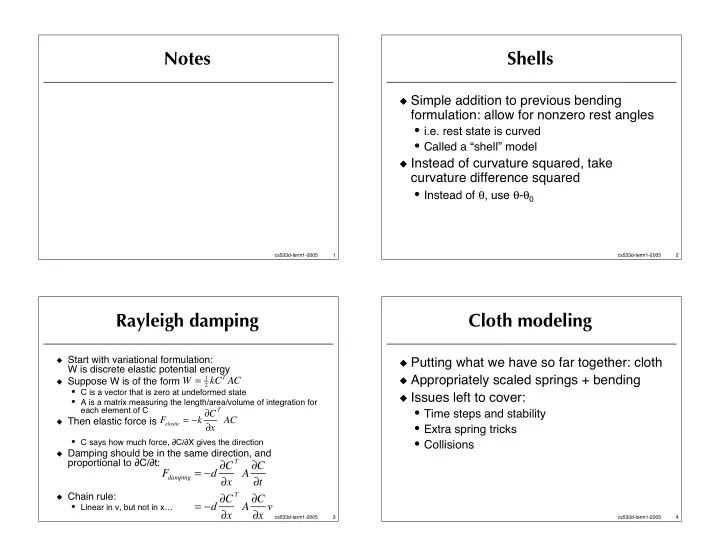
Notes Shells Simple addition to previous bending formulation: allow for nonzero rest angles i.e. rest state is curved Called a shell model Instead of curvature squared, take curvature difference squared Instead of ,


slide-1
SLIDE 1

1 cs533d-term1-2005

Notes

2 cs533d-term1-2005

Shells

Simple addition to previous bending

formulation: allow for nonzero rest angles

  • i.e. rest state is curved
  • Called a “shell” model

Instead of curvature squared, take

curvature difference squared

  • Instead of , use -0

3 cs533d-term1-2005

Rayleigh damping

Start with variational formulation:

W is discrete elastic potential energy

Suppose W is of the form

  • C is a vector that is zero at undeformed state
  • A is a matrix measuring the length/area/volume of integration for

each element of C

Then elastic force is

  • C says how much force, C/X gives the direction

Damping should be in the same direction, and

proportional to C/t:

Chain rule:

  • Linear in v, but not in x…

W = 1

2 kCT AC

F

elastic = k C

x

T

AC

F

damping = d C

x

T

A C t = d C x

T

A C x v

4 cs533d-term1-2005

Cloth modeling

Putting what we have so far together: cloth Appropriately scaled springs + bending Issues left to cover:

  • Time steps and stability
  • Extra spring tricks
  • Collisions
slide-2
SLIDE 2

5 cs533d-term1-2005

Spring timesteps

For a fully explicit method:

  • Elastic time step limit is
  • Damping time step limit is
  • What does this say about scalability?

t O mL2 EA

  • = O 1

n

  • t O mL2

DA

  • = O

1 n2

  • 6

cs533d-term1-2005

Bending timesteps

Back of the envelope from discrete

energy:

Or from 1D bending problem

  • [practice variational derivatives]

a x 1 m B e

2

A 2 x2 = O L2 L2L2L2

  • t = O

1 n2

  • 7

cs533d-term1-2005

Fourth order problems

Linearize and simplify drastically, look for steady-state

solution (F=0): spline equations

  • Essentially 4th derivatives are zero
  • Solutions are (bi-)cubics

Model (nonsteady) problem: xtt=-xpppp

  • Assume solution

Wave of spatial frequency k, moving at speed c

  • [solve for wave parameters]
  • Dispersion relation: small waves move really fast
  • CFL limit (and stability): for fine grids, BAD
  • Thankfully, we rarely get that fine

x p,t

( ) = e

1k pct

( )

8 cs533d-term1-2005

Implicit/Explicit Methods

Implicit bending is painful In graphics, usually unnecessary

  • Dominant forces on the grid resolution we use tend to be the 2nd
  • rder terms: stretching etc.

But nice to go implicit to avoid time step restriction for

stretching terms

No problem: treat some terms (bending) explicitly, others

(stretching) implicitly

  • vn+1=vn+t/m(F1(xn,vn)+F2(xn+1,vn+1))
  • All bending is in F1, half the elastic stretch in F1, half the elastic

stretch in F2, all the damping in F2

slide-3
SLIDE 3

9 cs533d-term1-2005

Hacking in strain limits

Especially useful for cloth:

  • Biphasic nature: wont easily extend past a certain

point

Sweep through elements (e.g. springs)

  • If strain is beyond given limit, apply force to return it to

closest limit

  • Also damp out strain rate to zero

No stability limit for fairly stiff behaviour

  • But mesh-independence is an issue…

See X. Provot, “Deformation constraints in a mass-

spring model to describe rigid cloth behavior”, Graphics Interface '95

10 cs533d-term1-2005

Extra effects with springs

(Brittle) fracture

  • When a spring is stretched too far, break it
  • Issue with loose ends…

Plasticity

  • Whenever a spring is stretched too far,

change the rest length part of the way

More on this late