SLIDE 1 STELLAR SHELLS IN THE ILLUSTRIS SIMULATION
Ana-Roxana Pop in collabora*on with Lars Hernquist, Annalisa Pillepich, Nicola Amorisco
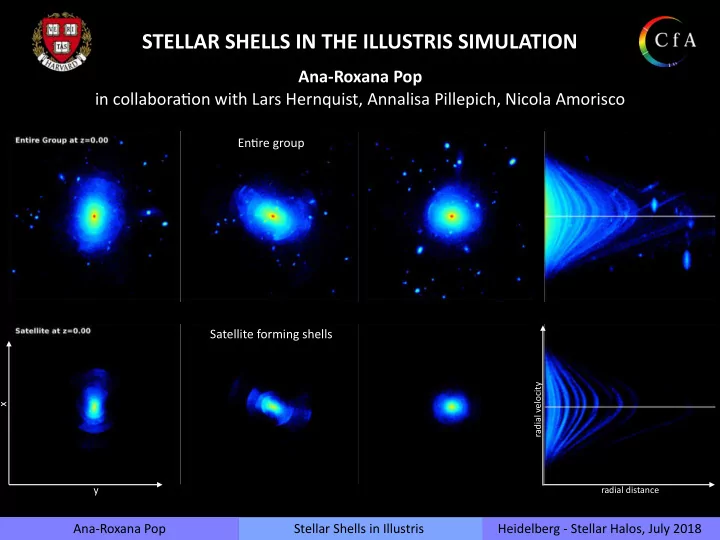
Satellite forming shells En*re group
radial distance radial velocity
x y
Ana-Roxana Pop Stellar Shells in Illustris Heidelberg - Stellar Halos, July 2018
SLIDE 2 Hubble DECam coadded image
Ana-Roxana Pop ITC Luncheon, April 2018 Galaxies with Stellar Shells
NGC 474 CFHT/Coelum/MegaCam J.-C. Cullandre & G.A. Anselmi ESO 381-12 NASA, ESA, P. Goudfrooij (STScI)
NS-NS merger - GW170817
- ccurred in a shell galaxy (NGC 4993)
Credits: NASA, ESA, A. Levan (U. Warwick)
A few famous shells
Ana-Roxana Pop Heidelberg - Stellar Halos, July 2018
SLIDE 3 Tidal Features in Illustris
INTRODUCTION
- I. FORMATION
- II. METALLICITY
- III. HALO SHAPES
Type II Shells Type I Shells Streams and other ]dal features
Ana-Roxana Pop Heidelberg - Stellar Halos, July 2018 Galaxies with Stellar Shells Pop+2017a, arXiv:1706.06102
SLIDE 4 Hendel & Johnston 2015
From Shells to Streams
Ana-Roxana Pop Galaxies with stellar shells ITC Luncheon, April 2018 Ana-Roxana Pop ITC Luncheon, April 2018 Galaxies with Stellar Shells
increasing angular momentum
SHELLS STREAMS “wrappings” radial orbit more circular orbit
Sanderson & Helmi 2013
Arp 230 (Arp 1966)
Mar]nez-Delgado+2008
Ana-Roxana Pop Heidelberg - Stellar Halos, July 2018
SLIDE 5 Different Types of Shells
Ana-Roxana Pop Galaxies with stellar shells ITC Luncheon, April 2018 Ana-Roxana Pop ITC Luncheon, April 2018 Galaxies with Stellar Shells
SHELLS radial orbit
Prieur 1988 NGC 474 - Turnbull et al., 1999 NGC 7600 - Turnbull et al., 1999
Type I shells Type II shells
Prieur (1989) and Wilkinson et al. (1987) introduced a system of classifying shells based on their morphology
Prieur 1988
shells aligned with the major axis shells more randomly distributed
Ana-Roxana Pop Heidelberg - Stellar Halos, July 2018
SLIDE 6
Observed shell galaxy
Shell galaxies in the Illustris simula]on
Ana-Roxana Pop Shell galaxies in Illustris ITC Luncheon, April 2018 Ana-Roxana Pop ITC Luncheon, April 2018 Shell Galaxies in Illustris Ana-Roxana Pop Heidelberg - Stellar Halos, July 2018
SLIDE 7 Observed shell galaxy
Shell galaxies in the Illustris simula]on
Ana-Roxana Pop Shell galaxies in Illustris ITC Luncheon, April 2018 Ana-Roxana Pop ITC Luncheon, April 2018 Shell Galaxies in Illustris Ana-Roxana Pop Heidelberg - Stellar Halos, July 2018
PART 1 (arXiv:1706.06102) — First study of shell galaxies in a cosmological se^ng (Illustris)
- What is the frac*on of shells in a cosmological simula*on?
- How do shells form?
PART 2 (arXiv:1708.01615) — Metallicity of stellar shells PART 3 (paper in progress) — The shape of halos hos*ng shell galaxies
SLIDE 8 Observed shell galaxy
Shell galaxies in the Illustris simula]on
INTRODUCTION
Galaxy sample: 220 most massive galaxies in Illustris at z=0,
Two selec]on steps:
Score of 2 Score of 1 Score of 0
Step 1
Visual iden]fica]on Observer M200crit > 6 × 10¹² M
Ana-Roxana Pop ITC Luncheon, April 2018 Iden*fying Shell Galaxies in Illustris Ana-Roxana Pop Heidelberg - Stellar Halos, July 2018
SLIDE 9 Observed shell galaxy
Shell galaxies in the Illustris simula]on
INTRODUCTION
- II. METALLICITY
- III. HALO SHAPES
Galaxy sample: 220 most massive galaxies in Illustris at z=0,
Two selec]on steps: Step 1
Visual iden]fica]on Observer
Step 2
Stellar History Catalogs & tracing the individual satellites forming shells Theorist (s i m u l a t i
s) M200crit > 6 × 10¹² M
Ana-Roxana Pop ITC Luncheon, April 2018 Iden*fying Shell Galaxies in Illustris Ana-Roxana Pop Heidelberg - Stellar Halos, July 2018
SLIDE 10 Satellite forming shells En*re group
radial distance radial velocity
x y
INTRODUCTION
- I. FORMATION
- II. METALLICITY
- III. HALO SHAPES
Ana-Roxana Pop ITC Luncheon, April 2018 Iden*fying Shell Galaxies in Illustris
Step 2
Stellar History Catalogs & tracing the individual satellites forming shells Theorist (s i m u l a t i
s)
At each important *me in the life*me of a star (forma]on, accre]on, stripping) we save informa*on about the star and its progenitor galaxy.
Ana-Roxana Pop Heidelberg - Stellar Halos, July 2018
SLIDE 11 We find that the frac]on of shell galaxies increases with stellar and virial mass. In our total sample of 220 galaxies, we find 18% +/- 3% of the galaxies have shells. This es]mate is in overall agreement with the latest observa]ons.
18% shells out of 220 galaxies with
M200crit > 6 × 10¹² M
Pop+2017a, arXiv:1706.06102
Shell Galaxies in Illustris
Ana-Roxana Pop ITC Luncheon, April 2018 Shell Galaxies in Illustris Ana-Roxana Pop Heidelberg - Stellar Halos, July 2018
SLIDE 12 Hendel & Johnston 2015
The Progenitors of Shell Galaxies
Ana-Roxana Pop Galaxies with stellar shells ITC Luncheon, April 2018 Ana-Roxana Pop ITC Luncheon, April 2018 Galaxies with Stellar Shells
increasing angular momentum
SHELLS STREAMS “wrappings” radial orbit more circular orbit
Sanderson & Helmi 2013
Arp 230 (Arp 1966)
Mar]nez-Delgado+2008
however, there are several observa*ons of shells that seem to be the result of major mergers: Schiminovich et al. 1995, Balcells et al. 2001 Goudfrooij et al. 2001, Serra et al. 2006 most studies focused on radial minor mergers
Ana-Roxana Pop Heidelberg - Stellar Halos, July 2018
SLIDE 13 p<0.0001
PART I - Selec*ng Shell Galaxies in Illustris PART II - Global Proper*es of Shell Galaxies PART III - Shell Progenitors and Their Mergers
The Progenitors of Shell Galaxies
We aim to iden*fy the key parameters that make a satellite likely to form shells in a cosmological segng! Order-zero recipe:
- 1. radial infall orbit
- 2. massive satellite
- 3. accre*on *me 4-8 Gyr ago
We aim to iden*fy the key parameters that make a satellite likely to form shells in a cosmological segng. the satellites forming shells are rela*vely massive compared to the host galaxy!
Ana-Roxana Pop Heidelberg - Stellar Halos, July 2018 Forma*on of Shell Galaxies
SLIDE 14 p<0.0001
PART I - Selec*ng Shell Galaxies in Illustris PART II - Global Proper*es of Shell Galaxies PART III - Shell Progenitors and Their Mergers
The Progenitors of Shell Galaxies
We aim to iden*fy the key parameters that make a satellite likely to form shells in a cosmological segng! Order-zero recipe:
- 1. radial infall orbit
- 2. massive satellite
- 3. accre*on *me 4-8 Gyr ago
We aim to iden*fy the key parameters that make a satellite likely to form shells in a cosmological segng.
Order-zero recipe:
- 1. radial infall orbit
- 2. massive satellite
- 3. accre*on *me 4-8 Gyr ago
Radial Velocity Ratio (@ t_acc)
Ana-Roxana Pop Heidelberg - Stellar Halos, July 2018 Forma*on of Shell Galaxies
SLIDE 15 Radial Velocity Ra*o at Accre]on Time
INTRODUCTION
- I. FORMATION
- II. METALLICITY
- III. HALO SHAPES
What type of mergers produce shell galaxies?
Ana-Roxana Pop Heidelberg - Stellar Halos, July 2018 Forma*on of Shell Galaxies Pop+2017a, arXiv:1706.06102
SLIDE 16 Central Host
R200mean
Small Satellite
Small satellites (stellar mass ra]os ~1:10) can produce shells if they arrive on radial orbits
What type of mergers produce shell galaxies?
Ana-Roxana Pop Forma*on of Shell Galaxies ITC Luncheon, April 2018
Radial Velocity Ratio (@ t_acc)
Stellar Mass Ratio
Ana-Roxana Pop Heidelberg - Stellar Halos, July 2018 Pop+2017a, arXiv:1706.06102
SLIDE 17 Central Host
R200mean
Small Satellite
Small satellites (stellar mass ra]os ~1:10) can produce shells if they arrive on radial orbits
Massive Satellite
Very massive satellites (stellar mass ra]os > 1:3) have their final infall orbits radialized by dynamical fric]on.
What type of mergers produce shell galaxies?
Ana-Roxana Pop Forma*on of Shell Galaxies ITC Luncheon, April 2018
Central Host
R200mean
Radial Velocity Ratio (@ t_acc)
Stellar Mass Ratio
Ana-Roxana Pop Heidelberg - Stellar Halos, July 2018 Pop+2017a, arXiv:1706.06102
SLIDE 18 What type of mergers produce shell galaxies?
Ana-Roxana Pop Forma*on of Shell Galaxies ITC Luncheon, April 2018
Radial Velocity Ratio (@ t_acc)
Stellar Mass Ratio
Ana-Roxana Pop Heidelberg - Stellar Halos, July 2018
Remember Nicola “the younger” talk on Monday! Msat/Mhost - 1/6 Msat/Mhost - 1/40
Amorisco 2017a
higher mass ra]o (close to major mergers) more efficient
Pop+2017a, arXiv:1706.06102
SLIDE 19
Pop et al. 2018, in prepara]on Ana-Roxana Pop Metallici*es of Stellar Shells ITC Luncheon, April 2018
Metallici]es of Stellar Shells
Stellar shells formed due to rela*vely major mergers can be more metal rich than host stars at similar radii.
Ana-Roxana Pop Heidelberg - Stellar Halos, July 2018 Pop+2017b, arXiv:1708.01615
SLIDE 20
Pop et al. 2018, in prepara]on Pop+2017b, arXiv:1708.01615 Ana-Roxana Pop Metallici*es of Stellar Shells ITC Luncheon, April 2018
Metallici]es of Stellar Shells
Ana-Roxana Pop Heidelberg - Stellar Halos, July 2018
SLIDE 21
Pop et al. 2018, in prepara]on Pop+2017b, arXiv:1708.01615 Ana-Roxana Pop Metallici*es of Stellar Shells ITC Luncheon, April 2018
Metallici]es of Stellar Shells
Ana-Roxana Pop Heidelberg - Stellar Halos, July 2018
See Erin’s talk on observed HSC shells arXiv:1805.05970
SLIDE 22 INTRODUCTION
- I. FORMATION
- II. METALLICITY
- III. HALO SHAPES
Ana-Roxana Pop Heidelberg - Stellar Halos, July 2018 Metallici*es of Stellar Shells 1 : 1.3 1 : 1.6 1 : 6 1 : 2 1 : 4 1 : 4.3 1 : 1.3 1 : 2.5 1 : 4 Stellar Mass Ra]o — Pop+2017b, arXiv:1708.01615
Metallici]es of Stellar Shells
SLIDE 23
Pop et al. 2018, in prepara]on
Compe*ng effects: outer shells correspond to the first stars stripped -> metal-poor stars BUT for ~major mergers, outer shells contain metal-rich stars which are deposited at large effec*ve radii, where the host galaxy is metal-poor.
Ana-Roxana Pop Metallici*es of Stellar Shells ITC Luncheon, April 2018 Pop+2017b, arXiv:1708.01615
Metallici]es of Stellar Shells
Ana-Roxana Pop Heidelberg - Stellar Halos, July 2018
SLIDE 24 10 out of 39 shell galaxies in our sample have mul*ple shell-forming progenitors.
Pop et al. 2018, in prepara]on
In some cases, there is a significant difference in the metallicity of shells formed from the two different progenitors
- > metallicity measurements can be used to iden*fy systems with mul*ple progenitors.
Ana-Roxana Pop Metallici*es of Stellar Shells ITC Luncheon, April 2018 Pop+2017b, arXiv:1708.01615
Metallici]es of Stellar Shells
Ana-Roxana Pop Heidelberg - Stellar Halos, July 2018
SLIDE 25
Halo Shapes of Shell Galaxies
Pop+2018, in prepara]on Ana-Roxana Pop Halo Shapes of Shell Galaxies ITC Luncheon, April 2018 Ana-Roxana Pop Heidelberg - Stellar Halos, July 2018
Preliminary results Email me at ana-roxana.pop@cfa.harvard.edu to discuss results presented in the talk about the stellar and dark marer halo shapes of shell galaxies.
SLIDE 26
- In Illustris, at redshio z = 0, 18% +/- 3% of galaxies with have shells.
The frac*on of shells is higher for more massive galaxies.
- Shells in massive hosts form through mergers between about 1:10 - 1:1 in stellar mass ra]o,
with the progenitors being accreted on radial orbits between 4-8 Gyrs ago.
- Dynamical fric]on is more effec*ve at radializing the orbits of massive satellites, while
smaller ones need to be accreted on very radial orbits.
- Outer shells are ooen *mes more metal-rich than the surrounding stellar material in the host
halo at similar radii. Can poten*ally use metallicity measurements to dis*nguish between different shell-forming progenitors in the same system.
- Type I shells are predominantly found in prolate halos.
M200crit > 6 × 10¹² M
Most shell galaxies are prolate. Especially Type I shells! Outer shells are osen metal-rich (compared to host stars at same radius) shells in massive galaxies form through mergers 1:10 - 1:1 in stellar mass ra]o
- n radial orbits, 4 - 8 Gyrs ago
Conclusions
P S O
T
b/a c/a