Notes Modern FEM Galerkin framework (the most common) Assignment 2 - - PowerPoint PPT Presentation

notes modern fem
SMART_READER_LITE
LIVE PREVIEW

Notes Modern FEM Galerkin framework (the most common) Assignment 2 - - PowerPoint PPT Presentation

Notes Modern FEM Galerkin framework (the most common) Assignment 2 is up Find vector space of functions that solution (e.g. X(p)) lives in E.g. bounded weak 1st derivative: H 1 Say the PDE is L[X]=0 everywhere (strong)


slide-1
SLIDE 1

1 cs533d-term1-2005

Notes

Assignment 2 is up

2 cs533d-term1-2005

Modern FEM

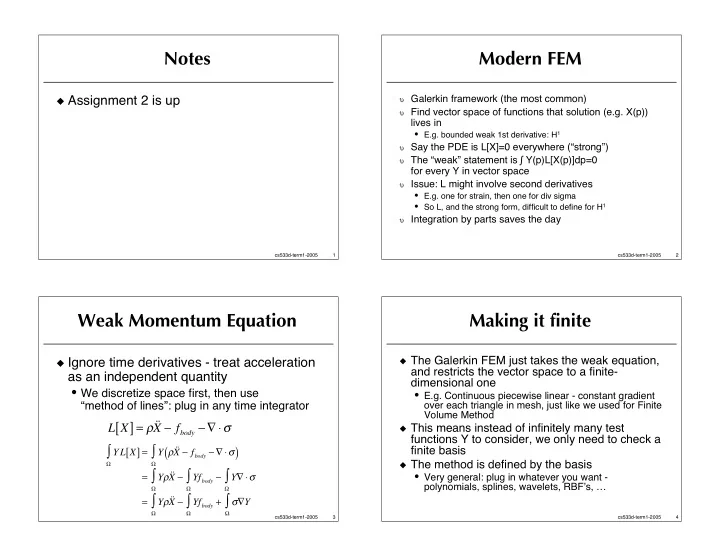
Galerkin framework (the most common) Find vector space of functions that solution (e.g. X(p))

lives in

  • E.g. bounded weak 1st derivative: H1

Say the PDE is L[X]=0 everywhere (“strong”) The “weak” statement is Y(p)L[X(p)]dp=0

for every Y in vector space

Issue: L might involve second derivatives

  • E.g. one for strain, then one for div sigma
  • So L, and the strong form, difficult to define for H1

Integration by parts saves the day

3 cs533d-term1-2005

Weak Momentum Equation

Ignore time derivatives - treat acceleration

as an independent quantity

  • We discretize space first, then use

“method of lines”: plug in any time integrator

L X

[ ] = ˙

˙ X fbody

Y L X

[ ]

  • =

Y ˙ ˙ X fbody

( )

  • =

Y˙ ˙ X

  • Yfbody
  • Y
  • =

Y˙ ˙ X

  • Yfbody
  • +

Y

  • 4

cs533d-term1-2005

Making it finite

The Galerkin FEM just takes the weak equation,

and restricts the vector space to a finite- dimensional one

  • E.g. Continuous piecewise linear - constant gradient
  • ver each triangle in mesh, just like we used for Finite

Volume Method

This means instead of infinitely many test

functions Y to consider, we only need to check a finite basis

The method is defined by the basis

  • Very general: plug in whatever you want -

polynomials, splines, wavelets, RBFs, …

slide-2
SLIDE 2

5 cs533d-term1-2005

Linear Triangle Elements

Simplest choice Take basis {i} where

i(p)=1 at pi and 0 at all the other pjs

  • Its a “hat” function

Then X(p)=i xii(p) is the continuous piecewise linear

function that interpolates particle positions

Similarly interpolate velocity and acceleration Plug this choice of X and an arbitrary Y= j (for any j) into

the weak form of the equation

Get a system of equations (3 eq. for each j)

6 cs533d-term1-2005

The equations

j ˙ ˙ x

ii i

  • j fbody
  • +

j

  • = 0

ji˙ ˙ x

i

  • i
  • =

j fbody

  • j
  • Note that j is zero on all but the triangles

surrounding j, so integrals simplify

  • Also: naturally split integration into separate

triangles

7 cs533d-term1-2005

Change in momentum term

Let Then the first term is just Let M=[mij]: then first term is M is called the mass matrix

  • Obviously symmetric (actually SPD)
  • Not diagonal!

Note that once we have the forces (the other

integrals), we need to invert M to get accelerations mij = i j

  • m ji˙

˙ x

i i

˙ x

8 cs533d-term1-2005

Body force term

Usually just gravity: fbody=g Rather than do the integral with density all over

again, use the fact that I sum to 1

  • They form a “partition of unity”
  • They represent constant functions exactly - just about

necessary for convergence

Then body force term is gM1 More specifically, can just add g to the

accelerations; dont bother with integrals or mass matrix at all

slide-3
SLIDE 3

9 cs533d-term1-2005

Stress term

Calculate constant strain and strain rate (so

constant stress) for each triangle separately

Note j is constant too So just take j times triangle area [derive what j is] Magic: exact same as FVM!

  • In fact, proof of convergence of FVM is often (in other

settings too) proved by showing its equivalent or close to some kind of FEM

10 cs533d-term1-2005

The algorithm

Loop over triangles

  • Loop over corners
  • Compute integral terms
  • nly need to compute M once though - its constant
  • End up with row of M and a “force”

Solve Ma=f Plug this a into time integration scheme

11 cs533d-term1-2005

Lumped Mass

Inverting mass matrix unsatisfactory

  • For particles and FVM, each particle had a mass, so

we just did a division

  • Here mass is spread out, need to do a big linear solve
  • even for explicit time stepping

Idea of lumping: replace M with the “lumped

mass matrix”

  • A diagonal matrix with the same row sums
  • Inverting diagonal matrix is just divisions - so diagonal

entries of lumped mass matrix are the particle masses

  • Equivalent to FVM with centroid-based volumes

12 cs533d-term1-2005

Consistent vs. Lumped

Original mass matrix called “consistent” Turns out its strongly diagonal dominant (fairly

easy to solve)

Multiplying by mass matrix = smoothing Inverting mass matrix = sharpening Rule of thumb:

  • Implicit time stepping - use consistent M

(counteract over-smoothing, solving system anyways)

  • Explicit time stepping - use lumped M

(avoid solving systems, dont need extra sharpening)

slide-4
SLIDE 4

13 cs533d-term1-2005

Locking

Simple linear basis actually has a major problem:

locking

  • But graphics people still use them all the time…

Notion of numerical stiffness

  • Instead of thinking of numerical method as just getting

an approximate solution to a real problem,

  • Think of numerical method as exactly solving a

problem thats nearby

  • For elasticity, were exactly solving the equations for a

material with slightly different (and not quite homogeneous/isotropic) stiffness

Locking comes up when numerical stiffness is

MUCH higher than real stiffness

14 cs533d-term1-2005

Locking and linear elements

Look at nearly incompressible materials Can a linear triangle mesh deform incompressibly?

  • [derive problem]

Then linear elements will resist far too much: numerical

stiffness much too high

Numerical material “locks” FEM isnt really a black box! Solutions:

  • Dont do incompressibility
  • Use other sorts of elements (quads, higher order)

15 cs533d-term1-2005

Quadrature

Formulas for linear triangle elements and constant

density simple to work out

Formulas for subdivision surfaces (or high-order

polynomials, or splines, or wavelets…) and varying density are NASTY

Instead use “quadrature”

  • I.e. numerical approximation to integrals

Generalizations of midpoint rule

  • E.g. Gaussian quadrature (for intervals, triangles, tets) or tensor

products (for quads, hexes)

Make sure to match order of accuracy [or not]

16 cs533d-term1-2005

Accuracy

At least for SPD linear problems (e.g.

linear elasticity) FEM selects function from finite space that is “closest” to solution

  • Measured in a least-squares, energy-norm

sense

Thus its all about how well you can

approximate functions with the finite space you chose

  • Linear or bilinear elements: O(h2)
  • Higher order polynomials, splines, etc.: better
slide-5
SLIDE 5

17 cs533d-term1-2005

Hyper-elasticity

Another common way to look at elasticity

  • Useful for handling weird nonlinear compressibility laws, for

reduced dimension models, and more

Instead of defining stress, define an elastic potential

energy

  • Strain energy density W=W(A)
  • W=0 for no deformation, W>0 for deformation
  • Total potential energy is integral of W over object

This is called hyper-elasticity or Green elasticity For most (the ones that make sense)

stress-strain relationships can define W

  • E.g. linear relationship: W=:=trace(T)

18 cs533d-term1-2005

Variational Derivatives

Force is the negative gradient of potential

  • Just like gravity

What does this mean for a continuum?

  • W=W(X/p), how do you do -d/dX?

Variational derivative:

  • So variational derivative is
  • •W/A
  • And f=•W/A
  • Then stress is W/A

Easy way to do reduced

dimensional objects (cloth etc.)

Wtotal X + Y

[ ] =

W X p + Y p

  • W X

p

  • + W

A Y p

  • = Wtotal +

W A Y p

  • = Wtotal

Y W A

  • 19

cs533d-term1-2005

Numerics

Simpler approach: find discrete Wtotal as a sum

  • f Ws for each element
  • Evaluate just like FEM, or any way you want

Take gradient w.r.t. positions {xi}

  • Ends up being a Galerkin method

Also note that an implicit method might need

Jacobian = negative Hessian of energy

  • Must be symmetric, and at least near stable

configurations must be negative definite