Non-magnet detectors XVI International Symposium on Very High - - PowerPoint PPT Presentation

non magnet detectors
SMART_READER_LITE
LIVE PREVIEW

Non-magnet detectors XVI International Symposium on Very High - - PowerPoint PPT Presentation

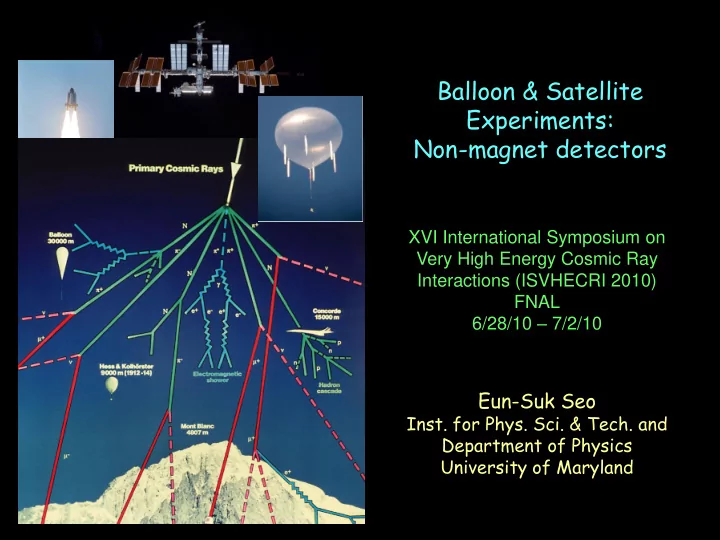
Balloon & Satellite Experiments: Non-magnet detectors XVI International Symposium on Very High Energy Cosmic Ray Interactions (ISVHECRI 2010) FNAL 6/28/10 7/2/10 Eun-Suk Seo Inst. for Phys. Sci. & Tech. and Department of Physics


slide-1
SLIDE 1

Balloon & Satellite Experiments: Non-magnet detectors

Eun-Suk Seo

  • Inst. for Phys. Sci. & Tech. and

Department of Physics University of Maryland XVI International Symposium on Very High Energy Cosmic Ray Interactions (ISVHECRI 2010) FNAL 6/28/10 – 7/2/10

slide-2
SLIDE 2

CREAM SOURCES SNRs, shocks Superbubbles photon emission acceleration

Interstellar medium X, 

e-

P He C, N, O etc. Z = 1- 92

e-

 gas P He C, N, O etc. gas

p

Halo Disk: sources, gas

escape

B Be

10Be

Synchrotron

Inverse Compton Bremstrahlung

e+e-

Chandra CGRO Voyager ACE AMS BESS

Energy losses Reacceleration Diffusion Convection

ATIC

B 

Exotic Sources: Antimatter Dark matter etc.. Fermi

slide-3
SLIDE 3

Balloons & Satellites Eun-Suk Seo 4

BESS ATIC CREAM, TRACER

ground based

AMS

How do cosmic accelerators work?

ANITA

  • Relative abundances range
  • ver 11 orders of magnitude
  • Detailed composition limited

to less than ~ 10 GeV/nucleon

Elemental Charge

slide-4
SLIDE 4

Balloons & Satellites Eun-Suk Seo 5

  • Beam measurements for

150 GeV electrons show 91% containment of incident energy, with a resolution of 2% at 150 GeV

  • Proton containment ~38%

Beam test: electrons

Advanced Thin Ionization Calorimeter (ATIC)

Seo et al. Adv. in Space Res., 19 (5), 711, 1997; Ganel et al. NIM A, 552(3), 409, 2005 Flight Data

slide-5
SLIDE 5

Balloons & Satellites Eun-Suk Seo 6

Electron Selection

proton electron gamma

  • Remove heavy ions with ZSi ≥ 2 and -ray with ZSi = 0
  • Separate e from p using shower profile in the calorimeter
  • Electron and gamma-ray showers are narrower than the proton showers

Ed ~ 250 GeV

Reject all but 1 in 5000 protons while keeping 84% of the electrons

slide-6
SLIDE 6
  • Possible candidate local sources would include supernova remnants (SNR), pulsar

wind nebulae (PWN) and micro-quasars

The ATIC Electron Results Exhibits a “Feature”

 ATIC 1+2,  AMS,  HEAT  BETS,  PPB-BETS,  Emulsion chambers

Chang et al., Nature, 456, 362, 2008

Balloons & Satellites 7 Eun-Suk Seo

Profuma (arXiv: 0812.4457v1), 2008

  • High energy electrons have a high energy loss rate  E2

– Lifetime of ~105 years for >1 TeV electrons

  • Transport of GCR through interstellar space is a diffusive process

– Implies that source of electrons is < 1 kpc away ) ] [ 10 5 . 2 (

1 5

years TeV E T

   ) ] [ 600 ( pc TeV E R  Cited > 200 times in ~ 9 mo

slide-7
SLIDE 7

Or, a Message From the Dark Side?

Balloons & Satellites 8 Eun-Suk Seo Chang et al., Nature, 456, 362, 2008 620 GeV Kaluza-Klein particle boosting factor 230

Cholis et al. (arXiv: 0811.3641v1), 2008

  • DM annihilation to light boson  e+e-
  • An intermediate light boson represses

production of anti-protons.

  • Reasonable fit to PAMELA, ATIC & WMAP

with particle mass of ~1 TeV and similar “boost factors”.

  • Also predicts enhancement of GC gammas
slide-8
SLIDE 8

LAT

  • Highly granular multi-layer Si

stripTracker (1.5 X0)

  • Finely segmented fully active

CsI Calorimeter (8.6 X0 )

  • Highly efficient hermetic Anti-

Coincidence Detector (ACD)

Balloons & Satellites Eun-Suk Seo 9

2008.06.11

e

+

e– 

Calorimeter Tracker ACD

Abdo, A. A. et al., PRL 102, 181101, 2009 Latronico, Fermi Symposium, 2009

Cited > 150 times in ~ 1 yr

slide-9
SLIDE 9

10

Calorimetric Electron Telescope (CALET)

Silicon Pixel Array (Charge Z=1-35)

Silicon Pixel 11.25 mm x 11.25 mm x 0.5mm 2 Layers with a coverage of 54 x 54 cm2

Imaging Calorimeter (Particle ID, Direction)

Total Thickness of Tungsten (W) : 3 X0 Layer Number of Scifi Belts: 8 Layers ×2(X,Y)

Total Absorption Calorimeter (Energy Measurement, Particle ID)

PWO 20 mm x 20 mm x 320 mm Total Depth of PWO: 27 X0 (24 cm)

SIA

120

TASC

TASC-FEC PD

IMC

20 156.5 240 320 712 100

IMC-FEC

MAPMT

32 95

SIA Electronics

448 540

SIA

120

SIA

120

TASC

TASC-FEC PD

IMC

20 156.5 240 320 712 100

IMC-FEC

MAPMT

32 95

SIA Electronics

448 540

TASC

TASC-FEC PD

IMC

20 156.5 240 320 712 100

IMC-FEC

MAPMT

32 95

IMC-FEC

MAPMT

32 95

SIA Electronics

448 540

Balloons & Satellites Eun-Suk Seo

Approved for Phase B: launch target summer, 2013

slide-10
SLIDE 10

Cosmic Ray Electron-Synchrotron Telescope (CREST)

  • CREST identifies UHE electrons by observing the characteristic linear trail of

synchrotron gamma rays generated as the electron passes through the Earth’s magnetic field

  • This results in effective detector area much larger than the physical instrument size
  • CREST expected to fly as Antarctic LDB payload in the 2010-2011 season
  • Upgrade of CREST for ULDB operation would be straightforward

Expected result: 100-day CREST exposure CREST Detector – A 2 x 2 m array of 1600 1” diameter BF2 crystals.

Balloons & Satellites 11 Eun-Suk Seo

slide-11
SLIDE 11

Balloons & Satellites Eun-Suk Seo

SNR acceleration limit:

ΤeV Ζ ZeBVT c v E 100 ~ ~

max

Ankle Knee

  • The all particle spectrum extends

several orders of magnitude beyond the highest energies thought possible for supernova shocks

  • And, there is a “knee” (index

change) above 1015 eV

  • Acceleration limit signature:

Characteristic elemental composition change over two decades in energy below and approaching the knee

  • Direct measurements of individual

elemental spectra can test the supernova acceleration model

12

Is the “knee” due to a limit in SNR acceleration?

slide-12
SLIDE 12

Balloons & Satellites

13

Cherenkov dE/dx TRD

LORENTZ FACTOR γ SIGNAL (arb. units) ENERGY RESPONSE: Acrylic Cherenkov Counter (γ < 10) Specific Ionization in Gas (4 < γ < 1000) Transition Radiation Detector (γ > 400)

Transition Radiation Array for Cosmic Energetic Radiation (TRACER)

2 m 1.2 m

  • 2003 ANTARCTICA 14 days

OXYGEN (Z=8) to IRON (Z=26)

  • 2006 SWEDENCANADA 4.5 days

BORON (Z=5) to IRON (Z=26)

Eun-Suk Seo 13

slide-13
SLIDE 13

Cosmic Ray Energetics And Mass (CREAM)

Seo et al. Adv. in Space Res., 33 (10), 1777, 2004; Ahn et al., NIM A, 579, 1034, 2007

  • Transition Radiation Detector (TRD) and

Tungsten Scintillating Fiber Calorimeter

  • In-flight cross-calibration of energy scales for Z > He
  • Complementary Charge Measurements
  • Timing-Based Charge Detector
  • Cherenkov Counter
  • Pixelated Silicon Charge Detector
  • CREAM uses two designs
  • With and without the TRD
  • This exploded view shows the “With TRD” design
  • The “Without TRD” design uses Cherenkov Camera

Balloons & Satellites 14 Eun-Suk Seo

slide-14
SLIDE 14

CREAM-I 12/16/04 – 1/27/05 42 days

Five successful Flights: ~ 156 days cumulative exposure

CREAM-IV 12/19/08 – 1/7/09 19 days 13 hrs

Many thanks to CSBF, WFF, NSF & RPSC for a great campaign!

Balloons & Satellites Eun-Suk Seo

CREAM-III 12/19/07-1/17/08 29 days CREAM-II 12/16/05-1/13/06 28 days

15

CREAM-V 12/1/09 – 1/8/10 37 days 10 hrs

slide-15
SLIDE 15

CREAM flight data: all particle counts

Balloons & Satellites Eun-Suk Seo 16

slide-16
SLIDE 16

Balloons & Satellites Eun-Suk Seo 17

Elemental Spectra over 4 decades in energy

Ahn et al., ApJ 707, 593, 2009

slide-17
SLIDE 17

Balloons & Satellites Eun-Suk Seo 18

Cosmic Ray Propagation

Consider propagation of CR in the interstellar medium with random hydromagnetic waves.

Steady State Transport Eq.:

The momentum distribution function f is normalized as where N is CR number density, D: spatial diffusion coefficient, : cross section… Cosmic ray intensity Escape length Xe Reacceleration parameter 

  • E. S. Seo and V. S. Ptuskin, Astrophys. J., 431, 705-714, 1994.

 

k j k jk j j ion j j j e j

I m Q I dx dE dE d I m X I

                      

,

...

                             

j k jk j j ion j j j j j j

S q f dt dp p p p p f K p p p f v m z f D z

, 2 2 2 2

1 1  

f p dp N  

2

) ( ) (

2

p f p A E I

j j j

slide-18
SLIDE 18

Balloons & Satellites Eun-Suk Seo

  • Measurements of the relative

abundances of secondary cosmic rays (e.g., B/C) in addition to the energy spectra

  • f primary nuclei will allow

determination of cosmic-ray source spectra at energies where measurements are not currently available

  • First B/C ratio at these high

energies to distinguish among the propagation models

What is the history of cosmic rays in the Galaxy?

Ahn et al. (CREAM collaboration) Astropart. Phys., 30/3, 133-141, 2008

 

 R Xe

Reaccleration Model

20

slide-19
SLIDE 19

P & He: prior to CREAM

Balloons & Satellites Eun-Suk Seo 23

 

 E I j

AMS P = 2.78 ± 0.009 He = 2.74 ± 0.01 JACEE P = 2.80 ± 0.04 He = 2.68+0.04-0.06 RUNJOB P = 2.78 ± 0.05 (2.74 ± 0.08) He = 2.81 ± 0.06 (2.78 ± 0.2)

slide-20
SLIDE 20

P & He: prior to CREAM

Balloons & Satellites Eun-Suk Seo 24

ATIC2 P = 2.63 ± 0.01 He = 2.58 ± 0.01

 

 E I j

AMS P = 2.78 ± 0.009 He = 2.74 ± 0.01 JACEE P = 2.80 ± 0.04 He = 2.68+0.04-0.06 RUNJOB P = 2.78 ± 0.05 (2.74 ± 0.08) He = 2.81 ± 0.06 (2.78 ± 0.2)

slide-21
SLIDE 21

Balloons & Satellites Eun-Suk Seo 26

CREAM: p & He spectra are not the same

CREAM-1 P = 2.66 ± 0.02 He = 2.58 ± 0.02

Our fluxes are significantly higher than the extrapolation of a single-power law fit to the low energy spectra Different types of sources or acceleration mechanisms? (e.g., Biermann, P. L. A&A 271, 649,1993)

Ahn et al. (CREAM collaboration), ApJ 714, L89, 2010

slide-22
SLIDE 22

Balloons & Satellites Eun-Suk Seo 27

TeV spectra are harder than spectra < 200 GeV/n

AMS P = 2.78 ± 0.009 He = 2.74 ± 0.01 CREAM-1 P = 2.66 ± 0.02 He = 2.58 ± 0.02

Ahn et al. (CREAM collaboration), ApJ 714, L89, 2010

slide-23
SLIDE 23

Balloons & Satellites Eun-Suk Seo 29

Discrepant hardening

slide-24
SLIDE 24

Not a single power law

Balloons & Satellites Eun-Suk Seo 30

 < 200 GeV/n = 2.77 ± 0.03  > 200 GeV/n = 2.56 ± 0.04

  • Effect of a non-uniform

distribution of sources?

(Erlykin & Wolfendale A&A 350, L1,1999)

  • Younger sources would

dominate the high-energy spectra (Taillet et al. ApJ 609,

173, 2004)

  • Effect of distributed

acceleration by multiple remnants?

(Medina-Tanco & Opher ApJ 411, 690, 1993)

  • Superbubbles?

(Butt & Bykov, ApJ 677, L21, 2008)

  • Departure from a single power

law caused by cosmic ray interactions with the shock?

(e.g., Ellison et al. ApJ 540, 292, 2000)

CREAM C-Fe He CREAM = 2.58 ± 0.02 AMS = 2.74 ± 0.01 Ahn et al. ApJ 714, L89, 2010

slide-25
SLIDE 25

Results & Implications

Spectral difference between p and He

– Are there different types of sources or acceleration mechanisms? (Biermann, A&A 271, 649,1993; Biermann et al. PRL 103, 061101, 2009; ApJ 710, L53, 2010)

Flattening of elemental spectra at high energies

– Are the source spectra harder than previously thought, based on the low energy data? – Evidence for concavity due to cosmic ray interactions with the shock? (Ellison et al. ApJ 540, 292,2000; Allen et al. ApJ 683/2,773, 2008). – If not an effect of acceleration or propagation, and if the conventional model is valid, are we seeing a local source of hadrons? – Effect of a non-uniform distribution of sources? (Erlykin & Wolfendale A&A 350, L1,1999;Taillet et al. ApJ 609, 173, 2004) – Effect of distributed acceleration by multiple remnants (Medina-Tanco & Opher ApJ 411, 690, 1993)

  • Superbubbles? (Butt & Bykov, ApJ 677, L21, 2008)

– Related to 10 TeV anisotropy reported by Milagro? (Abdo et al. PRL, 101, 221101, 2008)

Balloons & Satellites Eun-Suk Seo 31

slide-26
SLIDE 26

Trans-Iron Galactic Element Recorder (TIGER)

Ultra heavy nuclei, clues to nucleosynthesis and origin of galactic CRs

  • TIGER was a 1 m2 electronic instrument to measure the elemental composition of the

rare galactic cosmic rays heavier than iron – Obtained best measurement to date of abundances of 31Ga, 32Ge, & 34Se.

  • Two balloon flights over Antarctica totaling 50 days at float

– Dec. 2001 – Jan. 2002, 32 day flight; Dec. 2003 – Jan. 2004, 18 day flight – TIGER data recovered, but instrument only partially recovered in Jan. 2006

Combined results from both flights 50 days of data Fe Ni Zn Ga GeSe Sr Ga is well resolved from Zn, despite ratio ~ 10:1 Fe/Co & Ni/Cu ~ 100:1

Balloons & Satellites 32 Eun-Suk Seo

slide-27
SLIDE 27

~A2/3 ~A1

10 20 30 40 50 60 70 80 90100 0.1 1

Volatile Refractory

GCRS/(80% SS+20% MSO) Atomic Mass

Mg Al Si P Ca Fe Co Ni Sr N Ne S Ar Cu Zn Ga Ge Se

Refractories Volatiles

6.9.10_Figure_for_MHI/TIG_GCRS_vs_80-20mix_rev2

Origin of Cosmic Rays

  • Elements present in interstellar grains are accelerated

preferentially compared with those found in interstellar gas

  • Data are consistent with the idea of CR origin in OB associations

Balloons & Satellites Eun-Suk Seo (Grains) (Gas) 33

Rauch et al., ApJ 697, 2083, 2009

slide-28
SLIDE 28

~A2/3 ~A1

10 20 30 40 50 60 70 80 90100 0.1 1

Volatile Refractory

GCRS/(80% SS+20% MSO) Atomic Mass

Mg Al Si P Ca Fe Co Ni Sr N Ne S Ar Cu Zn Ga Ge Se

Refractories Volatiles

6.9.10_Figure_for_MHI/TIG_GCRS_vs_80-20mix_rev2

Origin of Cosmic Rays

  • Elements present in interstellar grains are accelerated

preferentially compared with those found in interstellar gas

  • Data are consistent with the idea of CR origin in OB associations

Balloons & Satellites Eun-Suk Seo

Ahn et al., ApJ, 715, 1400, 2010

(Grains) (Gas) 34

Rauch et al., ApJ 697, 2083, 2009

slide-29
SLIDE 29

First LDB flight planned for December 2012.

2.3 m 1.15 m

Super-TIGER balloon mission & OASIS study

  • OASIS: Being studied as a medium class

NASA Astrophysics Strategic Mission in the US

  • ENTICE: With three years in polar orbit

would detect at least 100 cosmic-ray actinides.

ULDB Super-TIGER mission: measure individual element abundances up to Barium (Z=56) with high precision, even Pt to Pb with ~20% precision

Balloons & Satellites 35 Eun-Suk Seo Orbiting Astrophysical Spectrometer in Space (OASIS)

slide-30
SLIDE 30

All Particle Spectrum

Balloons & Satellites 37 Eun-Suk Seo

slide-31
SLIDE 31

38

Antarctic Impulsive Transient Antenna (ANITA)

Ultra-High Energy Particle Astrophysics

ANITA-2 (2008-2009) limits 2010: currently world’s best in UHE range; several mainstream cosmogenic neutrino models are now eliminated at >90%CL; several models predict 2-3 events.

ANITA-3 plans:

  • Improve sensitivity by x3 with better

hardware trigger, more antennas

  • Optimize for both UHECRs &

neutrinos

  • ~350-500 UHECR events

expected

  • Try for up to 60 days of flight

exposure, 5-10 neutrino events? ANITA-1 (2006- 2007) detected UHECRs via geosynchrotron radio impulse detection arXiv:1005.0035v2 [astro-ph.HE]

Balloons & Satellites Eun-Suk Seo

slide-32
SLIDE 32

Balloons & Satellites Eun-Suk Seo 39

A step closer to ULDB

Successful SPB Test Flight 54 days 7 MCF At Float

(12/28/08 – 2/20/09) The super pressure balloon’s altitude stability CREAM-IV SPB ANITA-II

slide-33
SLIDE 33

Balloons & Satellites Eun-Suk Seo 40

Acknowledgment