No Warning Shot April 3 rd 2014 Nick Sanders Tech 435 Dr. Earl - - PDF document

no warning shot
SMART_READER_LITE
LIVE PREVIEW

No Warning Shot April 3 rd 2014 Nick Sanders Tech 435 Dr. Earl - - PDF document

4/30/2014 No Warning Shot April 3 rd 2014 Nick Sanders Tech 435 Dr. Earl Hansen The Presenter Nick Sanders Graduating Senior from Northern Illinois University Bachelors in Industrial Management & Technology, Emphasis


slide-1
SLIDE 1

4/30/2014 1

April 3rd 2014 Nick Sanders Tech 435

  • Dr. Earl Hansen

No Warning Shot The Presenter

Nick Sanders

 Graduating Senior from Northern Illinois University  Bachelors in Industrial Management & Technology, Emphasis

Environmental Health and Safety

 Double Minor, Safety & Productivity

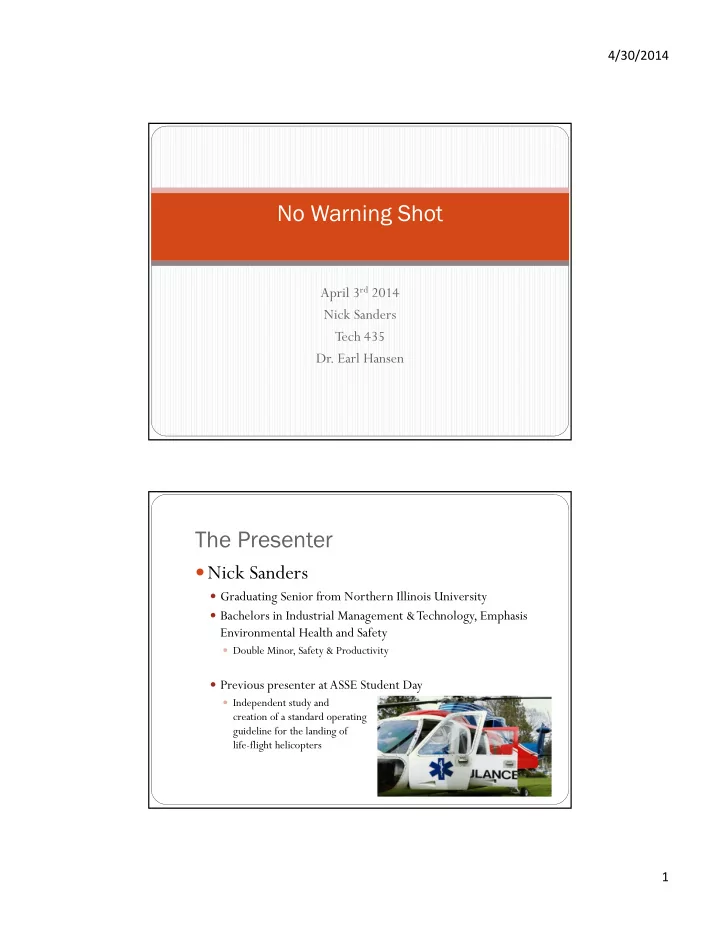
 Previous presenter at ASSE Student Day

 Independent study and

creation of a standard operating guideline for the landing of life-flight helicopters

slide-2
SLIDE 2

4/30/2014 2

Case Overview

 Johnson v. Colt Industries

 Product liability

 In 1973 somewhere in Kansas Mr. Johnson is legally carrying his

pistol in a holster while fishing.

 Mr. Johnson was shot in the buttocks by his gun, a Colt Single

Action .22, after it fell from his holster striking a rock while in the hammer down position

 (negligent discharge or ND)

 Mr. Johnson sued for damages physical and psychological

http://openjurist.org/797/f2d/1530/johnson-v-colt-industries-operating-corporation

Why This Case?

 Breadth

 Several layers of responsibility are at play  Mr. Johnson, Colt, the gun store  Several distinct and different torts were claimed

 Failure to warn, negligence  Product defect in design, manufacturing, and marketing

 Depth

 Colt Industries is an iconic, cultural landmark in American History –

associated with the Wild West, cowboys, six-shooters, etc

 The case would later show that the company had known about the defective

products from it’s inception until the then-current day of the lawsuit 130+ years
slide-3
SLIDE 3

4/30/2014 3

What is a “hammer”?

 The hammer is the portion of

the gun which strikes the bullet, causing it to fire

 In a single action model, the

hammer must be manually cocked back to fire, before the trigger can be pulled – Mr. Johnson’s hammer was not pulled back

 2 hammer positions: safe and

ready to fire

http://neaca.com/images/Colt_SAA_45LC_343642_1922_12_.JPG

http://s cience.h

  • wstuff

works.c

  • m/rev
  • lver2.h

tm

Hammer Positions

 The hammer can only be in two positions:  Forward, or safe  Rear / cocked, or ready to fire

http://www.cowanauctions.com/item Images/w9894.jpg http://p2.la- img.com/446/34854/14296502_1_l.jpg

slide-4
SLIDE 4

4/30/2014 4

Why is this case different?

 Johnson v. Colt Industries intersects several unique

  • ccurrences and concepts in American culture and law

 Iconic company  Existing patents and knowledge  Multiple similar incidents  Several different tort claims  Very high human cost of error  Very large damages sought  Multiple defendants in the tort  Incredible feats of human “stupidity”

Call the Lawyers

 Mr. Johnson sued Colt under the Kansas tort of product

liability and negligence, claiming they were responsible for damages to his person

 Defective design  Defective manufacturing  Defective product  Negligence

 Colt argued that they owed zilch

slide-5
SLIDE 5

4/30/2014 5

The Crux of the Issue

 Neither side questioned the basic facts of the incident, or the

level of damage suffered by Mr. Johnson

 The case revolved entirely around this question:

Who is responsible for Mr. Johnson’s damages?

 Colt argued the onus should be on the user, while Johnson

argued that Colt recklessly did not hold up their end of the bargain with respect to dangers of the product

Johnson Opens

 Among the key points of Mr. Johnson’s arguments:

 The gun was in the safe position as instructed by the manual  The trigger was not affected by the drop  This is a danger not expressed to Mr. Johnson by either the gun

store or Colt

 Thus, the gun is “unreasonably dangerous” and Colt is

responsible for their failure to act or warn Mr. Johnson

slide-6
SLIDE 6

4/30/2014 6

Colt Responds

 Colt’s defense centered around:

 The instructions said to leave an empty chamber under the

hammer (only load 5 rounds)

 Mr. Johnson should have been more careful  Their duty was fulfilled by the above two arguments

 Argued the consumers duty > their duty to warn / act

 ………that’s it!

Colt Takes a Broadside

 Colt is exposed handily during opening

arguments

 Johnson’s lawyers get Colt’s Chief Engineer to admit

having prior knowledge of related incidents

 Johnson’s team introduces a patent filed in 1850 in

Samuel Colt’s name,

 Patent is for a mechanical stop (i.e. integrated guard) to

prevent this hazard in an earlier model gun  Johnson introduces also evidence showing the

cultural impact of the weapon, including the Wild West and the term “6-shooter”

 Owners manual is found to have conflicting

information regarding loading ammo

http://images.fineartamerica.com/images-medium-large/1- samuel-colt-1814-1862-granger.jpg

slide-7
SLIDE 7

4/30/2014 7

A Point of Contention

 During the case the judge provided instructions to the jury

regarding both the duties of the manufacturer and user of dangerous objects per prior caselaw

 “A manufacturer of firearms has the duty to exercise the highest

degree of care in the design of the product so that it will be reasonably safe…failure to fulfill this duty constitutes negligence.”

 "One who has in his possession, or under his control, an

instrumentality exceptionally dangerous in character is bound to take exceptional precautions to prevent an injury being done by the instrumentality. The degree of care must be equal to the degree of danger involved."

(1)http://openjurist.org/797/f2d/1530/johnson-v-colt-industries-operating-corporation

On the Division of Duties

 Colt had argued that their “highest degree of care” was

superceded by Johnson’s “degree of care equal to the danger”

 Colt also argued that the degree of care Johnson must take

per jury instruction is not stringent enough

 The court did not agree (surprise)

slide-8
SLIDE 8

4/30/2014 8

Judges do not suffer shenangins

 My favorite passage from the ruling, Judges Mckay, Seth and

Timbers write:

 “We are at somewhat of a loss to understand appellant's problem with

the instruction. The court obviously placed an "exceptional" duty of care on appellee. We cannot envision a more exacting duty of care short of presumed contributory negligence. Appellant's semantic argument borders on the frivolous.”  In the conclusion of the ruling, Colt is noted for their all-or-

nothing legal style throughout the court battle

The Decision is In

 Finding in favor of Johnson  The court divides liability for the incident as follows:

 Colt: 85% Liable  The gun store: 10% Liable  Mr. Johnson: 5% liable

 Mr. Johnson receieved $500,000 in compensatory damages, as did

his wife.

 Reduced to $850,00 total to reflect Colt’s liability

 Mr. Johnson also receieved $1.25 million in punitive damages

slide-9
SLIDE 9

4/30/2014 9

Today’s Impact

 Today Colt continues to manufacture weapons in the United

States and remains a popular choice for officers of all kinds

 Product liability cases against weapon manufacturers

continue in unrelated incidents

 Remington 700 cases

 With so much precedent and focus on gun safety in today’s

culture, any case which wins will be both a) rare and b) incredible in the dollar amount of damages

http://www.thespecialistsltd.com/files/Remington-Model-700-BDL.jpg

Bibliography

 http://openjurist.org/797/f2d/1530/johnson-v-colt-industries-operating-corporation  http://neaca.com/images/Colt_SAA_45LC_343642_1922_12_.JPG  http://science.howstuffworks.com/revolver2.htm  http://images.fineartamerica.com/images-medium-large/1-samuel-colt-1814-1862-

granger.jpg

 http://www.thespecialistsltd.com/files/Remington-Model-700-BDL.jpg