NO DISCLOSURES Fact and Fiction Richard A. Jacobs, M.D., PhD. - - PDF document

no disclosures
SMART_READER_LITE
LIVE PREVIEW

NO DISCLOSURES Fact and Fiction Richard A. Jacobs, M.D., PhD. - - PDF document

3/15/18 Lyme Disease NO DISCLOSURES Fact and Fiction Richard A. Jacobs, M.D., PhD. Willie Burgdorfer, Ph.D. (1925-2014) RM Lab in Hamilton, MT Polly Murray who first reported an outbreak of arthritis in 12 children from Old Lyme, CT in


slide-1
SLIDE 1

3/15/18 1

Lyme Disease Fact and Fiction

Richard A. Jacobs, M.D., PhD.

NO DISCLOSURES

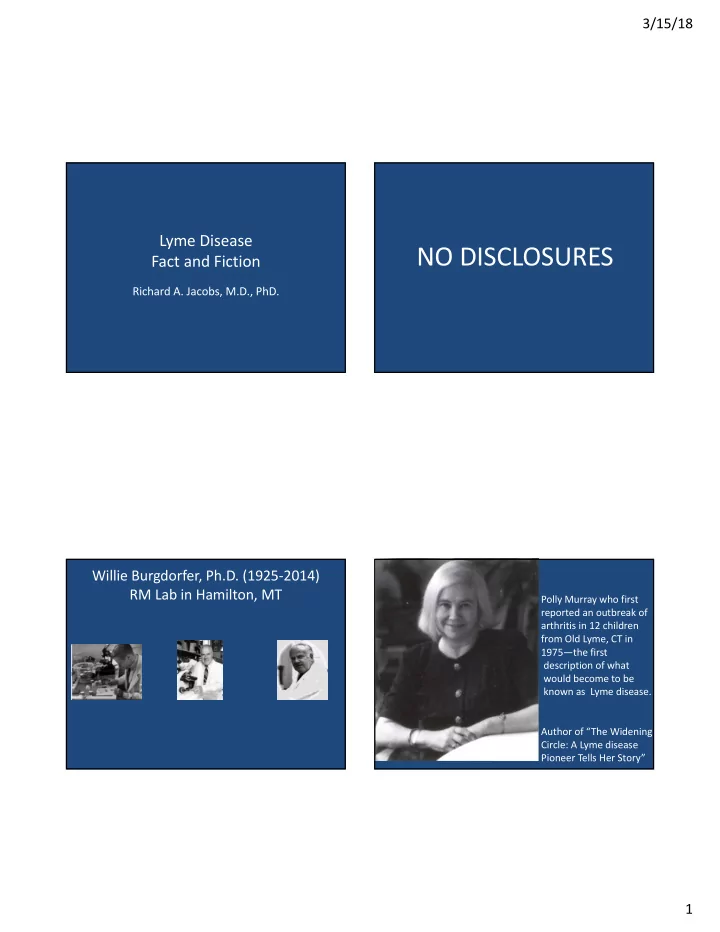
Willie Burgdorfer, Ph.D. (1925-2014) RM Lab in Hamilton, MT

Polly Murray who first reported an outbreak of arthritis in 12 children from Old Lyme, CT in 1975—the first description of what would become to be known as Lyme disease. Author of “The Widening Circle: A Lyme disease Pioneer Tells Her Story”

slide-2
SLIDE 2

3/15/18 2

  • Dr. Allen Steere, who at the time

was a Rheumatology Fellow at Yale University, was sent to investigate the

  • utbreak of arthritis.

In 1977 published a paper on Lyme Arthritis. (Arthritis and Rheumatism 1977;20:7)

Outline

  • Clinical manifestations
  • Diagnosis
  • Therapy
  • Prevention
  • Controversies

Case

  • A 35 yo woman is being evaluated for a 6 month h/o

fatigue, arthalgias without arthritis and memory loss manifest as word-finding difficulties and

  • forgetfulness. The work-up has been thorough but

frustrating for both the provider and the patient because answers have not been forthcoming. Finally, after an exhaustive internet search, she requests that Lyme disease serologies be performed. The provider reluctantly agrees.

Case

  • Serologies

– CDC recommends 2-stage testing

  • Screening ELISA or IFA—very sensitive but not

specific –If negative—>no further testing –If positive/equivocal—>confirmatory test

  • Confirmatory Western blot

–IgM –IgG

slide-3
SLIDE 3

3/15/18 3

Case

  • Serologies return:

– Screening test is equivocal –Confirmatory Western blot is IgM (+) and IgG (-)

Questions

  • How do you interpret the serologies?
  • Does she have Lyme disease?

Definition

Lyme disease is a bacterial infection caused primarily by the spirochete Borrelia burgdorferi in the US ( less commonly by B. mayonii in the upper mid-West) and B. afzelii, and garinii in Europe and Asia (less commonly by B. burgdorferi and rarely by

  • B. speilmanii and B. bavariensis) and is transmitted

to humans by the bite of infected Ixodes ricinus complex deer tick. The clinical manifestations can be complex but affect primarily the skin, joints, nervous system and heart

“Tick Biology 101”

slide-4
SLIDE 4

3/15/18 4

“Tick Biology 101”

  • Hard ticks (over 700 species)

– Ixodes ricinus complex – Different geographic distributions

  • Northeastern and upper midwestern states

–Ixodes scapularis (also called Ixodes dammini)

  • Western states—Ixodes pacificus
  • Europe—Ixodes ricinus
  • Asia—Ixodes persulcatus
  • Soft ticks (over 150 species)

“Tick Biology 101” (continued)

  • Three stages:

– Larval—feeds from August to September on white-footed mouse – Nymphal★★--feeds from May through July on white-footed mouse – Adult—feeds on larger mammals, especially deer in the spring and fall ★★ Nymph primarily responsible for disease transmission Most clinical cases occur in the summer months

Tick Biology (continued) Tick Biology (continued)

slide-5
SLIDE 5

3/15/18 5

Tick Biology (continued) Engorged Tick Clinical Manifestations

  • Early Localized Disease

– Usually occurs 7-10 days after the bite – Range 3-30 days

  • Early Disseminated Disease

– Weeks to months after the bite

  • Late Disease

– Months to years after exposure

Early Localized Disease

  • Erythema Migrans

– Seen in 70%-80% of cases – Begins 7-10 days after the bite (3-30 day range) – Starts at the site of the the tick bite – Slowly expanding (over several days to weeks), flat

  • r slightly raised, erythematous rash that is often

described by patients as burning or itching or less commonly, painful – Clears spontaneously over weeks

slide-6
SLIDE 6

3/15/18 6

Central Clearing Bulls Eye Rash

slide-7
SLIDE 7

3/15/18 7

Early Localized Disease

  • Erythema Migrans

–Usually accompanied with

  • Nonspecific systemic symptoms

– Fatigue – Anorexia – HA – Myalgias – Fever

Early Localized Disease

  • Erythema Migrans

–Usually with

  • Nonspecific systemic symptoms

– Fatigue – Anorexia – HA – Myalgias – Fever

  • About 40% of patients have spirochetemia

“SUMMER FLU”

Early Disseminated Disease (weeks to months)

  • Cutaneous Manifestations

– EM at sites other than the original bite

  • Neurologic (15% of UNTREATED patients)

– Lymphocytic meningitis – Cranial nerve palsies (especially the facial nerve) – Radiculoneuritis

  • Heart (5% of UNTREATED patients)

– Atrioventricular block – Myocarditis (rarely)

Early Disseminated Cutaneous Disease

slide-8
SLIDE 8

3/15/18 8 Early Disseminated Cutaneous Disease Early Disseminated Cutaneous Disease Early Disseminated Disease (weeks to months)

  • Cutaneous Manifestations

– EM at sites other than the original bite

  • Neurologic (15% of UNTREATED patients)

– Lymphocytic meningitis – Cranial nerve palsies (especially the facial nerve) – Radiculoneuritis

  • Heart (5% of UNTREATED patients)

– Atrioventricular block – Myocarditis (rarely)

Late Disease (months to years)

– Arthritis (60% of UNTREATED patients)

  • Large weight bearing joints
  • Often recurrent (70%)

– Neurologic

  • Polyneuropathy
  • Encephalomyelits

– True infection of the neuroaxis – Very rare < 1/106 – More common with B. garinii

slide-9
SLIDE 9

3/15/18 9 Late Disease (months to years)

– Arthritis (60% of UNTREATED patients)

  • Large weight bearing joints
  • Often recurrent (70%)

– Neurologic

  • Polyneuropathy
  • Encephalomyelits

– True infection of the neuroaxis – Very rare < 1/106 – More common with B. garinii

Encephalopathy

  • Encephalopathy (memory difficulties/cognitive

slowing)

– Common problem in patients with inflammatory diseases – Common background complaint in the general population

  • THESE SYMPTOMS ARE NOT MANIFESTATIONS

OF CNS LYME DISEASE IN THE ABSENCE OF SEROLOGIC EVIDENCE OF EXPOSURE

Diagnosis

  • Early Disease

– Clinical Diagnosis – 2-tier testing only 25% sensitive because of slow rise in IgM antibodies (1-2 weeks) and IgG antibodies (2-6 weeks)

slide-10
SLIDE 10

3/15/18 10

Diagnosis

  • Late Stages

– CDC recommends 2-stage serologic testing

  • Screening ELISA or IFA—very sensitive but not

specific (syphilis, gingivitis, LYMErix, SLE, RA etc) –If negative—>no further testing –If positive/equivocal—>confirmatory test

  • Confirmatory Western blot

Diagnosis of Late Manifestations

(Steere AC et al. Clin Infect Dis 2008:47:188)

  • Sensitivity of 2-tier testing in late Lyme disease

is 100% and specificity is 99%

  • “Therefore, current thinking is that all patients

with objective neurologic, cardiac, or joint abnormalities associated with Lyme disease have serologic response (a + IgG western blot titer) to B. burgdorferi”

New Approaches to Serodiagnosis

  • V1sE C6 peptide ELISA (C6 test) —measures

antibodies to a protein-like sequence expressed in the sixth invariant region

– More sensitive in early disease than 2-stage testing – More sensitive for European strains

  • CDC, IDSA and AAN have yet to endorse the test

– Stand alone – Replace Western blot

Commonly Asked Questions

  • What is the explanation of an isolated positive

Western blot IgM?

– FALSE POSITIVE

  • Can you get Lyme disease more than once?

– Almost always re-infection – NOT relapse

  • Does Lyme disease in pregnancy affect the fetus?

– Does not predispose to congenital anomalies or fetal demise

slide-11
SLIDE 11

3/15/18 11

Clues to Diagnosis

  • EM occurs 3-30 days after bite--most commonly in 7-

10 days – Early reactions that fade are due to the tick bite and are not EM

  • Ticks must feed 24-36 hours to transmit organism
  • Know prevalence in your area

– East Coast 60-70% infected – West Coast < 5% infected

Clues to Diagnosis

  • EM occurs 3-30 days after bite--most commonly in 7-

10 days – Early reactions that fade are due to the tick bite and are not EM

  • Ticks must feed 24-36 hours to transmit organism
  • Know prevalence in your area

– East Coast 60-70% infected – West Coast < 5% infected

slide-12
SLIDE 12

3/15/18 12

slide-13
SLIDE 13

3/15/18 13

Prevention

  • Light colored protective clothing with shirt

tucked into pants and pants tucked into socks

  • DEET
  • Permethrin spray for clothes
  • Tick checks with prompt removal
  • Antibiotic prophylaxis—200 mg doxycycline

– Ixodes tick; fed for 36 hours; tick infection rate >20%; antibiotics given within 72 hours of tick removal

Proper Tick Removal Prevention

  • Light colored protective clothing with shirt

tucked into pants and pants tucked into socks

  • DEET
  • Permethrin spray for clothes
  • Tick checks with prompt removal
  • Antibiotic prophylaxis—200 mg doxycycline

– Ixodes tick; fed for 36 hours; tick infection rate >20%; antibiotics given within 72 hours of tick removal

Back to the Case

  • A 35 yo woman is being evaluated for a 6 month

h/o fatigue, arthalgias without arthritis and memory loss manifest as word-finding difficulties and forgetfulness.

  • Lab tests

– ELISA –equivocal – WB—positive IgM and negative IgG

  • NOTE—EXPLANATION OF AN ISOLATED (+)

Western blot IgM IS THAT IT IS A FALSE (+)

  • IN LATE STAGES OF DISEASE ALMOST ALL HAVE A

(+) IgG ANTIBODY TITER

slide-14
SLIDE 14

3/15/18 14 New Lyme-disease Borrelia spp Identified

  • Borrelia mayonii

– Found in the upper midwestern states – Transmitted by Ixodes scapularis tick

  • Only a few patients identified

– More nausea and vomiting – Higher temperatures – Diffuse rash – High grade spirochetemia

  • Detected by current 2-tier testing and C6 test
  • Responds to standard Lyme disease therapy

Lancet Infect Dis, Feb 5, 2016

Controversies in Lyme Disease Controversies in Lyme Disease

  • IDSA (Infectious Disease Society of America)
  • Alternate view of the disease

– LLMDs—Lyme literate physicians – ILADS—International Lyme and Associated Disease Society in US

  • Own set of guidelines
  • Supported by powerful patient advocacy groups

– European equivalents

  • German Borreliosis Society
  • Dutch Lyme Association

How Far Apart Are The Views?

  • IDSA

– Clinical Manifestations

  • Skin
  • Joints (arthritis)
  • Neurologic system
  • Heart
  • ILADS/LLMDs

– Clinical Manifestations

  • Fatigue
  • Low grade fever/hot flashes
  • Night sweats
  • Sore throat
  • Swollen glands
  • Stiff neck
  • Arthralgias/stiffness/less commonly arthritis
  • Myalgias
  • Chest pain/palpitations
  • Abdominal pain/nausea
  • Diarrhea
  • Sleep disturbance
  • Poor concentration and memory
  • Irritability and mood swings
  • Depression
  • Back pain
  • Blurred vision/eye pain
  • Jaw pain
  • Testicular/pelvic pain
  • Tinnitus
  • Vertigo
  • Dizziness/lightheadedness
  • Headaches
  • Cranial nerve disturbances
slide-15
SLIDE 15

3/15/18 15

How Far Apart Are The Views?

  • IDSA

– Diagnosis

  • 2-tier testing

– 1983 study using “crude” (early) assay 94% had a positive test – 2008 article by Steere 99% with late disease had positive test

  • ILADS/LLMDs

– Diagnosis

– Since there is no definitive test for Lyme disease, laboratory results should not be used to exclude an individual treatment – Lyme disease is a clinical diagnosis and tests should be used to support rather than supersede the physicians judgment – Diagnosis of Lyme by 2-tier confirmation fails to detect up to 90% of cases

How Far Apart Are The Views?

  • IDSA

– Therapy

  • Longest duration 28 days
  • May need to re-treat

some with persistent arthritis

  • ILADS/LLMDs

– Therapy

  • Rather than an arbitrary

30-day treatment course, the patients clinical response should guide duration of therapy

  • Combination and

sequential therapy that can last months

very

How Contentious Is It?

Lancet Infect Dis 2011;11:713-719

slide-16
SLIDE 16

3/15/18 16

Antiscience and Ethical Concerns

  • Antiscience groups and pseudoscientific

practitioners

  • Using unvalidated laboratory tests
  • Various specialty laboratories in CA and KS

that have been investigated and fined

  • List current and former ILADS officers

sanctioned by state medical boards or reprimanded by federal agencies

Unvalidated Laboratory Tests by “Specialty Laboratories”

  • Urine PCR for tick-borne pathogens

Unvalidated Laboratory Tests by “Specialty Laboratories”

  • Urine PCR for tick borne pathogens
  • 11 pathogens from a single patient

– B. burgdorferi, B. miyamotoi, B. recurrentis, A. phagocytophilum, B microti, B. divergens, B. duncani, B. bacilliformis, B. henselae, B. quintana and E. chaffeensis

Unvalidated Laboratory Tests by “Specialty Laboratories”

  • Urine PCR for tick borne pathogens
  • 11 pathogens from a single patient

– B. burgdorferi, B. miyamotoi, B. recurrentis, A. phagocytophilum, B microti, B. divergens, B. duncani, B. bacilliformis, B. henselae, B. quintana and E. chaffeensis

  • Current political climate these positive results
slide-17
SLIDE 17

3/15/18 17 Unvalidated Laboratory Tests by “Specialty Laboratories”

  • Urine PCR for tick borne pathogens
  • 11 pathogens from a single patient

– B. burgdorferi, B. miyamotoi, B. recurrentis, A. phagocytophilum, B microti, B. divergens, B. duncani, B. bacilliformis, B. henselae, B. quintana and E. chaffeensis

  • Current political climate these positive results

ALTERNATIVE FACTS

Antiscience and Ethical Concerns

  • Antiscience groups and pseudoscientific

practitioners

  • Using unvalidated laboratory tests
  • Various specialty laboratories in CA and KS

that have been investigated and fined

  • List current and former ILADS officers

sanctioned by state medical boards or reprimanded by federal agencies

Positive Negative

Antiscience and Ethical Concerns

  • Antiscience groups and pseudoscientific

practitioners

  • Using unvalidated laboratory tests
  • Various specialty laboratories in CA and KS

that have been investigated and fined

  • List current and former ILADS officers

sanctioned by state medical boards or reprimanded by federal agencies

slide-18
SLIDE 18

3/15/18 18

Prolonged use of antibiotics—months to years Three patients with PICC line sepsis Using “unconventional therapy”—IV garlic

“Lyme Doctor Protection Act”

  • A law signed by Governor Andrew Cuomo on

December 15, 2014

  • The law prohibits the state board of medicine

from investigating complaints of substandard care “based solely on their recommendation or provision of treatment modality that is currently not universally accepted by the medical profession.”

  • In NY, “unconventional therapy” is now protected

under law

JAMA 2014

JAMA Internal Medicine January 2015 p 132

slide-19
SLIDE 19

3/15/18 19

CDC Website

Pituitary tumor misdiagnosed as CLD for 3 years

Counterpoint

  • World Wide Lyme Rally & Protest May 10,

2013 Union Square, NYC—comments by Dr. Kenneth Liegner

Counterpoint

  • “Chronic Lyme disease does not exist”
  • There are at least four possibilities to explain

why a person might hold this view:

Counterpoint

  • “Chronic Lyme disease does not exist”
  • There are at least four possibilities to explain

why a person might hold this view:

– They can be “dumb as bags of rocks”

slide-20
SLIDE 20

3/15/18 20

Counterpoint

  • “Chronic Lyme disease does not exist”
  • There are at least four possibilities to explain

why a person might hold this view:

– They can be “dumb as bags of rocks” – They can be character-disordered, with exceeding rigid thinking, impenetrable, circular logic

Counterpoint

  • “Chronic Lyme disease does not exist”
  • There are at least four possibilities to explain

why a person might hold this view:

– They can be “dumb as bags of rocks” – They can be character-disordered, with exceeding rigid thinking, impenetrable, circular logic – They can be corrupt

Counterpoint

  • “Chronic Lyme disease does not exist”
  • There are at least four possibilities to explain

why a person might hold this view:

– They can be “dumb as bags of rocks” – They can be character-disordered, with exceeding rigid thinking, impenetrable, circular logic – They can be corrupt – They can be sociopaths

Counterpoint

  • “Chronic Lyme disease does not exist”
  • There are at least four possibilities to explain

why a person might hold this view:

– They can be “dumb as bags of rocks” – They can be character-disordered, with exceeding rigid thinking, impenetrable, circular logic – They can be corrupt – They can be sociopaths

  • One thing is for damn sure:
slide-21
SLIDE 21

3/15/18 21

Counterpoint

  • “Chronic Lyme disease does not exist”
  • There are at least four possibilities to explain why

a person might hold this view:

– They can be “dumb as bags of rocks” – They can be character-disordered, with exceeding rigid thinking, impenetrable, circular logic – They can be corrupt – They can be sociopaths

  • One thing is for damn sure: they are truly lousy

clinicians

How Contentious Is It?

Clinical Infectious Diseases 2006;43:1089-1134

How Contentious Is It?

Shortly after the guidelines were published , then AG Blumenthal sued the IDSA saying the guidelines “severely constrict choices and legitimate diagnosis and treatment options of patients”. In addition, he accused the IDSA:

  • 1. Several panelist had conflicts of interest
  • 2. Panel refused to consider information about CLD
  • 3. Refused to appoint panelists with divergent

views on CLD

Law Suit Against IDSA

  • Blumenthal ended suit in 2008
  • Blumenthal & IDSA agreed to appoint a new

committee vetted by both sides to review the data in the recommendations

  • All day open public hearing to offer a forum

for alternative views of the diagnosis and treatment of Lyme disease

– 3 from Lyme advocacy groups – 4 ILADS/LLMDs

slide-22
SLIDE 22

3/15/18 22

The Final Report--2010

  • The recommendations in the 2006 Guidelines

were evidence-based and of the highest scientific quality-- all recommendations should stand.

  • The approach to diagnosis and therapy

supported by of the International Lyme and Associated Disease Society (ILADS/LLMDs) was not evidence-based and should not alter the published recommendations

Two Common Scenarios

  • Scenario 1

– Patient has documented Lyme disease and after therapy continues to have nonspecific symptoms

  • Post-Lyme disease Syndrome (<10%)

– Antibiotics – multiple RDBPCS

  • 3mos of abx v placebo —> no difference in symptoms

– Persisters—organisms tolerant to 1st line therapy

  • May respond to other abxs (daptomycin, clofazimine,

cefuroxime)

– Immunology

  • TH17 response with high levels of IL-23 v usual TH1 response

Two Common Scenarios

  • Scenario 2

– Patient has nonspecific symptoms and no evidence of exposure to Borrelia burgdorferi i.e. antibody tests are negative

  • This is where most of the “philosophical

divide” occurs

– They may have some underlying infection…BUT

  • I don’t think it is Lyme disease
  • I have seen no evidence that the symptoms respond to

antibiotics

Some Observations

  • Spirochetal diseases that affect humans

– Relapsing fever (Borrelia recurrentis and other Borrelia spp) – Leptospirosis (Leptospira species) – Syphilis (Treponema pallidum) – Lyme disease (Borrelia species)

  • Diagnosed with antibody studies &/or direct visualization

– Relapsing fever—70% by visualization – Leptospirosis—55% by serology – Syphilis—95%-100% by serology

  • Duration of therapy

– Relapsing fever—single dose to 10 days – Leptospirosis—up to 7 days for severe disease – Syphilis—depends on stage of disease; neurosyphilis 10-14 days

slide-23
SLIDE 23

3/15/18 23

Some Questions

  • With all of the patients with “chronic Lyme

disease” treated by LLMDs with long term antibiotics, why has there never been a randomized, double-blinded controlled study to see if antibiotics are any more effective than placebo?

Poly-ticks: Blue State versus Red State for Lyme disease-2004

Poly-ticks: Blue State versus Red State for Lyme disease-2004

Lyme Disease/Ixodes tick Southern Tick-Associated Rash Illness—STARI/ Amblyomma americanum (Lone Star Tick) Bush/Cheney V Kerry/Edwards