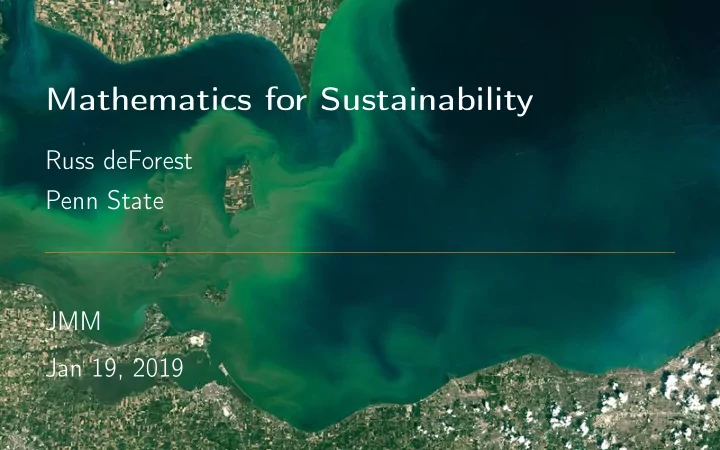
SLIDE 1
Mathematics for Sustainability
Russ deForest Penn State JMM Jan 19, 2019
SLIDE 2
John Roe Oct 6, 1959 – Mar 9, 2018
SLIDE 3
Penn State’s General Education Objectives
In Quantification (GQ) fields, students practice and master basic mathematical and statistical skills of lifelong value in solving real world problems. –Penn State’s Updated Learning Objectives
SLIDE 4
- Mathematical Mindsets, interview with Jo
Boaler
Steven Strogatz
SLIDE 5
- Mathematical Mindsets, interview with Jo
Boaler
- “Think about how many people hate
mathematics.” Steven Strogatz
SLIDE 6
- Mathematical Mindsets, interview with Jo
Boaler
- “Think about how many people hate
mathematics.”
- Many students are not well served.
Steven Strogatz
SLIDE 7
- Mathematical Mindsets, interview with Jo
Boaler
- “Think about how many people hate
mathematics.”
- Many students are not well served.
- “We need a math revolution.”
Steven Strogatz
SLIDE 8 Mathematics for Sustainability. . .
- . . . invites students to be active participants in shaping the
future of our world
SLIDE 9 Mathematics for Sustainability. . .
- . . . invites students to be active participants in shaping the
future of our world
- . . . admits up front that we don’t have the answers to many
important questions
SLIDE 10 Mathematics for Sustainability. . .
- . . . invites students to be active participants in shaping the
future of our world
- . . . admits up front that we don’t have the answers to many
important questions
- . . . facilitates students in asking their own questions
SLIDE 11 Mathematics for Sustainability. . .
- . . . invites students to be active participants in shaping the
future of our world
- . . . admits up front that we don’t have the answers to many
important questions
- . . . facilitates students in asking their own questions
- . . . encourages students to see themselves as advocates for, and
creators of, solutions that make the world a better place
SLIDE 12 Mathematics for Sustainability. . .
- . . . invites students to be active participants in shaping the
future of our world
- . . . admits up front that we don’t have the answers to many
important questions
- . . . facilitates students in asking their own questions
- . . . encourages students to see themselves as advocates for, and
creators of, solutions that make the world a better place
- . . . develops quantitative skills that can help students be more
effective advocates for the things they care about
SLIDE 13
Sustainability, Springer (May, 2018)
- Also available electronically
through SpringerLink
SLIDE 14
Water Energy Climate
SLIDE 16
- Oct, 2015 landslide
- 180 million tonnes of
debris
SLIDE 17
- Oct, 2015 landslide
- 180 million tonnes of
debris
midsize SUVs”.
SLIDE 18
- Oct, 2015 landslide
- 180 million tonnes of
debris
midsize SUVs”.
put the size of this landslide in familiar terms?
SLIDE 20 One Solution
- Niagara Falls flow rate:
- 2800 tonnes/sec
SLIDE 21 One Solution
- Niagara Falls flow rate:
- 2800 tonnes/sec
- Landslide lasted 1 min
SLIDE 22 One Solution
- Niagara Falls flow rate:
- 2800 tonnes/sec
- Landslide lasted 1 min
- How long for a similar
mass of water to go over Niagara Falls?
SLIDE 23 One Solution
- Niagara Falls flow rate:
- 2800 tonnes/sec
- Landslide lasted 1 min
- How long for a similar
mass of water to go over Niagara Falls?
SLIDE 24
- 180 million metric tons of
debris
- 600 foot high wave
- Fourth largest tsunami
recorded in the past 100 years
SLIDE 25 Unit-Factor Method
Estimate total carbon-dioxide emissions from round-trip travel to a Penn State football game.
100,000 ✘✘✘
✘
people game × 1 ✘✘✘
✘
vehicle 4 ✘✘✘
✘
people × 300✘✘✘
✘
miles 1 ✘✘✘
✘
vehicle × 1 ✘✘✘
✘
gallon 15 ✘✘
✘
miles × 20 ✚
✚
lbs 1 ✘✘✘
✘
gallon × 1 ton 2000 ✚
✚
lbs = 100,000×300×20 4×15×2000 tons game ≈ 5000 tons game
SLIDE 26 Making Effective Comparisons
- 5000 tons of carbon-dioxide emissions
- Avoided emissions from 1 wind turbine running one year
- Avoided emissions from switching 150,000 incandescent bulbs to
LEDs (annual).
- Avoided emission from recycling 1700 tons of waste
- Carbon sequestered by 5000 acres of forest in one year.
- See the EPA Greenhouse Gas Equivalencies calculator
SLIDE 27
Dynamic Equilibrium
SLIDE 28
Out of Equilibrium
SLIDE 29 Earth’s Energy Balance
Short wave radiation Planet Temperature T + Long wave radiation − +
SLIDE 30
Earth’s Energy Balance
100 150 200 250 300 100 200 300 400 Temperature, T (kelvins) Power (W/m2) Inflow Outflow (naked planet) Outflow (glass ball)
SLIDE 31
Feedbacks
Methane in Frozen Soils Melting Atmospheric Methane Global Temp Short Wave Radiation Long Wave Radiation
SLIDE 32
Stability of equilibria
50 100 150 200 250 300 50 100 150 A B C P Phosphorus (tons) Flow rate (tons/yr) Outflow Inflow
SLIDE 33
Tipping points and hysteresis
50 100 150 200 250 300 50 100 150 A P Phosphorus (tons) Flow rate (tons/yr) Outflow Inflow
SLIDE 34
Tipping points and hysteresis
50 100 150 200 250 300 50 100 150 A P Phosphorus (tons) Flow rate (tons/yr) Outflow Inflow
SLIDE 35
Tipping points and hysteresis
50 100 150 200 250 300 50 100 150 A P Phosphorus (tons) Flow rate (tons/yr) Outflow Inflow
SLIDE 36
Homophily in Networks
SLIDE 37
Figure 1: Links between political web pages prior to 2004 U.S. Presidential election.
SLIDE 38
Information cascade
A B C D E F G H
SLIDE 39
Uncertainty and Risk
Temperature anomaly under 3 ◦C 3–4 ◦C 4–5 ◦C 5–6 ◦C 6–7 ◦C 7 ◦C+ Probability (no policy) 0.01 0.12 0.34 0.15 0.09 Temperature anomaly under 2 ◦C 2–2.5 ◦C 2.5–3 ◦C 3 ◦C+ Probability (with policy) 0.43 0.27 0.10
SLIDE 40
What is a 1,000 year storm?
SLIDE 41 The Stern Review
Economics of Climate Change
- Controversy on discount rates
used in assessing future costs
- f climate change
- Discounting applied over long
time horizons involves making an ethical choice
SLIDE 42 The Tragedy of the Commons
- Game Theory
- Resolving the Tragedy of the
Commons
- Cap and Trade
- Revenue Neutral Carbon Taxes
SLIDE 43 Course Details
- Active learning environment
- Students work in groups, facilitated by undergraduate teaching
assistants:
- Alexa Derago
- Bethany Barkley
- Jason Wang
SLIDE 44 Writing Assignments
- In the News: Blog posts connecting current events or news
with themes of course
- Make an Estimate: Personal estimates of water use, energy
use, greenhouse gas emissions
- Critical Response: refuting or supporting others’ arguments
with quantitative evidence.
- Write and Respond Project: Advocacy or analysis writing
piece related to the course, supported by quantitative arguments
- Reflective writing assignment
SLIDE 45 Instructor Resources
- Mathematics for Sustainability, Springer
- Rubrics, assignments, exercises, quizzes, slides available by
request
SLIDE 46 Student Feedback
- “The writing assignments helped us pick topics we were
personally interested in and it helped to make it more fun and intriguing.”
SLIDE 47 Student Feedback
- “The writing assignments helped us pick topics we were
personally interested in and it helped to make it more fun and intriguing.”
- “This is a wonderful course that made me appreciate math and
what its impact is on the "real world"
SLIDE 48 Student Feedback
- “The writing assignments helped us pick topics we were
personally interested in and it helped to make it more fun and intriguing.”
- “This is a wonderful course that made me appreciate math and
what its impact is on the "real world"
- “I was confused with why there were so many writing
assignments for this math course... This is a Gen Ed math course... Only math majors should be writing papers about math.”
SLIDE 49 Student Feedback
- “I chose this class because I thought it would be an easier math
class for me to take because I was not good at quantification, that was the wrong idea. There was nothing easy about this class but in the end, I do feel more confident in my quantitative skills.”
SLIDE 50 Student Feedback
- “I chose this class because I thought it would be an easier math
class for me to take because I was not good at quantification, that was the wrong idea. There was nothing easy about this class but in the end, I do feel more confident in my quantitative skills.”
- “After this semester Math 33 has inspired me to do so much
more – and I have decided to pursue Earth and Sustainability as a minor.”
SLIDE 51 Student Feedback
- “I chose this class because I thought it would be an easier math
class for me to take because I was not good at quantification, that was the wrong idea. There was nothing easy about this class but in the end, I do feel more confident in my quantitative skills.”
- “After this semester Math 33 has inspired me to do so much
more – and I have decided to pursue Earth and Sustainability as a minor.”
- “I always feel engaged in the discussions, as well as am excited
to think critically on the issues presented in the course.”
SLIDE 52 Student Feedback
- “I chose this class because I thought it would be an easier math
class for me to take because I was not good at quantification, that was the wrong idea. There was nothing easy about this class but in the end, I do feel more confident in my quantitative skills.”
- “After this semester Math 33 has inspired me to do so much
more – and I have decided to pursue Earth and Sustainability as a minor.”
- “I always feel engaged in the discussions, as well as am excited
to think critically on the issues presented in the course.”
- “I never realized I would learn so many interesting topics in a
math class.”
SLIDE 53
Thank You!