Nikon KeyMission 360 Course Evaluation : Log into aefis.wisc.edu - - PowerPoint PPT Presentation

nikon keymission 360
SMART_READER_LITE
LIVE PREVIEW

Nikon KeyMission 360 Course Evaluation : Log into aefis.wisc.edu - - PowerPoint PPT Presentation

12/8/16 Nikon KeyMission 360 Course Evaluation : Log into aefis.wisc.edu using your netid (or click on the course link from the email you were sent) 1. Go to the Notification Center and Dashboard, find course and click Take Survey 2.


slide-1
SLIDE 1

12/8/16 1 Course Evaluation: Log into aefis.wisc.edu using your netid (or click on the course link from the email you were sent)

  • 1. Go to the

Notification Center and Dashboard, find course and click “Take Survey”

  • 2. Answer

questions

  • 3. Once complete,

choose “Finish and Submit”

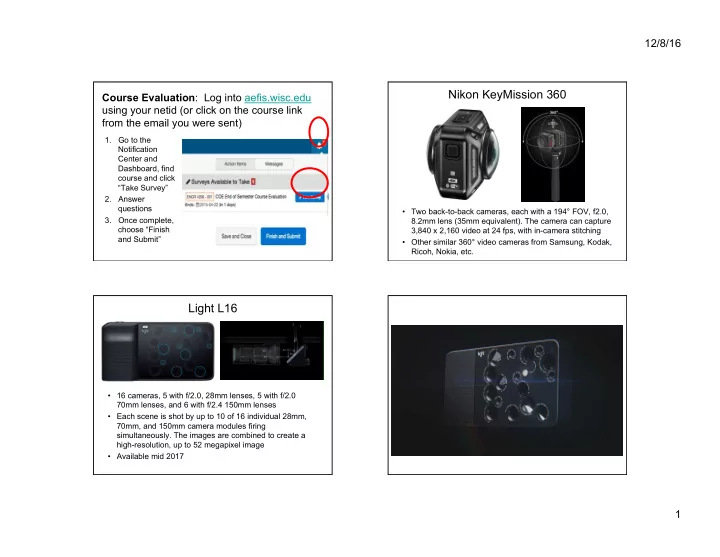
Nikon KeyMission 360

  • Two back-to-back cameras, each with a 194° FOV, f2.0,

8.2mm lens (35mm equivalent). The camera can capture 3,840 x 2,160 video at 24 fps, with in-camera stitching

  • Other similar 360° video cameras from Samsung, Kodak,

Ricoh, Nokia, etc.

Light L16

  • 16 cameras, 5 with f/2.0, 28mm lenses, 5 with f/2.0

70mm lenses, and 6 with f/2.4 150mm lenses

  • Each scene is shot by up to 10 of 16 individual 28mm,

70mm, and 150mm camera modules firing

  • simultaneously. The images are combined to create a

high-resolution, up to 52 megapixel image

  • Available mid 2017
slide-2
SLIDE 2

12/8/16 2

3 Final Problems

  • Photography in low light
  • Photography in bad weather
  • Detecting fake photos

Photography in Low Light

Using available ambient light:

+ natural lighting

  • high noise
  • color needs

white balancing

  • blur

No-flash

Adding Lighting Shows Details

Using flash:

+ details + color + low noise

  • flat/artificial
  • flash shadows
  • red eye

Flash

Flash + No-Flash Photography

Take 2 photos and combine best aspects of each

Flash No-flash Result

slide-3
SLIDE 3

12/8/16 3

Flash + No-Flash Approach

+ original lighting + details/sharpness + noise removal + color

Result No-flash

Either use the no-flash image to relight the flash image, or use the flash image to relight the no-flash image

Acquisition Process

Lock Focus & Aperture

1 time

Acquisition Process

1/30 s ISO 3200

No-Flash Image Large Sensor Gain/ISO Lock Focus & Aperture

2 1 time

Acquisition Process

1/30 s ISO 3200 1/125 s ISO 200

No-Flash Image Large Sensor Gain/ISO Lock Focus & Aperture Flash Image Low Sensor Gain/ISO

2 3 1 time

slide-4
SLIDE 4

12/8/16 4

Eisemann and Durand Algorithm

Flash shadow detection and deletion texture detail color after white balancing

Use color from flash image after inverse white balancing

Eisemann and Durand Algorithm

Flash shadow detection and deletion

Decomposition

Color + Intensity Representation:

  • riginal

= *

intensity color

B B G R B G B G R G R B G R R I + + + + + + + + =

I B B I G G I R R = = = , ,

Decoupling

  • Lighting = Coarse-scale variation
  • Detail / Texture = Fine-scale variation
  • Implemented using a bilateral filter, which is a weighted average of

the pixels in a neighborhhood, and the weight is a product of a Gaussian and the pixel intensity difference

Detail / Texture Lighting

slide-5
SLIDE 5

12/8/16 5

Recombination

Coarse-scale No-flash Fine-scale Flash

*

Intensity Result

=

Recombination: Large scale * Detail = Intensity

Recombination

Intensity Result Color Flash

~

*

~

Result

Recombination: Intensity * Color = Original shadow removal

Results

No-flash Flash

Results

Result No-flash Flash

slide-6
SLIDE 6

12/8/16 6

Poor Result

Flash No-flash

Haze Removal from a Single Image

Haze Mist Rain Fog

Images Courtesy : Steve and Carol Sheldon

  • Low contrast

Aerial Perspective

  • aka Atmospheric

Perspective

  • Objects farther away

appear less saturated (whiter) and less sharp (blurrier) than those nearby

  • The more atmospheric

particles between the viewer and a distant object, the more light is scattered

slide-7
SLIDE 7

12/8/16 7

Distant Objects are Desaturated Aerial Perspective

Leonardo, Virgin and

  • St. Anne, 1510

Color Perspective

Distant objects tend toward blue, near objects toward red

“Single image haze removal using dark channel prior,” K. He et al., CVPR, 2009

slide-8
SLIDE 8

12/8/16 8

Heuristic: Haze-free images have higher contrast than hazy images

Medium transmission

When the atmosphere is homogeneous, scene radiance is attenuated exponentially with scene depth, d, but we don’t know d

Heuristic: Most local patches in haze-free outdoor images that do not contain sky contain some pixels that have very low intensity values in at least one color channel

slide-9
SLIDE 9

12/8/16 9

Haze-free images have most pixels in the dark channel near 0

slide-10
SLIDE 10

12/8/16 10

Daytime, outdoor landscapes or cityscapes from Flickr

slide-11
SLIDE 11

12/8/16 11

  • The intensity of the dark channel is an approximation of

the thickness of the haze – use it to estimate J, A, and t

slide-12
SLIDE 12

12/8/16 12

Results

input

Results

recovered image

Results

depth

Results

input recovered image

slide-13
SLIDE 13

12/8/16 13

Digital Image Forensics: Detecting Faked/Manipulated Images

A Long History of Photo Manipulation

Iconic Portrait of Lincoln (1860) Examples collected by Hany Farid: http://www.cs.dartmouth.edu/farid/research/tampering.html

slide-14
SLIDE 14

12/8/16 14

Photo Manipulation as Art

Sarolta Ban

Photo Manipulation for Aesthetics

Airbrushing and retouching to enhance appearance Retouching is “completely in line with industry standards”

Before and After Retouching Examples

slide-15
SLIDE 15

12/8/16 15

1989 composite of Oprah and Ann-Margret (without either’s permission)

Photo Manipulation for Government Campaigns

NYC poster shows man who supposedly lost his leg to diabetes, though

  • riginal image is on right. Source: New York Times, 1/25/2012

2000: black student’s face inserted into UW magazine

http://www.cs.dartmouth.edu/farid/research/digitaltampering/

Photo Manipulation in Journalism

Pulitzer Prize winning photograph of Kent State killing (1970)

slide-16
SLIDE 16

12/8/16 16

2003: Long-time staff photographer for LA Times was fired for this one Published photo

Fake Photos in Politics

1930s: Stalin had disgraced comrades removed from photos

http://www.cs.dartmouth.edu/farid/research/digitaltampering/ http://www.newseum.org/berlinwall/commissar_vanishes/index.htm

Mussolini in a Heroic Pose (1942)

Fake Photos in Politics

2008

slide-17
SLIDE 17

12/8/16 17

“Talking to a Trump volunteer who says this picture of Clinton and Bin Laden is real and she saw it on TV in the 70s.” -- Ben Jacobs, The Guardian

“Shirtless Biden Washes Trans Am In White House Driveway,” The Onion, May 5, 2009

Kerry at Rally for Peace 1971 Fonda at rally in 1972

Caption: “Actress and Anti-war activist Jane Fonda speaks to a crowd of Vietnam veterans, as activist and former Vietnam vet John Kerry listens and prepares to speak next concerning the war in Vietnam.” (AP Photo)

“Ape Appointed Banana Czar,” The Onion, March 19, 1997

slide-18
SLIDE 18

12/8/16 18

Detecting Forgery: Cloning

  • Exposing Digital Forgeries by Detecting Duplicated

Image Regions

– A.C. Popescu and H. Farid – Technical Report, TR2004-515, Dartmouth College, Computer Science

Detecting Forgery: Retouching

  • Exposing Digital Forgeries in Color Filter Array

Interpolated Images

– A.C. Popescu and H. Farid – IEEE Transactions on Signal Processing, 53(10):3948-3959, 2005

2005: Pres Bush scribbles a note to C. Rice during UN Security Council Meeting

Demosaicing Prediction

  • In demosaicing, RGB values are filled in based on

surrounding measured values

  • Filled in values will be correlated in a particular way for

each camera

  • Local tampering will destroy these correlations

Farid: “Photo Fakery and Forensics” 2009

Detecting Forgery: Lighting/Shadows

  • Exposing Digital Forgeries by Detecting

Inconsistencies in Lighting

– M.K. Johnson and H. Farid – ACM Multimedia and Security Workshop, New York, NY, 2005

slide-19
SLIDE 19

12/8/16 19

Detecting Forgery: Lighting/Shadows

  • Exposing Digital Forgeries by Detecting

Inconsistencies in Lighting

– M.K. Johnson and H. Farid – ACM Multimedia and Security Workshop, New York, NY, 2005

Estimating Lighting Direction

1 Method: 2D direction from occluding contour

  • Provide at least 3 points on occluding contour (surface

has 0 angle in Z direction)

  • Estimate light direction from brightness

Estimate Ground Truth

Detecting Inconsistencies in Lighting

Fake photo Real photo

Detecting Forgery: Lighting/Shadows

slide-20
SLIDE 20

12/8/16 20

Lighting: Specular Highlights in the Eye

M.K. Johnson and H. Farid, “Exposing Digital Forgeries Through Specular Highlights on the Eye,” 2007

Estimating Lighting from Eyes Summary

  • Digital forgeries are a major problem as it is easy

to fake images

  • A variety of automatic and semi-automatic

methods are available for detection forgeries

– Checking lighting consistency – Checking demosaicing consistency – Checking JPEG compression level consistency

  • But more methods are needed!