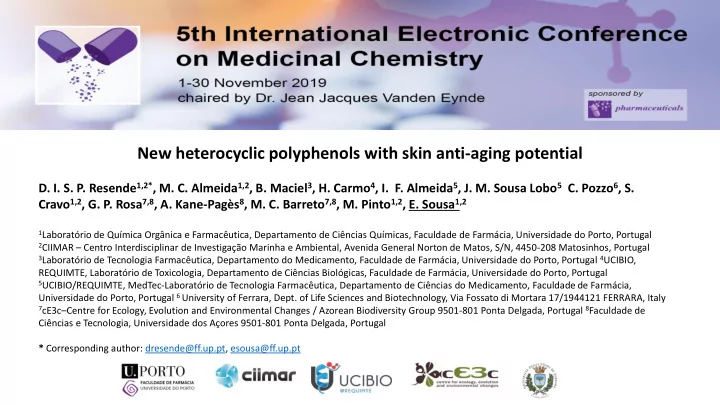
New heterocyclic polyphenols with skin anti-aging potential D. I. S. - - PowerPoint PPT Presentation

new heterocyclic polyphenols with skin anti aging
SMART_READER_LITE
LIVE PREVIEW

New heterocyclic polyphenols with skin anti-aging potential D. I. S. - - PowerPoint PPT Presentation

New heterocyclic polyphenols with skin anti-aging potential D. I. S. P. Resende 1,2* , M. C. Almeida 1,2 , B. Maciel 3 , H. Carmo 4 , I. F. Almeida 5 , J. M. Sousa Lobo 5 C. Pozzo 6 , S. Cravo 1,2 , G. P. Rosa 7,8 , A. Kane-Pags 8 , M. C. Barreto


slide-1
SLIDE 1

New heterocyclic polyphenols with skin anti-aging potential

  • D. I. S. P. Resende1,2*, M. C. Almeida1,2, B. Maciel3, H. Carmo4, I. F. Almeida5, J. M. Sousa Lobo5 C. Pozzo6, S.

Cravo1,2, G. P. Rosa7,8, A. Kane-Pagès8, M. C. Barreto7,8, M. Pinto1,2, E. Sousa1,2

1Laboratório de Química Orgânica e Farmacêutica, Departamento de Ciências Químicas, Faculdade de Farmácia, Universidade do Porto, Portugal 2CIIMAR – Centro Interdisciplinar de Investigação Marinha e Ambiental, Avenida General Norton de Matos, S/N, 4450-208 Matosinhos, Portugal 3Laboratório de Tecnologia Farmacêutica, Departamento do Medicamento, Faculdade de Farmácia, Universidade do Porto, Portugal 4UCIBIO,

REQUIMTE, Laboratório de Toxicologia, Departamento de Ciências Biológicas, Faculdade de Farmácia, Universidade do Porto, Portugal

5UCIBIO/REQUIMTE, MedTec-Laboratório de Tecnologia Farmacêutica, Departamento de Ciências do Medicamento, Faculdade de Farmácia,

Universidade do Porto, Portugal 6 University of Ferrara, Dept. of Life Sciences and Biotechnology, Via Fossato di Mortara 17/1944121 FERRARA, Italy

7cE3c–Centre for Ecology, Evolution and Environmental Changes / Azorean Biodiversity Group 9501-801 Ponta Delgada, Portugal 8Faculdade de

Ciências e Tecnologia, Universidade dos Açores 9501-801 Ponta Delgada, Portugal * Corresponding author: dresende@ff.up.pt, esousa@ff.up.pt

slide-2
SLIDE 2

New heterocyclic polyphenols with skin anti-aging potential

1 2 4 3 5

Synthesis

DPPH Stability

  • pH Stability

Antioxidant Activity Stability

  • DPPH Scavenging Effect
  • Metal chelating effect

Solubility Stability

  • Water
  • Glycerol

Anti-aging Activity

  • Anti-Tyrosinase
  • Anti-Elastase
  • Anti-Colagenase
  • Anti-Hialuronidase
  • Benzophenone method
  • Ullmann ether synthesis
  • GSS method

Phototoxicity

  • Evaluation in a human keratinocyte

cell line (HaCaT)

slide-3
SLIDE 3

Abstract:

Xanthones or dibenzo-gamma-pyrones are heterocyclic polyphenolic compounds that can be found in microorganisms, fungi, lichens, and some higher plants. Structure-activity relationship studies emerged from a library of natural and synthetic polyoxygenated have suggested that xanthones with vicinal diol groups have promising antioxidant activity. Antioxidants have long been used in the cosmetic industry to prevent or minimize skin aging which is mediated by oxidative stress, making the search for new antioxidant agents highly desirable in this field. Considering the structure-activity relationship studies, it was hypothesized that trioxygenated xanthones could be promising antioxidants with potential as skin anti-aging ingredients. Hence, the synthesis of trioxygenated xanthones was attempted by the Smiles rearrangement pathway and also via acyl radical cyclization. The Smiles rearrangement pathway failed to yield the ester intermediate that was essential in this approach and was therefore

  • abandoned. In the acyl radical cyclization method it was possible to obtain the 1,4-dihydroxy-3-methoxy-9H-

xanthen-9-one. The antioxidant activity of this new xanthone as well as of four other polyoxygenated xanthones was evaluated by the DPPH assay, and two new derivatives showed IC50 values in the same range as the ascorbic acid. Almost all of the compounds were excellent tyrosinase inhibitors, were weak to moderate collagenase inhibitors, and showed no activity against elastase. The stability in presence of metal ions and dependence of the pH was also studied, as well as their solubility in water and glycerol. Finally, the phototoxicity of the most promising xanthone was evaluated in a human keratinocyte cell line and no phototoxicity was observed in the concentration range tested, which is an important requirement for topical ingredients. Keywords: Xanthones; antioxidants; synthesis; skin-degrading enzymes; stability, phototoxicity

3

slide-4
SLIDE 4

4

Previously…

Cidade H, et al. Arab. J. Chem. 2017, https://doi.org/10.1016/j.arabjc.2017.01.006

slide-5
SLIDE 5

Synthesis of polyhydroxyxanthones

Benzophenone method

1 2 3

Benzophenone method Ullmann ether synthesis

Sousa, E. P. et al. Helv. Chim. Acta 2002, 85 (9), 2862-2876. Resende, D. et al. Molecules 2018, 23 (10), 2617. Resende, D. et al. Molecules 2018, 23 (10), 2617.

slide-6
SLIDE 6

GSS method

4 5

Benzophenone method

Adapted from Kraus, G. A.; Liu, F., Tetrahedron Lett. 2012, 53 (2), 111-114.

Synthesis of new polyhydroxyxanthones

slide-7
SLIDE 7

DPPH SCAVENGING CAPACITY

Results

Antioxidant Activity

Compound IC50 M (at 60min) DPPH Scavenging effect ( %) at 25 M Ascorbic Acid 40.0  0.8 28.9  0.3 Compound 1 31.2  4.8* 36.8  4.9 Compound 2 47.3  0.4 24.9  1.3 Compound 3 28.4  0.2 43.3 1.5 Compound 4 Not determined 9.2  2.4 Compound 5 Not determined 34.6  3.2

*standard deviation derived from three independent experiments

% 𝑡𝑑𝑏𝑤𝑓𝑜𝑕𝑗𝑜𝑕 𝑝𝑔 𝐸𝑄𝑄𝐼 = 100 − 𝐵𝑐𝑡 𝑡𝑏𝑛𝑞𝑚𝑓 𝑥 / 𝐸𝑄𝑄𝐼 − 𝐵𝑐𝑡 𝑡𝑏𝑛𝑞𝑚𝑓 𝑐𝑚𝑏𝑜𝑙 𝐵𝑐𝑡 𝐸𝑄𝑄𝐼 − 𝐵𝑐𝑡 𝐹𝑢𝑃𝐼 𝑦100

1 3

slide-8
SLIDE 8

METALS CHELATING EFFECT

Results

Stability

FeCl3 CuCl2 Compound 1 B N Compound 2 B N Compound 3 B B Compound 4 B N Compound 5 B B

Summary of the observed shift in UV/Vis spectra B* bathochromic effect, N* no relevant changing

Solutions of xanthone 5 after ten additions

  • f FeCl3 on the left

and CuCl2 on the right Figure 7: Solutions of xanthones (starting from the left) 1-4 after ten additions of FeCl3 (left picture) and CuCl2 (right picture)

Bathochromic shift on the UV/Vis spectra indicates the formation of a complex between the hydroxyl groups and the metals

Antioxidant Activity

3 5

slide-9
SLIDE 9

DERMAL ENZYME INHIBITION ACTIVITIES

Results

Antiaging Activity

Tyrosinase Elastase Colagenase Hialuronidase

Compounds % Inhibition (150 µM) IC50 (µM) % Inhibition (150 µM) IC50 (µM) % Inhibition (150 µM) IC50 (µM) % inhibition (150 μM)

1 84.05 8.93 10.85 26.83

n.a.

2 91.42 3.28 18.21 24.91

n.a.

3 96.17 7.8 35.2 35.77

n.a.

4 47.32

  • 24.12

0.38

n.a. Kojic acid 12.81 MAAPVCK 0.26 EDTA 102.95 Anti-aging Activity

  • Anti-tyrosinase
  • Anti-elastase
  • Anti-collagenase
  • Anti-hyaluronidase

After exposure to sunlight, these enzymes are induced, leading to wrinkle formation, skin pigmentation and skin sagging

n.a. - Not active (0% inhibition) Results from three independent experiments; results of three independent experiments; *standard deviation not shown

2 3 1

slide-10
SLIDE 10

pH

Results

Stability

Xanthone 1 stability given by variation of absorbance in pH buffers over the time of analysis (0, 1, 2, 24, 192, 360 and 504 hours). Xanthone 3 stability given by variation of absorbance in pH buffers over the time of analysis (0, 1, 2, 24, 192, 360 and 504 hours).

pH is a significant parameter regarding skin compatibility of the cosmetic formulations . The pH of human skin normally ranges from 4.5 to 6.0. A pH closer to this range is desirable. These results are also of utmost importance for the formulation of a suitable vehicle, that maximizes the chemical stability of the actives incorporated.

Xanthones 1 and 3 were submitted under a range of pH buffers to know what is the pH where each one is more stable.

1 3

0,2 0,4 0,6 0,8 1 1,2 100 200 300 400 500 600

C1_pH2 (310nm) C1_pH3 (310nm) C1_pH4 (310nm) C1_pH5 (310nm) C1_pH6 (310nm) C1_pH7 (310nm) C1_pH8 (310nm)

0,05 0,1 0,15 0,2 0,25 0,3 0,35 100 200 300 400 500 600 C3_pH2 (390nm) C3_pH3 (390nm) C3_pH4 (390nm) C3_pH5 (390nm) C3_pH6 (390nm)

slide-11
SLIDE 11

SOLUBILITY

Results

Solubility

Solubility in Water (mg/mL)

Xanthone 1: 0.001 (Practically insoluble) Xanthone 3: n.d. (Practically insoluble)

Water

Descriptive terms Solubility (mg/mL) Very soluble >1000 Freely soluble 100-1000 Soluble 33-100 Sparingly soluble 10-33 Slightly soluble 1-10 Very slight soluble 0.1-1 Practically insoluble <0.1

Solubility criteria European Pharmacopeia Glycerol

The absorbance of saturated samples (suspension was shaken until the equilibrium solubility was achieved) was evaluated by HPLC at 310 nm and 255 nm for xanthone 1 and at 390 nm and 285 nm for xanthone 3. n.d. not detected

Solubility in Glycerol (mg/mL)

Xanthone 1: n.d. (Practically insoluble) Xanthone 3: 0.019 (Practically insoluble)

1 3

slide-12
SLIDE 12

Results

Phototoxicity Compound IC50 (-irr) IC50 (+irr) PIF

Xanthone 3 > 200 µM > 200 µM Not applicable Xanthone 3 was not cytotoxic to HaCaT cells even after irradiation. The IC50 values and consequently the PIF could not be obtained. However, as the cell viability was not decreased after UV exposure, the compound is deemed non phototoxic up to 200 µM. Photo Irritation Factor (PIF) No Phototoxicity <2

Probable Phototoxicity

2 – 5

Phototoxicity

>5

3

Adapted from OECD 432 guideline

3 3

slide-13
SLIDE 13

Conclusions

Xanthones 1 and 3 were practically insoluble in water and glycerol Solubility Xanthone 3 is non phototoxic up to 200 µM. Phototoxicity It was possible to synthesize one new compound, 1,8-dihydroxy-3,6-dimethyl- 9H-xanthen-9-one (4) Synthesis Almost all xanthones were excellent tyrosinase inhibitors, more active than control inhibitor kojic acid Anti-aging Activity pH: Xanthone 3 presented a stable profile in the range of pH from 3 to 5 Stability DPPH: Xanthones 1 and 3 showed IC50 values lower than the ones

  • btained for ascorbic acid

Antioxidant Activity Metals: Xanthones 3 and 5 exhibited metal chelating ability

slide-14
SLIDE 14

Acknowledgements

This work was developed under the Strategic Funding UID/Multi/04423/2019 and Project No. POCI- 01-0145-FEDER-028736, co-financed by COMPETE 2020, Portugal 2020 and the European Union through the ERDF, and by FCT through national funds, QREN,FEDER, COMPETE, by funding the cE3c centre (Ref. UID/BIA/00329/2019) and Azores DRCT for funding ABG. This work was also supported by the Applied Molecular Biosciences Unit-UCIBIO which is financed by national funds from FCT/MCTES (UID/Multi/04378/2019.