SURGICAL, ENZYMATIC, Monara Dini DPM Inflammatory phase: Injury - - PowerPoint PPT Presentation

surgical enzymatic
SMART_READER_LITE
LIVE PREVIEW

SURGICAL, ENZYMATIC, Monara Dini DPM Inflammatory phase: Injury - - PowerPoint PPT Presentation

4/16/2016 NORMAL WOUND HEALING Components: SURGICAL, ENZYMATIC, Monara Dini DPM Inflammatory phase: Injury 7 days & HYDROSURGICAL Assistant Clinical Proliferative phase: 3 days 3 weeks


slide-1
SLIDE 1

4/16/2016 1

Monara Dini DPM Assistant Clinical Professor, UCSF/SFGH

SURGICAL, ENZYMATIC, & HYDROSURGICAL DEBRIDEMENT MECHANISM OF ACTION

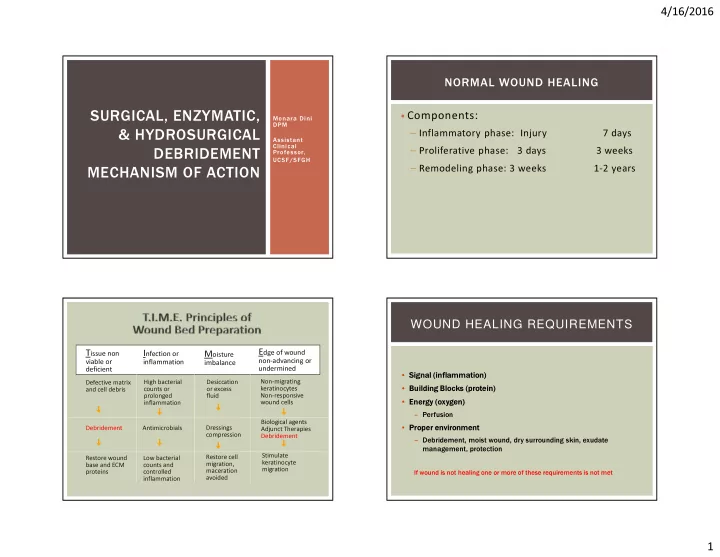
  • Components:

– Inflammatory phase: Injury 7 days – Proliferative phase: 3 days 3 weeks – Remodeling phase: 3 weeks 1-2 years

NORMAL WOUND HEALING

Tissue non

viable or deficient

Infection or

inflammation

Moisture

imbalance

Edge of wound

non-advancing or undermined

Defective matrix and cell debris High bacterial counts or prolonged inflammation Desiccation

  • r excess

fluid Non-migrating keratinocytes Non-responsive wound cells Debridement Antimicrobials Dressings compression Biological agents Adjunct Therapies Debridement Restore wound base and ECM proteins Low bacterial counts and controlled inflammation Restore cell migration, maceration avoided Stimulate keratinocyte migration

WOUND HEALING REQUIREMENTS

  • Signal (inflammation)
  • Building Blocks (protein)
  • Energy (oxygen)

– Perfusion

  • Proper environment

– Debridement, moist wound, dry surrounding skin, exudate management, protection

If wound is not healing one or more of these requirements is not met

slide-2
SLIDE 2

4/16/2016 2 SURGICAL DEBRIDEMENT

Fast Selective Excision of nonviable tissue revitalizes the wound bed with cytokines and growth factors +/- anesthetic Mild-moderate bleeding

SURGICAL DEBRIDEMENT: MECHANISM OF ACTION

Retrospective analysis of 2 controlled, prospective, randomized trials 366 VLUs, 310 DFUs

Serial debridement: higher rate of healing shorter time to healing

Surgical Debridement No Debridement VLU 11.7% (SAR) 50% (12 wk closure rate) 8.7% SAR 28% (12 wk closure rate) DFU 15.5% (SAR) 30% (12 wk closure rate) 12.5% (SAR) 13% (12 wk closure rate) Randomized, prospective, double-blind trial N= 118 at 10 centers

ALL patients had aggressive sharp debridement Centers with more frequent debridement = Higher rate of healing

slide-3
SLIDE 3

4/16/2016 3

Collagenase:

Specifically digests ONLY triple helical collagen

ENZYMATIC DEBRIDEMENT ENZYMATIC DEBRIDEMENT: MECHANISM OF ACTION

Naturally occurring proteolytic enzymes stimulate break down

  • f necrotic tissue:

Slow Not selective Material digested by enzyme may provide a medium for bacterial growth

Painless Minimal blood loss No anesthetic required

Prospective & retrospective studies that compared collagenase or papain-urea (1960-2008) Does enzymatic debridement remove necrotic debris and promote wound healing in ulcers (i.e. pressure ulcers, leg ulcers,

  • r burn wounds)?
  • Collagenase more effective

than placebo

  • Collagenase and Papain-urea

rate of healing is equivocal

slide-4
SLIDE 4

4/16/2016 4 HYDROSURGICAL DEBRIDEMENT

Versajet:

FDA-approved medical device Ability to focus a high-powered (15,000 psi) stream of water into a high-energy cutting device

+/- anesthetic Mild-moderate bleeding

slide-5
SLIDE 5

4/16/2016 5 CONCLUSION

Wound debridement is a vital adjunct in the care of patients with chronic foot ulcers