
SLIDE 1
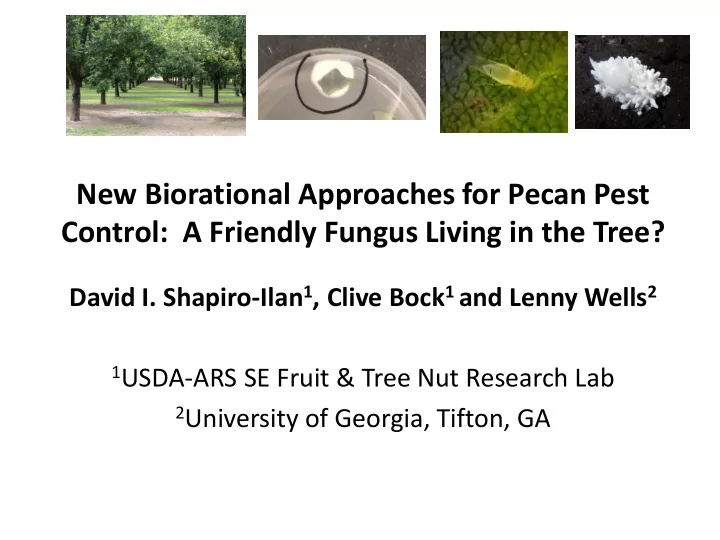
New Biorational Approaches for Pecan Pest Control: A Friendly Fungus Living in the Tree?
David I. Shapiro-Ilan1, Clive Bock1 and Lenny Wells2
1USDA-ARS SE Fruit & Tree Nut Research Lab 2University of Georgia, Tifton, GA
New Biorational Approaches for Pecan Pest Control: A Friendly Fungus - - PowerPoint PPT Presentation
New Biorational Approaches for Pecan Pest Control: A Friendly Fungus Living in the Tree? David I. Shapiro-Ilan 1 , Clive Bock 1 and Lenny Wells 2 1 USDA-ARS SE Fruit & Tree Nut Research Lab 2 University of Georgia, Tifton, GA Outline
1USDA-ARS SE Fruit & Tree Nut Research Lab 2University of Georgia, Tifton, GA
black pecan aphid, Melanocallis caryaefoliae blackmargined aphid, Monellia caryella yellow pecan aphid, Monelliopsis pecanis
OK, KS, MO
(but mostly mid-Aug to mid-Sept)
(Rainey & Eikenbary; Cottrell & Wood)
average 20-30 d, up to 75 d
Traps used for monitoring
per female.
form a soil cell at 3” to 10” depth
yr in soil & emerge as adults the next yr
extra yr (3 yr life-cycle)
Endemic (native) Fungus in the Orchard: 30% to 50% pecan weevil mortality from endemic fungi, e.g., B. bassiana (Shapiro-Ilan et al., 2003) Applied/Introduced Fungi:
peak weevil emergence
the ground with a cover crop - Sudan grass (Shapiro-Ilan et al., 2008; Hudson et al., 2010)
B A A A
100 200 300 400 Endemic-bare Endemic-clover Applied-bare Applied-clover # Cfus Treatment
2010
Shapiro-Ilan et al., 2012. Environmental Entomology
B A A A
100 200 300 400 Endemic-bare Endemic-clover Applied-bare Applied-clover # Cfus
the plant!
1991)
crops: bananas, beans, cacao, cotton, coffee, pine, tomato, wheat
in cotton, weevils in banana) and reduce diseases prevalence (e.g., Fusarium, Pythium)
Endophytic fungus growing from pecan leaf and root sections
10 20 30 40 50 60 70 Control Drench Dry gha Soak
% Mortality
and control seedlings
nutritive agar plates (PDA)
though sequencing results were variable (possibly due to secondary compound contaminants or low amounts of fungal DNA in the tissue)
PDA were confirmed as B. bassiana based on amplicon size
Shapiro-Ilan 2001). Pecan weevil larvae placed in 30 ml soil cups with 4x10⁶ conidia spores. Mortality assessed after 21
plates (GHA), fungus from an infected insects, fungus from pecan, control
from inoculated trees to assess for endophyte activity (assay
pecan seedlings -so far 1.5 years (and continuing)
inoculation of endophytic fungus using various methods
power)
conserved in the plant
10 20 30 40 50 60
Drench Dry Soak Control
% Colonization
10 20 30 40 50
Control Gha Cadaver Plant % Mortality
b a a a
and one for black margined aphid (based on Shapiro-Ilan et al., 2008).
endophyte or control seedling were placed into Petri dishes (100 mm diam) half-filled with 1.5% water agar. Ten adult aphids were added to each dish
temperature (22 C ± 1 °C)
There were 12 replicate seedlings of each treatment and control
B A 2 4 6 8 10
Endophyte Control Number of blackmargined aphids per leaf disc
B A 2 4 6 8 10
Endophyte Control Number of black pecan aphids per leaf disc
lab and also conduct leaf assays with Phytophthora (and possibly scab)
Pathol.) and Shapiro-Ilan et al. (2014, Biological Control)
endophytic B. bassiana and control seedlings (without endophytes) will be placed in an orchard in a replicated
monitored through the season
pecan trees without endophyte will be drenched up to three times with B. bassiana and the success of inoculation will be assessed using molecular and re-isolation techniques on
pecan using seed treatments and or drenching of seedlings in the same manner as was accomplished with B. bassiana. Initial tests on pest or disease suppression will be implemented as well. M. brunneum has been documented as an endophyte in other plants (e.g., potato) and has provided benefits
Mention of a proprietary product name does not imply USDA’s approval of the product to the exclusion of others that may be suitable