New and Noteworthy Citrus Varieties Citrus species & Citrus - - PowerPoint PPT Presentation

new and noteworthy citrus varieties citrus species amp
SMART_READER_LITE
LIVE PREVIEW

New and Noteworthy Citrus Varieties Citrus species & Citrus - - PowerPoint PPT Presentation

New and Noteworthy Citrus Varieties Citrus species & Citrus Relatives Hundreds of varieties available. CITRON Citrus medica The citron is believed to be one of the original kinds of citrus. Trees are small and shrubby with an


slide-1
SLIDE 1

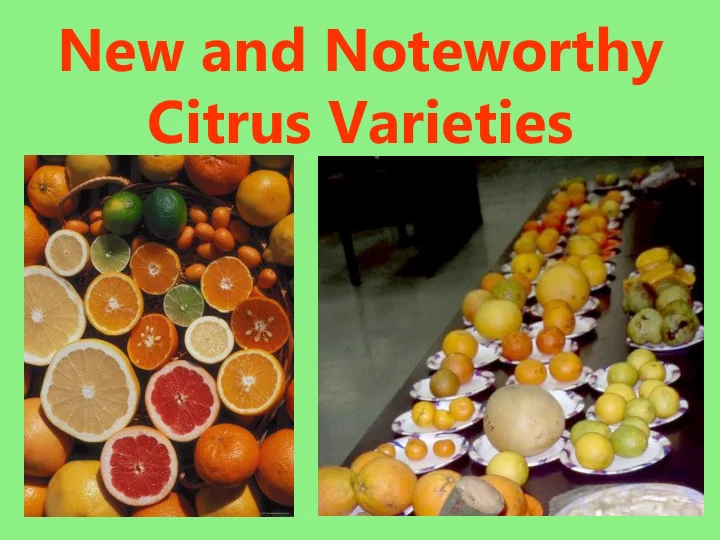
New and Noteworthy Citrus Varieties

slide-2
SLIDE 2

Citrus species & Citrus Relatives

Hundreds of varieties available.

slide-3
SLIDE 3

CITRON Citrus medica

  • The citron is believed to be one of the original kinds of citrus.
  • Trees are small and shrubby with an open growth habit. The new growth and

flowers are flushed with purple and the trees are sensitive to frost.

  • Ethrog or Etrog citron is a

variety of citron commonly used in the Jewish Feast of

  • Tabernacles. The flesh is

pale yellow and acidic, but not very juicy. The fruits hold well on the tree. The aromatic fruit is considerably larger than a lemon.

  • The yellow rind is glossy,

thick and bumpy. Citron rind is traditionally candied for use in holiday fruitcake.

Ethrog or Etrog citron

slide-4
SLIDE 4

CITRON Citrus medica

  • Buddha’s Hand or Fingered citron is a unique citrus grown mainly as a
  • curiosity. The six to twelve inch fruits are apically split into a varying number of

segments that are reminiscent of a human hand.

  • The rind is yellow and highly fragrant at maturity. The interior of the fruit is solid

rind with no flesh or seeds.

  • Fingered citron fruits usually mature in late fall to early winter and hold

moderately well on the tree, but not as well as other citron varieties.

Buddha’s Hand or Fingered citron

slide-5
SLIDE 5

NAVEL ORANGES Citrus sinensis

  • ‘Washington navel orange’ is also known

as the Bahia. It was imported into the United States in 1870.

  • These exceptionally delicious, seedless,

easy-peeling fruits quickly attracted the attention of citrus growers, and within a decade the "Washington" navel orange, as it came to be known, was the most widely planted variety in California.

  • ‘Lane Late Navel’ was the first of a

number of late maturing Australian navel orange bud sport selections of Washington navel imported into California.

  • The fruit is of similar size and shape, but

it has a smoother peel and a slightly smaller navel.

  • The fruit matures four to six week later

than the Washington navel orange and stores on the tree for several months after reaching maturity before the quality deteriorates. ‘Washington navel orange’ ‘Lane Late Navel’

slide-6
SLIDE 6

New late-maturing Navel orange selections

  • A number of new late-

maturing navel orange selections were identified in Australia in the late 1980's and early 1990's and five of them were sent for evaluation to the CCPP in California and were later released for propagation.

  • Autumn Gold, Barnfield,

Chislett, Powell and Wiffen are new late maturing navel

  • range varieties. They are

patented, propietary cultivars owned by their

  • riginal Australian selectors

who have licensed the propagation rights to various Californian

  • nurseries. Currently these

varieties are propagated for planting in the UC-Riverside CVC and commercially available from the Citrus Clonal Protection Program (CCPP).

slide-7
SLIDE 7

Chislett navel orange Citrus sinensis

  • Time of maturity is later than Lane Late navel by 3 – 6 weeks.
  • The variety has a higher juice content than Lane Late.
  • In comparison with other emerging late navel oranges, the Chislett Navel exceeds
  • thers in size and ability to hold on the tree.
  • Brokaw Nursery, Saticoy, CA, retains exclusive propagation rights in the U.S.
slide-8
SLIDE 8

Cara Cara navel orange Citrus sinensis

  • Most tree and fruit characteristics reflect its

Washington navel orange ancestry, but the flesh is deep pink, similar to the darkest of the red grapefruit varieties.

  • Flavor is slightly less acid than Washington

navel.

slide-9
SLIDE 9

Variegated Cara Cara navel orange Citrus sinensis

  • During a visit in Sept, 2004 Jose Chaparro stated that all

variegated ‘Cara Cara’ budsports had pigmented fruit.

  • Not commercially available in California
slide-10
SLIDE 10

SWEET Oranges Citrus sinensis

  • ‘Midknight’ is a virtually

seedless, medium-large, somewhat

  • blong fruit of excellent quality and

medium-late maturity.

  • ‘Delta’ is a South African variety

produces a seedless fruit of high quality that resembles the Valencia but matures somewhat earlier.

  • Acid levels drop early and the Delta can

be picked 2 to 3 weeks earlier than most

  • ther Valencias. The Delta is completely

seedless and has an attractive, smooth rind.. ‘Midknight’ ‘Delta’

slide-11
SLIDE 11

Rhode Red Valencia orange Citrus sinensis

  • Deep orange colored flesh. Matures same as other Valencias.
  • Only real advantage over other Valencias is the deeper flesh

color.

slide-12
SLIDE 12

Variegated Valencia orange Citrus sinensis

  • Striped

immature fruit turns solid orange when ripe.

  • Mature fruit

has distinct ridges. Flavor and seediness similar to a standard Valencia

  • range.
slide-13
SLIDE 13

SWEET ORANGES Citrus sinensis

  • The fruit of ‘Trovita’ are earlier

maturing, smaller, juicier and milder in flavor than Washington navel.

  • The trees are vigorous and

uprights in growth but have a tendency to alternate bear.

  • ‘Shamouti’ is a medium to large,
  • val-shaped sweet orange. It is

nearly seedless, and has a thick, leathery rind.

  • Shamouti peels well, and ships

and stores well. It is a midseason fruit.

slide-14
SLIDE 14

Smith Red Valencia orange Citrus sinensis

  • The fruit is of good size and flavor and is very low-seeded.
  • The rind frequently carries a heavy red blush and the flesh is heavily pigmented

with anthocyanin.

  • Although the fruit is mature in late winter, it holds well into late spring, well past

the season for conventional blood oranges.

slide-15
SLIDE 15

BLOOD ORANGES Citrus sinensis

Tarocco Moro Sanguinelli

slide-16
SLIDE 16

BLOOD ORANGES Citrus sinensis

  • Flavor is usually tart-sweet to tart. Ripening season is December – March.
  • ‘Moro’ is also the earliest ripening of the blood oranges. The fruit is usually low-

seeded with a flesh that can become very dark red late in the season.

  • ‘Sanguinelli’ is a late midseason blood orange. External red pigmentation rarely

equalled by other blood oranges and excelled by none.

  • ‘Tarocco’ is one of the most delicious blood orange varieties. The distinctive color

requires a chilly winter to develop properly. Fruit color is often unreliable.

slide-17
SLIDE 17

Bream Tarocco blood orange Citrus sinensis

  • Bream Tarocco is a medium-large to

large blood orange variety with few to no seeds and very good coloration properties.

  • It is originally a bud mutation of a

Tarocco tree from the garden of Robert Bream, Lindsay, California. It is a Tarocco blood orange tree which might be an improvement over the

  • ld VI 384 budline of Tarocco.
  • Bream Tarocco is one of the few

varieties where the outer pigmentation matches the color

  • inside. However, the distinctive color
  • f course requires cold winter nights

to develop properly but in a good year it can have one of the darkest pigmentations of all blood oranges.

slide-18
SLIDE 18

SOUR ORANGE / BITTER ORANGE Citrus aurantium

  • ‘Seville’ sour orange is the variety of sour orange traditionally used to make orange
  • marmalade. Seville fruits mature in winter and are seedy, bitter, and acidic.
  • ‘Bouquet de Fleurs’ is a sour orange variety planted primarily as an ornamental. The low-

seeded fruits mature in winter and hold very well on the tree. Bouquet de Fleurs fruits are bitter and acidic and typically are not consumed.

slide-19
SLIDE 19

SOUR ORANGE / BITTER ORANGE Citrus aurantium

  • ‘Chinotto’ sour orange is sometimes

referred to as the Myrtle-leaf orange. The tree grows very slowly and has a dwarf compact habit. The leaves are small usually under two inches in length.

  • These fruits mature in winter and are

moderately tart and seedy. The fruits hang on the tree for most of the year, making the tree highly ornamental.

  • Bergamot Orange

Bergamot oil of the rind is used in Earl Grey tea and perfume. On handling or scratching the rind, the oil released has a beautifully and unique aroma. Flesh is very acidic and has a bitter flavor.

Bergamot Orange

slide-20
SLIDE 20

Dekopon or Sumo Mandarin Citrus reticulata

  • Dekopon is a cross between a Kiyomi tangor and a Ponkan. Kiyomi tangor is

a variety from Japan and a cross between a Trovita orange and a Mikan or Satsuma.

  • Dekopon is a seedless and highly sweet citrus fruit developed in Japan in

the year 1972. The generic name of Dekopon is shiranuhi or shiranui.

  • The size of Dekopon is very large and has a protruding bump on the top of

the fruit and had sweet taste.

slide-21
SLIDE 21

Encore Mandarin Citrus reticulata

  • The fruit of the Encore mandarin is medium in size with a thin, yellow-orange rind.

Encore fruits hold well on the tree without much puffing of the rind. They have an excellent flavor.

  • Encore tend to be alternate bearing. Commerically available beginning in mid-March,

but flavor is best from May to July. Can be held on tree as late as September.

Encore

slide-22
SLIDE 22

Gold Nugget Mandarin Citrus reticulata

  • Gold Nugget fruits are usually medium in size with a somewhat bumpy orange rind.

The rind is moderately easy to peel.

  • The flesh is bright orange, finely-textured, and seedless. The flavor is rich and

sweet.

  • The fruit usually matures by early March, but holds exceptionally well on the tree,

with summer-harvested fruit still being of good quality.

slide-23
SLIDE 23

Imperial Mandarin Citrus reticulata

  • 'Imperial' is an extremely early maturing mandarin, October to December in

Riverside.

  • Fruit quality is considered good with a good balance or sugar and acid and good

internal color.

  • The skin is thin and soft, and although adherent, it peels easily. There are usually 4
  • r less seeds per. The fruit is medium sized (or small in heavy crop years).
slide-24
SLIDE 24

Kishu Mandarin Citrus reticulata

  • Kishu is a very small seedless mandarin that peels & sections well. The flesh is

firm, meaty, and pleasantly sweet in flavor. Fruit maturity occurs in early midseason.

Kishu

slide-25
SLIDE 25

Pixie Mandarin Citrus reticulata

  • Pixie mandarins have a

rind that is yellow-

  • range with a slightly

pebbled texture that is easy to peel.

  • The flesh is seedless,
  • range colored, and
  • juicy. The flavor is mild

and sweet.

  • Pixie matures in late

winter and holds exceptionally late on the tree; in certain mild locations, the fruit is known to hold well into summer.

slide-26
SLIDE 26

Tango Mandarin Citrus reticulata

  • Tango, a nearly seedless mandarin developed at UC Riverside, It is the most promising

mandarin the university has ever produced. The interest in it is worldwide. This is a variety that is going to be in high-volume planting. There will be well over a million trees planted in California in the next three to four years.

  • The Tango tastes good and has a smooth, deep orange rind that is easily peeled.
  • Tango matures in late-January at most locations in California and good fruit quality can be

maintained on the tree for 3-4 months past maturity.

slide-27
SLIDE 27

MANDARINS - The TDE Hybrids

Temple tangor, and Dancy and Encore mandarin Hybrids

  • ‘Shasta Gold’ has a tendency to alternate bearing. The large fruits have a relatively thin rind.

The flesh is seedless, bright orange, and juicy. The flavor is rich and sweet when mature. The season mid-February to mid-March and the fruits hold well on the tree into April or May.

  • The season for ‘Tahoe Gold’ is mid-January to mid-February. The fruit does not hold well on

the tree. The rind is of medium thickness and moderately easy to peel when fruit are

  • mature. Production is excellent.
  • ‘Yosemite Gold’ produces large fruits that have a relatively thin rind and has a tendency to

alternate bearing. The flesh is seedless, bright orange, finely-textured and juicy. The flavor is rich and sweet. The season is January to mid-March and the fruits hold well on the tree into April.

slide-28
SLIDE 28

MANDARIN Citrus reticulata Rangpur Lime

  • The name lime in connection with this fruit is often misleading because there are

very little similarities between the Rangpur and true limes. However, Rangpurs are highly acid and can be used as a substitute for commercial limes.

slide-29
SLIDE 29

TANGOR Citrus reticulata X C. sinensis

  • Ortanique is a natural tangor that was discovered in Jamaica.

The name is a combination of “or” for orange, “tan” for tangerine, and “ique” for unique.

  • The fruit is medium in size, obovate in shape, and has a

pebbled, dark orange rind. The flesh is orange-colored, tender, and exceptionally juicy. When cross-pollinated, the fruit is

  • seedy. The flavor is rich and sweet. Ortanique is usually late in

maturity, and the fruit holds very well on the tree.

  • Temple is a natural tangor that was discovered in 1896 in
  • Jamaica. The fruit develops a satisfactory sugar to acid ratio
  • nly when grown in the warmest interior valleys.

TEMPLE

slide-30
SLIDE 30

Ugli Tangor

  • Ugli Fruit, is a mandarin hybrid so named

after a Canadian produce market described it as being ugly.

  • The fruit is the result of a cross between a

grapefruit, orange, and mandarin. Although unattractive, the fruit is quite

  • succulent. It has a baggy, thick, light
  • range rind that is easy to peel and smells
  • f citron.
  • The yellow-orange flesh is tender and

sweet evoking both a sweet orange and tangerine taste with a hint of honey or pineapple.

  • As many as sixteen large segments

surround its hollow core, a characteristic which adds to the fruit's lack of density. Nevertheless, it can still weigh up to two pounds when grown in its native Jamaica.

slide-31
SLIDE 31

‘Allspice’ Tangelo’ Citrus x paradisi X C. reticulata

  • Allspice resulted from a cross of the Imperial grapefruit and Willowleaf

mandarin made in 1917 by H. B. Frost of the University of California Citrus Research Center, Riverside.

  • Although the fruit is small, it is attractive because of its rich flavor and spicy
  • fragrance. Fruit medium-small, color orange-yellow, seedy. Rind thin,

slightly pebbled, and rather tightly adherent.

  • Flesh tender and juicy; rich, tart, spicy flavor and aroma. Midseason in

maturity and loses quality if left on tree much past maturity.

slide-32
SLIDE 32

TANGELO HYBRIDS Citrus x paradisi X C. reticulata X C. Spp.

  • ‘Page’ is a cross between Minneola tangelo and Clementine mandarin. Its

parentage is three-fourths mandarin and one-fourth grapefruit.

  • Rind is medium-thin, leathery, moderately adherent but easily peelable, reddish-
  • range at maturity.
  • Flesh color deep orange; tender and juicy; flavor rich and sweet. Seeds

moderately numerous. Early in maturity.

slide-33
SLIDE 33

TANGELO HYBRIDS Citrus x paradisi X C. reticulata X C. Spp.

  • ‘Wekiwa’ is reported to be a hybrid of a grapefruit and Sampson tangelo and,

therefore, is in reality a tangelolo.

  • Fruit medium-small, spherical to obovate or pyriform; color pale yellow; seeds

comparatively few. Rind medium-thick, smooth, and fairly adherent.

  • Flesh tender, juicy; flavor sweet and mildly acid, becoming unpleasant when
  • verripe. Under favorable conditions rindis pink-blushed and flesh amber-
  • pink. Early in maturity.

Wekiwa Tangelolo

slide-34
SLIDE 34

‘Variegated Eureka’ Citrus limon

  • ‘Variegated

Eureka’ lemon has both foliage and young fruit attractively variegated but fruit variegation fades with maturity and mature fruit could easily masquerade as an ordinary Eureka.

  • Sometimes sold as

‘Sungold’ lemon.

Variegated Eureka’ or ‘Sungold’

slide-35
SLIDE 35

‘Variegated Pink-fleshed Eureka’ Citrus limon

  • ‘Variegated Pink-fleshed Eureka’ lemon is sometimes sold under the name ‘Pink

Lemonade’ and is a sport of the conventional Eureka lemon. The leaves are variegated green and white, making the tree quite ornamental.

  • The rind is striped green and cream and is sometimes rougher than conventional
  • Eureka. When fully ripe, the stripes fade, and the rind turns yellow. The flesh is

light pink at full maturity, low-seeded, and very acidic.

Variegated Pink Fleshed Eureka lemon

slide-36
SLIDE 36

‘Ponderosa’ lemon Citrus × limon

  • This is possibly a hybrid between a citron and a lemon. Ponderosa lemon is a

large fruit with a thick and bumpy rind. Flesh color pale green; juicy; flavor

  • acid. Fruits mature throughout year.
  • Ponderosa makes a nice ornamental with its purple-tinged flowers and new

growth, however it is sensitive to cold and very thorny.

Ponderosa Lemon

slide-37
SLIDE 37

Giant Key lime

Citrus aurantifolia

  • Fruit are more than twice

as large as ordinary diploid key lime but have true key lime flavor and aroma.

slide-38
SLIDE 38

GRAPEFRUITS Citrus x paradisi ( C. sinensis X C.grandis )

  • To achieve acceptable quality grapefruit must be grown in locations that satisfy their high

heat requirement.

  • ‘Rio Red’ flesh is juicy and well-pigmented. It is mid to late-season in maturity.
  • Compared to other grapefruit varieties, ‘Star Ruby’ is more difficult to grow well. It has

exhibited greater susceptibility to phytophthora, nutrient deficiencies, cold temperatures, and pest problems. The flesh is very darkly-pigmented, juicy, and low-seeded or

  • seedless. Star Ruby’s season of maturity is mid to late-season, and the fruit holds well on

the tree with some loss of flesh color as the season progresses.

slide-39
SLIDE 39

‘Sarawak’ pummelo Citrus grandis

  • ‘Sarawak’ pummelo is sometimes referred to as Tahitian
  • pummelo. The fruit is round with a flattened bottom and has a

greenish-yellow rind that is thinner than the typically thick pummelo rind.

  • The flesh is greenish, juicy, and sweet with a flavor some refer to as

melon-like or even lime-like. It is early to mid-season in maturity and holds well on the tree.

slide-40
SLIDE 40

PUMMELOS Citrus grandis

  • ‘Mato Buntan’ Pummelo has fruit

medium-large, seedy and light-yellow at maturity.

  • Flesh color light greenish-yellow;

crisp, somewhat tough, lacking in juice; flavor sweet (mildly acid), sometimes with trace of bitterness.

  • Early in maturity.
  • ‘Thong Dee’ pummelo is of the Thai

group of pummelos. The fruit is very large and very seedy when cross- pollinated.

  • The smooth light yellow rind is

medium-thin and tightly

  • adherent. The flesh is tinged pink and

the flavor is good when grown under appropriate climatic conditions.

Mato Buntan Pummelo Thong Dee pummelo

slide-41
SLIDE 41

Valentine Pummelo Citrus maxima hybrid

  • A very exciting low-acid new release with dark red pigmented flesh and many
  • seeds. The ‘Valentine’ fruit is attractive, juicy, sweet and distinctive.
  • A cross of ‘Siamese Sweet’ Pummelo , ‘Ruby’ Blood Orange and ‘Dancy’
  • Mandarin. ‘Valentine’ combines large size and low acidity from its pummelo

parent, complex, floral taste from ‘Dancy,’ and juicy red pulp from ‘Ruby.’

  • Season is mid-January –mid-February.
slide-42
SLIDE 42

PUMMELO Citrus grandis

  • Pummelos have a

very thick rind and the membrane which surrounds the fruit segments is tough and bitter. For this reason, the fruit is often peeled and segmented.

slide-43
SLIDE 43

PUMMELO Citrus grandis

slide-44
SLIDE 44

‘Cocktail’ Grapefruit Citrus grandis X C. reticulata

  • ‘Cocktail’ is actually a hybrid of ‘Siamese Sweet’ pummelo and ‘Frua’
  • mandarin. The fruit can vary from the size of an orange to the size of a
  • grapefruit. It has a thin, smooth, yellow rind.
  • The flesh is seedy, yellow-orange in color, and exceptionally juicy. The flavor is

pleasantly sub-acid.

  • Cocktail matures in early winter and the fruits hold well on the tree, puffing when

they become very old, but not desiccating.

slide-45
SLIDE 45

‘Chironja’ Orangelo

Citrus x paradisi X C. sinensis

  • An orangelo is a hybrid citrus fruit believed to

have originated in Puerto Rico. The fruit, a cross between a grapefruit and an orange.

  • ‘Chironja’ orangelos are often eaten in the

same manner as grapefruit but are sweeter and brighter in color than grapefruit, as well as being easier to peel. The rind can be candied successfully.

slide-46
SLIDE 46

KUMQUATS Fortunella spp.

  • The fruit of ‘Nordmann

Seedless’, Fortunella margarita, is teardrop shape with sweet yellow-orange

  • rind. The pulp is tart, fairly

juicy and seedless. Flavor is similar to Nagami.

  • ‘Changshou’ kumquat,

Fortunella obovata, is also called the ‘Fukushu’ kumquat in Japan. Changshou is oval with a depressed apex. The rind is

  • range and thinner than

Nagami or Meiwa. The flesh is orange, acidic, and contains a few seeds. The flavor is sweeter than Nagami, but more acid than Meiwa.

Nordmann Seedless Changshou (Fukushu)

slide-47
SLIDE 47

‘Centenniel Variegated Kumquat’ Fortunella margarita hybrid X mandarin?

  • The leaves of ‘Centennial’ are variegated pale yellow and cream, and the immature fruits

are striped light green and light yellow.

  • At maturity, the fruits acquire an orange color and the striping becomes less
  • pronounced. The fruits are oval and necked, up to two and one-half inches long, with a

smooth rind. The flesh is acidic, juicy, light orange, and low-seeded. The fruit matures in winter and holds well on the tree.

  • There is a much greater proportion of juicy flesh and a thinner peel than one finds in

Nagami kumquat.

slide-48
SLIDE 48

Calamondin Citrus madurensis

  • Calamondin is an acid fruit that is most

commonly grown in the Philippine

  • Islands. It is believed to be a natural

hybrid, with kumquat in the parentage. In the Philippines it is sometimes called calamonding or calamansi.

  • Calamondin is cold-resistant and the

leaves are small and dense giving the tree a fine textural appearance. The fruits are very small, round, and orange at full maturity. The orange flesh is acidic, juicy, and contains a few seeds. Calamondin trees flower and set fruit intermittently throughout the year.

  • A variegated form, with marbled leaves

and faintly-striped fruit is sometimes marketed under the name Peters. Fruit is variegated only when immature. Attractive light green & variegated foliage- consider for ornamental usage.

slide-49
SLIDE 49

KUMQUAT HYBRIDS

  • Lemonquat fruits are orange

yellow when ripe. The interior

  • f the fruit is lemon like, has a

pleasant acidity, and becomes sweeter in March and April.

  • These fruit are actually hybrids
  • f kumquat and mandarin

making these mandarinquats.

‘Sunquat’ Lemonquat ‘Rio Grande Valley’ lemonquat

slide-50
SLIDE 50

KUMQUAT HYBRIDS

  • ‘Nippon’ Orangequat: Nippon
  • rangequat is a hybrid of the

satsuma mandarin orange and kumquat.

  • Trees are very cold hardy and are

prolific bearers.

  • The fruits have a sweet orange

taste and ripen in late fall. Hardy to around 10 F .

  • Citrangequats are very prolific bearers and

the immature fruits make great lime substitutes.

  • Fruit ripens in late fall and has a

kumquat/orange flavor.

  • Hardy to around 5 F, combining the cold-

hardiness of the kumquat and trifoliate

  • range.

Nippon Orangequat Thomasville Citrangequat

slide-51
SLIDE 51

‘Indio’ Mandarinquat

  • ‘ Indio’ traces back to an open pollinated seedling under a large old Nagami tree at UCLA. It

is a kumquat-mandarin hybrid with orange bell-shaped fruit much larger than a typical

  • kumquat. The sweet peel is eaten along with the tart flesh for a unique flavor combination.
  • This variety usually blooms during the summer months and produces abundant crops of fruit

that stay on the tree during the winter months.

  • Indio looks like a giant kumquat, with similar tangy-sweet flesh and edible rind. A very

decorative tree. Indio mandarinquat

slide-52
SLIDE 52

‘Vaniglia Sanguigno’ Sweet Orange Citrus sinensis

  • ‘Vaniglia Sanguigno’ is an acidless, seedy

sweet orange with a pink flesh. Fruit season is November to March.

  • Pink color is in albedo and flesh next to

rind only.

  • The fruit is very juicy and is especially

prized by Middle Eastern people.

slide-53
SLIDE 53

‘Palestine’ Sweet Lime Citrus limettiodes

  • Palestine sweet lime C. limettiodes, is also known as Indian sweet lime. At

maturity, the rind is pale green to orange-yellow. The flesh is pale yellow, tender and juicy, with some seeds.

  • The flavor is insipid due to the lack of acidity in the fruit but is appealing to some.
slide-54
SLIDE 54

’Lemonaid’ Sweet Lemon Citrus limettioides

  • 'Lemonade' is reported to be a sweet lemon hybrid of

unknown parentage with a very pleasant taste, and can be readily but not easily peeled.

  • A small to medium fruit with a very pleasant taste and few
  • seeds. Originally from New Zealand.
slide-55
SLIDE 55

‘Pomona’ Sweet Lemon Citrus limetta

  • ‘Pomona’ is a variety on unknown origin. The budwood for the variety that

is available was collected from a very old tree in North Pomona, CA.

  • The fruit is usually seedless, very sweet and has almost no acidity. The

flavor is pleasant and the rind flavor is distinct and sharp.

slide-56
SLIDE 56

Kaffir lime, Kuffre lime Citrus hystrix

  • Tree is small and shrubby with

distinctive leaves that have a petiole almost as large and wide as the leaf blade. It is these pungent leaves and not the fruit of this species that is commonly used in Thai and Indonesian cooking.

  • When the fruit reaches full

maturity in late winter to early spring, the rind turns yellow and the fruit falls from the tree. In some places the fruit is used to make a shampoo that is insect repelling.

  • Leaves of Kaffir Lime that have

been imported to California for seasoning have been found to be infected with Citrus Canker Virus.

slide-57
SLIDE 57

Australian Finger Lime Citrus australasica

  • Commercial use of finger lime fruit started in the mid-1990s in boutique marmalades made

from wild harvested fruit. By 2000 the finger lime was being sold in restaurants, including the export of fresh fruit.

  • The globular Juice vesicles have been likened to a "caviar lime", which can be used as a

garnish or added to various recipes. The fresh vesicles have the effect of a burst of effervescent tangy flavor as they are chewed. The fruit juice is acidic and similar to that of a lime.

  • There is a wide range of

different colored variants of finger lime fruit, including green, yellow, orange, red, purple, black and brown. Finger lime is thought to have the widest range of color variation within any Citrus species.

  • Marmalade and pickles are also

made from finger lime. The finger lime peel can be dried and used as a flavoring spice.

slide-58
SLIDE 58

Australian Finger Lime Citrus australasica

  • The Australian Cultivar Registration Authority Inc. (ACRA) has registered the following cultivated varieties of the

Australian Finger Lime.

  • 'Alstonville‘

Selected in 1989. Fruit is dark green to black, vesicles translucent pale green. A tall growing selection which bears fruit earlier and in large clusters with few to no seeds.

  • 'Blunobia Pink Crystal‘

First introduced in 1988. Vesicles deep pink and easy to extract.

  • ‘Byron Sunrise’

A medium sized selection with a clean smooth skin and a distinctive tangerine/red colored flesh. The flesh/ vesicles becomes darker when exposed to air for several hours.

  • 'Durhams Emerald'

Introduced into cultivation in 1994. A heavy bearer during Summer to late Autumn, with continual light cropping all year around. Vesicles easy to extract.

  • 'Jali Red‘

The flesh/ vesicles red/pink and becomes darker when exposed to air for several hours.

  • 'Judy's Everbearing‘

Selected in 1993. A tall growing selection which bears fruit all year round.

  • 'Pink Ice‘

Selected in 1989.. Variation of skin color green to brown &pink, vesicles from clear to different shades of pink. A medium growing selection which bears fruit with vesicles varying from clear/translucent, to deep pink.

slide-59
SLIDE 59

‘Sudachi’ Ichandarin (papeda hybrid)

Citrus ichangensis X C. reticulata var. austere

  • ‘Sudachi’ is thought to be a hybrid of Ichang

papeda(Citrus cavaleriei) and a sour mandadin(Citrus sunki).

  • Young fruits have a distinctive fragrance and are used green for

cooking or as a flavoring in food and drinks or served in cut halves as a garnish. .

slide-60
SLIDE 60

‘Yuzu’ ichandrin (papeda hybrid)

Citrus ichangensis X C. reticulata var. austere

  • ‘Yuzu’ is thought to be a hybrid between Ichang papeda

and Satsuma mandarin. Native to China, commercially cultivated in Japan.

  • Yellow to orange skinned citrus, usually medium sized,

with highly fragrant rind and flesh. Flavor is acidic and

  • tart. The fruit is relatively rare, and highly prized.
  • The juice and rind and used in drinks and flavorings.

Fragrance is extracted for use in perfumes, lotions, and soaps.

slide-61
SLIDE 61

New and Noteworthy Citrus Varieties