
SLIDE 1
International Citrus & Beverage Conference 2010 Clearwater Beach, FL W. N. Dixon, FDACS
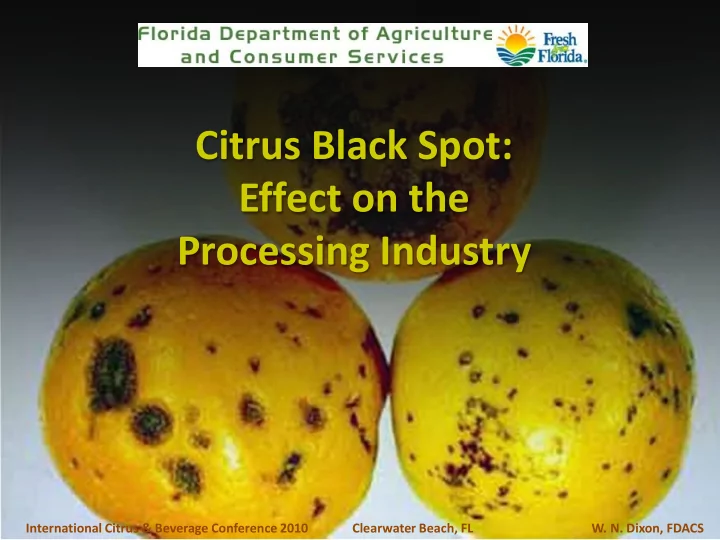
Citrus Black Spot: Effect on the Processing Industry International - - PowerPoint PPT Presentation
Citrus Black Spot: Effect on the Processing Industry International Citrus & Beverage Conference 2010 Clearwater Beach, FL W. N. Dixon, FDACS Citrus Black Spot: Effect on Processing Industry
International Citrus & Beverage Conference 2010 Clearwater Beach, FL W. N. Dixon, FDACS
Citrus Black Spot: Effect on Processing Industry
International Citrus & Beverage Conference 2010 Clearwater Beach, FL
(G. mangiferae -- saprophyte)
Citrus Black Spot: Effect on Processing Industry
International Citrus & Beverage Conference 2010 Clearwater Beach, FL
Citrus Black Spot: Effect on Processing Industry
International Citrus & Beverage Conference 2010 Clearwater Beach, FL
Citrus Black Spot: Effect on Processing Industry
International Citrus & Beverage Conference 2010 Clearwater Beach, FL
Citrus Black Spot: Effect on Processing Industry
International Citrus & Beverage Conference 2010 Clearwater Beach, FL
Citrus Black Spot: Effect on Processing Industry
International Citrus & Beverage Conference 2010 Clearwater Beach, FL
Citrus Black Spot: Effect on Processing Industry
International Citrus & Beverage Conference 2010 Clearwater Beach, FL
Citrus Black Spot: Effect on Processing Industry
International Citrus & Beverage Conference 2010 Clearwater Beach, FL
Freckle Spot Virulent Spot Hard Spot
Early Symptoms of Citrus Black Spot
International Citrus & Beverage Conference 2010 Clearwater Beach, FL
Citrus Black Spot: Effect on Processing Industry
Citrus Black Spot: Effect on Processing Industry
International Citrus & Beverage Conference 2010 Clearwater Beach, FL
Freckle Spot Virulent Spot Hard Spot
Citrus Black Spot: Effect on Processing Industry
International Citrus & Beverage Conference 2010 Clearwater Beach, FL
Citrus Black Spot: Effect on Processing Industry
International Citrus & Beverage Conference 2010 Clearwater Beach, FL
Citrus Black Spot: Effect on Processing Industry
International Citrus & Beverage Conference 2010 Clearwater Beach, FL
Citrus Black Spot: Effect on Processing Industry
International Citrus & Beverage Conference 2010 Clearwater Beach, FL
Citrus Black Spot: Effect on Processing Industry
International Citrus & Beverage Conference 2010 Clearwater Beach, FL
Citrus Black Spot: Effect on Processing Industry
International Citrus & Beverage Conference 2010 Clearwater Beach, FL
Grove Multiblocks in Citrus Black Spot Regulated Areas:
TRS 47-29-15, mb7 TRS 47-29-14, mb4 TRS 47-29-22, mb1, mb2, mb3, mb4 TRS 47-29-23, mb1, mb2, mb3, mb4, mb5 TRS 47-29-24, mb2, mb3, mb4 TRS 47-29-25, mb1, mb2 TRS 47-29-27, mb1, mb2, mb3, mb4 TRS 47-29-26, mb1, mb2, mb3, mb4 TRS 47-29-28, mb3 TRS 47-29-34, mb1, mb2, mb3, mb4, mb5, mb6, mb7, mb8, mb9, mb10 TRS 47-29-35, mb1, mb5, mb6, mb7 TRS 48-29-03, mb1, mb2, mb3, mb4, mb5, mb6, mb7, mb8 TRS 48-29-02, mb11 TRS 48-29-01, multi-blocks 1 to 24 TRS 48-30-06, mb1, mb2, mb3 TRS 48-29-10, mb1, mb2, mb3, mb4, mb5, mb6, mb7, mb8, mb9, mb10, mb11 TRS 48-29-11, mb1, mb3, mb4, mbIMM001, mbIMM002 TRS 48-29-12, mb1, mb2, mb3, mb4, mb5, mb6 TRS 48-29-13, mb9 TRS 48-29-15, mb6 TRS 46-31-35, mb3, mb4, mb6 TRS 46-31-36, mb1, mb2, mb3, mb4 TRS 47-31-01, mb1, mb2, mb3, mb4 TRS 47-31-02, mb1, mb2, mb3 TRS 47-31-12, mb1 TRS 47-32-06, mb1, mb2
Citrus Black Spot: Effect on Processing Industry
International Citrus & Beverage Conference 2010 Clearwater Beach, FL
Citrus Black Spot: Effect on Processing Industry
International Citrus & Beverage Conference 2010 Clearwater Beach, FL
Requirements for Movement of Citrus Fruit from Regulated Areas:
All vehicles with an open trailer or cargo area transporting Florida citrus that
cover the load in a manner to preclude the loss of citrus fruit, stems, leaves Solid wall construction on sides and rear of the cargo area - tarp on open top Side and rear wall construction of wire mesh screen or expanded metal greater than 3/4 x 1-11/16 inch must have the cargo area covered completely Pallet boxes, field boxes, must have the cargo area covered in a manner that does not allow any openings greater than ½ inch exposing the fruit. Covers or tarpaulins may be constructed of any fabric that has a weave of less than ½ inch
Citrus Black Spot: Effect on Processing Industry
International Citrus & Beverage Conference 2010 Clearwater Beach, FL
Requirements for Movement of Citrus Fruit from Regulated Areas:
When plant material comes directly in contact with the vehicle, the vehicle must be decontaminated following movement Upon departing any citrus grove, all personnel and equipment must be cleaned free of fruit, limbs, leaves, soil and debris prior to chemical decontamination Identity of each load of fruit must be maintained by issuing an individually numbered trip ticket
Citrus Black Spot: Effect on Processing Industry
International Citrus & Beverage Conference 2010 Clearwater Beach, FL
Requirements for Processors that Receive Fruit from Regulated Area: Processors receiving fruit from the Citrus Black Spot regulated area will be under an Emergency Action Notification (EAN) Shipments of fruit originating from an EAN-regulated citrus black spot area are subject to regulation, and all activities must be reported to PPQ prior to the fruit dump process and the handling of regulated debris. This includes the assurance of tarped trucks upon arrival and USDA, PPQ supervision of the removal and handling of plant debris and trailer decontamination
Citrus Black Spot: Effect on Processing Industry
International Citrus & Beverage Conference 2010 Clearwater Beach, FL
Requirements for Processors Receiving Fruit from Regulated Area:
After shipments are emptied at the processing plant , trailers, tarps, field boxes, and field bins must be cleaned of all leaves and other plant debris: Heat treated to at least 180 degrees F for a period of at least 1 hour or Incinerated or Buried at a landfill to a depth of at least six feet After being emptied at the processing plant and cleaned of plant debris, trailers, field boxes or bins must be disinfected using: Quaternary Ammonia at label rates; or Sodium Hypochlorite at 200 parts per million with a pH of 6.0 to 7.5; Peroxyacetic Acid (PAA) at label rates
Citrus Black Spot: Effect on Processing Industry
International Citrus & Beverage Conference 2010 Clearwater Beach, FL
Citrus Black Spot: Effect on Processing Industry
International Citrus & Beverage Conference 2010 Clearwater Beach, FL
Citrus Black Spot: Effect on Processing Industry
International Citrus & Beverage Conference 2010 Clearwater Beach, FL
Originally 4 declarations which were redeveloped into another 4 declarations
Citrus Black Spot: Effect on Processing Industry
International Citrus & Beverage Conference 2010 Clearwater Beach, FL
County PPQ Contact
Polk John Hadman 863-421-4131 Broward David Petendree 954-797-6943 Indian River Buddy Cheslock 772-562-9014 X409 Martin Carl Lightfoot 772-429-2045
Carl Lightfoot 772-429-2045 Desoto Steve Bonstedt 941-358-6409 X16 Hendry Stephanie Burgess 239-278-7520 Lee Stephanie Burgess 239-278-7520 Manatee Steve Bonstedt 941-358-6409 X16
(which is close to ruination) .
International Citrus & Beverage Conference 2010 Clearwater Beach, FL
Citrus Black Spot: Effect on Processing Industry
International Citrus & Beverage Conference 2010 Clearwater Beach, FL
Citrus Black Spot: Effect on Processing Industry
International Citrus & Beverage Conference 2010 Clearwater Beach, FL
Citrus black spot fruit lesions can be somewhat variable in appearance depending on age and host, but most lesions are 1-5 mm in diameter and irregularly distributed on the fruit peel (Figs.1 -2). A dark reddish-brown raised border encloses a light brown imbedded necrotic lesion which can contain black fruiting bodies, which are pycnidia of the anamorph, Phyllosticta citricarpa. This is known as the “hard spot” lesion; it is distinctive enough to serve for field identification after some training. Conidia from these pycnidia are water-splash
“freckle spot” or “false melanose” (Fig. 3), and also a larger, more diffuse and confluent necrotic lesion called “virulent spot” (Fig. 4). So far, mostly hard spot lesions and the less conspicuous freckle spot lesions have been observed in Florida. Leaf symptoms while on the tree are absent to relatively minor with this disease, but as quiescently infected leaves abscise and decay on the orchard floor, they provide much of the inoculum in the form of air-borne ascospore for new infections (McOnie 1967). Twigs and old peduncles cansupport the pathogen too, though direct damage to these parts is not a major component of this disease. Ascospores from perithecia in the decaying leaves are discharged into the air during the onset
spring and summer.