Neutrophils (a.k.a. leukocyte, granulocyte, white blood cell, - - PowerPoint PPT Presentation

neutrophils a k a leukocyte granulocyte white blood cell
SMART_READER_LITE
LIVE PREVIEW

Neutrophils (a.k.a. leukocyte, granulocyte, white blood cell, - - PowerPoint PPT Presentation

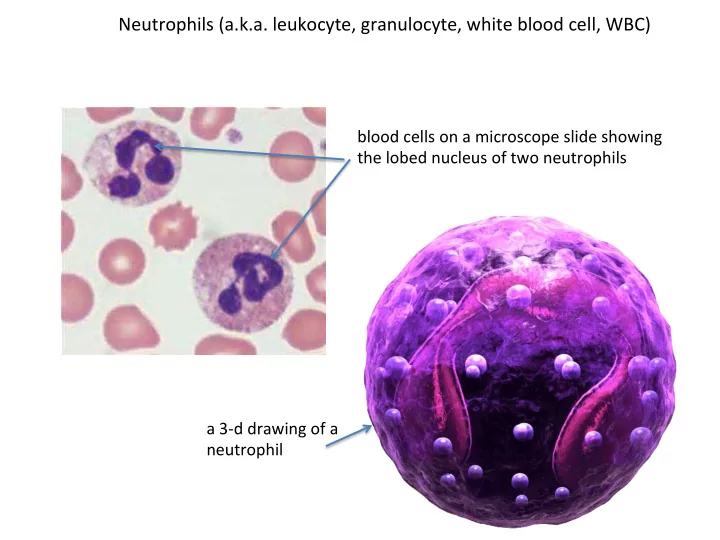
Neutrophils (a.k.a. leukocyte, granulocyte, white blood cell, WBC) blood cells on a microscope slide showing the lobed nucleus of two neutrophils a


slide-1
SLIDE 1

Neutrophils ¡(a.k.a. ¡leukocyte, ¡granulocyte, ¡white ¡blood ¡cell, ¡WBC) ¡ ¡

blood ¡cells ¡on ¡a ¡microscope ¡slide ¡showing ¡ the ¡lobed ¡nucleus ¡of ¡two ¡neutrophils ¡ a ¡3-­‑d ¡drawing ¡of ¡a ¡ neutrophil ¡

slide-2
SLIDE 2

By ¡Mikael ¡Häggström ¡

This ¡chart ¡shows ¡how ¡blood ¡cells ¡are ¡produced ¡in ¡the ¡bone ¡marrow ¡from ¡“stem ¡cells” ¡and ¡ ¡ how ¡we ¡organize ¡them ¡into ¡groups. ¡

slide-3
SLIDE 3

“Neutrophils ¡and ¡neutrophil-­‑like ¡cells ¡are ¡the ¡ major ¡pathogen-­‑fighKng ¡immune ¡cells ¡in ¡

  • rganisms ¡ranging ¡from ¡slime ¡molds ¡to ¡
  • mammals. ¡Central ¡to ¡their ¡funcKon ¡is ¡their ¡

ability ¡to ¡be ¡recruited ¡to ¡sites ¡of ¡infecKon, ¡to ¡ recognize ¡and ¡phagocytose ¡(eaKng ¡foreign ¡

  • bjects ¡like ¡bacteria) ¡microbes, ¡and ¡then ¡to ¡kill ¡

pathogens ¡through ¡a ¡combinaKon ¡of ¡cytotoxic ¡ mechanisms.” ¡ ¡ The ¡Mul(faceted ¡Func(ons ¡of ¡Neutrophils ¡ Tanya ¡N. ¡Mayadas,1 ¡Xavier ¡Cullere,1 ¡and ¡Clifford ¡A. ¡Lowell2 ¡ ¡

slide-4
SLIDE 4

Form ¡

  • average ¡diameter ¡of ¡12-­‑15 ¡micrometers ¡(µm) ¡in ¡peripheral ¡blood ¡smears ¡
  • in ¡suspension, ¡neutrophils ¡have ¡an ¡average ¡diameter ¡of ¡8.85 ¡µm ¡
  • ¡mulK-­‑lobed ¡shape ¡nucleus ¡
  • survive ¡for ¡only ¡8–12 ¡h ¡in ¡the ¡circulaKon ¡and ¡up ¡to ¡1–2 ¡days ¡in ¡Kssues ¡
  • Neutrophils ¡will ¡show ¡increasing ¡segmentaKon ¡(many ¡segments ¡of ¡nucleus) ¡as ¡they ¡
  • mature. ¡A ¡normal ¡neutrophil ¡should ¡have ¡3-­‑5 ¡segments. ¡
  • Neutrophils ¡account ¡for ¡approximately ¡50-­‑70% ¡of ¡all ¡white ¡blood ¡cells ¡(leukocytes) ¡

Func(on ¡ ¡

  • first ¡line ¡of ¡host ¡defense ¡against ¡a ¡wide ¡range ¡of ¡infecKous ¡pathogens ¡including ¡bacteria, ¡

fungi, ¡and ¡protozoa ¡

  • Neutrophils are generated at a rate of 1011 per day, which can increase to 1012 per day

during bacterial infection.

  • Researchers ¡once ¡believed ¡that ¡neutrophils ¡were ¡present ¡only ¡during ¡the ¡most ¡acKve ¡

phase ¡of ¡an ¡infecKon, ¡funcKoning ¡as ¡pathogen ¡killers. ¡ ¡We ¡now ¡know ¡that ¡neutrophils ¡ can ¡regulate ¡the ¡immune ¡system ¡by ¡acKvaKng ¡and ¡working ¡with ¡other ¡immune ¡cells. ¡

This ¡info ¡came ¡from ¡Wikipedia ¡

slide-5
SLIDE 5

Taken ¡from: ¡The ¡Mul(faceted ¡Func(ons ¡of ¡Neutrophils ¡ Tanya ¡N. ¡Mayadas,1 ¡Xavier ¡Cullere,1 ¡and ¡Clifford ¡A. ¡Lowell2 ¡ ¡