Neutrino Astronomy at the South Pole Neutrino Astronomy at the South - - PowerPoint PPT Presentation

neutrino astronomy at the south pole neutrino astronomy
SMART_READER_LITE
LIVE PREVIEW

Neutrino Astronomy at the South Pole Neutrino Astronomy at the South - - PowerPoint PPT Presentation

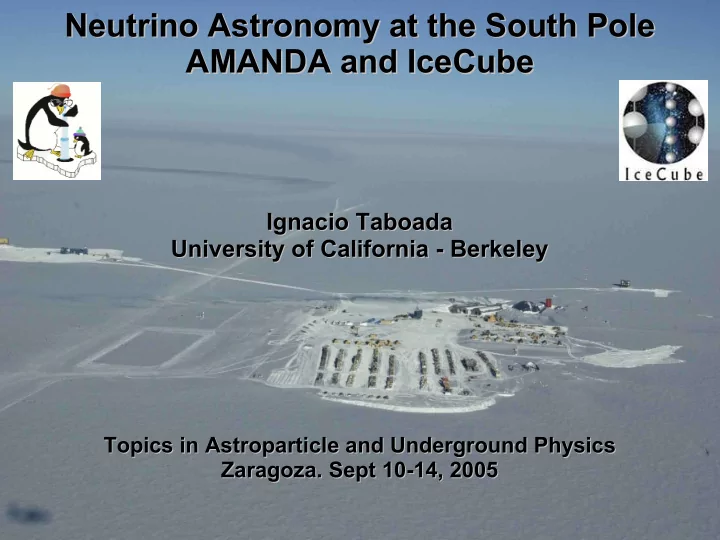
1 Neutrino Astronomy at the South Pole Neutrino Astronomy at the South Pole AMANDA and IceCube AMANDA and IceCube Ignacio Taboada Ignacio Taboada University of California - Berkeley University of California - Berkeley Topics in


slide-1
SLIDE 1

1

  • I. Taboada

TAUP-2005. Zaragoza

Neutrino Astronomy at the South Pole Neutrino Astronomy at the South Pole AMANDA and IceCube AMANDA and IceCube

Ignacio Taboada Ignacio Taboada University of California - Berkeley University of California - Berkeley

Topics in Astroparticle and Underground Physics Topics in Astroparticle and Underground Physics

  • Zaragoza. Sept 10-14, 2005
  • Zaragoza. Sept 10-14, 2005
slide-2
SLIDE 2

2

  • I. Taboada

TAUP-2005. Zaragoza

USA:

Bartol Research Institute University of Alabama Pennsylvania State University University of California – Berkeley University of California – Irvine Clark-Atlanta University University of Maryland Institute for Advanced Study University of Wisconsin-Madison University of Wisconsin-River Falls Lawrence Berkeley National Lab University of Kansas Southern University and A&M College

Sweden:

Uppsala Universitet Stockholm Universitet

In March 2005, AMANDA merged into the IceCube collaboration

UK:

Imperial College Oxford University

Netherlands:

Utrecht University

Belgium:

Université Libre de Bruxelles Vrije Universiteit Brussel Universiteit Gent Université de Mons-Hainaut

Germany:

Humboldt Universität Universität Mainz DESY-Zeuthen Universität Dortmund Universität Wuppertal Universität Berlin

Japan:

Chiba University

New Zealand:

University of Canterbury

The IceCube Collaboration The IceCube Collaboration

Antarctica:

Amundsen Scott South Pole Station

slide-3
SLIDE 3

3

  • I. Taboada

TAUP-2005. Zaragoza

Explained by SN Unexplained

Astronomical Messengers:

Neutrinos Neutrinos: Not absorbed, not

  • deflected. Small cross section

→ Big Detectors Needed

Protons

  • Protons. Deflected by

Magnetic fields. Absorbed GZK

Photons

  • Photons. Not deflected. Absorbed

E> 10 TeV (IR) and E>10 PeV (3K)

Neutrino Astronomy Neutrino Astronomy

Candidate sources:

SN remnants, Quasars

Active Galactic Nuclei

Gamma Ray Bursts

Exotics Guaranteed sources:

  • Atmospheric neutrinos (from π & K decay)
  • Galactic plane:

CR interacting with ISM, concentrated on the disk

  • GZK

p γ γ   ∆+  n π+ (p π0)

slide-4
SLIDE 4

4

  • I. Taboada

TAUP-2005. Zaragoza

Neutrino Detection in Antarctic Ice Neutrino Detection in Antarctic Ice

Θ μν≈0.7°⋅Eν/TeV−0.7

O(10 m) cascades O(km) muons ~15 m Event reconstruction by Cherenkov light timing

Average Ice Properties

λabs ~ 110 m @ 400 nm λsca ~ 20 m @ 400 nm Most transparent natural solid known

slide-5
SLIDE 5

5

  • I. Taboada

TAUP-2005. Zaragoza

Amundsen-Scott South Pole Station Amundsen-Scott South Pole Station

South Pole South Pole Dome Dome Summer camp Summer camp AMANDA AMANDA

Road to work Road to work

1500 m 1500 m 2000 m 2000 m

[not to scale] [not to scale]

IceCube IceCube

S k y w a y S k y w a y

slide-6
SLIDE 6

6

  • I. Taboada

TAUP-2005. Zaragoza

AMANDA AMANDA

PMT noise: ~1 kHz AMANDA-B10

(inner core of AMANDA-II)

10 strings 302 OMs

Data years: 1997-99

Optical Module

“Up-going”

(from Northern sky)

“Down-going”

(from Southern sky)

AMANDA-II 19 strings 677 OMs

Data years: 2000 –

AMANDA-B4

(first 4-string prototype)

4 strings 80 OMs

Data years: 1996

1996 1997 2000

What’s up? W e

We use the Earth as a filter for down-going atmospheric muons

slide-7
SLIDE 7

7

  • I. Taboada

TAUP-2005. Zaragoza

Results shown in this talk:

✔ Atmospheric neutrinos ✔ Searches for extra-terrestrial fluxes ✔ Neutrino Diffuse fluxes ✔ Neutrino Point sources ✔ Neutrinos from the galactic plane ✔ Neutrinos from GRBs ✔ SNe in the Milky Way

Other results:

✔ Searches for WIMPs: Sun/Earth center ✔ Atmospheric muon spectrum ✔ Cosmic Ray composition ✔ Search for magnetic monopoles ✔ Many others ...

AMANDA Physics Topics AMANDA Physics Topics

Agreed collaboration strategy: Blind Analyses

slide-8
SLIDE 8

8

  • I. Taboada

TAUP-2005. Zaragoza

Atmospheric Neutrinos Atmospheric Neutrinos

E2Φνμ(E) < 2.6·10–7 GeV cm-2 s-1 sr-1 Set limit on cosmic neutrino flux: How much E-2 cosmic ν - signal allowed within uncertainty of highest energy bins? Limit on diffuse E-2 ν

μ flux (100 -300 TeV):

Atmospheric neutrinos:

  • Guaranteed test beam
  • Background for other searches

✔ Neural Network energy

reconstruction of up-going µ's

✔ Regularized unfolding

→ ν energy spectrum

slide-9
SLIDE 9

9

  • I. Taboada

TAUP-2005. Zaragoza

Diffuse fluxes Diffuse fluxes

UHE: UHE: E Eν

ν > P eV

> P eV

  • Earth opaque

Earth opaque

  • Search in the upper

Search in the upper hemisphere and close to hemisphere and close to the horizon the horizon

  • Bright events: many hit

Bright events: many hit OMs with several hits/OM OMs with several hits/OM

  • Energy-related

Energy-related variables best handle variables best handle

  • f analysis
  • f analysis
  • Limit from 1997.

Limit from 1997. Sensitivity from 2000. Sensitivity from 2000. HE HE: TeV < E : TeV < Eν

ν < PeV

< PeV

  • Use directionality +

Use directionality + energy-related variables energy-related variables to reject atm to reject atm µ µ background background

  • Search confined to up-

Search confined to up- going tracks going tracks

  • Use high-quality tracks

Use high-quality tracks

  • Limits from 1997 and

Limits from 1997 and 2000-2003 2000-2003 HE: HE: TeV < E TeV < Eν

ν < PeV

< PeV

  • 4

4π π search search

  • Background: brem. from

Background: brem. from down-going muons down-going muons

  • Limits from 1997, 1999

Limits from 1997, 1999 and 2000 and 2000

νµ Search All flavor search

Signal Background

Limits that assume Limits that assume ν νe

e:

:ν νµ

µ:

:ν ντ

τ :: 1:1:1

:: 1:1:1 All flavor search Limits on Limits on ν νµ

µ

slide-10
SLIDE 10

10

  • I. Taboada

TAUP-2005. Zaragoza

Diffuse fluxes: Summary Diffuse fluxes: Summary

slide-11
SLIDE 11

11

  • I. Taboada

TAUP-2005. Zaragoza

Neutrino Point Sources Neutrino Point Sources

  • Search for excesses of events compared to

the background from:

  • The Northern sky
  • A set of selected candidate sources
  • Cuts optimized by declination bands
  • Require good pointing resolution

(good quality events)

  • Background estimated from exp. data with

randomized α (i.e. time)

  • Sensitivity ~ flat up to horizon
  • Significant improvement w.r.t. first analysis

with AMANDA-B10

average flux upper limit [cm-2s-1]

sin(δ)

AMANDA-B10 AMANDA-II

Average upper limit = sensitivity (δ>0°) (integrated above 10 GeV, E-2 signal) Declination averaged sensitivity Declination averaged sensitivity for a E for a Eν

ν

  • 2
  • 2 spectrum and E

spectrum and Eν

ν > 10 GeV

> 10 GeV

Φν

lim ~ 0.6·10-8 cm-2s-1

δ declination

δ=0o → (horizontal) δ=90o ↑ (vertical)

At the south pole:

slide-12
SLIDE 12

12

  • I. Taboada

TAUP-2005. Zaragoza

Neutrino Point Sources Neutrino Point Sources

Maximum significance: 3.4 σ

Data from 2000-2003 (807 days) 3369 ν from northern hemisphere 3438 ν expected from atmosphere

Event selection optimized for both E-2 & E-3 spectra

Probability of a background fluctuation: 92 %

slide-13
SLIDE 13

13

  • I. Taboada

TAUP-2005. Zaragoza

Neutrino Point Sources Neutrino Point Sources

0.21 4.50 2 SS433 1.25 5.36 10 Crab Nebula 0.40 5.21 4 Cygnus X-1 0.77 5.04 6 Cygnus X-3 0.38 3.71 5 1ES1959+650 0.68 5.58 6 Markarian 421 Flux Upper Limit Φ90%(Eν>10 GeV) [10-8cm-2s-1] Expected bckg (4 years) # of ν events (4 years) Source Selected objects and full scan of the northern sky: No statistically significant effect observed

… out of 33 Sources Systematic uncertainties under investigation Sensitivity Φν/Φγ~2 for 200 days of “high-state” and spectral results from HEGRA

Crab Nebula: The chance probability

  • f such an excess

(or higher) given the number of trials is 64%

Preliminary

On-Source Off-Source

We have also performed a time-dependent search for specific sources. No evidence of sources found.

slide-14
SLIDE 14

14

  • I. Taboada

TAUP-2005. Zaragoza

Neutrinos from the Galactic Plane Neutrinos from the Galactic Plane

  • Location of AMANDA not optimal  reach only
  • uter region of the galactic plane: 33o < δ < 213o
  • Three signal ansatz:

Line source, Gaussian source, Diffuse source

  • Limits include systematic uncertainty
  • f 30% on atm. ν flux
  • Energy range: 0.2 to 40 TeV

On-source region On-source events Expected bckg.

Limit

2o 4.4o 128 271 129.4 283.3

6.4x10⁻⁵ (line) GeV-1cm-2s-1rad-1 6.6x10⁻⁴ (diffuse) GeV-1cm-2s-1sr-1 4.8x10⁻⁴ (gauss) GeV-1cm-2s-1sr-1

  • Gaus. limit

Model

slide-15
SLIDE 15

15

  • I. Taboada

TAUP-2005. Zaragoza

  • Several search techniques:
  • Muons
  • Coincident with T90
  • Precursor
  • Cascades
  • Coincident with T90
  • Rolling time window
  • Bckg Measurement &

Stability ±1 hour from burst

Neutrinos from GRBs Neutrinos from GRBs

Low background analysis due to time and directional coincidence

E2dΦν/dE = 2.7 · 10-6 GeV cm-2s-1sr-1

Rolling window

(425) '01

(Assuming Razzaque et. al. model)

E2dΦν/dE = 5 · 10-8 GeV cm-2 s-1 sr-1

IPN bursts

50 '01 - '03

E2dΦν/dE = 9.5 · 10-7 GeV cm-2s-1sr-1

BATSE triggered bursts

73 '00

E2dΦν/dE = 3 · 10-8 GeV cm-2 s-1 sr-1

BATSE & IPN bursts

139 '00 - '03

BATSE triggered bursts

from

E2dΦν/dE = 4 · 10-8 GeV cm-2s-1 sr-1

312 '97 - '00

Preliminary 90%CL limit / sensitivity assuming WB spectrum (EB at 100 TeV and Γ = 300)

# GRB year

T90 10 min 1 hour 1 hour 110 s

time

Off-Time Precursor On Time Always Blind A search for νµ in coincidence with GRB030329 has also been made

slide-16
SLIDE 16

16

  • I. Taboada

TAUP-2005. Zaragoza

Supernovae Supernovae

90 000 light years SMC LMC

Approximate AMANDA horizon Crab Nebula Sun

  • Cassiopeia. A

Cygnus-X1

  • Burst of low-energy

(MeV) neutrinos from core-collapse supernovae

  • Global PMT noise rate

increase due to νe + p → e+ + n

  • Low energy O(MeV)

track: no pointing

  • Monitor stable subset
  • f Optical Modules
  • Special DAQ
  • 92% (mass) coverage
  • f the Galaxy
  • AMANDA part of

SNEWS alert network

slide-17
SLIDE 17

17

  • I. Taboada

TAUP-2005. Zaragoza

IceCube Observatory IceCube Observatory

AMANDA

Firn Ice 2450 m 1450 m 324 m

IceCube: deep ice array

 80 Strings / 60 DOMs each  17 m DOM spacing  125 m between strings  1 km3 instrumented

IceTop: air shower array

✔ 80 Stations / 2 Tanks each ✔ 2 DOMs per tank ✔ 125 m grid, 1 km2 at 690 g/cm2 ✔ Ethres ~ 300 TeV for ≥ 4 stations ✔ Useful rate up to ~EeV

Digital Optical Module

50 m

PMT Noise 700 Hz

slide-18
SLIDE 18

18

  • I. Taboada

TAUP-2005. Zaragoza

IceCube Status IceCube Status

1 In-Ice String 1 In-Ice String with 60 DOMs deployed

with 60 DOMs deployed

4 IceTop Stations 4 IceTop Stations / 8 Tanks / 16 DOMs

/ 8 Tanks / 16 DOMs

An IceTop Station: Two tanks An In-Ice DOM being lowered into the ice

slide-19
SLIDE 19

19

  • I. Taboada

TAUP-2005. Zaragoza

An IceCube-IceTop Event An IceCube-IceTop Event

4 IceTop Stations D e p l

  • y

e d S t r i n g AMANDA

slide-20
SLIDE 20

20

  • I. Taboada

TAUP-2005. Zaragoza

IceCube Outlook IceCube Outlook

  • Season 2005/2006:

– Up to 12 new strings to be deployed – Up to 16 new stations to be deployed

  • Instrumented volume would be ~10 times

larger than that of AMANDA-II

  • Detector to finish construcion by 2009/2010
slide-21
SLIDE 21

21

  • I. Taboada

TAUP-2005. Zaragoza

Summary Summary

  • Many results from AMANDA-B10 and AMANDA-II
  • n multiple physics topics
  • Results from combined 2000-2003 analyses
  • No evidence for extraterrestrial neutrinos yet
  • First IceCube string and 4 IceTop stations deployed

and taking data

  • IceCube will significantly improve astrophysics and

cosmic ray measurements