Notes Time scales [work out] For using Pixie (the renderer) make - - PowerPoint PPT Presentation

notes time scales
SMART_READER_LITE
LIVE PREVIEW

Notes Time scales [work out] For using Pixie (the renderer) make - - PowerPoint PPT Presentation

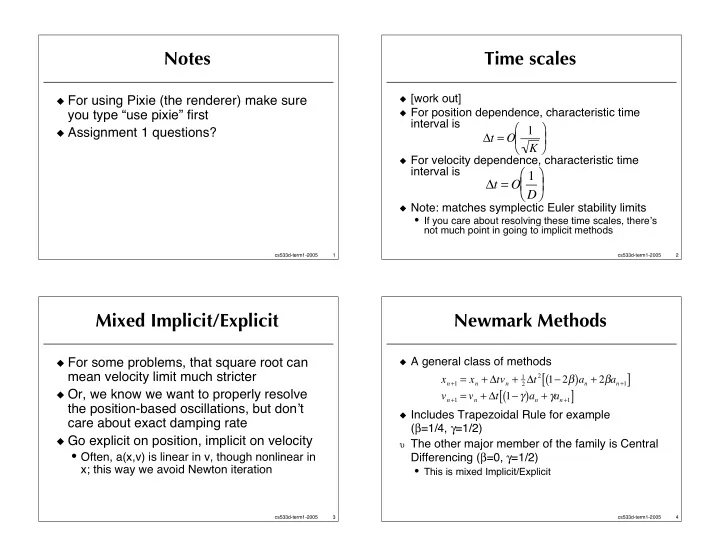
Notes Time scales [work out] For using Pixie (the renderer) make sure For position dependence, characteristic time you type use pixie first interval is 1 Assignment 1 questions? t = O K For


slide-1
SLIDE 1

1 cs533d-term1-2005

Notes

For using Pixie (the renderer) make sure

you type “use pixie” first

Assignment 1 questions?

2 cs533d-term1-2005

Time scales

[work out] For position dependence, characteristic time

interval is

For velocity dependence, characteristic time

interval is

Note: matches symplectic Euler stability limits

  • If you care about resolving these time scales, theres

not much point in going to implicit methods

t = O 1 K

  • t = O 1

D

  • 3

cs533d-term1-2005

Mixed Implicit/Explicit

For some problems, that square root can

mean velocity limit much stricter

Or, we know we want to properly resolve

the position-based oscillations, but dont care about exact damping rate

Go explicit on position, implicit on velocity

  • Often, a(x,v) is linear in v, though nonlinear in

x; this way we avoid Newton iteration

4 cs533d-term1-2005

Newmark Methods

A general class of methods Includes Trapezoidal Rule for example

(=1/4, =1/2)

The other major member of the family is Central

Differencing (=0, =1/2)

  • This is mixed Implicit/Explicit

xn+1 = xn + tvn + 1

2 t 2 1 2

( )an + 2an+1

[ ]

vn+1 = vn + t 1

( )an + an+1

[ ]

slide-2
SLIDE 2

5 cs533d-term1-2005

Central Differencing

Rewrite it with intermediate velocity: Looks like a hybrid of:

  • Midpoint (for position), and
  • Trapezoidal Rule (for velocity - split into

Forward and Backward Euler half steps)

vn+ 12 = vn + 1

2 ta xn,vn

( )

xn+1 = xn + tvn+ 12 vn+1 = vn+ 12 + 1

2 ta xn+1,vn+1

( )

6 cs533d-term1-2005

Central: Performance

Constant acceleration: great

  • 2nd order accurate

Position dependence: good

  • Conditionally stable, no damping

Velocity dependence: good

  • Stable, but only conditionally monotone

Can we change the Trapezoidal Rule to

Backward Euler and get unconditional monotonicity?

7 cs533d-term1-2005

Staggered Implicit/Explicit

Like the staggered Symplectic Euler, but use

B.E. in velocity instead of F.E.:

Constant acceleration: great Position dependence: good (conditionally stable,

no damping)

Velocity dependence: great (unconditionally

monotone) vn+ 12 = vn 12 + 1

2 (tn+1 tn1)a xn,vn+ 12

( )

xn+1 = xn + tvn+ 12

8 cs533d-term1-2005

Summary (2nd order)

Depends a lot on the problem

  • Whats important: gravity, position, velocity?

Explicit methods from last class are probably bad Symplectic Euler is a great fully explicit method

(particularly with staggering)

  • Switch to implicit velocity step for more stability, if damping time

step limit is the bottleneck

Implicit Compromise method

  • Fully stable, nice behaviour
slide-3
SLIDE 3

9 cs533d-term1-2005

Example Motions

10 cs533d-term1-2005

Simple Velocity Fields

Can superimpose (add) to get more

complexity

Constants: v(x)=constant Expansion/contraction: v(x)=k(x-x0)

  • Maybe make k a function of distance |x-x0|

Rotation:

  • Maybe scale by a function of distance |x-x0| or

magnitude

v(x) = x x0

( )

x x0

( )

11 cs533d-term1-2005

Noise

Common way to perturb fields that are too

perfect and clean

Noise (in graphics) =

a smooth, non-periodic field with clear length- scale

Read Perlin, “Improving Noise”, SIGGRAPH02

  • Hash grid points into an array of random slopes that

define a cubic Hermite spline

Can also use a Fourier construction

  • Band limited signal
  • Better, more control, but (possibly much) more

expensive

  • FFT - check out www.fftw.org for one good

implementation

12 cs533d-term1-2005

Example Forces

Gravity: Fgravity=mg (a=g) If you want to do orbits Note x0 could be a fixed point (e.g. the Sun) or

another particle

  • But make sure to add the opposite and equal force to

the other particle if so!

Fgravity = GmM0 x x0 x x0

3

slide-4
SLIDE 4

13 cs533d-term1-2005

Drag Forces

Air drag: Fdrag=-Dv

  • If theres a wind blowing with velocity vw then

Fdrag=-D(v-vw)

D should be a function of the cross-section

exposed to wind

  • Think paper, leaves, different sized objects,

Depends in a difficult way on shape too

  • Hack away!

14 cs533d-term1-2005

Spring Forces

Springs: Fspring=-K(x-x0)

  • x0 is the attachment point of the spring
  • Could be a fixed point in the scene
  • …or somewhere on a characters body
  • …or the mouse cursor
  • …or another particle (but please add equal

and oppposite force!)

15 cs533d-term1-2005

Nonzero Rest Length Spring

Need to measure the “strain”:

the fraction the spring has stretched from its rest length L

Fspring = K x x0 L 1

  • x x0

x x0

16 cs533d-term1-2005

Spring Damping

Simple damping: Fdamp=-D(v-v0)

  • But this damps rotation too!

Better spring damping:

Fdamp=-D(v-v0)•u/L u

  • Here u is (x-x0)/|x-x0|, the spring direction

[work out 1d case] Critical damping: fastest damping possible

  • For individual springs, gives a good typical

damping force you can multiply by a factor

slide-5
SLIDE 5

17 cs533d-term1-2005

Collision and Contact

18 cs533d-term1-2005

Collision and Contact

We can integrate particles forward in time, have

some ideas for velocity or force fields

But what do we do when a particle hits an

  • bject?

No simple answer, depends on problem as

always

General breakdown:

  • Interference vs. collision detection
  • What sort of collision response: (in)elastic, friction
  • Robustness: do we allow particles to actually be

inside an object?

19 cs533d-term1-2005

Interference (=penetration)

  • Simply detect if particle has ended up inside object,

push it out if so

  • Works fine if [w=object width]
  • Otherwise could miss interaction, or push dramatically

the wrong way

  • The ground, thick objects and slow particles

Collision

  • Check if particle trajectory intersects object
  • Can be more complicated, especially if object is

moving too…

For now, lets stick with the ground (y=0)

vt < 1

2 w

Interference vs. Collision

20 cs533d-term1-2005

Repulsion Forces

Simplest idea (conceptually)

  • Add a force repelling particles from objects when they

get close (or when they penetrate)

  • Then just integrate: business as usual
  • Related to penalty method:

instead of directly enforcing constraint (particles stay

  • utside of objects), add forces to encourage

constraint

For the ground:

  • Frepulsion=-Ky when y<0 [think about gravity!]
  • …or -K(y-y0)-Dv when y<y0 [still not robust]
  • …or K(1/y-1/y0)-Dv when y<y0
slide-6
SLIDE 6

21 cs533d-term1-2005

Repulsion forces

Difficult to tune:

  • Too large extent: visible artifact
  • Too small extent: particles jump straight through, not

robust (or time step restriction)

  • Too strong: stiff time step restriction, or have to go

with implicit method - but Newton will not converge if we guess past a singular repulsion force

  • Too weak: wont stop particles

Rule-of-thumb: dont use them unless they really

are part of physics

  • Magnetic field, aerodynamic effects, …

22 cs533d-term1-2005

Collision and Contact

Collision is when a particle hits an object

  • Instantaneous change of velocity

(discontinuous)

Contact is when particle stays on object

surface for positive time

  • Velocity is continuous
  • Force is only discontinuous at start

23 cs533d-term1-2005

At point of contact, find normal n

  • For ground, n=(0,1,0)

Decompose velocity into

  • normal component vN=(v•n)n and
  • tangential component vT=v-vN

Normal response:

  • =0 is fully inelastic
  • =1 is elastic

Tangential response

  • Frictionless:

Then reassemble velocity v=vN+vT

vN

after = vN before,

0,1

[ ] vT

after = vT before

Frictionless Collision Response