Need a name / acronym ! GOAL : to build a consortium CERN Europe - - PowerPoint PPT Presentation

need a name acronym
SMART_READER_LITE
LIVE PREVIEW

Need a name / acronym ! GOAL : to build a consortium CERN Europe - - PowerPoint PPT Presentation

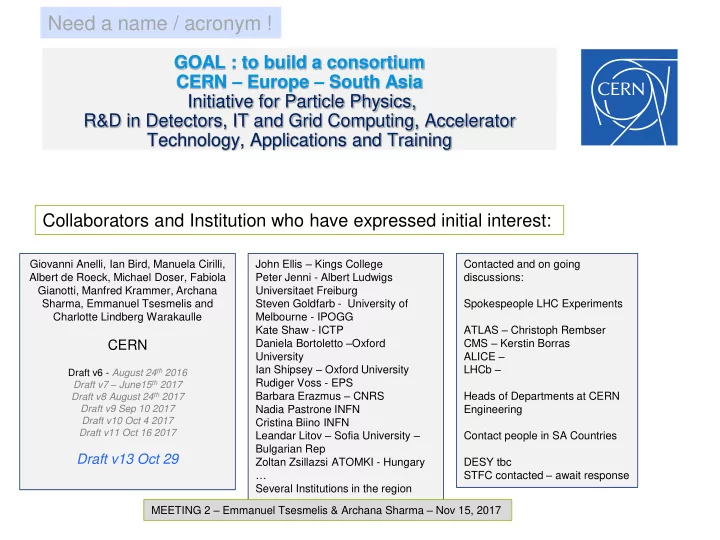
Need a name / acronym ! GOAL : to build a consortium CERN Europe South Asia Initiative for Particle Physics, R&D in Detectors, IT and Grid Computing, Accelerator Technology, Applications and Training Collaborators and Institution


slide-1
SLIDE 1

GOAL : to build a consortium CERN – Europe – South Asia Initiative for Particle Physics, R&D in Detectors, IT and Grid Computing, Accelerator Technology, Applications and Training

Need a name / acronym !

John Ellis – Kings College Peter Jenni - Albert Ludwigs Universitaet Freiburg Steven Goldfarb - University of Melbourne - IPOGG Kate Shaw - ICTP Daniela Bortoletto –Oxford University Ian Shipsey – Oxford University Rudiger Voss - EPS Barbara Erazmus – CNRS Nadia Pastrone INFN Cristina Biino INFN Leandar Litov – Sofia University – Bulgarian Rep Zoltan Zsillazsi ATOMKI - Hungary … Several Institutions in the region Giovanni Anelli, Ian Bird, Manuela Cirilli, Albert de Roeck, Michael Doser, Fabiola Gianotti, Manfred Krammer, Archana Sharma, Emmanuel Tsesmelis and Charlotte Lindberg Warakaulle

CERN

Draft v6 - August 24th 2016 Draft v7 – June15th 2017 Draft v8 August 24th 2017 Draft v9 Sep 10 2017 Draft v10 Oct 4 2017 Draft v11 Oct 16 2017

Draft v13 Oct 29

Contacted and on going discussions: Spokespeople LHC Experiments ATLAS – Christoph Rembser CMS – Kerstin Borras ALICE – LHCb – Heads of Departments at CERN Engineering Contact people in SA Countries DESY tbc STFC contacted – await response

Collaborators and Institution who have expressed initial interest:

MEETING 2 – Emmanuel Tsesmelis & Archana Sharma – Nov 15, 2017

slide-2
SLIDE 2

Mauritius

BHUTAN

Maldives

CERN -EU INDIA PAK

Sri Lanka Nepal Afghanistan Bangla Desh

Build a consortium SA Countries – CERN and European Institutions Associate Members in region take lead

4

slide-3
SLIDE 3

DRAFT Initial ideas for discussion of a Marie-Curie (RISE) R&D and Innovation Staff Exchange Proposal

WP2 R&D for Future Accelerator Applications

Large Area Fast Detectors Readout & Trigger Electronics

WP7 Linkages with Industry WP8 Education, training Disseminati

  • on &

Outreach

Project Management WP1

WP3 R&D Intelligent / Light Mechanical Engineering WP6 Detector technologies

Tracking Detectors

WP5 Advanced IT Computing And Services

Simulations for Complex Analytics and Algorithm Dev Procurements Linkages for WP2 to WP8 VLS Tomography Construction Feasibility Study Develop Business case for Medical Applications in Europe and South Asia Industries Novel Concept for Data Repositories

  • f physics

related digital

  • bjects, pubs

and s/w Cloud Computing for analysis reconstruction and simulation Feasibility study of tunable Ions Accelerators Video Tutorials, Media Events Interdisciplin ary (WP2-9) Outreach Events Service WP2,4,6,7

WP4 Development

  • f Software

Tools

Machine Learning Innovative DB Concepts

WP9 Building the case for Future Cancer Treatment with HEP Tools

Sharing Lessons learnt from European Health Management program Radiation Safety Training Education & Advanced Training Large systems FLUKA& GEANT Education & Training on Cancer Treatment & Hadron Therapy Training, dissemination and education Detector-School

Transversal Transversal Transversal Transversal

Developing Engineering Tools for very Large Scanner VLS Scanning: CT for mapping as built Experiments

Transversal

Developing Materials for Schools on FLUKA GEANT and DB mgmt R&D and Training on State of the art Cryogenics Novel high field magnets Training, dissemination and education Engineering Tools School

slide-4
SLIDE 4

WP2 R&D for Future Accelerator Applications

Large Area Fast Detectors Readout & Trigger Electronics Linkages with Industry

WP8 Education, training Dissemination & Outreach

Project Management WP1

WP3 R&D Intelligent / Light Mechanical Engineering WP6 Detector technologies

Tracking Detectors

WP5 Advanced IT Computing And Services

Simulations for Complex Analytics and Algorithm Dev Procurements Linkages for WP2 to WP8 Develop Business case for Medical Applications in Europe and South Asia Industries Novel Concept for Data Repositories of physics related digital objects, pubs and s/w Cloud Computing for analysis reconstruction and simulation Feasibility study of tunable Ion Accelerators Video Tutorials, Media Events Interdisciplinary Outreach Events Service for WP2,4,6,7

WP4 Development

  • f Software

Tools

Machine Learning Innovative DB Concepts

WP9 Building the case for Future Cancer Treatment with HEP Tools

Sharing Lessons learnt from European Health Management program Radiation Safety Training Large systems FLUKA& GEANT Developing Engineering Tools for very Large Scanner Developing Materials for Schools on FLUKA GEANT and DB mgmt State of the art Cryogenics Novel high field magnets

Training material to be converted into Reference Materials

Calorimetry VLS Tomography Construction Feasibility Study Training schools (Engineering, Detectors, Software, Instrumentation, Hadron therapy etc.)

Transversal Transversal Transversal Transversal WP7 Linkages with Industry

Suggestions for names

Status - after some discussions 14.11.2017 WP9 NON LHC Experiments

ISOTOPES nTOF ..

slide-5
SLIDE 5

WP2 R&D for Future Accelerator Applications

Large Area Fast Detectors Readout & Trigger Electronics

WP9 Education, training Dissemination & Outreach

Project Management WP1

WP3 R&D Intelligent / Light Mechanical Engineering

Tracking Detectors

WP5 Advanced IT Computing And Services

Simulations for Complex Analytics and Algorithm Dev Procurements Linkages for WP2 to WP8 Novel Concept for Data Repositories of physics related digital objects, pubs and s/w Cloud Computing for analysis reconstruction and simulation Feasibility study of tunable Ion Accelerators Video Tutorials, Media Events Interdisciplinary Outreach Events Service for WP2,4,6,7

WP4 Development

  • f Software

Tools

Machine Learning Innovative DB Concepts Radiation Safety Training Large systems FLUKA& GEANT Developing Engineering Tools for very Large Scanner Developing Materials for Schools on FLUKA GEANT and DB mgmt State of the art Cryogenics Novel high field magnets

Training material to be converted into Reference Materials

Calorimetry VLS Tomography Construction Feasibility Study Training schools (Engineering, Detectors, Software, Instrumentation, Hadron therapy etc.)

WP8 Linkages with Industry

Suggestions for names

Proposal

WP7 NON LHC Experiments

ISOTOPES nTOF .. Antimatter AD / COMPASS NA62/SHIP Can these be merged?

WP5 Detector technologies LHC Experiments & beyond

slide-6
SLIDE 6

WP2 R&D for Future Accelerator Applications

Large Area Fast Detectors Readout & Trigger Electronics

WP8 Education, training Dissemination & Outreach

Project Management WP1

WP3 R&D Intelligent / Light Mechanical Engineering WP5 Detector technologies LHC Experiments & beyond

Tracking Detectors Simulations for Complex Analytics and Algorithm Dev Procurements Linkages for WP2 to WP8 Novel Concept for Data Repositories of physics related digital objects, pubs and s/w Cloud Computing for analysis reconstruction and simulation Feasibility study of tunable Ion Accelerators Video Tutorials, Media Events Interdisciplinary Outreach Events Service for WP2,4,6,7

WP4 Development of Software Tools Advanced IT Computing And Services

Machine Learning Innovative DB Concepts Radiation Safety Training Large systems FLUKA& GEANT Developing Engineering Tools for very Large Scanner Developing Materials for Schools on FLUKA GEANT and DB mgmt State of the art Cryogenics Novel high field magnets

Training material to be converted into Reference Materials

Calorimetry VLS Tomography Construction Feasibility Study Training schools (Engineering, Detectors, Software, Instrumentation, Hadron therapy etc.)

WP7 Linkages with Industry

Suggestions for names

Proposal for discussion

WP6 NON LHC Experiments

ISOTOPES nTOF .. Antimatter AD / COMPASS NA62/SHIP Can these be merged?

slide-7
SLIDE 7

Archana Sharma 20-6-2017

Marie Skłodowska-Curie

Research and Innovation Staff Exchange (RISE)

EU Support Office

From Svet 1.11.2017

slide-8
SLIDE 8

Archana Sharma 20-6-2017

What is a RISE action?

8

The RISE scheme promotes international and inter-sector collaboration through research and innovation staff exchanges, and through sharing of knowledge and ideas from academia to industry (and vice-versa).

 To strengthen existing and build new networks of international and/or inter- sectoral cooperation  To significantly improve the interaction between organisations in the academic and non-academic sectors within Europe and worldwide  knowledge sharing  To broaden the career development of participating staff  exposure to other countries and sectors

Purpose

slide-9
SLIDE 9

Archana Sharma 20-6-2017

Financial aspects

9

UNIT COSTS = a fixed amount per person-month of secondment

Staff member unit cost = 2,000 € per person-month Institutional unit cost = 2,500 € per person-month  EU contribution = unit cost * person-months

Research, training & networking = 1,800 € Management & indirect costs = 700 €

Can be used to pay an additional top up allowance to the staff member to cover additional travel and subsistence costs, to organise additional training activities or horizontal networking events

RISE 540 PMs 2,000 € * 540 PMs = 1,080,000 1,800 € *540 PMs = 972,000 700 € *540 PMs = 378,000

 2,430,000 € max. grant

slide-10
SLIDE 10

Archana Sharma 20-6-2017

How to apply?

10

 Call opens = 22 November 2017  Deadline = 21 March 2018

slide-11
SLIDE 11

Archana Sharma 20-6-2017

TOWARDS WRITING A PROPOSAL

The success rate of the RISE proposals is of the order of ~ 25% The success rate at CERN is about 43 % 2 coordinated by CERN assisted by consultants; 1 coordinated by CERN written by CERN 3/7 successful Our preferred model – Coordinated by CERN, assisted by consultants Investigated the 3 successful consultant models

slide-12
SLIDE 12

Archana Sharma 20-6-2017

  • No. 1

Two stages – One upfront fee of 30,600 Euros If successful – An additional fee of 15,000 Euros TOTAL: 45,600 Euros No involvement after success Very competent very professional Company

slide-13
SLIDE 13

Archana Sharma 20-6-2017

  • No. 2

Single Stage – 130 Euro per hour –Estimate 200-300 Hours Approximate one time cost ~ 30,000 Euros No involvement after success Very competent very professional Individual With assistants

slide-14
SLIDE 14

Archana Sharma 20-6-2017

  • No. 3

Two stages – One upfront fee of 9,500 Euros If successful – partner as coordinator for project management and dissemination TOTAL: 90-110 K Euros Very competent very professional Company

slide-15
SLIDE 15

Archana Sharma 20-6-2017

Next Steps until Nov. 22

 Commitment / Expression of interest from each partner institute, group or

department

 WP’s and coordinators to be defined  Fair Share of months in WPs to be drafted  Sharing of months with students, doctoral, Professor, Post Doc, researcher  Definition of the Project management  Definition of budget outlay and cost profile 4 years  Define impact factor in each country Europe & South Asia  Definition of work plan for each package  Next meeting Dec 6 same time?

15

slide-16
SLIDE 16

Archana Sharma 20-6-2017

BACK UP

From Svet

slide-17
SLIDE 17

Archana Sharma 20-6-2017

RISE in practice

17

 the seconded staff member  who would acquire and/or transfer new knowledge and skills  the host organisation  who would establish new collaborations, reinforce cooperation, be exposed to innovative and international environment

Secondments should provide benefit to:

Applicants propose a joint R&I action, implemented through:

  • Secondments (main modality)
  • Training & networking activities: organising and taking part in

workshops, seminars, summer schools, conferences

Duration of RISE projects = up to 4 years

slide-18
SLIDE 18

Archana Sharma 20-6-2017

Eligibility of the partnership

18

Proposals should include at least three partners, which can be universities, research institutions or non-academic organisations, SMEs.

3 partners

from 3 different countries at least 2 of them must be established in different EU or associated countries Beneficiaries = legal entities established in EU or associated countries = signatories of the Grant Agreement Partner organisations = legal entities established in third countries (not EU nor associated countries) = not signatories of the Grant Agreement  they cannot directly claim costs to the EC, but they can receive financial contribution through a beneficiary for the eligible secondments

  • No maximum size for the number of participating organisations

 BUT maximum 540 person-months of EU funded secondments per action

slide-19
SLIDE 19

Archana Sharma 20-6-2017

Eligible countries for EC support to secondments

19

EU Member States

All

Countries Associated to H2020:

Iceland Norway Albania Bosnia and Herzegovina The former Yugoslav Republic

  • f Macedonia

Montenegro Serbia Turkey Israel Moldova Switzerland Faroe Islands Ukraine Tunisia Georgia Armenia

Certain third countries

Afghanistan Algeria American Samoa Angola Argentina Azerbaijan Bangladesh Belarus Belize Benin Bhutan Bolivia Botswana Burkina Faso Burundi Cambodia Cameroon Cape Verde Central African Republic Chad Chile Colombia Comoros Congo (Democratic People’s Republic) Congo (Republic) Costa Rica Côte d’Ivoire Cuba Djibouti Democratic People's Republic of Korea Dominica Dominican Republic Ecuador Egypt El Salvador Eritrea Ethiopia Fiji Gabon Gambia Ghana Grenada Guatemala Guinea Guinea-Buissau Guyana Haiti Honduras Indonesia Iran Iraq Jamaica Jordan Kazakhstan Kenya Kiribati Kosovo Kyrgyz Republic Lao Lebanon Lesotho Liberia Libya Madagascar Malawi Malaysia Maldives Mali Marshall Islands Mauritania Mauritius Micronesia Mongolia Morocco Mozambique Myanmar Namibia Nepal Nicaragua Niger Nigeria Pakistan Palau Palestine Panama Papua New Guinea Paraguay Peru Philippines Rwanda Samoa Sao Tome and Principe Senegal Seychelles Sierra Leone Solomon Islands Somalia South Africa South Sudan Sri Lanka

  • St. Kitts and Nevis
  • St. Lucia
  • St. Vincent and the Grenadines

Sudan Suriname Swaziland Syrian Arab Republic Tajikistan Tanzania Thailand Timor-Leste Togo Tonga Turkmenistan Tuvalu Uganda Uruguay Uzbekistan Vanuatu Venezuela Vietnam Yemen Zambia Zimbabwe

N.B. India is not eligible to receive EC support (for secondments to Europe). However, European secondments to Indian participants are eligible for support.

slide-20
SLIDE 20

Archana Sharma 20-6-2017

Rules for secondments

20

  • 1. Staff members (managerial, technical or administrative roles) of any nationality and any career

level can be seconded, as long as they are actively engaged or linked to R&D activities. eligible staff categories: researchers, managers, technicians, as well as PhD candidates that have a contract with the sending organisation

  • 2. Staff members must have been at the sending institution for at least 6 months prior to the first

secondment.

  • 3. For the duration of the secondment, the staff member should have a link with the sending
  • rganisation to ensure the implementation of activities in compliance with the Grant Agreement.
  • 4. A seconded staff member should be devoted full-time to the action during the secondment period.
  • Total duration of secondments per individual staff member: max 12 months, min 1 month, which can

be split in multiple stays

  • Staff members must return to the sending organisation after the secondment to pass on their

knowledge.

slide-21
SLIDE 21

Archana Sharma 20-6-2017

Eligible secondments

21

Intra-European

Academic ↔ Academic Academic ↔ Non-academic Non-academic ↔ Non-academic

International

European beneficiary → Third country participant (without sector restriction) Third country participant → European beneficiary (without sector restriction) Third country participant ↔ Third country participant

Only if the third country is eligible for funding

For the purpose of MSCA, the EC defines participants as belonging to either academic or non-academic sectors