
SLIDE 1
Natural Areas & Community Amenities Workshop
January 26, 2019
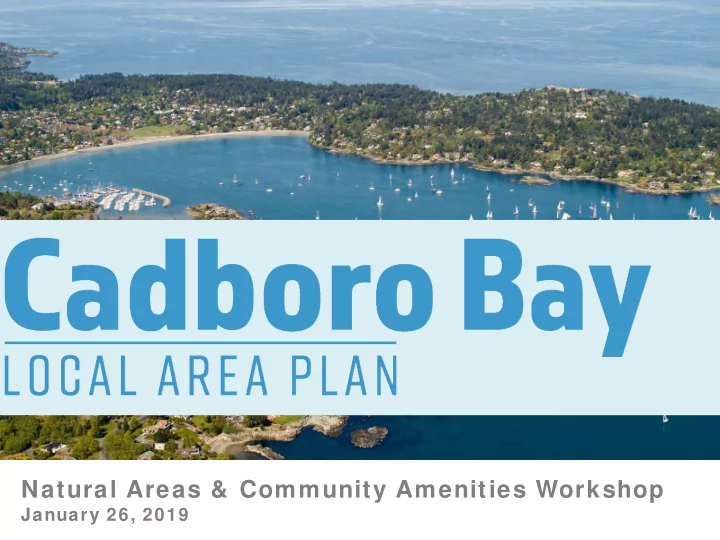
Natural Areas & Community Amenities Workshop January 26, 2019 - - PowerPoint PPT Presentation
Natural Areas & Community Amenities Workshop January 26, 2019 Our Ecosystems in a Changing Climate SUSTAINABILITY IN SAANICH UPDATED CLIMATE PLAN Become a 100% Renewable Energy Community by 2050 Reduce our GHG emissions by
Natural Areas & Community Amenities Workshop
January 26, 2019
Community by 2050
from 2007 Levels by 2050
Integrates Mitigation (reducing GHG emissions) and Adaptation (preparing for impacts)
We are here
ACTION AREAS:
1.
Transportation
2.
Buildings
3.
Consumption & Waste
4.
Food & Agriculture
5.
Climate Adaptation
6.
Leading By Example
Public Adaptation Priorities:
Source: Climate Projections for the Capital Region (2017, CRD)
Changes in timing of lifecycle events Range Shifts Food Web Disruptions Pathogens and Disease Invasive Species Coastal Squeeze Direct Climate Stressors
Image: OceanWatch
species to thrive
species as they adapt
lands
provenances) for native species, or new species on the edge of their Southern range?
Storm-water management – storage Urban cooling and air quality Water quality Carbon sequestration Coastal protection Mental health and wellbeing Storm-water management – flood reduction
Photo by Bob Bridgeman
Maggie Baynham Senior Sustainability Planner Maggie.Baynham@Saanich.ca
Saanich Parks Quick Facts
Cadboro Bay
Urban Forest Strategy
Vision “The urban forest in Saanich is a highly valued asset comprised of a rich and diverse forest that is widely recognized and appreciated for the contribution that it makes to our community and to our sustainable environment.” Goal To protect and enhance the Urban Forest. Tree Protection Bylaw Regulates cutting, removing or damaging of trees and sets requirements for replacing Protected trees. Amendments to the bylaw in 2014 offer greater protection to private trees.
Pulling Together Volunteer Program
Parks offers a great program to be part of:
Recent Park Projects
interpretive, wayfinding and regulatory signage, and Finnerty Creek restoration
Upcoming Park Projects
2015, event access 2018
It contains the majority of Hobbs Creek Watershed plus Sheep Cove Creek, Haro Creek, Finnerty Creek, Guinevere Creek, and unnamed coastal drainages.
The Mystic Pond Great Blue Heron colony is one of the most successful on Vancouver Island.
The entire Ten Mile Point is documented as historical Garry Oak and Associated Ecosystems. (In red is what remains today)
Mystic Vale contains the only known old growth forest in the area and is home to more than 75 native plant species.
Canada’s first Pacific migratory bird sanctuary stretches all along the coastline from the Portage Inlet to 10 Mile Point?
There are 9 significant trees in the local area, such as this native Big Leaf Maple.
The beaches are known forage fish habitat.
The area is also known for Bald Eagle nests however there has been a recent decline in the known nests in Cadboro Bay.
Phyllis Park serves as a corridor for wildlife, connecting the forests of the Queenswood, Konukson Park and Bedford Road Park with the ocean.
Rare and endangered plants found here include: Bearded-owl clover, Macoun’s meadow-foam, Twisted Oak Moss, Yellow Sand-verbena, Slimleaf Onion, and Winged Water-starwort.
Many invasive plants occur here such as English Ivy, Daphne/Spurge Laurel, English Holly, Scotch Broom, Lesser Celandine, and Himalayan Blackberry
Ten Mile Ecological Reserve is a protected area with high marine productivity.
Considerable volunteer resources have been at work at Haro Woods, Goward House, and Knoksun Park.
What else do you know about the natural history of Cadboro Bay that is special?
Artwork use kindly donated by Paul Redchurch, Goward House Volunteer Artist
Natural Areas & Community Amenities WORKSHOP