NATO Show 2012 Second Annual Trade Show Offered More Exhibitors, - - PDF document

nato show 2012
SMART_READER_LITE
LIVE PREVIEW

NATO Show 2012 Second Annual Trade Show Offered More Exhibitors, - - PDF document

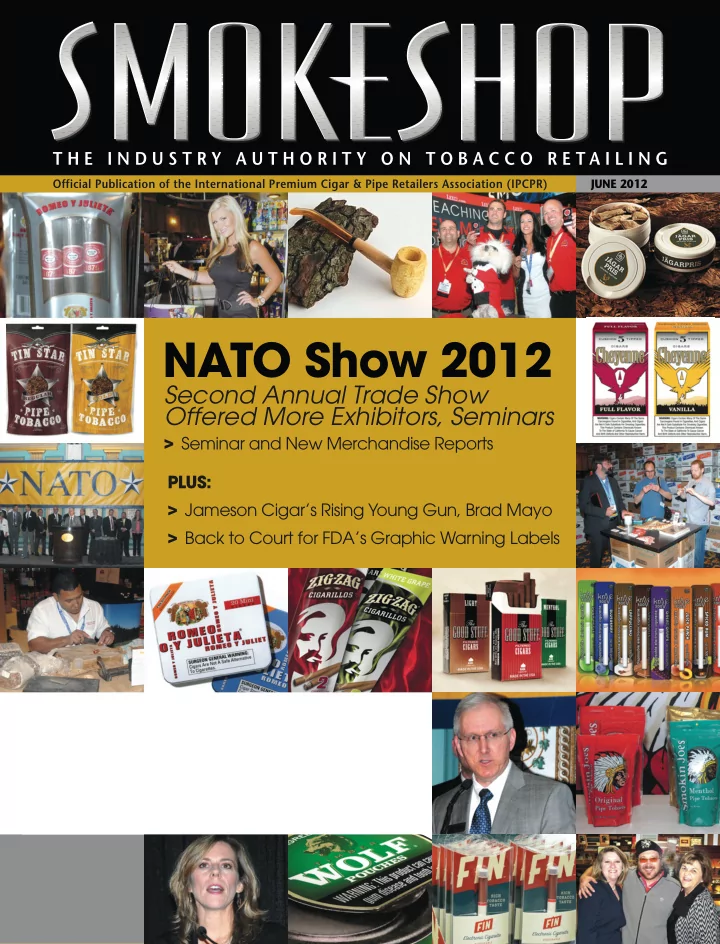
T H E I N D U S T R Y A U T H O R I T Y O N T O B A C C O R E T A I L I N G Official Publication of the International Premium Cigar & Pipe Retailers Association (IPCPR) JUNE 2012 NATO Show 2012 Second Annual Trade Show Offered More


slide-1
SLIDE 1

JUNE 2012

NATO Show 2012

PLUS: > Jameson Cigar’s Rising Young Gun, Brad Mayo > Back to Court for FDA’s Graphic Warning Labels

Second Annual Trade Show Offered More Exhibitors, Seminars

> Seminar and New Merchandise Reports

Official Publication of the International Premium Cigar & Pipe Retailers Association (IPCPR)

T H E I N D U S T R Y A U T H O R I T Y O N T O B A C C O R E T A I L I N G

slide-2
SLIDE 2

48

SMOKESHOP June 2012

I

n a split decision issued on March 19, 2012, a three judge panel of the United States Court of Appeals for the Sixth Circuit upheld the provisions

  • f the Family Smoking Prevention and

Tobacco Control Act (the “Act”) requir- ing graphic warning labels on cigarette packaging and advertisements. The Sixth Circuit’s decision differs starkly from the February 29, 2012 ruling of the United States District Court for the District of Columbia, which held that the Food and Drug Administration’s nine chosen graphic labels violated the plaintiff-tobacco companies’ right of free speech under the First

  • Amendment. The courts’ ultimate deci-

sions, however, were not the only dif- ferences in these two cases. The Sixth Circuit addressed only a facial challenge to the constitutionality

  • f the Act’s graphic image requirement.

This means that the court was tasked with determining whether the Act’s graphic image requirement, itself, was allowable under the Constitution, not whether the specific images chosen by FDA were constitutional. The Sixth Circuit ultimately concluded, albeit not unanimously, that the Act’s graphic image requirement should be charac- terized as a commercial-speech disclo- sure requirement, rather than as com- pelled commercial speech. The Court found the disclosure requirement was reasonably related to the government’s purpose

  • f

preventing consumer deception concerning the health risks

  • f tobacco use.

The D.C. District Court, on the

  • ther hand, was charged with deter-

mining whether FDA’s specified nine graphic images on tobacco packaging and advertisements unconstitutionally compelled speech. The D.C. District Court, as discussed below, found that FDA’s rule essentially required tobacco companies to be spokesmen for the government’s anti-tobacco agenda, which was not only too burdensome for these companies, but also was com- pelled speech that was not permissible under the Constitution. NEW WARNING LABELS In addition to mandating several textual warnings, the Act requires the Secretary

  • f the U.S. Department of Health and

Human Services to “issue regulations that require color graphics depicting the negative health consequences of smok- ing.” The Act also requires the new warnings to occupy the top 50 percent of the front and back panels of all cigarette packages, the top 30 percent of all smoke- less tobacco packages, and the top 20 percent of all tobacco advertising. On June 22, 2011, FDA published its final rule, which revealed the nine graph- ic images that are to be included on ciga- rette packaging and advertisements. These graphics included color images of: a man exhaling cigarette smoke through a tracheotomy hole; a plume of cigarette smoke enveloping an infant receiving a kiss from its mother; a pair of diseased lungs next to a pair of healthy lungs; a diseased mouth afflicted with cancerous lesions; a man breathing into an oxygen mask; a bare-chest male cadaver lying on a table; a woman weeping uncontrol- lably; and a man wearing a t-shirt featur- ing a “no smoking” symbol and the words “I QUIT.” APPELLATE COURT UPHOLDS WARNING REQUIREMENT In determining whether the Act’s graph- ic image requirement was constitution- al, the Sixth Circuit first examined whether the images could accurately convey factual information and, there- fore, permitted as merely a government- mandated disclosure subject to a lesser rational basis review, or whether the images would be considered generally as compelled speech, which is subject to a stricter analysis. The Court likened the Act’s graphic image requirement to the use of pictures and diagrams in text books. Specifically, the Sixth Circuit stated that,”[s]tudents in biology, human anatomy, and medical school courses look at pictures or draw- ings in textbooks of both healthy and damaged cells, tissues, organs, organ sys- tems, and humans because those pictures convey factual information about med- ical conditions and biological systems.” As such, the Court found that if a picture

  • r drawing can accurately represent a

medical condition or body part in a text book, then the graphics required under the Act can also accurately represent a negative health consequence of smoking, such as a cancerous lung. Since it found that the Act’s graphic image requirement

REGULATION FOCUS

Courts Disagree on Tobacco Warnings

The battle over graphic warning labels rages on: Two federal courts split over the constitutionality of the FDA’s warning label requirement, possibly leading to a showdown before the supreme court.

>BY TROUTMAN SANDERS TOBACCO TEAM

>
slide-3
SLIDE 3

50

SMOKESHOP June 2012 could be considered a government-man- dated disclosure of accurate information, the requirement is subject to a rational basis review by the courts—a standard that usually survives court review. Because the court found the Act’s graphic image requirement was subject to a rational basis review, the federal government was required to show that the graphic images were reasonably related to a legitimate governmental

  • interest. The Sixth Circuit found that the

Act’s graphic image requirements sur- vived this standard. Based on what the Sixth Circuit char- acterized as the tobacco industry’s decades-long practices of knowingly conspiring to deceive the public about the health risks and addictiveness of cig- arettes, the Court found that the federal government had a legitimate interest in providing consumers with truthful information as they make decisions about purchasing and using tobacco

  • products. The Sixth Circuit found that

the Act’s graphic image requirement was reasonably related to this purpose. As support for its holding, the Sixth Circuit discussed the alleged inadequacy

  • f the existing warnings. For example,

the Court stated that existing warnings are easily overlooked because they take up less than 5 percent of packaging and require an individual to be able to read at a relatively high level to understand the warnings. The Sixth Circuit relied on scientific studies finding that pictures are easier to remember than words to conclude that the Act’s new larger and colorful graphic images and warnings rationally address the problems associated with the current tobacco warnings. The Court also found persuasive studies examining the ability

  • f required graphic warning labels to

inform consumers of the health risks associated with tobacco use. Notably, the Sixth Circuit’s deci- sion was not unanimous. Judge Clay, who dissented with the Court’s find- ing that the graphic image requirement was permissible, stated that “colorful graphic images can evoke a visceral response that subsumes rational deci- sion-making” and “can be seen one way by some smokers, yet another by

  • ther smokers.” As such, Judge Clay

indicated that the graphics could not convey purely factual information and, therefore, could not be considered a permissible disclosure requirement under the Constitution. D.C. TRIAL COURT REJECTS MANDATED WARNINGS Judge Clay’s analysis was consistent with the D.C. District Court’s earlier rul- ing that the specific images chosen by FDA were unconstitutional. The D.C. District Court acknowledged that nar- row exceptions under the First Amendment allow the Government to require certain disclosures to protect consumers from confusion or deception. However, the D.C. District Court found that FDA’s chosen graphics are “not the type of purely factual and uncontrover- sial disclosures” that can be permissible under the Constitution. Citing a report issued by the Institute of Medicine, which stated that warnings must be designed to reduce the number of peo- ple who use and become addicted to tobacco products, the D.C. District Court concluded that the graphic images are not being required as an effort to dissem- inate purely factual and uncontroversial information, but rather to discourage the consumption of tobacco products. The D.C. District Court found that FDA’s graphic images were subject to a more difficult standard of review—strict

  • scrutiny. Under a strict scrutiny analysis,

the government must demonstrate that its actions are narrowly tailored to achieve a compelling government inter-

  • est. The D.C. District Court ruled that the

government failed to meet both prongs

  • f the strict scrutiny analysis.

First, the D.C. District Court found that FDA’s chosen graphic images were representative of the government’s actu- al purpose to encourage smoking cessa- tion and to discourage potential new smokers from starting, rather than its claimed purpose of attempting to con- vey to consumers “the devastating con- sequences of smoking and nicotine addiction.” The Court acknowledged that an interest in informing or educat- ing the public about the dangers of smoking “might” be compelling, but a government “interest in simply advocat- ing that the public not purchase a legal product is not.” Additionally, the D.C. District Court concluded that FDA’s graphic image requirements were not narrowly tai-

  • lored. Specifically, the Court stated that

FDA is requiring tobacco companies to “act as the Government’s mouthpiece by dedicating the top 50 percent of the front and back of all cigarette packages manu- factured and distributed in the United States to display the Government’s anti- smoking message: not to purchase this product.” In other words, the D.C. District Court contended that FDA’s graphic images would rebrand every single pack of cigarettes in the United States as a “mini-billboard.” Such a forced rebranding, according to the D.C. District Court, failed to meet the narrow- ly tailored requirement of the strict scrutiny analysis. Notably, the Court

  • utlined several other options the gov-

ernment could pursue that would be less burdensome for tobacco companies, but would educate the public about tobacco

  • use. For example, the government could:
  • disseminate its anti-smoking

message itself by increasing anti-smoking advertisements; reduce the space appropriated for the proposed graphic images to 20 percent of the packaging or require

REGULATION FOCUS

>

>The D.C. District Court acknowledged

that an interest in informing or educating the public about the dangers of smoking “might” be compelling, but a government “interest in simply advocating that the public not purchase a legal product is not.”

slide-4
SLIDE 4

June 2012 SMOKESHOP

51

the images only on the front or back

  • f the packaging;
  • select graphic images that convey
  • nly purely factual and

uncontroversial information rather than gruesome images designed to disgust the consumer;

  • increase cigarette taxes; or
  • improve efforts to prevent the

unlawful sale of cigarettes to minors. WHAT’S NEXT? On April 10, 2012, a three-judge panel

  • f the U.S. Court of Appeals for the

District of Columbia Circuit held oral arguments in the federal government’s appeal challenging the D.C. District Court’s decision. During oral argu- ments, Judge Janice Rogers Brown was troubled by the potential impact that the graphic images could have on the federal government’s ability to compel speech for other industries. Specifically, Judge Brown stated: “I don’t really understand where this stops. It seems to me that there is nothing that the gov- ernment can’t compel the seller of a dis- favored product to put on their product if they think it’s for the public good.” In

  • ther words, Judge Brown stated that

the government is telling smokers “don’t buy this product.” Judge A. Raymond Randolph also questioned whether the government could require auto makers to place warning labels containing images of gruesome car acci- dents to warn people about the risks of

  • speeding. However, Judge Randolph

also noted that there is no case holding that a government-mandated disclo- sure could only provide information rather than attempt to deter a con- sumer’s use of a particular product. Regardless of the D.C. Circuit’s deci- sion, it is likely that the case will contin- ue on to the United States Supreme Court for an ultimate decision. Additionally, it is likely that the tobacco companies will petition the Supreme Court to hear an appeal of the Sixth Circuit decision. The tobacco com- panies have until mid-June 2012 to file their petition. Given what looks like a possible split by the lower courts, the Supreme Court could follow several paths in determining the fate of FDA’s chosen graphic images. First, the Court could side with the Sixth Circuit, finding that,

  • n its face, the Act’s graphic image

requirement is constitutional. If the Court goes this way, it will also have to determine whether the nine images chosen by FDA are acceptable under the Constitution. The Court could also decide that FDA’s final rule implement- ing the Act’s graphic image require- ment does not pass muster under a strict scrutiny analysis. If this is the case, the Court could, like the D.C. District Court, suggest other less bur- densome methods and send FDA back to the drawing board to identify consti- tutionally-permissible warnings. Troutman Sanders Tobacco Team, Troutman Sanders LLP , 1001 Haxall Point, Richmond, Va. 23219, Tel: (804) 697-2206, Fax: (804) 697-1339, Web: www.troutmansanders.com, Email: ashley.taylor@troutmansanders.com.