Nanotechnology in Food: Lessons from the Industrialization and - - PowerPoint PPT Presentation

nanotechnology in food lessons from the industrialization
SMART_READER_LITE
LIVE PREVIEW

Nanotechnology in Food: Lessons from the Industrialization and - - PowerPoint PPT Presentation

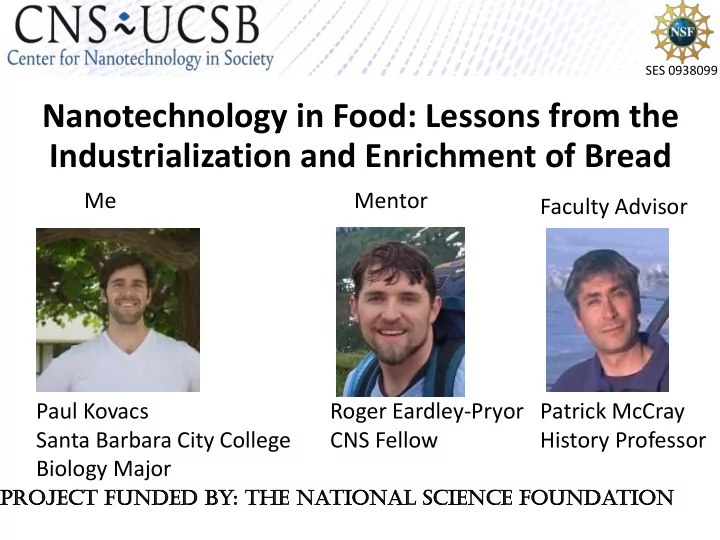
SES 0938099 Nanotechnology in Food: Lessons from the Industrialization and Enrichment of Bread Me Mentor Faculty Advisor Paul Kovacs Roger Eardley-Pryor Patrick McCray Santa Barbara City College CNS Fellow History Professor Biology Major


slide-1
SLIDE 1

SES 0938099

Nanotechnology in Food: Lessons from the Industrialization and Enrichment of Bread

Paul Kovacs Santa Barbara City College Biology Major Roger Eardley-Pryor CNS Fellow Patrick McCray History Professor Me Mentor Faculty Advisor

Pr Proj

  • ject

ct Fun unde ded d by by: The National ional Scienc ence e Fou

  • unda

dation tion

slide-2
SLIDE 2

SES 0938099

What is Nanotechnology?

  • Materials with at least one

dimension on the nano-scale (1-100nm)

  • Center for Nanotechnology in

Society

– Study the social effects of nanotechnology – IRG-1: Applied History of nanotechnology

slide-3
SLIDE 3

SES 0938099

Nanotechnology in Food

  • Titanium Dioxide Nanoparticles

found in common food products

– Alex Weir et. al., Titanium Dioxide Nanoparticles in Food and Personal Care Products, Environ. Sci.

  • Technol. 2012, 46, 2242-2250
  • Used to change food’s color,

smell, flavor, and texture

  • Used to introduce antibacterial

properties to foods

  • Nanotech is being used in bread
slide-4
SLIDE 4

SES 0938099

Research Questions & Argument

  • How did nanotechnology come to be

used as a tech solution in bread?

  • How is nanotechnology being used in

food today?

  • How does the history of bread help

us to understand the implications of nano in food?

slide-5
SLIDE 5

SES 0938099

  • Problem: White Flour Expensive
  • Considered a status symbol (pre-

19th Century)

  • Expensive and time intensive to

produce

  • Tech Fix: Alum (19th Century)

– Aluminum Sulfate – Added to flour – Cheap whitener

http://www.123rf.com/photo_16037016 _white-flour-with-wooden-scoop.html

History of White Bread

slide-6
SLIDE 6

SES 0938099

New Problem: Outcry Against Alum and other Adulterated Foods

  • Negative Health Effects of Alum

– Rickets and Neurodegenerative Disorders during 19th Century

  • Upton Sinclair, The Jungle (1905)
  • Pure Food and Drug Act of 1906
  • Public Fear of

“Unsanitary” Bread

slide-7
SLIDE 7

SES 0938099

Tech Fix: Mechanical Flour Processing (early 20th century)

  • Steel Roller Milling

– Removed Germ and Bran – Responsible for Brown Color

  • f Bread
  • Chemical Bleaching

– Further Whitened Flour – Chlorine Dioxide, Nitrogen Dioxide, Organic Peroxides

slide-8
SLIDE 8

SES 0938099

New Problem: Degraded Nutrition

  • Bran: Vitamin A, Calcium,

Vitamin B6, Iron, and Fiber

  • Germ: B Vitamins, Omega-3s,

Omega-6s, Iron, and Vitamin E

  • Endosperm: Primarily Starch
slide-9
SLIDE 9

SES 0938099

World War II

  • Mass Nutrient Deficiencies

– Americans got more calories from bread than any other food

  • Aaron Borrow-Strain. White Bread: A Social History of the Store-Bought Loaf.

Boston: Beacon Press. 2012.

– Malnutrition responsible for 1/3 of all draft rejections

  • W. H. Sebrell, Urgent Problems in Nutrition for National Betterment American

Journal of Public Health and the Nation's Health. 1942 January; 32(1)15

– Vitamin Deficiencies: Iron, Thiamin, Niacin, Vitamin A – Conditions: Pellagra, Beriberi, Night- blindness, and others

New Problem: Americans Unfit for Service

slide-10
SLIDE 10

SES 0938099

Tech Fix: Enrichment of Bread

  • United States mandated

enrichment tablets (1943)

  • Other options were available

– England Mandated Whole Grain Bread – Equally effective

slide-11
SLIDE 11

SES 0938099

New Problem: After the War

  • White Bread has a High

Glycemic Index

  • Consumption of High Glycemic

Foods Contributes to Obesity, Heart Disease, and Diabetes Bread is Enriched with Vitamins BUT…

slide-12
SLIDE 12

SES 0938099

Overweight Rates in Industrialized World

Organization for Economic Cooperation and Development : http://economix.blogs.nytimes.com/2010/09/23/the-world-is-fat/

slide-13
SLIDE 13

SES 0938099

Overweight and Obesity Statistics

  • Approximately 70% of Americans are overweight

– Weight-control Information Network (branch of NIH)

  • Obesity cost the US $190 Billion dollars in 2005

– Cawley J, Meyerhoefer C. The medical care costs of obesity: an instrumental variables approach. J Health Econ. 2012; 31:219-30.

  • An estimated 300,000 deaths per year in the US

are related to co-morbidities of obesity

– US Surgeon General http://www.surgeongeneral.gov/library/calls/obesity/index.html

  • Two most common obesity related killers are…

– Type 2 Diabetes, and heart disease

slide-14
SLIDE 14

SES 0938099

New Tech Fix? - Heart Healthy Enrichment with Nanotech

slide-15
SLIDE 15

SES 0938099

Tip Top Up Nano-Bread

  • Uses nano-encapsulation to enrich

bread with heart healthy Omega 3s

  • No fishy smell or flavor
  • Intended to combat heart disease

HOWEVER…

Glycemic Index: White Bread (avg.): 75 Table Sugar (avg.): 65

Simin Liu, et. al, A prospective study of dietary glycemic load, carbohydrate intake, and risk of coronary heart disease in US women, Am J Clin Nutr June 2000 vol. 71 no. 6 1455-1461

“high dietary glycemic load from refined carbohydrates increases the risk of CHD, independent of known coronary disease risk factors”

slide-16
SLIDE 16

SES 0938099

Problems with Nano-encapsulation Fix

  • Doesn’t Address Essential Problem

– High in Carbohydrates – High Glycemic Index

  • Introduces New Risks

– Oxidation of Fish Oils – Toxicology of Encapsulation Materials Has Not been Studied

slide-17
SLIDE 17

SES 0938099

General Uncertainties of Nano

  • Evidence suggests nano behaves

differently in biological systems

  • Nanotoxicology methods are not

currently sufficient to evaluate safety

– Andrew Maynard, et al, “The New Toxicology of Sophisticated Materials: Nanotoxicology and Beyond,” Toxicol. Sci. 120 (2011): S109-S129

  • Regulatory bodies lack data for proper

health and safety determinations

– Scientific Opinion of the Scientific Committee on a request from the European Commission on the Potential Risks Arising from Nanoscience and Nanotechnologies on Food and Feed Safety,” The EFSA Journal 958 (2009): 1-39. – EPA Office of Inspector General, EPA Needs to Manage Nanomaterial Risks More Effectively, Report no. 12-P-0162 (Dec. 2011). – FDA et al, Draft Guidance for Industry… on the Safety and Regulatory Status of Food Ingredients (April 2012)

slide-18
SLIDE 18

SES 0938099

Current Applications of Nanotech in Food

  • Common Food Additive

Applications

– TiO2 Nanoparticles

  • Used to Whiten Powdered Sugar
  • Found in Powdered Donuts

– Nano-encapsulation

  • Tip Top Up Bread

– Other Applications Are Coming Soon…

slide-19
SLIDE 19

SES 0938099

Conclusions

  • Uncertainties surrounding Nano

indicate that more research is needed to ensure safety

  • The history of bread suggests that

Nano in food will create unintended consequences

  • Current applications of Nano do

not yet justify the risk of uncertainty associated with nanofoods

slide-20
SLIDE 20

SES 0938099

Is Nanofood Worth The Risk?

slide-21
SLIDE 21

SES 0938099

Thank You!

This research is based upon work supported by the National Science Foundation under Grant

  • No. SES 0938099. Any opinions, findings, and

conclusions or recommendations expressed in this material are those of the authors and do not necessarily reflect the views of the National Science Foundation.

21

slide-22
SLIDE 22

SES 0938099

slide-23
SLIDE 23

SES 0938099

slide-24
SLIDE 24

SES 0938099

slide-25
SLIDE 25

SES 0938099

Tip Top Up

  • Uses Nano-encapsulation technology
  • To Enrich bread with Omega 3 fatty

acids from Fish Oil Source

  • Intended to Combat Heart Disease
slide-26
SLIDE 26

SES 0938099

Case Study: The History of Bread Technology

slide-27
SLIDE 27

SES 0938099

Why is History Important?

  • The Fallacy of Modernity

– Through Science and Technology we can Solve the Essential Problems of Life

http://news.nd.edu/news/8531-center-for-ethics-and- culture-to-host-conference-on-modernity/

  • History Shows that Technology

Creates New Problems

  • Is the Present Special?
slide-28
SLIDE 28

SES 0938099

Historical Methodology & Sources

Journal Articles Books Reports

  • History is an Empirical Discipline
  • Rooted in Primary and Secondary Sources
slide-29
SLIDE 29

SES 0938099

Encapsulation Methods

  • High Shear Fluid processors

– Create Nano-sized capsules

slide-30
SLIDE 30

SES 0938099

Nano-encapsulation Technology

  • Each Microcapsule is defined by its

core composition, the composition of the capsule, and the encapsulation method

  • Many methods

– Spray Drying, spray-cooling, spray- chilling, air suspension coating, extrusion, centrifugal extrusion, freeze- drying, coacervation, rotational suspension separation, co-crystallization

  • Many core compounds
  • Many different compounds used in

the Capsule layer

slide-31
SLIDE 31

SES 0938099

Microencapsulation

  • Most Common Method

– Spray Drying

  • Many Ways to Encapsulate

– Method is Customized for Core Nutrient being Delivered – Materials Used Vary from Nutrient to Nutrient – Each Technique Must be Evaluated for Toxicology Separately

slide-32
SLIDE 32

SES 0938099

What Problems Could Nanoencapsulation Create?

  • Evidence that Nano Behaves Differently

in Biological Systems

  • Nanotoxicology Methods

– Characterization Techniques – Especially important in Encapsulation – Very Few Nanotoxicology Studies in General

slide-33
SLIDE 33

SES 0938099

  • History of Bread Technology has a Predictable

Pattern

– Problem/Solution/New problem – Tech Solutions to Problems Often Create New Problems with Unintended Consequences

Fundamental Insight

slide-34
SLIDE 34

SES 0938099

Ultrasonic Spray Nozzles

  • Used to create microcapsules
slide-35
SLIDE 35

SES 0938099

slide-36
SLIDE 36

SES 0938099

Microfluidizer processors

  • Used to Make Nanocapsules
slide-37
SLIDE 37

SES 0938099

The Tech Fix

slide-38
SLIDE 38

SES 0938099

“We cannot solve our problems with the same thinking we used when we created them”

http://quotes.lifehack.org/albert-einstein/Albert-Einstein-Miracle/

slide-39
SLIDE 39

SES 0938099

Tip Top Up Bread

  • Nanoencapsulation

Technology

  • Used to Enrich Bread with

Heart Healthy Omega 3 Fish Oils

  • High Sugar Content:

Contributes to Heart Disease

slide-40
SLIDE 40

SES 0938099

Demand for Sanitary Bread

  • White Flour

–“Clean” Bread was White Bread –White Bread used White Flour –White Flour is Still Expensive –Alum was not considered Safe

slide-41
SLIDE 41

SES 0938099

Chemical Bleaching

  • Steel Roll Milling Product

not quite White

  • No Time for Natural Aging
  • Chemical Bleaching

– Chlorine Dioxide, Nitrogen Dioxide, Organic Peroxides

slide-42
SLIDE 42

SES 0938099

  • BMI is used to determine weight status

– An adult who has a BMI between 25 and 29.9 is considered overweight. – An adult who has a BMI of 30 or higher is considered obese.

BMI

slide-43
SLIDE 43

SES 0938099

Overweight Statistics

  • According to a Study Titled Overweight and

Obesity Statistics funded by

– U.S. Department of Health and Human Services – National Institute of Health

  • “More than two-thirds (68.8 percent) of adults

are considered to be overweight or obese.”

  • http://www.win.niddk.nih.gov/statistics/#b
slide-44
SLIDE 44

SES 0938099

Overweight Statistics

Obesity in America

slide-45
SLIDE 45

SES 0938099

Weight-control Information Network (WIN)

The Weight-control Information Network (WIN) is an information service of the National Institute of Diabetes and Digestive and Kidney Diseases (NIDDK), part of the National Institutes of Health (NIH). Established in 1994, WIN provides the general public, health professionals, and the media with up-to-date, science-based information on obesity, weight control, physical activity, and related nutritional issues. WIN also developed Sisters Together: Move More, Eat Better, a national program to encourage black women to maintain a healthy weight by becoming more physically active and eating healthier foods. Source: http://win.niddk.nih.gov/about/index.htm

slide-46
SLIDE 46

SES 0938099

Image Sources

  • Slide 1

– Picture of Me – Picture of Roger – Picture of Patrick

  • Slide 2

– Picture of Einstein: http://quotes.lifehack.org/albert-einstein/Albert-Einstein-Miracle/

  • Slide 3

– Queestion Mark: http://en.wikipedia.org/wiki/File:Question_mark_%28black_on_white%29.png – Phones: http://www.busyevent.com/making-a-technology-decision-for-your-event-at-the-last-minute-9-things-to-

consider/

– Sick Child: http://www.multiplemayhemmamma.com/wp-content/uploads/2012/03/sickchild.jpg – Pill: http://www.flight001.com/big-pill-1.html – Stressed Mother: http://www.njfamily.com/NJ-Family/December-2011/Whats-for-Dinner/

– Microwave:

– Lap Band: http://en.wikipedia.org/wiki/Adjustable_gastric_band

  • Slide 4
  • Slide 5
  • Slide 6
  • Slide 7
slide-47
SLIDE 47

SES 0938099

Food Adulteration

  • Upton Sinclair (1905)

– The Jungle

  • Exposed Adulteration in

Meatpacking Industry

  • Provided motivation for Food

Safety Legislation

  • Strengthened “Food Purity”

Movement

slide-48
SLIDE 48

SES 0938099

My Project: Nanotechnology and Food

http://diamondenv.wordpress.com/2010/05/19/bohs-conference- nanotechnology/ http://www.123rf.com/photo_9230337_close-up-on- traditional-bread.html

slide-49
SLIDE 49

SES 0938099

My Research: Nanotechnology and Food

  • Project Description: Study Nanotechnology in

Food from a historical perspective

+

=

http://www.celsias.com/article/nanotechno logy-our-food/ http://farewellletter.blogspot.com/2010/ 08/chia-seeds.html

+ =

http://www.constructiondigital.com/green_building/p epsi-owns-first-leed-certified-food-factory-in-ca