Introduction to Nanotechnology Introduction to Nanotechnology - - PowerPoint PPT Presentation

introduction to nanotechnology introduction to
SMART_READER_LITE
LIVE PREVIEW

Introduction to Nanotechnology Introduction to Nanotechnology - - PowerPoint PPT Presentation

Introduction to Nanotechnology Introduction to Nanotechnology Applications of Nanotechnology Applications of Nanotechnology Nanotechnology Research at Nanotechnology Research at Clarkson Clarkson Conclusions


slide-1
SLIDE 1

1

  • Introduction to Nanotechnology

Introduction to Nanotechnology

  • Applications of Nanotechnology

Applications of Nanotechnology

  • Nanotechnology Research at

Nanotechnology Research at Clarkson Clarkson

  • Conclusions

Conclusions

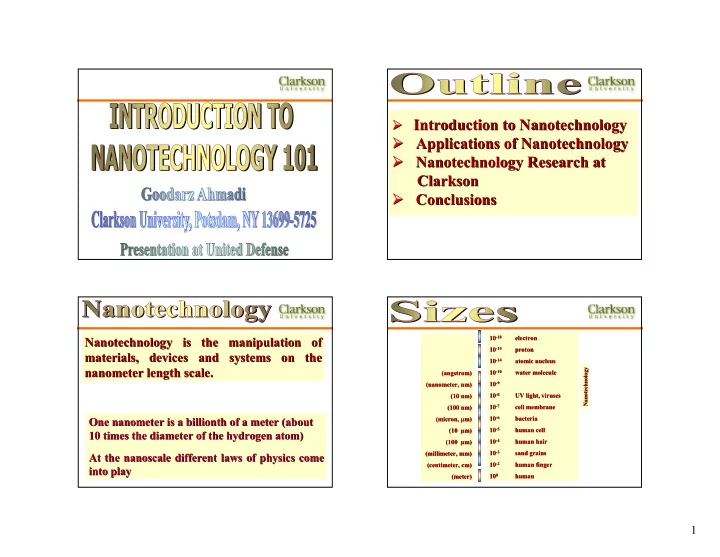
Nanotechnology is the manipulation of Nanotechnology is the manipulation of materials, devices and systems on the materials, devices and systems on the nanometer length scale. nanometer length scale.

One nanometer is a billionth of a meter (about One nanometer is a billionth of a meter (about 10 times the diameter of the hydrogen atom) 10 times the diameter of the hydrogen atom) At the At the nanoscale nanoscale different laws of physics come different laws of physics come into play into play

10 10-

  • 18

18

electron electron 10 10-

  • 15

15

proton proton 10 10-

  • 14

14

atomic nucleus atomic nucleus 10 10-

  • 10

10

water molecule water molecule 10 10-

  • 9

9

10 10-

  • 8

8

UV light, viruses UV light, viruses 10 10-

  • 7

7

cell membrane cell membrane 10 10-

  • 6

6

bacteria bacteria 10 10-

  • 5

5

human cell human cell 10 10-

  • 4

4

human hair human hair 10 10-

  • 3

3

sand grains sand grains 10 10-

  • 2

2

human finger human finger 10 100 human human (angstrom) (angstrom) (nanometer, nm) (nanometer, nm) (10 nm) (10 nm) (100 nm) (100 nm) (micron, (micron, µ µm) m) (10 (10 µ µm) m) (100 µm) (100 µm) (millimeter, mm) (millimeter, mm) (centimeter, cm) (centimeter, cm) (meter) (meter)

Nanotechnology Nanotechnology

slide-2
SLIDE 2

2

4

10

3

10

2

10

1

10

1

10−

2

10−

3

10− Diameter

4

10− Electro. Wave

X-Ray

µm

UV Vis Infrared Microwaves Fume

Definition

Dust Mist Spray Solid Liquid

Soil Atmospheric Typical Particles

Clay Silt Sand Gravel Smog Cloud/Fog Mist Rain Viruses Bacteria Hair Smoke Coal Dust Beach Sand

µm nm

4

10

3

10

2

10

1

10 10

1

10−

5

10

6

10

7

10 mm cm

Information Information Technology Technology Biotechnology Biotechnology Nanotechnology Nanotechnology

Bio Bio-

  • Infomatics

Infomatics Nano Nano-

  • Bio

Bio-

  • Technology

Technology Nano Nano-

  • Electronic

Electronic Quantum Quantum Computing Computing Nano Nano-

  • Bio

Bio-

  • Info

Info

  • Nanoelectronic

Nanoelectronic

  • Nanomaterials

Nanomaterials

  • Nanocomposites

Nanocomposites

  • Nanodevices

Nanodevices

  • Nanostructure

Nanostructure

  • Nanosensors

Nanosensors

  • Nanobiotechnology

Nanobiotechnology

  • Nanostructured

Nanostructured Catalysts Catalysts

  • Molecular Mechanics

Molecular Mechanics

  • Computers and Data Storage

Computers and Data Storage

  • High Performance Materials

High Performance Materials

  • Health and Medicine

Health and Medicine

  • Energy and Environment

Energy and Environment

  • Transportation

Transportation

  • Homeland Security

Homeland Security

slide-3
SLIDE 3

3

  • Targeted Drug Delivery

Targeted Drug Delivery

  • Sensors for Disease Detection

Sensors for Disease Detection

  • Artificial Tissues and Organs

Artificial Tissues and Organs

  • Nano

Nano-

  • Robots for Protection

Robots for Protection Against Bacteria and Viruses Against Bacteria and Viruses

  • Energy Storage and Production

Energy Storage and Production

  • Energy Efficiency

Energy Efficiency

  • Environmentally Friendly

Environmentally Friendly Manufacturing technologies Manufacturing technologies

  • Environmental Remediation

Environmental Remediation Technologies Technologies

  • Sensors for Environmental

Sensors for Environmental Monitoring Monitoring

  • Chemical, Biological, and

Chemical, Biological, and Radiological Sensors Radiological Sensors

  • High Strength, Light Weight

High Strength, Light Weight Military Platforms Military Platforms

  • Self Healing and Functional

Self Healing and Functional Materials Materials

  • Virtual Reality for Training

Virtual Reality for Training

CNT is a tubular form of carbon CNT is a tubular form of carbon with diameter of about 1 nm and a with diameter of about 1 nm and a Length of a few nm to microns. Length of a few nm to microns. CNT exhibits extraordinary CNT exhibits extraordinary mechanical properties: mechanical properties:

  • Young’s modulus > 1

Young’s modulus > 1 Tera Tera Pa Pa

  • Stiffness ~ diamond

Stiffness ~ diamond

  • Tensile strength ~ 200

Tensile strength ~ 200 GPa GPa

  • Strain ~ 10%

Strain ~ 10%

Meyyappan Meyyappan, NASA , NASA

slide-4
SLIDE 4

4

Meyyappan Meyyappan NASA NASA Li et al. Li et al. (2002) (2002)

Mechanical Applications Mechanical Applications

  • High Strength Composites

High Strength Composites

  • Body Armor

Body Armor

  • Cables, Tethers, Beams

Cables, Tethers, Beams Challenges Challenges

  • Fabrication of Composite with Controlled

Fabrication of Composite with Controlled properties properties

  • Characterization and Modeling

Characterization and Modeling

  • Large Scale Production

Large Scale Production

Meyyappan Meyyappan NASA NASA Meyyappan Meyyappan NASA NASA

slide-5
SLIDE 5

5

Nanoporous glass shapes sizes between 1 to 100 microns are self- assembled using biomemetic processes.

Sokolov Sokolov

These glass particles can carry 100,000 Billions dye combinations. This makes them unbreakable security tags for labeling and tracing. The tags can be used in medicine and biology for tagging various diseases.

Sokolov Sokolov

Microcapsules Catalyst Crack Healing Agent Polymerized Healing Agent

slide-6
SLIDE 6

6

Crack Crack Healed crack Healed crack crack crack

Release of healing component Release of healing component (fluorescent) (fluorescent) Sokolov Sokolov Ahmadi Ahmadi Ahmadi Ahmadi McLaughin McLaughin

  • Coating

Coating SiC SiC nanoparticles nanoparticles for fillers in next for fillers in next-

  • generation lighter but stronger body armor.

generation lighter but stronger body armor. (Natick) (Natick)

  • Preparation of metallic particle aerosols for

Preparation of metallic particle aerosols for

  • bscuration of IR. (Aberdeen)
  • bscuration of IR. (Aberdeen)
  • Dispersing carbon black for use in lenses for

Dispersing carbon black for use in lenses for eye protection from lasers. (TACOM) eye protection from lasers. (TACOM)

Partch Partch

slide-7
SLIDE 7

7

fullerene (electron relay) crown ether (ion attractor/sensor) pharmaceutical (controlled delivery/release)

  • rganometallic

(electroluminescence) continuous, uniform bulk coatings (chemical stabilizers) (dispersion enhancers) (hardness modifiers) (density regulators) Where is a covalent tether

Partch Partch Current vest ~ 38 lbs 2” x 2” tiles on Kevlar Titles of aluminum oxide micro-sized particles Proposed vest < 18 lbs Kevlar with embedded silicon carbide nano-sized partices Completed coating 30 nm SiC particles with polycarbonate for Army Natick Partch Partch

reflectance IR Source

absorbance

transmittance

Partch Partch Partch Partch

Flakes are Flakes are 10 10-

  • 30 nm thick

30 nm thick

slide-8
SLIDE 8

8

10 20 30 40 50 60 70 80 90 100 500 1000 1500 2000 2500 3000 3500 4000 Wavenum nbers (cm

  • 1)

% Transmittance

Carbon/Aluminum Particles Aluminum Amorphous Carbon Graphite

Partch Partch

laser source eye damage lens without absorber particles

Partch Partch

laser source laser source lens with absorber particles

  • Work completed for Army-TACOM/Wright Patterson AFB

eye undamaged

Partch Partch Hopke Hopke

slide-9
SLIDE 9

9

Hopke Hopke Hopke Hopke

TSI ATOFMS provides particle size and composition TSI ATOFMS provides particle size and composition

  • n a particle
  • n a particle-
  • by

by-

  • particle basis for particles > 50 nm.

particle basis for particles > 50 nm.

Hopke Hopke

Expertise in the experimental study of vapor Expertise in the experimental study of vapor-

  • liquid nucleation including homogeneous,

liquid nucleation including homogeneous, heterogeneous, and ion heterogeneous, and ion-

  • induced.

induced. Tools to study nucleation and to characterize Tools to study nucleation and to characterize airborne particles in sizes ranging from 3 nm and airborne particles in sizes ranging from 3 nm and up. up.

Hopke Hopke

slide-10
SLIDE 10

10

Benjamin F. Dorfman, Science Dr., research professor, Clarkson University. CAMP NOW: multifunctional coatings: surface reinforcement, best tribology in any humidity & water, anti-icing,

  • electric. tunable, capability for topographic stress monitoring sensors’ system

Potentially – smart self-monitoring ultra-light weight construction material

No L No L-

  • J

J Weak L Weak L-

  • J

J Strong L Strong L-

  • J

J Weak L Weak L-

  • J

J Strong bond Strong bond

Muller Muller Shen Shen Muller Muller Shen Shen

slide-11
SLIDE 11

11

Acoustic Monitoring of Acoustic Monitoring of Industrial Processes Industrial Processes

  • Non

Non-

  • contact, non

contact, non-

  • destructive techniques

destructive techniques

  • Online quality control

Online quality control Motion and Adhesion of Motion and Adhesion of Nano/Micro Nano/Micro-

  • Particles

Particles

  • Adhesion of

Adhesion of nano nano/micro /micro-

  • scale objects

scale objects

  • Motion of micro

Motion of micro-

  • particles

particles

  • n dry surfaces
  • n dry surfaces

Cetinkaya Cetinkaya

Before After Before After

Mirror Substrate Alignment Laser Beam Alignment Laser Particles Mirror Nd:YAG Pulsed Laser Convex Lens Plasma Shockwaves Alignment Laser Mirror Substrate Alignment Laser Beam Alignment Laser Particles Mirror Nd:YAG Pulsed Laser Convex Lens Plasma Shockwaves Alignment Laser

Nanoparticle Nanoparticle Removal Removal with Pulsed Lasers with Pulsed Lasers

  • Challenge: Removal of

Challenge: Removal of sub sub-

  • 100nm particles

100nm particles

  • Pulsed laser induced

Pulsed laser induced plasma methods plasma methods

Cetinkaya Cetinkaya

Mach Number Mach Number Mach Number Pressure Pressure Pressure Temperature Temperature Temperature CO2 Snow CO CO2

2 Snow

Snow Before Before Before After After After

Ahmadi Ahmadi

  • Carbon

Carbon Nanotube Nanotube (CNT) reinforced ceramic (CNT) reinforced ceramic composites to enhance fracture toughness composites to enhance fracture toughness without compromising ballistic impact without compromising ballistic impact performance. performance.

  • CNTs

CNTs can absorb energy through their highly can absorb energy through their highly flexible elastic behavior during deformation. flexible elastic behavior during deformation.

  • Potential to improve performance of armor

Potential to improve performance of armor systems significantly compared to the current systems significantly compared to the current state state-

  • of
  • f-
  • the

the-

  • art.

art.

Jha Jha

slide-12
SLIDE 12

12

Research Needs: Research Needs:

  • Understand the underlying science issues

Understand the underlying science issues

  • Investigate and optimize manufacturing

Investigate and optimize manufacturing methods methods

  • Formulate physics

Formulate physics-

  • based multi

based multi-

  • scale predictive

scale predictive models models

  • Perform material characterization through

Perform material characterization through extensive testing extensive testing

  • Develop design procedures for CNT reinforced

Develop design procedures for CNT reinforced ceramic matrix composite structures ceramic matrix composite structures

Jha Jha

  • DIRECTED SELF

DIRECTED SELF-

  • ASSEBLY OF

ASSEBLY OF NANOPARTICLES REGULATED WITH NANOPARTICLES REGULATED WITH POLYMERS POLYMERS

  • PHASE SEGREGATION IN POLYMER

PHASE SEGREGATION IN POLYMER SYSTEMS DRIVEN BY OUTSIDE SYSTEMS DRIVEN BY OUTSIDE CONDITIONS CONDITIONS

  • TEMPLATING POLYMERS WITH

TEMPLATING POLYMERS WITH POLYMERS POLYMERS

Minko Minko

  • SMART COATINGS/THIN FILMS:

SMART COATINGS/THIN FILMS:

  • Self

Self-

  • repairing, self

repairing, self-

  • healing systems (with

healing systems (with external signal, stimuli); external signal, stimuli);

  • responsive surfaces (change mechanical

responsive surfaces (change mechanical behavior, size, surface energy, behavior, size, surface energy, wettability wettability, , adhesion, etc with external stimuli) adhesion, etc with external stimuli)

  • adaptive surfaces (response to environmental

adaptive surfaces (response to environmental changes); changes);

FOR PROTECTIVE COATINGS, TEXTILES, SMART FOR PROTECTIVE COATINGS, TEXTILES, SMART CLOTHES, SELF CLOTHES, SELF-

  • HEALING COMPOSITES

HEALING COMPOSITES

Minko Minko

  • SENSORS

SENSORS

  • miniaturized sensors to detect small amount of

miniaturized sensors to detect small amount of chemicals chemicals

  • transform the interaction between chemicals and

transform the interaction between chemicals and polymer materials into electrical or optical signals; polymer materials into electrical or optical signals;

  • rapid analysis and high selectivity due to the high

rapid analysis and high selectivity due to the high permeability of ultra permeability of ultra-

  • thin films

thin films

FOR ANALYSIS of toxins, chemical weapons, food quality FOR ANALYSIS of toxins, chemical weapons, food quality

Minko Minko

slide-13
SLIDE 13

13

  • NEW MATERIALS WITH UNIQUE PHYSICAL

NEW MATERIALS WITH UNIQUE PHYSICAL PROPERTIES (MECHANICAL, ELECTRO PROPERTIES (MECHANICAL, ELECTRO-

  • CONDUCTIVE, THERMOCONDUCTIVE, OPTICAL)

CONDUCTIVE, THERMOCONDUCTIVE, OPTICAL)

  • Nanoscopic metal clusters separated by

Nanoscopic metal clusters separated by nonmetal materials, quantum dots, nonmetal materials, quantum dots, supraparamagnetic supraparamagnetic particles, particles, nanowires nanowires

For electromagnetic screens, miniaturized optical and For electromagnetic screens, miniaturized optical and electronic devices, information storage electronic devices, information storage

Minko Minko

  • 1. Stoichiometric ratio solution preparation
  • 2. Dip- or spin coating
  • 3. Vapor annealing
  • 4. HABA extraction

Fast and simple route!

Fabrication of a well Fabrication of a well-

  • ordered film
  • rdered film

2-(4-Hydroxyphenylazo)benzoic acid (HABA)

Functions of low Functions of low-

  • molar mass additive (HABA)

molar mass additive (HABA)

  • determines copolymer symmetry: S→C morphology
  • affects interfacial interactions
  • serves as extractable agent
  • provides desired functionality/physical properties

Supramolecular assembly (SMA) Supramolecular assembly (SMA)

PS PS 35500 35500 g/mol g/mol PVP 3680 g/mol PVP 3680 g/mol

Minko Minko

Switching is reversible and fast (minutes) Switching is reversible and fast (minutes) and does not depend on chemical nature of and does not depend on chemical nature of substrate! substrate!

1,4 1,4-

  • dioxane

dioxane vapors vapors chloroform chloroform vapors vapors

Minko Minko

AFM AFM template Grazing Grazing incidence incidence SAXS SAXS

0.01 0.1 2.0 2.5 3.0 3.5 4.0 √7

1 √3 qy, Å

  • 1

log(Int), a.u.

1.5 2.0 2.5 3.5 4.0 4.5 Cr into template template Φ, deg Si

log(Int), a.u.

500×500 nm2

0.0 0.1 0.2 0.3 0.4 0.5 1E-7 1E-6 1E-5 1E-4 1E-3 0.01 0.1 1

Int., a.u. qy, Å

  • 1

X X-

  • ray reflectivity study

ray reflectivity study

100 200 300 400 10 20 30 40 50 60 70 SiO2 Si Au into template

reρ, 10

  • 6 Å
  • 2

z, Å

Horizontal slice Vertical slice

AFM AFM loaded template

Minko Minko

slide-14
SLIDE 14

14

XPEEM XPEEM (Ni 2p contrast) (Ni 2p contrast) AFM AFM Ni dots Ni dots AFM AFM Block copolymer template Block copolymer template

Electrodeposition Electrodeposition of Ni

  • f Ni

through vertical channels through vertical channels

1×1 µm2

Minko Minko JACS 2002, 124, 10192-10197, Nano Letters, 2002, 2, 881-885 Minko Minko

100 nm 100 nm 100 nm

100 nm 100 nm

59K 176K 385K 735K

  • JACS. 2002, 124,

10192-10197 NanoLetters 2003; 3 (3); 365-368.

Minko Minko

AFM 20x20 µm2

  • Aver. pore
  • Aver. pore diam
  • diam. 295 nm

. 295 nm

  • Aver. pore diam. 630 nm
  • Aver. pore diam. 1520 nm

Minko Minko

slide-15
SLIDE 15

15

1.0µm

0.5 1 1.5 2 20 40 60 X[µ m] Z[nm] 0.5 1 1.5 2 10 20 30 40 X[µ m] Z[nm]

Minko Minko

pH = 2.0 pH = 5.0 OH- H+ 15.4 ±6.8 nm 400 500 600 700 800 0.20 0.35 Wavelength (λ), nm Gold nanoislands Gold nanoparticles 5.2 ±2.0 nm A ∆λmax = 50 nm PGMA

1 2 3 4 5 10 20 30 40 50 7 12 17 22 6 7

pH ∆λmax, T-SPR

spectrum, nm

thickness of polymer brush, nm

λmax = 624 nm λmax = 574 nm

Schematics of the reversible pH change Schematics of the reversible pH change induced swelling of gold induced swelling of gold nanoparticle nanoparticle coated polyelectrolyte polymer brushes. coated polyelectrolyte polymer brushes. Bottom: T Bottom: T-

  • SPR spectra of gold

SPR spectra of gold nanoislands nanoislands at pH 2.0 and pH 5.0. at pH 2.0 and pH 5.0.

JACS, Nov. 2004

Minko Minko

brush of brush of t two in wo inc compatible

  • mpatible

polymers in a common solvent polymers in a common solvent c chain hains s avoid energetically avoid energetically unfavorable unfavorable contacts but grafting prevents contacts but grafting prevents macrophase macrophase separation separation interaction with confining wall interaction with confining wall switches switches morphology morphology

  • Phys. Rev. Lett. 2002, 88, 3, 035502

Minko Minko

In a solvent selective for the polymer B In a non-selective solvent In a solvent selective for the polymer A

Switching of a PS-PVP brush.

89 81 65 60 19 10 20 30 40 50 60 70 80 90 100 Toluene Chloroform Water Ethanol Acidic water Contact angle, deg

Switching/adaptive properties

  • Macromol. Rapid. Commun.,

2001, 22, 206-211 Langmuir, 2002, 18, 289-296 Minko Minko

slide-16
SLIDE 16

16

Pin Pin -

  • like PTFE substrate with

like PTFE substrate with grafted PS grafted PS-

  • P2VP mixed brush.

P2VP mixed brush. Rolling of water drop on PTFE with the Rolling of water drop on PTFE with the grafted PS grafted PS-

  • P2VP binary brush after

P2VP binary brush after exposure to toluene (h) and wetting after exposure to toluene (h) and wetting after exposure to water (i). exposure to water (i). h i

JACS, 2003, 125 (13); 3896-3900 Minko Minko

JACS, 2003, 125, 8302-8306.

Minko Minko JACS, 2003, 125 (13); 3896-3900 Minko Minko

  • Microreactors
  • Microchannels
  • 2D array of colloids

Polymer Preprints 2003, 44(1), 478-479 JACS, 2003, 125, 8302-8306.

Minko Minko

slide-17
SLIDE 17

17

McLaughlin McLaughlin McLaughlin McLaughlin McLaughlin McLaughlin McLaughlin McLaughlin

slide-18
SLIDE 18

18

McLaughlin McLaughlin Ahmadi Ahmadi Ahmadi Ahmadi

Basic Science Courses Basic Science Courses Future Future

  • Physics

Physics

  • Chemistry

Chemistry

  • Mathematics

Mathematics

  • Biology

Biology

  • Nanotechnology

Nanotechnology Past Past

  • Physics

Physics

  • Chemistry

Chemistry

  • Mathematics

Mathematics

slide-19
SLIDE 19

19

Elective Courses on Nanotechnology Elective Courses on Nanotechnology

  • Bulk and

Bulk and nano nano properties properties

  • Introduction to synthesis of

Introduction to synthesis of nano nano-

  • materials

materials

  • Characterization of

Characterization of nanosystems nanosystems

  • Examples of

Examples of nanomaterials nanomaterials: :

  • tubes, wires, particles

tubes, wires, particles

  • Surface phenomena

Surface phenomena

  • Quantum phenomena

Quantum phenomena

  • Emerging applications

Emerging applications

Suni Suni Rasmussen Rasmussen

  • Nanotechnology is critical to the future development

Nanotechnology is critical to the future development

  • f micro
  • f micro-
  • electronics, computing, high performance

electronics, computing, high performance materials, manufacturing, energy, transportation, etc. materials, manufacturing, energy, transportation, etc.

  • Challenges include:

Challenges include:

  • Synthesis techniques

Synthesis techniques

  • Characterization of nanoscale properties

Characterization of nanoscale properties

  • Large scale production of materials

Large scale production of materials

  • Applications

Applications

  • Industry

Industry-

  • university collaboration and integration of

university collaboration and integration of fundamentals of nanotechnology into engineering and fundamentals of nanotechnology into engineering and science curriculum is important for the future science curriculum is important for the future development development