Na Nanosca scale sti stick ck-sl slip p fricti ction stu - - PowerPoint PPT Presentation

na nanosca scale sti stick ck sl slip p fricti ction stu
SMART_READER_LITE
LIVE PREVIEW

Na Nanosca scale sti stick ck-sl slip p fricti ction stu - - PowerPoint PPT Presentation

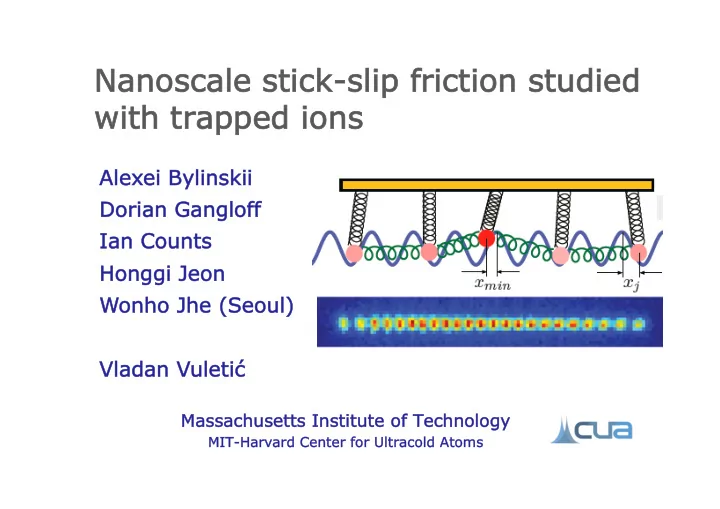
Na Nanosca scale sti stick ck-sl slip p fricti ction stu studi died d with th tr trappe pped d ions s Al Alex exei ei Bylinsk skii Dorian Gangl gloff Ian Counts ts Honggi ggi Jeon Wo Wonho Jhe Jhe ( (Seoul Seoul)


slide-1
SLIDE 1

Na Nanosca scale sti stick ck-sl slip p fricti ction stu studi died d with th tr trappe pped d ions s

Al Alex exei ei Bylinsk skii Dorian Gangl gloff Ian Counts ts Honggi ggi Jeon Wo Wonho Jhe Jhe ( (Seoul Seoul) Vlada dan Vuleti tić

Massa ssach chuse setts tts Insti stitu tute te of Tech chnology gy

MIT-Harvard d Cente ter for Ultr traco cold d Ato toms s

slide-2
SLIDE 2

Outl tline

  • Ion-trap emulator of friction with cold

trapped ions

  • Single-asperity, single-atom friction (Prandtl-

Tomlinson model 1928)

  • Thermolubricity, velocity dependence of

friction

  • From few- to many-particle friction (Frenkel-

Kontorova model 1938)

  • Superlubricity and the Aubry transition (Aubry

1983)

  • Friction in multistable potentials
slide-3
SLIDE 3

Frict rictio ion at the nanosca scale le

  • Spectacular advances
  • Molecular dynamics simulations with thousands of

atoms at the surface layer.

  • A. Socoliuc, R. Bennewitz, E. Gnecco,

and E. Meyer, PRL 92, 134301 (2004).

  • Atomic force microscopy

friction can measure atomic- scale friction.

force

slide-4
SLIDE 4

Ion-cr crysta stal fricti ction emulato tor

Pioneering theoretical proposals by Shepelyansky, Vanossi & Tosatti, Haeffner and others

  • I. Garcıa-Mata, O. V. Zhirov, D. L. Shepelyansky, Eur.
  • Phys. J. D 41, 325 (2006).
  • A. Benassi, A. Vanossi, E. Tosatti, Nat. Commun. 2, 236

(2011).

  • D. Mandelli, A. Vanossi, E. Tosatti, Phys. Rev. B 87,

195418 (2013).

  • T. Pruttivarasin, M. Ramm, I. Talukdar, A. Kreuter, H.

Haeffner, New J. Phys. 13, 075012 (2011).

slide-5
SLIDE 5

Our ion fricti ction sy syste stem

a b ion trap (support) Yb+ ion chain

  • ptical lattice

(substrate) a=185nm d~5µm d~0.5nm support substrate chain a

Theory ¡proposals: ¡

  • Benassi, ¡A., ¡Vanossi, ¡A., ¡& ¡

Tosa5, ¡E. ¡(2011). ¡Nature ¡ Communica.ons, ¡2, ¡236 ¡ ¡

  • García-­‑Mata, ¡I., ¡Zhirov, ¡O. ¡V., ¡& ¡

Shepelyansky, ¡D. ¡L. ¡(2006). ¡The ¡ European ¡Physical ¡Journal ¡D, ¡ 41(2), ¡325–330 ¡(2006) ¡

  • Pru5varasin, ¡T., ¡Ramm, ¡M., ¡

Talukdar, ¡I., ¡Kreuter, ¡A., ¡& ¡ Häffner, ¡H. ¡New ¡Journal ¡of ¡ Physics, ¡13(7), ¡075012 ¡(2011) ¡

slide-6
SLIDE 6

Our ion fricti ction sy syste stem

Karpa, Bylinskii, Gangloff, Cetina, & Vuletic, Suppression of Ion Transport due to Long-Lived Subwavelength Localization by an Optical Lattice. PRL 111, 163002 (2013).

slide-7
SLIDE 7

Ion cr crysta stal fricti ction emulato tor

  • Position and track each atom

with sub-lattice-site resolution

  • Control all microscopic

parameters: Temperature, potential depth, lattice period, atom number, velocity, atom position, time resolved tracking.

slide-8
SLIDE 8

DC electrode voltage (V)

8 9 10 11 12 13 14 15 16

Collected counts/s

100 200 300 400 500 600

fitted curve

Subw bwavelength gth po posi siti tion tr track cking g F ∝ sin4(x)

x

185 nm

fluorescence

slide-9
SLIDE 9

Single-particle friction: Prandtl-Tomlinson model

slide-10
SLIDE 10

Singl gle-pa parti ticl cle mode del for nanofricti ction

Stick-slip friction

  • L. Prandtl, Z. Angew. Math. Mech. 8, 85 (1928);
  • G. A. Tomlinson, Philos. Mag. 7, 905 (1929).

movie

slide-11
SLIDE 11

Sti tick ck-sl slip p fricti ction with th ions s in

  • pti

ptica cal latti ttice ce

  • Ion imaging with 3 µm

resolution (sufficient to resolve neighboring ions)

  • Sub-lattice site resolution

via position dependent ion fluorescence (~20 nm for 100ms integration time, lattice spacing 185 nm)

slide-12
SLIDE 12

Time- and d latti ttice ce-si site te-reso solved d si singl gle-ion de dete tecti ction

Hysteresis loop measures friction

slide-13
SLIDE 13

Fricti ction measu surement t with th si singl gle ato tom

Solid line: Prandtl-Tomlinson model

  • L. Prandtl, Z. Angew. Math. Mech. 8, 85 (1928);
  • G. A. Tomlinson, Philos. Mag. 7, 905 (1929).

=​(​#↓%&'' /​#↓'*&

Prandtl- Tomlinson model Friction ∝ normal load

  • A. Bylinskii, D. Gangloff, and V. Vuletić,

Science 348, 1115 (2015).

slide-14
SLIDE 14

M

v Fs

Dependence of friction on velocity

slide-15
SLIDE 15

Veloci city tu tuning g of fricti ction

1 2 3 High T

  • r low v

2F Low T

  • r high v

Trap position: 1 2 3 UB 2F

Trap position 2F Fluorescence

High temperature

  • r low velocity:

Near equilibrium, Boltzmann factors Low temperature

  • r high velocity:

Non-equilibrium, atom stuck in metastable state

Friction is reduced by temperature. How much depends

  • n velocity

High T Low T 2Fs

Jinesh, Krylov, Valk, Dienwiebel, & Frenken, Phys. Rev. B 78, 155440 (2008).

slide-16
SLIDE 16

Thermolubr brici city ty

Thermal activation reduces friction force as ion follows global potential minimum. movie

Experiment and theory in real friction: Speed Dependence of Atomic Stick-Slip Friction in Optimally Matched Experiments and Molecular Dynamics Simulations Li, Dong, Perez, Martini, and Carpick, Phys. Rev. Lett. 106, 126101

slide-17
SLIDE 17

Four veloci city ty regi gimes s of fricti ction

  • D. Gangloff, A. Bylinskii, I. Counts, W. Jhe, and V. Vuletić, Nat. Phys. 11, 915 (2015).
slide-18
SLIDE 18

M

Fs

Dependence of friction on surface: Structural friction

slide-19
SLIDE 19

d K g U a

Ma Many-p y-part rticle icle mo model l of frict rictio ion η = 2π2

a2 U/K

= ω2

L/ω2

g/K d a (mod 1)

Frenkel-Kontorova (1938) Prandtl-Tomlinson (1928)

+

X = Fapp K

slide-20
SLIDE 20

Fricti ction with th se several ions: s: match tched d ca case se

Same as single-ion friction for each ion: large friction. All ions slip simultaneously. movie

slide-21
SLIDE 21

Match tched d and d mism smatch tched d co configu gurati tions s

Matched q=1 Mismatched q=1 Shown is phase of unperturbed ion position relative to optical lattice. Matching parameter

slide-22
SLIDE 22

Fricti ction with th se several ions: s: mism smatch tched d

Nearly vanishing friction: Superlubricity.

  • A. Bylinskii, D. Gangloff, and V. Vuletić, Science

348, 1115-1118 (2015).

movie

slide-23
SLIDE 23

Transi siti tion from match tched d to to mism smatch tched d regi gime

3 ions

  • - - T=0

____ T > 0

  • A. Bylinskii, D. Gangloff, and V. Vuletić, Science 348, 1115 (2015).

2 ions 6 ions

slide-24
SLIDE 24

Ma Match ched vs.

  • vs. misma

mismatch ched ch chain ins s

a d

d a (mod 1) = 0

a d

d a (mod 1) = 1 2

Essence of superlubricity: near-zero friction persists for finite spring constant.

slide-25
SLIDE 25

Match tched d and d mism smatch tched d fricti ction for tw two ions s

matched mismatched

  • D. Gangloff, A. Bylinskii, I. Counts, W. Jhe, and V. Vuletić, Nature

Physics (2015).

slide-26
SLIDE 26

Two-ion match tching g de depe pende dence ce of fricti ction: “su supe perlubr brici city ty” ”

“Superlubricity”: K. Shinjo, M. Hirano, Surf. Sci. 283, 473 (1993).

slide-27
SLIDE 27

Supe perlubr brici city ty in real fricti ction

  • Dienwiebel, M. et al. Superlubricity of graphite.
  • Phys. Rev. Lett. 92, 126101 (2004).
slide-28
SLIDE 28

Transpo sport t via kinks: s: sy synch chrony

Peierls-Nabarro potential for two ions Synchrony Polar plot representation of slipping times (2 ions) Polar plot representation of slipping times (5 ions)

slide-29
SLIDE 29

Transpo sport t via kinks: s: sy synch chrony

Transport via kinks Synchronous transport

commensurate incommensurate commensurate- incommensurate transition

Weak dependence of friction on matching Strong dependence on matching

slide-30
SLIDE 30

Nanofriction and Aubry transition

slide-31
SLIDE 31

Sta tati tic c Aubr bry tr transi siti tion

Infinite chain Maximally incommensurate d/a mod 1 = Golden Ratio What happens as periodic corrugating potential is increased?

Aubry, S. Exact models with a complete devil’s staircase. Journal of Physics C: Solid State Physics 16, 2497 (1983). Aubry, S. & Le Daeron, P. The discrete Frenkel-Kontorova model and its extensions. Physica D: Nonlinear Phenomena 8, 381–422 (1983).

Atoms suddenly localize in periodic potential at some criticial potential depth.

slide-32
SLIDE 32

An Analyt lyticit icity y bre reakin king

xpinned mod a

xinit mod a

0.5

  • 0.5
  • 0.5

0.5

U < Uc

Potential maximum Fractal structure: gaps in position space on every scale

Aubry, S. Exact models with a complete devil’s staircase. Journal of Physics C: Solid State Physics 16, 2497 (1983).

slide-33
SLIDE 33

Aubr bry tr transi siti tion

Initial position Final position

Position relative to lattice

Primary gap secondary gap

Aubry transition: smooth distribution of positions (for infinite chain) breaks up into fractal distribution. Highest critical potential for (d/a) mod 1 =(1+√5)/2 (Golden Ratio)

slide-34
SLIDE 34

Finite te Aubr bry tr transi siti tion

Position relative to lattice

Gaps correspond to bistable hysteresis loops in friction. Aubry sliding-to-pinned analycity breaking transition is transition from superlubricity to stick-slip friction.

slide-35
SLIDE 35

Aubr bry tr transi siti tion in finite te ch chain

Primary gap for one ion (avoiding potential maximum) corresponds to secondary gap for next ion.

slide-36
SLIDE 36

Obse bservati tion of pr primary and d se seco conda dary ga gaps ps in th three-ion ch chain

0.07 0.7

Δx Δx

  • A. Bylinskii, D. Gangloff, I. Counts,
  • V. Vuletic, Nat. Mat. (2016).

Primary gap Secondary gap

slide-37
SLIDE 37

Inte teracti ctions s wide den sl slidi ding g ph phase se

1 2 3 4 5 6 7 8 9 10 0.05 0.1 0.15 0.2

U [

1 2π2 Ka2]

Fs [Ka]

mean friction force

  • ptical lattice depth

Fs [Ka] U [

1 2π2 Ka2]

1 2 3 4 5 0.25 0.5

Uc

N=5 ¡ N=2 ¡ N=3 ¡ N=1 ¡

q = 1

q = 0

g/K=3.3 ¡ g/K=0.75 ¡ g/K=1.45 ¡ g/K=0 ¡

slide-38
SLIDE 38

Agreement with Aubry model

a b

g/K N Uc [

1 2π2 Ka2]

1 2 3 4 1 2 3 4 5 6 7 1 2 3 4 5

Critical potential depth mismatched matched More is different – Phil Anderson More is not that many

Dashed lines: infinite Aubry model

slide-39
SLIDE 39

Multislip friction (Friction in multistable potentials)

Multislip Friction with a Single Ion. I. Counts, D. Gangloff, A. Bylinskii, J. Hur, R. Islam, and V. Vuletić, to appear in Physical Review Letters, arXiv:1705.00716 (2017).

slide-40
SLIDE 40

Multi tisl slip fricti ction

In real friction: Medyanik, Liu, Sung, & Carpick, Phys. Rev. Lett. 97, 136106 (2006).

Increasing the lattice depth creates a potential with multiple minima. Prandtl-Tomlinson corrugation parameter η is ratio of periodic potential depth to spring constant

  • f harmonic trap.
slide-41
SLIDE 41

Expe perimenta tal si sign gnatu ture of multi tisl slip regi gime

The distribution of peak heights can be used to extract slip probabilities to different minima. First slip happens always (system prepared in global minimum). Second peak appears only if system slipped to next minimum A, etc.

slide-42
SLIDE 42

Extr tracti cting g sl slip p pr proba babi biliti ties s to to di different t minima

next minimum A second next minimum B third minimum C For large transport speed, localization in distant minimum observed before possible statically: Finite rethermalization time, additional minima open up before particle thermalizes.

slide-43
SLIDE 43

Extr tracti cting g sl slip p pr proba babi biliti ties s to to di different t minima

next minimum A second next minimum B third minimum C Solid lines: quasistatic Boltzmann model. Potential evolves due to trap motion while particle cools down exponentially. τ is fit parameter for the ion to localize in potential.

slide-44
SLIDE 44

Fricti ction force ce and d di dissi ssipa pati tion in multi tisl slip regi gime

Friction and dissipation are hardly affected by transition to multistable potentials. Solid line: Prandtl- Tomlinson model Points: experimental data

slide-45
SLIDE 45

Fricti ction force ce and d di dissi ssipa pati tion in multi tisl slip regi gime

Prandtl-Tomlinson model v/a = 0.78 γc fast v/a = 0.36 γc medium v/a = 0.17 γc slow Thermal hopping reduces friction. Dissipated energy if slip happens. Localization in distant potential slightly reduces dissipated energy.

slide-46
SLIDE 46

What’s next?

slide-47
SLIDE 47

Quantum m frict rictio ion?

U

Competition between kinetic energy (delocalization through tunneling) and interaction energy (leading to localization). Quantum friction? Quantum Aubry transition?

slide-48
SLIDE 48

Outlo look: k: simu simula latin ing imp impurit ritie ies

Different spin state can experience attractive potential

  • f different depth: simulate impurity with chemical

bond to surface or deeper trapping potential.

U

Add spin degrees of freedom

slide-49
SLIDE 49

Concl clusi sion

  • Simulator for one-dimensional stick-slip friction with

ion chains with atom-by-atom control and observation.

  • Stick-slip friction, superlubricity, and thermolubricity.
  • Close connection between the static Aubry transition

and the dynamic superlubricity transition.

  • Future: Quantum friction? Friction with impurities?

Friction in two-dimensional systems?