Myself Researcher at CNR-IMATI & Member of the Shape and - - PowerPoint PPT Presentation

myself
SMART_READER_LITE
LIVE PREVIEW

Myself Researcher at CNR-IMATI & Member of the Shape and - - PowerPoint PPT Presentation

Myself Researcher at CNR-IMATI & Member of the Shape and Seman2cs Modelling Group (since 2001) Responsible of the research line Numerical Geometry and Signal Processing Spectral Methods for NaDonal ScienDfic


slide-1
SLIDE 1

Spectral Methods for Geometry Processing & Shape Analysis

Giuseppe Patanè CNR-IMATI, Genova - Italy

patane@ge.imati.cnr.it

Myself

  • Researcher at CNR-IMATI & Member of the “Shape and Seman2cs Modelling

Group” (since 2001)

  • Responsible of the research line “Numerical Geometry and Signal Processing”
  • NaDonal ScienDfic HabilitaDon

– Full Professor in Computer Science (INF01) – Full Professor in Systems for Informa3on Processing (ENG-09/H1)

  • My research and training interests lie at the intersec2on of

– Computer Science: Computer Graphics & Mul2media, Machine Learning – Engineering: Informa2on & Signal Processing – Applied MathemaDcs: Numerical Analysis

  • ERC Sector: PE6 Computer Science & InformaDcs

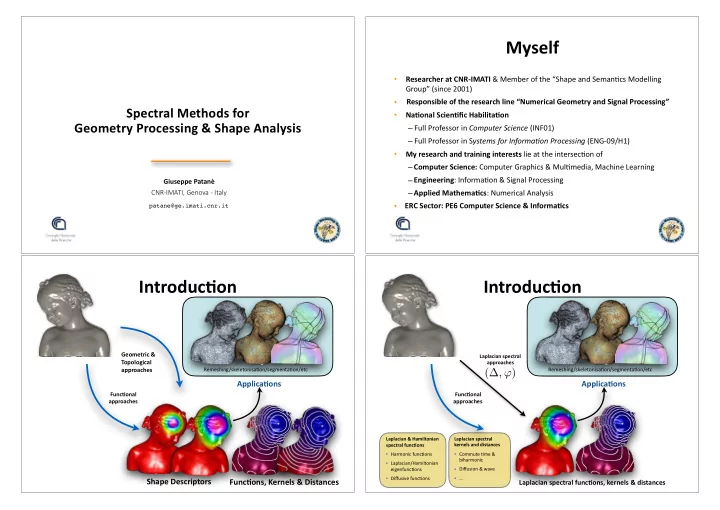
IntroducDon

Geometric & Topological approaches

FuncDonal approaches

Shape Descriptors FuncDons, Kernels & Distances

Remeshing/skeletonisa2on/segmenta2on/etc

ApplicaDons

IntroducDon

FuncDonal approaches

Laplacian spectral approaches

(∆, ϕ)

Remeshing/skeletonisa2on/segmenta2on/etc

ApplicaDons

Laplacian & Hamiltonian spectral funcDons

  • Harmonic func2ons
  • Laplacian/Hamiltonian

eigenfunc2ons

  • Diffusive func2ons

Laplacian spectral funcDons, kernels & distances

Laplacian spectral kernels and distances

  • Commute 2me &

biharmonic

  • Diffusion & wave
slide-2
SLIDE 2
  • Target properDes of the Laplacian spectral

func2ons, kernels, and distances –smoothness & orthonormality –intrinsic definiDon; ie., independent of data embedding/representa2on –mulD-scale definiDon, in order to encode local and global shape features –invariance to shape transformaDons; eg., isometries for pose invariance –compact support & localisaDon at feature/ seed points for encoding local geometry proper2es & saving memory space –efficient, stable, and parameter-free computaDon

Different resoluDons Different & parDal representaDons Different postures

IntroducDon IntroducDon

  • Working on the space of scalar funcDons defined on the input domain (eg., surface,

volume), we can address – mulD-scale signal representaDons and denoising, by projec2ng the input signals/data on a set of (mul3-scale) basis func2ons – sparse representaDons, by choosing a low number of basis func2ons in order to achieve a target approxima2on accuracy – compression, by quan2sing the representa2on coefficients

MulD-scale/sparse representaDon Compression

f =

k

X

i=1

αiϕi

k = 3, 20, 50, . . .

f = (x, y, z)

IntroducDon

  • Working on the space of scalar funcDons defined on the input domain (eg., surface,

volume), we can address – shape deformaDons, by modifying the coefficients that express the geometry of the input surface in terms of geometry-driven or shape-intrinsic basis funcDons (eg., harmonic barycentric coordinates)

f = X

i

αi(t)ϕi

Global basis Local basis

IntroducDon

  • Working on the space of scalar funcDons defined on the input domain (eg., surface,

volume), we can address – the defini2on of Laplacian spectral kernels and distances, as a filtered combina2on of the Laplacian spectral basis

d2(p, q) := X

i

αi|ϕi(p) − ϕi(q)|2

seed point

p

<latexit sha1_base64="TxjeQN1S0yLSUh93TOGy+Iti9rM=">A B8HicbVBNS8NAFHypX7V+VT16WSyCp5KIoN6KXjxWMLbYlrLZvrRLN5uwuxFK6L/w4kHFqz/Hm/ GTZuDtg4sD PvsfMmSATXxnW/ndLK6tr6RnmzsrW9s7tX3T940HGqGPosFrFqB1Sj4BJ9w43AdqKQRoHAVjC+yf3WEyrNY3lvJgn2IjqUPOSMGis9diNqRkGYJdN+tebW3RnIMvEKUoMCzX71qzuIWRqhNExQrTuem5heRpXhTOC0 k01JpSN6RA7lkoaoe5ls8RTcmKVAQljZ 80ZKb+3shopPUkCuxknlAvern4n9dJTXjZy7hMUoOSzT8KU0FMTPLzyYArZEZMLKFMcZuVsBFVlBlbUsW 4C2evEz8s/pV3bs7rzWuizbKcATHcAoeXEADbqEJPjCQ8Ayv8OZo58V5dz7moyWn2DmEP3A+fwBbsJDo</latexit> <latexit sha1_base64="TxjeQN1S0yLSUh93TOGy+Iti9rM=">A B8HicbVBNS8NAFHypX7V+VT16WSyCp5KIoN6KXjxWMLbYlrLZvrRLN5uwuxFK6L/w4kHFqz/Hm/ GTZuDtg4sD PvsfMmSATXxnW/ndLK6tr6RnmzsrW9s7tX3T940HGqGPosFrFqB1Sj4BJ9w43AdqKQRoHAVjC+yf3WEyrNY3lvJgn2IjqUPOSMGis9diNqRkGYJdN+tebW3RnIMvEKUoMCzX71qzuIWRqhNExQrTuem5heRpXhTOC0 k01JpSN6RA7lkoaoe5ls8RTcmKVAQljZ 80ZKb+3shopPUkCuxknlAvern4n9dJTXjZy7hMUoOSzT8KU0FMTPLzyYArZEZMLKFMcZuVsBFVlBlbUsW 4C2evEz8s/pV3bs7rzWuizbKcATHcAoeXEADbqEJPjCQ8Ayv8OZo58V5dz7moyWn2DmEP3A+fwBbsJDo</latexit> <latexit sha1_base64="TxjeQN1S0yLSUh93TOGy+Iti9rM=">A B8HicbVBNS8NAFHypX7V+VT16WSyCp5KIoN6KXjxWMLbYlrLZvrRLN5uwuxFK6L/w4kHFqz/Hm/ GTZuDtg4sD PvsfMmSATXxnW/ndLK6tr6RnmzsrW9s7tX3T940HGqGPosFrFqB1Sj4BJ9w43AdqKQRoHAVjC+yf3WEyrNY3lvJgn2IjqUPOSMGis9diNqRkGYJdN+tebW3RnIMvEKUoMCzX71qzuIWRqhNExQrTuem5heRpXhTOC0 k01JpSN6RA7lkoaoe5ls8RTcmKVAQljZ 80ZKb+3shopPUkCuxknlAvern4n9dJTXjZy7hMUoOSzT8KU0FMTPLzyYArZEZMLKFMcZuVsBFVlBlbUsW 4C2evEz8s/pV3bs7rzWuizbKcATHcAoeXEADbqEJPjCQ8Ayv8OZo58V5dz7moyWn2DmEP3A+fwBbsJDo</latexit> <latexit sha1_base64="TxjeQN1S0yLSUh93TOGy+Iti9rM=">A B8HicbVBNS8NAFHypX7V+VT16WSyCp5KIoN6KXjxWMLbYlrLZvrRLN5uwuxFK6L/w4kHFqz/Hm/ GTZuDtg4sD PvsfMmSATXxnW/ndLK6tr6RnmzsrW9s7tX3T940HGqGPosFrFqB1Sj4BJ9w43AdqKQRoHAVjC+yf3WEyrNY3lvJgn2IjqUPOSMGis9diNqRkGYJdN+tebW3RnIMvEKUoMCzX71qzuIWRqhNExQrTuem5heRpXhTOC0 k01JpSN6RA7lkoaoe5ls8RTcmKVAQljZ 80ZKb+3shopPUkCuxknlAvern4n9dJTXjZy7hMUoOSzT8KU0FMTPLzyYArZEZMLKFMcZuVsBFVlBlbUsW 4C2evEz8s/pV3bs7rzWuizbKcATHcAoeXEADbqEJPjCQ8Ayv8OZo58V5dz7moyWn2DmEP3A+fwBbsJDo</latexit>

q

<latexit sha1_base64="meX57DK1w2i7CaTi1VTDOai/VSY=">A B8HicbVBNS8NAFHzxs9avqkcvi0XwVBIR1FvRi8cKxhb Ujb Tbt0s4m7L0IJ/RdePKh49ed489+4aXPQ1oGFYeY9dt4EiRQGXf bWVpeWV1bL2 UN7e2d3Yre/v3Jk414z6LZaxbATVcCsV9FCh5K9GcRoHkzWB0nfvNJ6 NiNUdjhPejehAiVAwilZ6 EQUh0GYPU56lapbc6cgi8QrSBUKNHqVr04/ZmnEFTJ jWl7boLdjGoUTPJ uZManlA2ogPetlTRiJtuNk08IcdW6ZMw1vYpJFP190ZGI2PGUWAn84Rm3svF/7x2iuF NxMqSZErNvsoTCXBmOTnk7 QnKEcW0KZFjYrYUOqKUNbUtmW4M2fvEj809plzbs9q9avijZKcAhHcAIenEMdbqABPjBQ8Ayv8OY 58V5dz5mo0tOsXMAf+B8/gBdNJDp</latexit> <latexit sha1_base64="meX57DK1w2i7CaTi1VTDOai/VSY=">A B8HicbVBNS8NAFHzxs9avqkcvi0XwVBIR1FvRi8cKxhb Ujb Tbt0s4m7L0IJ/RdePKh49ed489+4aXPQ1oGFYeY9dt4EiRQGXf bWVpeWV1bL2 UN7e2d3Yre/v3Jk414z6LZaxbATVcCsV9FCh5K9GcRoHkzWB0nfvNJ6 NiNUdjhPejehAiVAwilZ6 EQUh0GYPU56lapbc6cgi8QrSBUKNHqVr04/ZmnEFTJ jWl7boLdjGoUTPJ uZManlA2ogPetlTRiJtuNk08IcdW6ZMw1vYpJFP190ZGI2PGUWAn84Rm3svF/7x2iuF NxMqSZErNvsoTCXBmOTnk7 QnKEcW0KZFjYrYUOqKUNbUtmW4M2fvEj809plzbs9q9avijZKcAhHcAIenEMdbqABPjBQ8Ayv8OY 58V5dz5mo0tOsXMAf+B8/gBdNJDp</latexit> <latexit sha1_base64="meX57DK1w2i7CaTi1VTDOai/VSY=">A B8HicbVBNS8NAFHzxs9avqkcvi0XwVBIR1FvRi8cKxhb Ujb Tbt0s4m7L0IJ/RdePKh49ed489+4aXPQ1oGFYeY9dt4EiRQGXf bWVpeWV1bL2 UN7e2d3Yre/v3Jk414z6LZaxbATVcCsV9FCh5K9GcRoHkzWB0nfvNJ6 NiNUdjhPejehAiVAwilZ6 EQUh0GYPU56lapbc6cgi8QrSBUKNHqVr04/ZmnEFTJ jWl7boLdjGoUTPJ uZManlA2ogPetlTRiJtuNk08IcdW6ZMw1vYpJFP190ZGI2PGUWAn84Rm3svF/7x2iuF NxMqSZErNvsoTCXBmOTnk7 QnKEcW0KZFjYrYUOqKUNbUtmW4M2fvEj809plzbs9q9avijZKcAhHcAIenEMdbqABPjBQ8Ayv8OY 58V5dz5mo0tOsXMAf+B8/gBdNJDp</latexit> <latexit sha1_base64="meX57DK1w2i7CaTi1VTDOai/VSY=">A B8HicbVBNS8NAFHzxs9avqkcvi0XwVBIR1FvRi8cKxhb Ujb Tbt0s4m7L0IJ/RdePKh49ed489+4aXPQ1oGFYeY9dt4EiRQGXf bWVpeWV1bL2 UN7e2d3Yre/v3Jk414z6LZaxbATVcCsV9FCh5K9GcRoHkzWB0nfvNJ6 NiNUdjhPejehAiVAwilZ6 EQUh0GYPU56lapbc6cgi8QrSBUKNHqVr04/ZmnEFTJ jWl7boLdjGoUTPJ uZManlA2ogPetlTRiJtuNk08IcdW6ZMw1vYpJFP190ZGI2PGUWAn84Rm3svF/7x2iuF NxMqSZErNvsoTCXBmOTnk7 QnKEcW0KZFjYrYUOqKUNbUtmW4M2fvEj809plzbs9q9avijZKcAhHcAIenEMdbqABPjBQ8Ayv8OY 58V5dz5mo0tOsXMAf+B8/gBdNJDp</latexit>
slide-3
SLIDE 3

IntroducDon

  • Working on the space of scalar funcDons defined on the input domain (eg., surface,

volume), we can address – shape correspondence and comparison, by expressing the problem with respect to a basis and conver2ng it to a linear or least-squares problem

p q

T : M → N δp

FT (δp) ≈ δq

FT : F(M) → F(N)

Goals

  • Review of previous work on the defini2on, discre2sa2on, and

computa2on of Laplacian & Hamiltonian spectral funcDons – harmonic func2ons – Laplacian/Hamiltonian eigenfunc2ons – diffusive func2ons, as solu2ons to the heat equa2on – …

Harmonic funcDon Diffusive funcDons at different scales

. . .

<latexit sha1_base64="M7GmIEvNqbUz4Gtf8JvV+IicJ18=">A B7HicbVBNS8NAEJ34WetX1aOXYBE8lUQE9Vb04rGCaQt KJvNpl272Q27E6GU/gcvHlS8+oO8+W/ctjlo64OBx3sz MyLMsENet63s7K6tr6xWdoqb+/s7u1XDg6bRuWasoAqoXQ7IoYJLlmAHAVrZ5qRNBKsFQ1vp37riWnDlXzAUcbClPQlTzglaKVmV8QKTa9S9WreDO4y8QtShQKNXuWrGyuap0wiFcSYju9lGI6JRk4Fm5S7uWEZoUPSZx1LJUmZCcezayfuqV iN1HalkR3pv6eGJPUmFEa2c6U4MAselPxP6+TY3IVjrnMcmS zhcluXBRudPX3ZhrRlGMLCFUc3urSwdE 4o2oLINwV98eZkE57Xrmn9/Ua3fFGmU4BhO4Ax8uIQ63E DAqDwCM/wCm+Ocl6cd+dj3r iFDNH8AfO5w8odo8M</latexit> <latexit sha1_base64="M7GmIEvNqbUz4Gtf8JvV+IicJ18=">A B7HicbVBNS8NAEJ34WetX1aOXYBE8lUQE9Vb04rGCaQt KJvNpl272Q27E6GU/gcvHlS8+oO8+W/ctjlo64OBx3sz MyLMsENet63s7K6tr6xWdoqb+/s7u1XDg6bRuWasoAqoXQ7IoYJLlmAHAVrZ5qRNBKsFQ1vp37riWnDlXzAUcbClPQlTzglaKVmV8QKTa9S9WreDO4y8QtShQKNXuWrGyuap0wiFcSYju9lGI6JRk4Fm5S7uWEZoUPSZx1LJUmZCcezayfuqV iN1HalkR3pv6eGJPUmFEa2c6U4MAselPxP6+TY3IVjrnMcmS zhcluXBRudPX3ZhrRlGMLCFUc3urSwdE 4o2oLINwV98eZkE57Xrmn9/Ua3fFGmU4BhO4Ax8uIQ63E DAqDwCM/wCm+Ocl6cd+dj3r iFDNH8AfO5w8odo8M</latexit> <latexit sha1_base64="M7GmIEvNqbUz4Gtf8JvV+IicJ18=">A B7HicbVBNS8NAEJ34WetX1aOXYBE8lUQE9Vb04rGCaQt KJvNpl272Q27E6GU/gcvHlS8+oO8+W/ctjlo64OBx3sz MyLMsENet63s7K6tr6xWdoqb+/s7u1XDg6bRuWasoAqoXQ7IoYJLlmAHAVrZ5qRNBKsFQ1vp37riWnDlXzAUcbClPQlTzglaKVmV8QKTa9S9WreDO4y8QtShQKNXuWrGyuap0wiFcSYju9lGI6JRk4Fm5S7uWEZoUPSZx1LJUmZCcezayfuqV iN1HalkR3pv6eGJPUmFEa2c6U4MAselPxP6+TY3IVjrnMcmS zhcluXBRudPX3ZhrRlGMLCFUc3urSwdE 4o2oLINwV98eZkE57Xrmn9/Ua3fFGmU4BhO4Ax8uIQ63E DAqDwCM/wCm+Ocl6cd+dj3r iFDNH8AfO5w8odo8M</latexit> <latexit sha1_base64="M7GmIEvNqbUz4Gtf8JvV+IicJ18=">A B7HicbVBNS8NAEJ34WetX1aOXYBE8lUQE9Vb04rGCaQt KJvNpl272Q27E6GU/gcvHlS8+oO8+W/ctjlo64OBx3sz MyLMsENet63s7K6tr6xWdoqb+/s7u1XDg6bRuWasoAqoXQ7IoYJLlmAHAVrZ5qRNBKsFQ1vp37riWnDlXzAUcbClPQlTzglaKVmV8QKTa9S9WreDO4y8QtShQKNXuWrGyuap0wiFcSYju9lGI6JRk4Fm5S7uWEZoUPSZx1LJUmZCcezayfuqV iN1HalkR3pv6eGJPUmFEa2c6U4MAselPxP6+TY3IVjrnMcmS zhcluXBRudPX3ZhrRlGMLCFUc3urSwdE 4o2oLINwV98eZkE57Xrmn9/Ua3fFGmU4BhO4Ax8uIQ63E DAqDwCM/wCm+Ocl6cd+dj3r iFDNH8AfO5w8odo8M</latexit>

Laplacian eigen-funcDons at different frequencies

Goals

  • Our review will be “independent” of

– data dimensionality (surface, volume, nD data) – discre2sa2on of the input domain (mesh, point set) and the Laplace-Beltrami operator

Goals

  • Analysis of preview work on the computa2on of the Laplacian

spectral func2ons, kernels, and distances in terms of – robustness with respect to the discre2sa2on of the input domain: connec2vity, sampling, and smoothness (eg. geometric/topological noise)

slide-4
SLIDE 4

Goals

  • Analysis of preview work on the computa2on of the Laplacian

spectral func2ons, kernels, and distances in terms of – numerical proper2es (eg., sparsity, condi2oning number) of the Laplacian matrix and filter behaviour

Goals

  • Analysis of preview work on the computa2on of the Laplacian

spectral func2ons, kernels, and distances in terms of – numerical accuracy/stability: convergence, Gibbs phen. – computa2onal cost & storage overhead – selec2on of parameters & heuris2cs

Goals

3D Shape

M

n points

. . .

Space of scalar funcDons defined on M

Φ ∈ Rn×n

  • In the space of scalar func2ons defined on M, we represent

– point-wise or piecewise linear scalar funcDons as vectors – linear operators as matrices

  • Numerical linear algebra is the main tool for addressing applica2ons in spectral

geometry processing and shape analysis

Goals

  • Focus & Novelty: unified review of the defini2on, discre2sa2on, and computa2on of

Laplacian spectral func2ons, kernels, and distances, independent of the data dimensionality and discre2sa2on of both the input domain and the Laplace-Beltrami

  • perator
  • ApplicaDons to geometry processing & shape analysis

– Geodesics & signal approxima2on – Diffusion smoothing, distances & descriptors – Laplacian spectral kernels & distances for shape comparison

  • Previous STARs have addressed

– the comparison of different discrete Laplacians[Zhang07] – Laplacian spectral smoothing[Taubin99] – surface coding & spectral par22oning[Karni00] – shape deforma2on based on differen2al coordinates[Sorkine06] – applica2ons to shape modeling & geometry processing[Lèvy06] – diffusion shape analysis[Bronstein12] & comparison[Biasoh15]

slide-5
SLIDE 5

Laplacian Operator

Laplacian equaDons

∆f = 0 ∆f = λf

∆ := div(grad)

  • Con2nuous case
  • Harmonic equa2on
  • Laplacian eigenvalue problem
  • Heat diffusion equa2on

(∂t + ∆)F(·, t) = 0

Discrete Laplacians

  • Aim: review of previous work on the discre2sa2on of the

Laplace-Beltrami operator through a unified representaDon

  • f the discrete Laplacians that is independent of the

– “dimensionality” of the input domain: surfaces, volumes, nD data – discreDsaDon of the input domain: graphs, triangle/ polygonal/tetrahedral meshes, point sets – Laplacian weights, as entries of the Laplacian matrix.

  • We represent the Laplacian matrix for graphs, meshes, and

point sets in a “unified” way as

  • Main properDes

– Posi2ve semi-definiteness: – Null eigenvalue: – B-self-adjointness:

Discrete Laplacians

h˜ Lf, fiB = f >Lf 0 ˜ L1 = 0

˜ L = B−1L

B-scalar product <f,g>B:=fTBg

  • n the space of scalar func2ons

defined on the input domain

L sparse, symm., posi2ve semi-definite, L1=0 B sparse, symm., posi2ve definite

h˜ Lf, giB = hf, ˜ LgiB

slide-6
SLIDE 6

Discrete Laplacians

˜ L = B−1L SDffness matrix Mass matrix

L(i, j) := 8 < : w(i, j) := − cot αij+cot βij

2

j ∈ N(i) − P

k∈N(i) w(i, j)

i = j else

  • Linear FEM Laplacian matrix[Reuter06] on triangle meshes
  • Voronoi-cotg on triangle[Desbrun99,Pinkall99] & polygonal

meshes[Alexa11,Herholz11], Curvature-based Laplacians[Aflalo2013]

  • Anisotropic Voronoi-cotg weights[Andreux14,Shi08,Kim13]

Discrete Laplacians

˜ L = B−1L

B(i, i) = vi

Area of the approximated Voronoi cell

L(i, j) = (

1 4πt2 exp

⇣ kpipjk2

2

4t

⌘ i 6= j P

k6=i L(i, k)

i = j

  • Laplacian matrix on point sets[Belkin03-06-08,Liu12]

Discrete Laplacians

˜ L = B−1L

i p j q

αk B encodes tetrahedral volumes

L(i, j) = ⇢

1 6

Pn

k=1 lk cot αk

j ∈ N(i) − P

k6=i L(i, k)

i = j

Laplacian EigenfuncDons

slide-7
SLIDE 7
  • The generalised Laplacian eigensystem of (L,B)

defines a set of n linearly independent func2ons that – can be used for the solu2on to discrete differen2al equa2ons involving the Laplacian matrix (eg., heat equa2on) – have a different behaviour: eigenfunc2ons associated with small/ large eigenvalues have a smooth/irregular behaviour

Laplacian eigenfuncDons

Lxi = λiBxi hxi, xjiB = δij λi  λi+1 ˜ L = B−1L

x2 x5 x10

Laplacian spectrum - ComputaDon

  • The O(n2) computaDon Dme and storage overhead of the whole Laplacian

spectrum are addressed by compu2ng only k eigenpairs - k<<n: O(kn)

  • comput. & storage cost[Golub89]

– shi` method computes spectral bands centred around a given eigenvalue – inverse method computes k smaller/larger eigenvalues – power method improves the convergence speed of the computa2on, by considering a power of the input matrix

  • Numerically unstable computaDons of the Laplacian eigenpairs are due to

– mulDple eigenvalues, associated with high dimensional eigenspaces – switched and/or numerically close eigenvalues with respect to the approxima2on accuracy of the solver of the Laplacian eigenproblem and are independent of the quality of the discre2sa2on of the input domain.

ApplicaDons

  • Spectral graph theory & Machine Learning

– Graph par22oning[Chung97,Fiedler93,Mohar93,Koren03] – Reduc2on of the bandwidth of sparse matrices[Golub89,Alpert99,Diaz02] – Dimensionality reduc2on with spectral embeddings[Belkin03,Xiao10]

  • Shape analysis

– Shape segmenta2on[Liu07,Zhang05] – Shape correspondence[Jain07,Jain&ZhangK07] – Shape comparison[Marini11,Reuter05-06-07,Rustamov07,Wardetzky07,Jain06-07] – Spectral kernels and distances

  • bi-harmonic kernels/distances[Lipman10,Rustamov11]
  • diffusion kernels/

distances[Bronstein10-11,Coifman06,Gebal09,Lafon06,Luo09,Hammond11,Patanè10]

  • wave kernels/distances[Bronstein11,Aubry11]

ApplicaDons

  • Geometry processing

– Data reduc2on[Belkin03-08] & compression[Karni00]

–Discrete differen2al forms[Desbrun99-05,Gu03] –Design of low-pass filters & Implicit mesh fairing[Taubin95,Desbrun99,Kim05,Pinkall93,Zhang03] –Mesh watermarking & Geometry compression[Obuchi01-02,Karni00] –Approxima2on and smoothing of scalar func2ons[Patanè13] –Surface deforma2on[Levy06,Sorkine04,Vallet08,Zhang07] –Local/global parameterisa2on[Floater,Patanè04-07,Zhang05] –Surface quadrangula2on[Dong05]

slide-8
SLIDE 8

Heat EquaDon & Kernel

Heat diffusion equaDon

Volume Surface ⇢ (∂t + ∆) F(·, t) = 0 F(·, 0) = f

  • The solu2on to the heat equa2on can be expressed in

terms of – the Laplacian spectrum – the ac2on of the diffusion operator

Heat diffusion equaDon

(λn, φn)+∞

n=0

F(p, t) = hKt(p, ·), fi2, Kt(p, q) =

+∞

X

n=0

exp(λnt)φn(p)φn(q)

diffusion kernel

F(·, t) = exp(t∆)f =

+∞

X

n=0

exp(λnt)hf, φni2φn

Φt := exp(−t∆)

  • Truncated spectral approximaDon of the heat kernel considers the

contribu2on of the Laplacian eigenvectors related to the k smaller eigenvalues

  • Main moDvaDons

–exponen2al decay of the filter as the eigenvalues/2me increase –the computa2on of the whole spectrum is not feasible for a large n –numerical instabili2es due to close/mul2ple eigenvalues, associated with“high” dimensional eigenspaces (eg., symmetric shapes)

  • Remark: for small scales, we must compute a large number of

eigenpairs to achieve a good approxima2on accuracy

Previous work

k

F(t) =

n

X

i=1

exp(λit)hf, xiiBxi

slide-9
SLIDE 9

Previous work

  • Truncated spectral approxima2on (k=200)

t = 10−4 t = 10−3 t = 10−2 t = 10−1 Volume

Spectrum-free approximaDon

3D Shape

⇢ (∂t + ∆) F(·, t) = 0 F(·, 0) = f

F(·, t) = exp(−t∆)f

F(p, t) = hKt(p, ·), fi2

  • Idea - 1D case[Golub89]

– Compute the best (r,r)-degree ra2onal approxima2on crr(x) of ex with respect to the l∞-norm – l∞ error between ex and its ra2onal approxima2on is lower than σrr≈10-r (unif. ra3onal Cheb. constant)

Chebyshev approximaDon

coeff poles

exp(x) ≈ α0 −

r

X

i=1

αi(x + θi)−1

  • Applying the Chebyshev approxima2on to , we get the

spectrum-free computaDon of the solu2on to the heat equa2on that requires the solu2on to r sparse, symmetric linear systems

  • No input parameters (degree r is fixed)
  • Numerical solver

– apply an itera2ve solver for linear systems (e.g., minres): O(rn)-O(rnlog(n)), according to the sparsity of (L,B) – pre-factorise the matrix B (if not diagonal); only for several values of t or several ini2al condi2ons F(.,0)=f (eg., diffusion distances)

Chebyshev approximaDon

Ktf ≈ α0f +

r

X

i=1

αigi

(tL + θiB)gi = −Bf, i = 1, . . . , r Kt = exp(−t˜ L)

slide-10
SLIDE 10

Chebyshev approximaDon

t

seed point

P.C. approx., r = 7

Numerical stability

  • The Cheb./polyn. approx. of exp(-tC) is unstable if ||tC||2 is too large.
  • From the upper bound

a well-condi2oned matrix B guarantees that ||tB-1L||2 is low.

  • If the Laplacian matrix is ill-condi2oned, then we can apply specialized

Laplacian pre-condi2oners[Krishnan13].

ktB−1Lk2  tλmax(L)λ−1

min(B)

κ2(tL + θiB) i = 1, . . . , r

Numerical stability - Gibbs phen.

Padè-Chebyshev approx. r:=7

  • Trunc. spectral approx. (k=500)

p

t = 10−1 t = 10−1 t = 10−2

t = 10−3

t = 10−2

t = 10−4

f(·) := Kt(p, ·) ≥ 0

Robustness

Sampling density

slide-11
SLIDE 11

Robustness

Geometric noise

Robustness

Holes Cuts

Robustness

SHREC’16: Matching of Deformable Shapes with Topological Noise - [Lahner16]

Topological noise

Robustness

SHREC’10: Robust shape retrieval - [Bronstein10]

Almost isometric deformaDons

slide-12
SLIDE 12

Polynomial approximaDon

  • RaDonal polynomial approximaDon[Pusa11] of the exponen2al

filter based on quadrature formulas derived from complex contour integrals.

  • Polynomial approximaDon[Golub89]

– applies the Taylor power series to the exponen2al matrix (first r terms) – has an accuracy lower than the Padè-Chebyshev method (point-wise instead of uniform convergence) – generalises the 1st order Taylor approxima2on applied by the power method

exp(−t˜ L) =

+∞

X

n=0

(−t˜ L)n n!

ApplicaDons Signal Smoothing

Diffusive smoothing: opDmal scale

t1 t2 t3 f

F(·, topt)

F(·, t)

⇢ (∂t + ∆)F(·, t) = 0 F(·, 0) = f

Diffusive smoothing: opDmal scale

kfk2

⇥ kfk2

2 |hf, φ0i2|2⇤1/2

|hf, φ0i2|

  • pDmal t

✏(t) = (kF(·, t) fk2, kF(·, t)k2)

Residual error Energy

slide-13
SLIDE 13

Diffusive smoothing: opDmal scale

  • Approx. error: P.C. <1%; trunc. specr. meth. 12% (k=100)-13% (k=1K)

Diffusion smoothing

ApplicaDons Diffusion distances & descriptors

  • Geodesic distances can be expressed in terms of the heat kernel as

–Otherwise[Crane13],

  • Integrate the heat flow (for a fixed t)
  • Evaluate the vector field
  • Solve the Poisson eq.
  • OpDmal transportaDon distances are approximated through the

solu2on of two sparse linear systems that involve the heat kernel[Solomon15] .

  • In both cases, we can apply the spectrum-free approach to

guarantee an accurate approxima2on of the heat kernel.

Geodesics approx. via heat kernel

dG(p, q) = − lim

t→0(4t log Kt(p, q))

[Varadhan’s formula[Varadhan67]]

∂tF(·, t) = ∆F(·, t)

∆φ = divX

X := rF(·, t)/krF(·, t)k2

Heat diffusion distance

  • Idea: associate a shape M with the funcDonal space

– F(M):={f:M—>R, f scalar func2on on M}

  • eg., Laplacian eigenproblem, heat equa2on, etc

and define the metric space (M,dM), equipped with diffusion distances derived from Kt on F(M) (diffusion geometry). Kt(p, ·)

Kt(q, ·)

q

dt(p, q) := kKt(p, ·) Kt(q, ·)k2

Diffusion distance

p P

slide-14
SLIDE 14

Heat diffusion distance

  • Apply the Padè-Chebyshev of the heat kernel to

approximate diffusion distances.

Diffusion signatures & descriptors

  • Heat kernel signature
  • Diffusion embegging
  • Wave kernel signature

HKS(p) :=

+∞

X

n=0

exp(−λnt)|φn(p)|2

WKS(p) =

+∞

X

n=0

exp(−iλnt)φ2

n(p)

DE(p) := (exp(−λn)φn(p))+∞

n=0

<latexit sha1_base64="4XHVvyajnYSeAHnmG37y7jFrTnk=">A CMXicbVDLSgMxFM34rPV delmsAgtYpmpgiIUig/osoJ9QKeWTJp QzOZkGTEMswvufFPxE0Xirj1J8y0XdTWA4HDuefe3HtcTolUljUylpZXVtfWUxvpza3tnd3M3n5dBqFAuIYCGoimCyWmhOGaIoriJhcY+i7FDXdwk9QbT1hIErAHNeS47cMeIx5BUGmpk6nc3uUcH6q+60U8zl+Vcg5+5rlTh+oZXdiJWJx3eJ8kZNaY10LJih+jE4cwTw3jTiZrFawxzEViT0kWTFHtZN6cboBCHzOFKJSyZVtctSMoFE Ux2knlJhDNIA93NKUQR/LdjS+ODaPtdI1vUDox5Q5Vmc7IuhLOfRd7Ux2lvO1RPyv1gqVd9mOCO hwgxNPvJCaqrATOIzu0RgpOhQE4gE0buaqA8FREqHnNYh2PMnL5J6sWCfFYr359ny9TSOFDgERyAHbHAByqACq AGEHgB7+ADfBqvxsj4Mr4n1iVj2nMA/sD4+QX4Qqoi</latexit>

Heat kernel & shape comparison

  • Diffusion descriptors for shape comparison have

been extensively analysed in SHREC contexts.

Transformations

  • Truncated spectral approximaDon:
  • Padè-Chebyshev approximaDon:

– solu2on to the heat equa2on or evalua2on of the diffusion distance between 2 points – one-to-all distance (no pre-factorisa3on): – one-to-all distance (pre-factorisa3on of B):

  • if B is not diagonal

ComputaDonal cost

O(rnτ(n)) ⇢ O(τ(n)) lin. syst. solver τ(n) ≈ n, n log n O(rτ(n)) O(kn) O(n log n + rn)

slide-15
SLIDE 15

Conclusions

Conclusions

  • Unified definiDon and computaDon of Laplacian spectral basis funcDons for

geometry processing and shape analysis, independent of – data discre2sa2on and representa2on – data dimensionality.

  • Future work

– Defini3on of basis funcDons for Dme-varying data (eg., graphs, videos); – Applica3on/specialisa3on of the basis func2ons to

  • shape correspondence & analysis
  • meshless approximaDon (eg., with radial basis func2ons) in order to deal

with sub-parts of different dimensionality

  • PDEs’ solvers, by defining shape-aware func3onal spaces where we

approximate the solu2on to PDEs (eg., through new barycentric coordinates

  • r basis func2ons that are shape-ware and oblivious of any domain

parameterisa3on – …

References

An Introduction to Laplacian Spectral Distance and Kernels

Giuseppe Patanè, CNR-IMATI Paperback ISBN: 9781681731391 Ebook ISBN: 9781681731407 Published 07/2017 • 139 pages Paperback: USD $45.95 Ebook: USD $36.76 Combo: USD $57.44

  • CONTENTS
  • List of Figures
  • List of Tables
  • Preface
  • Acknowledgments
  • Laplace-Beltrami Operator
  • Heat and Wave Equations
  • Laplacian Spectral Distances
  • Discrete Spectral Distances
  • Applications
  • Conclusions
  • Bibliography
  • Author’s Biography

In geometry processing and shape analysis, several applications have been addressed through the properties of the Laplacian spectral kernels and distances, such as commute-time, biharmonic, difusion, and wave distances. Within this context, this book is intended to provide a common background on the defjnition and computation of the Laplacian spectral kernels and distances for geometry processing and shape analysis. To this end, we defjne a unifjed representation of the isotropic and anisotropic discrete Laplacian operator on surfaces and volumes; then, we introduce the associated diferential equations, i.e., the harmonic equation, the Laplacian eigenproblem, and the heat equation. Filtering the Laplacian spectrum, we introduce the Laplacian spectral distances, which generalize the commute-time, biharmonic, difusion, and wave distances, and their discretization in terms of the Laplacian spectrum. As main applications, we discuss the design of smooth functions and the Laplacian smoothing

  • f noisy scalar functions.

All the reviewed numerical schemes are discussed and compared in terms

  • f robustness, approximation accuracy, and computational cost, thus

supporting the reader in the selection of the most appropriate with respect to shape representation, computational resources, and target application. ABOUT THE AUTHOR Giuseppe Patane is a researcher at CNR-IMATI (2006-today) Institute for Applied Mathematics and Information Technologies-Italian National Research Council. Since 2001, his research activities have been focused on the defjnition of paradigms and algorithms for modeling and analyzing digital shapes and multidimensional data. He received a Ph.D. in Mathematics and Applications from the University of Genova (2005) .

PRINT & eBOOK at: www.morganclaypoolpublishers.com

1210 Fifth Avenue • Suite 250 • San Rafael, CA 94901

Acknowledgments

  • People

– Bailin Deng – Shape and Seman2cs Modelling Group, CNR-IMATI, Italy

  • Projects

– H2020 ERC-AdG CHANGE – IMAGE-FUSION, Biannual Project funded by Regione Liguria & EU FESR

  • Shapes

– AIM@SHAPE Repository – SHREC2010/2016 data sets

  • AddiDonal material

– http://pers.ge.imati.cnr.it/patane/Home.html – http://pers.ge.imati.cnr.it/patane/SGP2019/Course.html

  • Contact: patane@ge.imati.cnr.it