A little bit about myself Tamanna Tam Roshan Lal MB ChB Board - - PowerPoint PPT Presentation

a little bit about myself
SMART_READER_LITE
LIVE PREVIEW

A little bit about myself Tamanna Tam Roshan Lal MB ChB Board - - PowerPoint PPT Presentation

A little bit about myself Tamanna Tam Roshan Lal MB ChB Board certified Paediatrician Johns Hopkins, Baltimore MD Medical Genetics Fellow graduating June 2017 Chief Resident June 2016-2017 Biochemical Genetics


slide-1
SLIDE 1

A little bit about myself

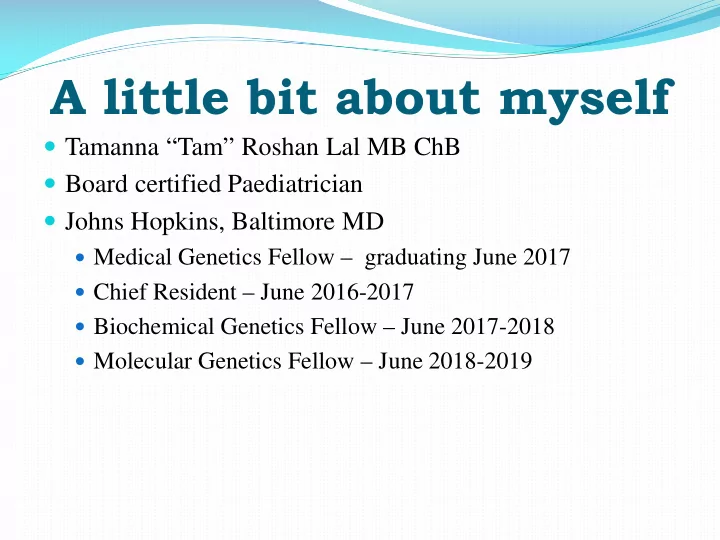
 Tamanna “Tam” Roshan Lal MB ChB  Board certified Paediatrician  Johns Hopkins, Baltimore MD

 Medical Genetics Fellow – graduating June 2017  Chief Resident – June 2016-2017  Biochemical Genetics Fellow – June 2017-2018  Molecular Genetics Fellow – June 2018-2019

slide-2
SLIDE 2

My Journey

 IMU Batch M2/99  Last batch that went to the PJ campus  University Manchester, United Kingdom in 2002  Graduated 2005  Foundation Training in the Greater Manchester (2 years)

 Paediatrics  General Medicine  General Surgery  Obstetrics and Gynaecology  General Practice  2005 to 2007

slide-3
SLIDE 3

My Journey

 Specialist Training in Paediatrics

 2007

 Grand scheme/plan of specialising in Paediatrics in the

UK and coming back to Malaysia

 BUT……the universe had other plans for me  I met a man – a US Marine in 2008, whom I married in

2009

 I had to move to USA  This meant that I had to start my medical career from

scratch

 It also meant I had to do the “dreaded USMLEs”

slide-4
SLIDE 4

My Journey

 Took me 1 year to finish all 3 steps  Applied for residency

 95 Paediatric programmes around the US  Got 4 interviews  Pre-matched to a programme in Baltimore – Sinai Hospital

 Completed residency in 2014  Applied for fellowship in Clinical Medical Genetics

 Stanford  Harvard  UCLA  Johns Hopkins

slide-5
SLIDE 5

My Journey

 Matched to Johns Hopkins  Currently am doing my fellowship at Johns Hopkins  11 years since I graduated, however:

 Still training  Will be training until 2019

 My other interest includes Global Health:

 Ghana  Haiti

slide-6
SLIDE 6

Malaysian Experience

 PBL based  Some lectures  A lot of self studying  Very strong clinical exposure  Prepares you well for the UK system  Not as well for the US system – both pre-clinical and

clinical

slide-7
SLIDE 7

UK Experience

 PBL based as well  Some lectures  A lot of self studying  Trains you well to be very good clinicians  2 years to be exposed to various aspects/specialisations

before making a decision

 However, takes up to 10 years to be a consultant/attending  Minimal exposure to research as a junior doctor – unless

in a big teaching university hospital

 Benefits – get to travel to Europe often

slide-8
SLIDE 8
slide-9
SLIDE 9
slide-10
SLIDE 10

US Experience

 A lot of didactics  Medical students work very hard – as hard as junior

doctors

 Have to decide what specialisation as soon as you

graduate

 Takes 3 to 6 years to be a consultant/attending  A lot of exposure to research – even as a medical student  Benefit – travel around North and South America (if you

can find the time)

slide-11
SLIDE 11
slide-12
SLIDE 12
slide-13
SLIDE 13
slide-14
SLIDE 14

Paediatrics

 Always wanted to be a Paediatrician  Diagnosed my sister with chicken pox at the age of 8

 My parents didn’t believe me, until she had a full blown

rash

 Confirmed by our paediatrician

 See a range of patients

 Neonates/Infants/Toddlers  Young children  Teenagers/Adolescents  Young adults

slide-15
SLIDE 15

Paediatrics

 Variety of settings

 Office (primary care)  Hospital  Specialist outpatient and Inpatient  Emergency  Paediatric and Neonatal ICU

slide-16
SLIDE 16

Clinical Medical Genetics

 Does anyone have an idea what is Clinical Genetics?  Sub-specialty of Paediatrics  Evaluate and treat individuals of all ages with known or

suspected genetic disorders, or who are at risk, because of family history, to develop such a condition

slide-17
SLIDE 17

Clinical Medical Genetics

 Working in Burnley, UK with a big Pakistani population  A lot of consanguinity amongst the community  Due to all the inter-marriages between cousins, there was

a high rate of children with genetic syndromes and congenital abnormalities

 Actually had patients who had conditions that we termed

“syndrome with no names

slide-18
SLIDE 18

My Research

 Type 2 Gaucher disease – a lysosomal storage disease  Extremely rare inborn error of metabolism  Autosomal recessive  Affects infants below the age of 12 months  Neurological devastation – typically die before 2 years of

age

 However, these children are living longer due to medical

intervention up to age 5

 Ventilators  Gastrostomy

slide-19
SLIDE 19

My Research

 As these children are living longer, we are seeing new

signs and symptoms that we have not seen before

 My research is to see these patients and interview their

parents to delineate the changing clinical course of this disease

 Important, as we can then make recommendations for

treatment protocols and management goals

slide-20
SLIDE 20

Future Plans

 Paediatric Biochemical Molecular Geneticist  Involved in clinical medicine as well as research (80/20)  Also includes analysing genetic testing  Would also like to do global health (mission trips)

 1 to 2 trips a year