Motivation for Assessment Assessment of Student Learning Measure what - - PDF document

motivation for assessment assessment of student learning
SMART_READER_LITE
LIVE PREVIEW

Motivation for Assessment Assessment of Student Learning Measure what - - PDF document

All Chairs Meeting UWF November 16, 2007 Motivation for Assessment Assessment of Student Learning Measure what you value, rather than valuing what you can measure. Kermit Hall Dr. Claudia J. Stanny 1944 2006, former President, University


slide-1
SLIDE 1

All Chairs Meeting ‐‐ UWF November 16, 2007 http://uwf.edu/cutla/ 1

Assessment of Student Learning

  • Dr. Claudia J. Stanny

Director Director

Center for University Teaching, Learning, and Assessment

All Chairs Meeting

November 16, 2007

Motivation for Assessment

Measure what you value, rather than valuing what you can measure.

Kermit Hall 1944‐2006, former President, University at Albany ‐ SUNY SUNY

If you don't measure what you value, it won't improve.

Alan Merten President, George Mason University

November 16, 2007 All Chairs Meeting ‐‐ UWF 2

PASD

Pre‐Assessment Stress Disorder Anxiety Denial P i Paranoia Passive‐Aggressive Behavior Amnesia for skills in research methods

November 16, 2007 All Chairs Meeting ‐‐ UWF 3

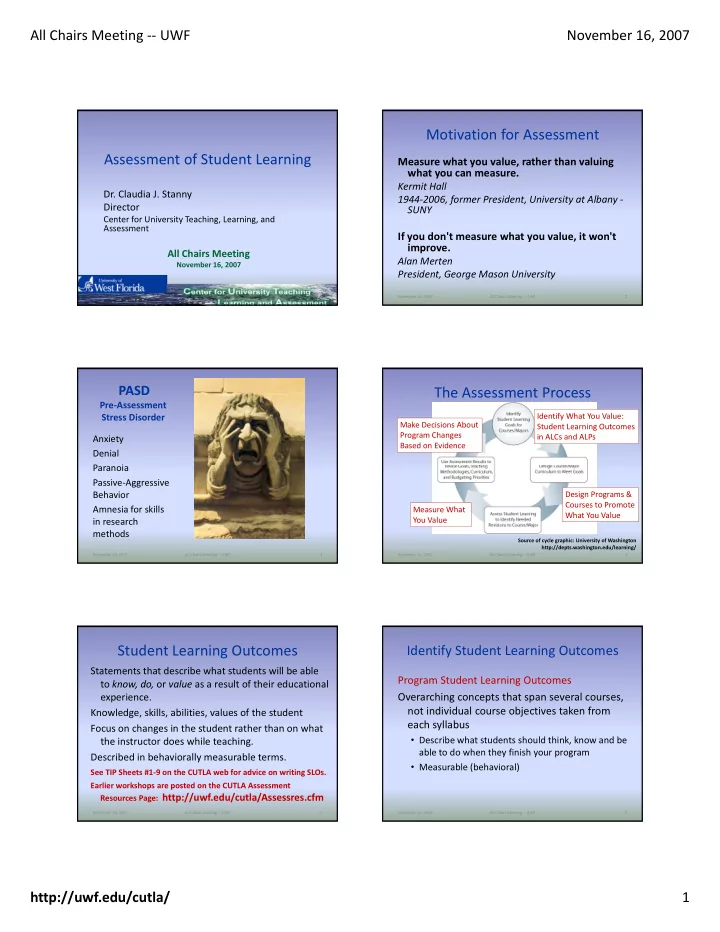
The Assessment Process

Identify What You Value: Student Learning Outcomes in ALCs and ALPs Make Decisions About Program Changes Based on Evidence

November 16, 2007 All Chairs Meeting ‐‐ UWF 4

Source of cycle graphic: University of Washington http://depts.washington.edu/learning/

Design Programs & Courses to Promote What You Value Measure What You Value

Student Learning Outcomes

Statements that describe what students will be able to know, do, or value as a result of their educational experience. Knowledge, skills, abilities, values of the student Focus on changes in the student rather than on what the instructor does while teaching. Described in behaviorally measurable terms.

See TIP Sheets #1‐9 on the CUTLA web for advice on writing SLOs. Earlier workshops are posted on the CUTLA Assessment Resources Page: http://uwf.edu/cutla/Assessres.cfm

November 16, 2007 All Chairs Meeting ‐‐ UWF 5

Identify Student Learning Outcomes

Program Student Learning Outcomes Overarching concepts that span several courses, not individual course objectives taken from each syllabus each syllabus

  • Describe what students should think, know and be

able to do when they finish your program

  • Measurable (behavioral)

November 16, 2007 All Chairs Meeting ‐‐ UWF 6

slide-2
SLIDE 2

All Chairs Meeting ‐‐ UWF November 16, 2007 http://uwf.edu/cutla/ 2

Identify Student Learning Outcomes

Course Student Learning Outcomes More specific learning outcomes that identify learning in an individual course Course SLOs should be included in the course syllabus

  • Describe what students should think, know and be

able to do when they finish the course

  • Measurable (behavioral)
  • Aligned to course topics, assignments, exams, and
  • ther graded work

November 16, 2007 All Chairs Meeting ‐‐ UWF 7

Curriculum Map

Graphic device that shows how the curriculum aligns to student learning outcomes Identify courses where educational outcomes are likely to be achieved Identify gaps in the curriculum where an Identify gaps in the curriculum where an educational outcome might not be addressed as well as hoped Identify courses that might be suitable for an embedded assessment

See TIP Sheets 10 & 11 on the CUTLA Web for more information

November 16, 2007 All Chairs Meeting ‐‐ UWF 8 November 16, 2007 All Chairs Meeting ‐‐ UWF 9

Assess Student Learning

Indirect Measures Student self‐reports Reports of clients or experts

  • n student skill

Alumni & employer surveys Direct Measures

Evaluation of work with a rubric:

  • Course papers & presentations
  • Theses
  • Case notes
  • Capstone experiences
  • Portfolios

Exit interviews or focus groups

  • Portfolios

Performance on state or national licensure, certification, or professional examinations Standardized tests (nationally standardized

  • r locally developed)

November 16, 2007 All Chairs Meeting ‐‐ UWF 10

See TIP Sheets 13‐15 on the CUTLA web for more information

Rubrics: Explicit criteria for assessing student work

Focus on specific student learning outcomes as rubric elements. Describe the criteria that will be used to evaluate the work on this assignment: What will the instructor look for during grading? for during grading? Describe the characteristics of performance at different levels of skill on the target student learning outcome. More effective than grades for assessment. Rubrics provide diagnostic information about strengths and weaknesses in student learning.

November 16, 2007 11 All Chairs Meeting ‐‐ UWF

Closing the Loop

Assessment data that are merely collected and archived serve no purpose Effective assessment practices make use of the data collected to inform decision making: g

  • Changes in instructional strategy
  • Changes in course offerings in the curriculum
  • Changes in course sequencing in the curriculum
  • Changes in support services and advising offered

to students

November 16, 2007 All Chairs Meeting ‐‐ UWF 12

slide-3
SLIDE 3

All Chairs Meeting ‐‐ UWF November 16, 2007 http://uwf.edu/cutla/ 3

Use Assessment‐Based Evidence to Refine Curriculum or Instructional Strategies

Plan when program faculty will meet to discuss assessment results and determine appropriate action U t lt t i iti t ti i d t Use assessment results to initiate action aimed at improving program Clearly relate the results back to the intended educational outcomes Document assessment work and decisions made for communication to external audiences

November 16, 2007 All Chairs Meeting ‐‐ UWF 13

Not all that can be measured is important and not all that is important can be measured.

[easily or reliably] [easily or reliably]

Albert Einstein Measure what you value, and others will value what you measure.

November 16, 2007 14 All Chairs Meeting ‐‐ UWF

General Resources on Assessment

Linda Suskie (2007). Assessing student

  • learning. Jossey‐Bass.

November 16, 2007 All Chairs Meeting ‐‐ UWF 15

General Resources on Assessment

Barbara E. Walvoord (2004). Assessment clear and simple: A practical guide for institutions, departments, and general education. Jossey‐Bass

November 16, 2007 All Chairs Meeting ‐‐ UWF 16

Useful Resources

Peggy L. Maki & Nancy A. Borkowski, Eds. (2006). The assessment of doctoral education: Emerging criteria and new models for improving outcomes. Stylus Publishing.

November 16, 2007 All Chairs Meeting ‐‐ UWF 17

Useful Web Resources

APA Cyberguide on Assessment

http://www.apa.org/ed/guide_outline.html

North Carolina State University

University Planning & Analysis Index of Assessment University Planning & Analysis Index of Assessment Resources

http://www2.acs.ncsu.edu/UPA/assmt/resource.htm

University of Washington

http://depts.washington.edu/learning

November 16, 2007 All Chairs Meeting ‐‐ UWF 18

slide-4
SLIDE 4

All Chairs Meeting ‐‐ UWF November 16, 2007 http://uwf.edu/cutla/ 4

CUTLA Web Resources on SLOs, ALCs, ALPs, and Assessment

TIP Sheets http://uwf.edu/cutla/Tipsheet.cfm Assessment Resources Page http://uwf.edu/cutla/Assessres.cfm

  • CUTLA workshops on assessment (2005 onward)
  • Barbara Walvoord workshop materials
  • Peggy Maki workshop materials

November 16, 2007 All Chairs Meeting ‐‐ UWF 19

Resources on Assessment

Maki, Peggy L. & Borkowski, Nancy A., Eds. (2006). The assessment of doctoral education: Emerging criteria and new models for improving outcomes. Stylus Publishing. y g Suskie, Linda (2007). Assessing student learning. Jossey‐Bass. Walvoord, Barbara E. (2004). Assessment clear and simple: A practical guide for institutions, departments, and general education. Jossey‐Bass.

November 16, 2007 All Chairs Meeting ‐‐ UWF 20

http://www.youtube.com/watch?v=Pk7yqlTMvp8

November 16, 2007 All Chairs Meeting ‐‐ UWF 21