Morris Ridge Solar Energy Project Mount Morris - Livingston County - - PowerPoint PPT Presentation

morris ridge solar energy project
SMART_READER_LITE
LIVE PREVIEW

Morris Ridge Solar Energy Project Mount Morris - Livingston County - - PowerPoint PPT Presentation

Morris Ridge Solar Energy Project Mount Morris - Livingston County April 2020 Deepali Welcome McCloe marigold Facilitator consulting, g, ll llc Todays Presentation Panelists will present Common Themes Submit your written


slide-1
SLIDE 1

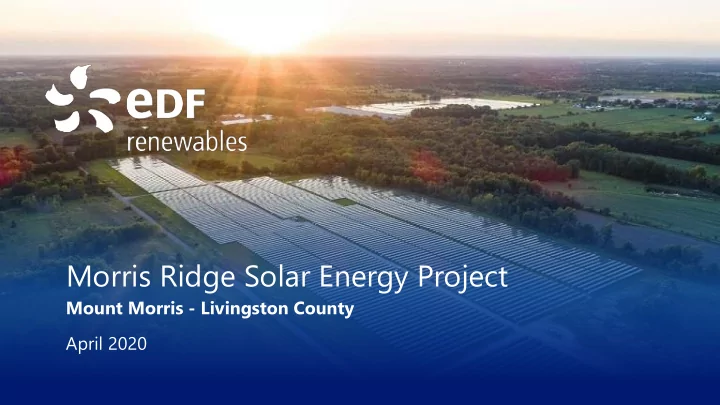
Morris Ridge Solar Energy Project

Mount Morris - Livingston County April 2020
slide-2
SLIDE 2

Deepali McCloe Facilitator Welcome

marigold consulting, g, ll llc

slide-3
SLIDE 3

Today’s Presentation

  • Panelists will present Common Themes
  • Submit your written questions
  • Facilitator will present questions to panelists
  • If your concern isn’t addressed, you can speak one-
  • n-one or submit a written comment form
  • Please be respectful of fellow participants and the

project team

slide-4
SLIDE 4

Common Themes

01 02 03 04 05

Project and Company Overview Public Health and Safety Noise Impacts Visual Impact Assessment Energy Storage

06

Compatibility with Agriculture

slide-5
SLIDE 5

Kevin Campbell Project Developer

Project and Company Overview

slide-6
SLIDE 6

Common Themes / Questions

  • Who is EDF Renewables?
  • Project Overview
  • Local Code
  • Operations Safety
  • Decommissioning and Site Reclamation
  • Morris Ridge Regulatory Process and Timeline
  • Benefits
slide-7
SLIDE 7
  • We are an established company
  • We collaborate with community

stakeholders in both planning and

  • perations
  • We value honesty, transparency, and

two-way dialogue

  • We are good neighbors
  • We evaluate and minimize impacts

and maximize benefits

Building trust in communities for 35+ years

slide-8
SLIDE 8

PROJECT LOCATION

  • Targeting up to 1,050 acres
  • f privately owned land within

the Town of Mt. Morris

  • Produce enough electricity to

power 38,000 New York households or drive an electric vehicle 1 billion miles per year

OVERVIEW

slide-9
SLIDE 9

Compliance with Local Code

  • Equipment enclosed by fence
  • Vegetative buffer to provide year-round screening

along public right of ways and in the field of view from a residence on an adjoining property

  • Solar panels setback 100’ from center line of

highway and 200’ from principal residential structures

  • Decommissioning security to cover 100% of the

cost of the removal of the solar farm and restoration of the property delivered to the Town prior to commencement of operations – to be renewed every 5 years

  • Integration of grazers and pollinators
slide-10
SLIDE 10

OPERATIONS SAFETY

  • EDFR’s local team will monitor and

maintain system to highest standards

  • Local first responders will be trained

before installation and annually

  • Local responders will provide feedback
  • n emergency reponse plan
  • 24-7-365 monitoring from San Diego
  • perations center and three full time

local operations staff

slide-11
SLIDE 11

Removal of Equipment and Restoration

  • Removal of all surface equipment and

improvements and below-ground materials to a depth of 4’

  • Security posted with bank in favor or host

Town to cover cost of equipment removal, adjusted for inflation.

  • Topsoil that was removed or disturbed

during construction, operation, or removal of facility is replaced and aerated; the land can be returned to farming.

slide-12
SLIDE 12

Anticipated Project Timeline

slide-13
SLIDE 13

LOCAL BENEFITS

Total project cost anticipated

~ $200 million

A portion is sourced locally (i.e. labor, material supply) More than

200 jobs

anticipated during the peak of construction Estimated

3 full time

permanent highly skilled

jobs during operation Propose to contribute more than $10 million in direct revenues for Livingston County, Town of Mount Morris and School District(s) in the first 20 years of operation

DIRECT BENEFITS:

Surveying, civil engineering, mechanical work, electrical work, road construction, transportation equipment, earthwork activities, maintenance of vehicle fleet, maintenance paths, snow removal and

  • ther related services.

INDIRECT BENEFITS:

Meals and accommodation for construction personnel; products, services and supplies.

slide-14
SLIDE 14

Common Themes

01 02 03 04 05

Project and Company Overview Public Health and Safety Nois ise e Im Impa pacts Visual Impact Assessment Energy Storage

06

Compatibility with Agriculture

slide-15
SLIDE 15

Ken Kaliski,

P .E., INCE Bd. Cert.

Noise Control Engineer

Noi Noise se Imp Impacts acts

slide-16
SLIDE 16

Noise

  • Overview
  • Types of equipment
  • How sound is measured
  • Potential impacts
  • Activities completed to date
  • Next Steps
  • Post-construction
slide-17
SLIDE 17

Overview

  • Average background is 43 dBA at

night, 46 dBA during day

  • Solar projects are typically

permitted at less than 45 dBA at the nearest home

  • Sources of noise include inverters,

transformers, and energy storage

slide-18
SLIDE 18

Sound Levels Around You

slide-19
SLIDE 19
  • Background sound measurements
  • Standards and design goals
  • Assessing noise impacts
  • Activities completed to date
  • Next steps
  • Post-construction

Potential Noise Impacts

Impact Analysis

slide-20
SLIDE 20

Potential Noise Impacts

Noise Contour Map: Preliminary Sound Level Projection from Solar Array Inverters and Transformers

slide-21
SLIDE 21

Common Themes

01 02 03 04 05

Project and Company Overview Public Health and Safety Noise Impacts Vis isua ual l Im Impa pact Ass sses essmen sment Energy Storage

06

Compatibility with Agriculture

slide-22
SLIDE 22

Potential Noise Impacts

Matthew Robinson

Visualization Project Manager

slide-23
SLIDE 23

Overview

  • Review of VIA process (Article 10 | Exhibit 24)
  • Overview of Research Completed
  • Next Steps Prior to Submittal
  • Techniques to Mitigate Potential Impacts
  • What will it Look Like? (Visual Simulations)
slide-24
SLIDE 24

VIA Update

Completed Activities Project Location

  • Viewshed Analysis
  • Visually Sensitive Resources Research
  • Landscape Similarity Zones
  • Multiple Field Visits
  • Outreach re. Visual Sensitive Resources
  • Public Outreach
  • Preliminary Mitigation Modules
  • Representative Visual Simulations
slide-25
SLIDE 25

VIA Update (cont.)

Ongoing/Upcoming Activities Project Location

  • Continued outreach re. Recommended

Viewpoints for Visual Simulations

  • Continued production of Visual

Simulations

  • Rating Panel (2 independent, 1 in house)
  • Results into final Visual Impact Analysis
  • Continued….
slide-26
SLIDE 26

Proposed Visual Screening Would

  • Utilize existing vegetative material
  • Replicate existing landscape character
  • Soften horizontal views with combinations
  • f deciduous and evergreen vegetation at

various sizes

  • Maximize potential for views across valley

to background ridgeline

  • Incorporate native planting materials
  • Decrease potential for environmental

impacts

  • Increase potential for blending of

project edge

slide-27
SLIDE 27

Potential Mitigation Materials

slide-28
SLIDE 28

Potential Module locations

Left: Project Area | Top: State Route 408 | Dutch Street Rd & Ridge Rd E

SR 408

Frost Road

Ridge Road E

slide-29
SLIDE 29

Existing Conditions:

  • Adjacent agricultural field, No existing hedgerow or

vegetative screening

Treatment:

  • Create buffer to soften view of panels within landscape and

add additional pollinator habitat

Design Considerations:

  • Viewed from moving car at speeds of 35+ MPH
  • Limited road use by pedestrians
  • No adjacent resource/residence
  • Mix of Deciduous and Evergreen Material

Module 1 Roadside Softening

slide-30
SLIDE 30

Module 1 Roadside Softening Cont.

Existing Conditions

County Route 30 (Dutch Street Rd)

slide-31
SLIDE 31

Module 1 Roadside Softening Cont. Visual Simulation – Year One

County Route 30 (Dutch Street Rd)

slide-32
SLIDE 32

Module 1 Roadside Softening Cont. Visual Simulation – 7 to 10 Years

County Route 30 (Dutch Street Rd)

slide-33
SLIDE 33

Module 2

Open Field / Supplemental Hedgerow

Existing Conditions:

  • Open Fields with 200’ + Set back / intermittent hedgerow

Treatment:

  • Fill gaps in hedgerows to soften view of panels within

landscape

Design Considerations:

  • Strengthens existing hedgerows at adjacent resources
  • Provides vertical element to soften horizontal lines of

Project

slide-34
SLIDE 34

Module 2 Open Field / Supplemental Hedgerow Cont.

Existing Conditions

State Route 408 (Mount Morris Nunda Rd.)

slide-35
SLIDE 35

Module 2 Open Field / Supplemental Hedgerow Cont.

Visual Simulation – Year One

State Route 408 (Mount Morris Nunda Rd.)

slide-36
SLIDE 36

Module 2 Open Field / Supplemental Hedgerow Cont. Visual Simulation – 7 to 10 Years

State Route 408 (Mount Morris Nunda Rd.)

slide-37
SLIDE 37

Module 3 Adjacent Resource / Residence

Existing Conditions:

  • Residence or sensitive structure adjacent to proposed array

field, no existing hedgerow

Treatment:

  • Create year-round buffer to screen view of panels within

landscape

Design Considerations:

  • Viewers will be stationary
  • Module utilizes the greatest amount screening material
slide-38
SLIDE 38

Module 3 Adjacent Resource / Residence Cont. Existing Conditions

State Route 408 (Mount Morris Nunda Rd.)

slide-39
SLIDE 39

Module 3 Adjacent Resource / Residence Cont.

Visual Simulation – Year One

  • State Route 408 (Mount Morris Nunda Rd.)
slide-40
SLIDE 40

Module 3 Adjacent Resource / Residence Cont. Visual Simulation – 7 to 10 Years

State Route 408 (Mount Morris Nunda Rd.)

slide-41
SLIDE 41

Common Themes

01 02 03 04 05

Project and Company Overview Public Health and Safety Noise Impacts Visual Impact Assessment En Ener ergy gy St Storage rage

06

Compatibility with Agriculture

slide-42
SLIDE 42

Victoria Carey Senior Consultant

Energy Storage

slide-43
SLIDE 43

Overview of Energy Storage

  • Might include battery energy

storage

  • Centrally located with project

substation

  • Could be located in a building, or a

number of containers

  • Energy storage allows solar energy

to be used when the sun is not shining

  • New York State committed to

deploying energy storage

South of Frost between Creek and Begole

slide-44
SLIDE 44

Example Battery Energy Storage System

Safety systems System is constantly monitored and can automatically isolate parts or whole system Battery cells Combine to create modules, and are stored on racks Thermal management HVAC, Active cooling

slide-45
SLIDE 45

45

How energy storage works

Image courtesy: energysage.com

slide-46
SLIDE 46

Common Themes

01 02 03 04 05

Project and Company Overview Pub ublic lic Hea ealth lth and nd Sa Safety ety Noise Impacts Visual Impact Assessment Energy Storage

06

Compatibility with Agriculture

slide-47
SLIDE 47

Public Health and Safety

  • Dr. Christopher

Ollson

Ph.D. Senior Health Scientist

slide-48
SLIDE 48

Battery Energy Storage Sites Public Health & Safety

  • Technology has been in place for years
  • New York leads the nation in safety
  • Becoming common for integration in

renewable energy projects across the U.S.

  • Li-ion batteries similar to those found in

everyday electronics

  • Often co-located in cities and residential

neighborhoods (e.g. NYC)

slide-49
SLIDE 49

Consequence of Battery ESS Fires

  • Risk of fire is low
  • Off gases and chemical

composition of smoke similar

  • r less than plastics fire
  • Should not pose an undue risk

to local residents

  • Proper siting and risk

evaluation to be done during Article 10 application

slide-50
SLIDE 50

SOLAR PANELS

SOLAR PANELS ARE SAFE

  • PV panels meet strict electrical safety standards
  • PV panels proposed for this project are manufactured using safe and non-

toxic materials comprised of silicon, copper and aluminum, sandwiched between glass and a plastic encapsulant with an aluminum frame. These are the same type of PV panels commonly installed on rooftops and schools

  • PV panel arrays are fenced to ensure safety and security
  • Solar panels rarely catch fire and are not combustible. In the unlikely event
  • f a fire within a solar panel, it would smoulder and not likely spread.

SOLAR PANELS DO NOT POLLUTE

  • No fossil fuels are burned to generate electricity
  • No fuel transport required
  • No combustion
  • No emissions or odors
  • No water discharges and no use of neighboring

water bodies for heating or cooling

slide-51
SLIDE 51

Lexie Hain

Partner

Compatibility with Agriculture

slide-52
SLIDE 52

Solar Energy and Agriculture

Complimentary uses:

  • Adding agriculture is efficient and

economically advantageous to the local community

  • Sheep & vegetative management
  • Flowering vegetation = food for

bees and butterflies, birds

EDF Renewables has successfully partnered with local farmers & apiarists.

slide-53
SLIDE 53

Data shows bee populations dwindling more and more each year. US Dept of Agriculture chart

Bees like solar

slide-54
SLIDE 54

Sheep​ Like Solar

  • Farmer-landowners
  • About 700 sheep rotated through

the site

  • Integrated into a 5,000 acre

farming operation

  • 20,000 lambs per year total

produced

  • Farmer-graziers sell grass fed, free

range lamb across their region

EDF Renewables - A second managed site 150 acres

slide-55
SLIDE 55

Thank You. Question?

Panel Discussion: Please submit index cards Kevin Campbell

Development Manager www.morrisridgesolar.com newyorksolar@edf-re.com 1-833-333-7369

slide-56
SLIDE 56

Sheep​ Like Solar

  • Managed for 3 years with solar grazing
  • In 2019: 100 pregnant ewes brought to

site

  • About 10 lambs born every day
  • End of June, expect ~300 sheep on-site
  • Solar grazing reduces mechanical

mowing

  • Farmer-graziers sell grass fed, free

range lamb

  • Participating landowner farmers get

the benefits of solar lease EDF Renewables – 200 acres site

slide-57
SLIDE 57

Farmers​ Like Solar

  • About 3500 to 4000 sheep

rotated through the site anticipated

  • A grazing plan was custom

made for Morris Ridge

  • Seed mix to support grazing,

biodiversity, honeybees

  • EDF is experienced at the

management required to bring in multiple uses of the land

slide-58
SLIDE 58

Sheep​ Like Solar

  • 7,000 + lambs produced per year
  • Sheep Cheeses, Wool, and meats

could be sold Income from the solar to provide a financial base to the farmer-grazier Winter:

  • Feed, housing, management,

veterinary = all locally sourced

  • Summer = reduced feed costs