
SLIDE 1
MORE: the radio science experiment of the mission BepiColombo to Mercury
- L. Iess
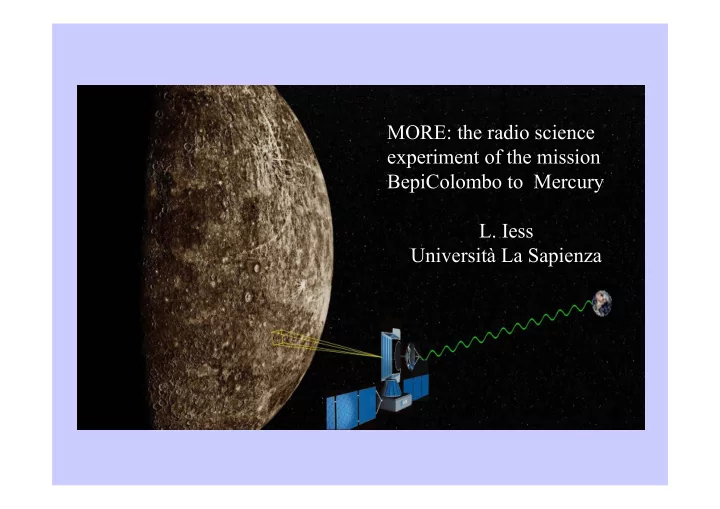
MORE: the radio science experiment of the mission BepiColombo to - - PowerPoint PPT Presentation
MORE: the radio science experiment of the mission BepiColombo to Mercury L. Iess Universit La Sapienza Surface Characteristics Mercury Planetary Orbiter Mercury Magnetospheric Orbiter BepiColombo MMO & MPO on dedicated orbits MMO
MMO & MPO on dedicated orbits MMO orbit optimized for study
MPO orbit optimized for study
High-accuracy measurements
Full coverage of planet surface at high resolution Optimal coverage of polar area Resolve ambiguities
High Resolution Colour Camera Stereo Camera Limb Pointing Camera Vis-Near-IR Mapping Spectrom. TIR Map. Spectrom/Radiometer X-ray Spectrom/Solar Monitor γ-Ray Neutron Spectrometer Ultraviolet Spectrometer Neutral & Ion Particle Analyser Laser Altimeter Radio Science Experiment Magnetometer
Structure, dynamics Morphology State of Core Composition
Temperature Topography Composition Core/Mantle Composition Magnetic Field Dynamics Surface Release Source/Sink Balance Composition Interactions
and order 25.
also SIMBIO-SYS)
needs SIMBIO-SYS).
the tracking geometry)
part in 107 (by combining MORE and BELA laser altimeter data ).
with BELA).
ranging signals to 2.5*10-6
to 5*10-6
gravitational mass to 2*10-5
2
s cm 10 3
−
× = =
y a
c σ τ σ
at τ = 1000 s Dynamical noise must be reduced to a level compatible with the accuracy of range-rate measurements:
LASCO images - SOHO
Multifrequency radio link (two-way)
Target accuracy: Δf/f = 10-14 at 103-104s Δρ = 10 cm KAT XSSA KaTWTA DST 7.2 GHz 34.3 GHz
X Ka X Ka
8.4 GHz 32.5 GHz σy=10-14 is equivalent to a one-way range rate of 1.5 micron/s The corresponding one-way displacement in 1000 s is 1.5 mm
Plasma noise in the X/X, X/Ka, Ka/Ka links and the calibrated Doppler observable (daily Allan dev. @1000s, Cassini SCE1) Minimum impact parameter: 1.6 Rs (DOY 172)
1.5 μm/s
Deflection of light Time delay Frequency shift
rad ) 1 ( 10 4 ) 1 ( 2
6
b R b M gr
sun sun
γ γ θ + × = + =
−
t l l t l l M t
sun
− + + + + = Δ
1 1
ln ) 1 ( γ
⋅
+ ≅ + + = Δ b b M l l l v l v
sun
) 1 ( 4 2
1 1 1
γ θ ν ν
= 72 km for a grazing beam ≈ 8×10⁻¹⁰ for a grazing beam
RMS range rate residuals: 2 10-6 m/s @ 300 s
B.Bertotti, L.Iess, P.Tortora: “A test of general relativity using radio links with the Cassini spacecraft” Nature, 425, 25 Sept. 2003, p. 374
The 34m beam waveguide tracking station DSS 25, NASA’s Deep Space Network, Goldstone, California The Advanced Media Calibration System for tropospheric dry and wet path delay corrections.
ESTEC, 24/25 January - 2005
Istituto Nazionale Di Astrofisica Istituto di Fisica dello Spazio Interplanetario 1st MPO Science Working Group Meeting
This result suggest for the best configuration of the accelerometer a location with the three sensitive masses aligned along the rotation axis of the MPO, and with the com of the mass with sensitive axis along the rotation axis coincident with the com
Z–sensitive axis Y–sensitive axis X–sensitive axis
Rotation axis
Istituto Nazionale Di Astrofisica Istituto di Fisica dello Spazio Interplanetario ESTEC, 24/25 January - 2005
1st MPO Science Working Group Meeting
T (Km) R (Km) TCA 1-σ (seconds) TCA estimate (HH.MM.SS.FF)
From AAS paper on “Cassini navigation during solar conjunctions” P.Tortora, L.Iess, J.J. Bordi, J.E. Ekelund, D. Roth
Luciano Iess Università di Roma La Sapienza Sami Asmar Jet Propulsion Laboratory John W. Armstrong Jet Propulsion Laboratory Neil Ashby University of Colorado Jean Pierre Barriot CNES Peter Bender University of Colorado Bruno Bertotti Università di Pavia Thibault Damour Institut des Hautes Etudes Scientifiques Veronique Dehant Observatoire de Bruxelles Peter W. Kinman Case Western Reserve University Alex Konopliv Jet Propulsion Laboratory Anne Lemaitre University of Namur Andrea Milani Comparetti Università di Pisa Tilman Spohn Westfälische Wilhelms-Universität Paolo Tortora Università di Bologna David Vokroulicky Charles University, Prague Michael Watkins Jet Propulsion Laboratory Xiaoping Wu Jet Propulsion Laboratory
Mercury Orbiter Radio-science Experiment