More on KURC EUR September 2015 2 KURC-1 K APPA U nconventional - - PowerPoint PPT Presentation

more on kurc
SMART_READER_LITE
LIVE PREVIEW

More on KURC EUR September 2015 2 KURC-1 K APPA U nconventional - - PowerPoint PPT Presentation

1 More on KURC EUR September 2015 2 KURC-1 K APPA U nconventional R esources C onsortium 28 effective members; 4 more potentially Data analysis of unconventional plays Phase 1 from July 2011 to January 2014 Development of


slide-1
SLIDE 1

1

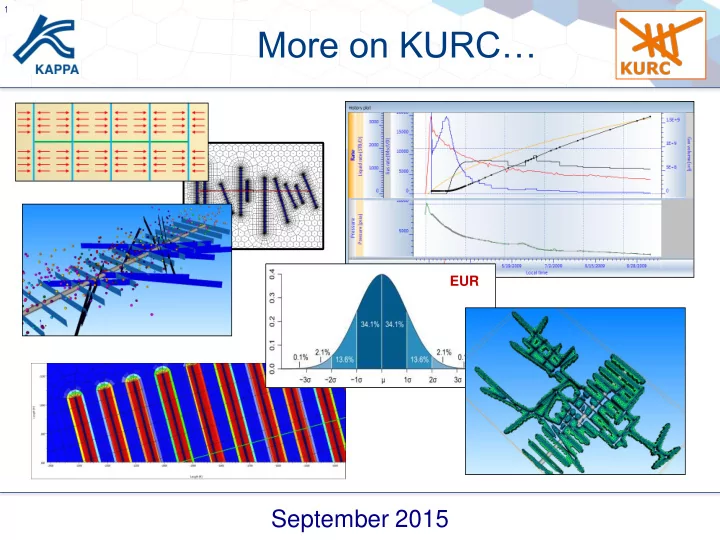
More on KURC…

September 2015

EUR
slide-2
SLIDE 2

2

  • KAPPA Unconventional Resources Consortium
  • 28 effective members; 4 more potentially
  • Data analysis of unconventional plays
  • Phase 1 from July 2011 to January 2014
  • Development of the KURC Application
  • 3-year exclusivity to consortium members
  • 150,000 € per participant

KURC-1

slide-3
SLIDE 3

3

28 participants (+3?)

slide-4
SLIDE 4

4

Budget and expenses

slide-5
SLIDE 5

5

KURC application

slide-6
SLIDE 6

6

KURC application

slide-7
SLIDE 7

7

Main KURC-1 developments

  • 1. Loglog analysis tools (*)
  • 2. Fast analytical / numerical: SRV, trilinear (*)
  • 3. Complex geometries (*)
  • 4. Generalized pseudofunctions (*)
  • 5. Discrete Fractures Networks (DFN)
  • 6. Water flowback
  • 7. Single well statistical EUR
  • 8. Import Microseismic results
  • 9. Import Fracturing software results

10.Confined PVT

(*) public in Q2-2016

slide-8
SLIDE 8

8

1 – Loglog analysis tools

k Lw x Xf k x N² x Xf²

slide-9
SLIDE 9

9

2 – Fast models (e.g. SRV)

slide-10
SLIDE 10

10

3 - Complex models

slide-11
SLIDE 11

11

4 – Pseudofunctions

  • Pseudopressure correction
  • m(p), Z(p)
  • k(p)
  • Pseudotime correction
  • c(p*(t))
  • F(p*(t))
  • Desorption
slide-12
SLIDE 12

12

5 - Analytical / numerical DFN

slide-13
SLIDE 13

13

6 – Water flowback

slide-14
SLIDE 14

14

7 - Statistical EUR

EUR

slide-15
SLIDE 15

15

8 – Import from microseismics

slide-16
SLIDE 16

16

9 – Import from fracturing sft.

slide-17
SLIDE 17

17

10 - Confined PVT

0.0 400.0 800.0 1200.0 1600.0 0.0 200.0 400.0 600.0 800.0 Conventional 10 nm

  • Eagle Ford Oil

11 components Confinement = 10 nm pore radius Validated against CSM models

7.00E-02 7.40E-02 7.80E-02 500 1000 1500 2000 10 nm Conventional

Temperature (oF) Pressure (psia) Pressure (psia) Viscosity (cp)

slide-18
SLIDE 18

18

2015 extension: KURC-2

  • KURC-1 membership as pre-requisite
  • Topics discussed with KURC-1 members
  • From January 2015 to December 2016
  • 50,000 € for KURC-1 member
  • 200,000 € for new members (incl. KURC-1)
slide-19
SLIDE 19

19

KURC-2 workflow

Simulation model History match Forecast U.A. DFN Flow mech. + I.S. + confined PVT + geomechanics Microseismics Fracture simulation

Constrain DFN realizations to interference times

slide-20
SLIDE 20

20

Main KURC-2 developments

  • 1. Multiple well interferences in DFN’s
  • 2. Fast Marching methods for DFN’s
  • 3. Complex well schedules (*)
  • 4. 3-D DFN’s
  • 5. Stochastic DFN’s from Microseismics
  • 6. Connection to Geomechanics software
  • 7. Enhanced permeability regions
  • 8. Adapted multiphace wellbore model for CSG
slide-21
SLIDE 21

21

1 – DFN interferences

slide-22
SLIDE 22

22

2 – Fast Marching

Simulation models History match

Constrain DFN realizations to interference times

FMM

DFN realizations

FMM

DFN realizations Interference times

slide-23
SLIDE 23

23

3 – Complex well schedules

  • Simulate water injection period prior to production
  • Assumption : Inject in pre-existing fracture planes, with Fc(P) curves

 Start production from perturbed initial {P, S} fields  Evaluate flowback

slide-24
SLIDE 24

24

4 – 3D DFN’s

WIP

slide-25
SLIDE 25

25

5 – DFN from Microseismics

3D

slide-26
SLIDE 26

26

6 – Geomechanics

Flow module (with pressure –dependent k and )

Geomechanical module time T0 T1 T2 … P k, At the end of each exchange time increment :

  • Mechanical module reads in new pore pressures
  • Mechanical module calculates new stresses and induced deformations
  • Mechanical module (or flow module) computes new permeability/porosities from the

knowledge of strains/effective stresses

  • Flow module reads in the new flow properties and use it in computations for the next

time increment

slide-27
SLIDE 27

27

7 – Enhanced k regions

slide-28
SLIDE 28

28

8 – CSG wellbore model

from Justin Knight and Tim Whittle, BG