AN INFORMATICS FRAMEWORK FOR TESTING DATA INTEGRITY AND CORRECTNESS - - PDF document

an informatics framework for testing data integrity and
SMART_READER_LITE
LIVE PREVIEW

AN INFORMATICS FRAMEWORK FOR TESTING DATA INTEGRITY AND CORRECTNESS - - PDF document

AN INFORMATICS FRAMEWORK FOR TESTING DATA INTEGRITY AND CORRECTNESS OF FEDERATED BIOMEDICAL DATABASES Mijung Kim , 1 Tahsin Kurc, 2 Alessandro Orso, 1 Jake Cobb, 1 David Gutman, 2 Mary Jean Harrold, 1 Andrew Post, 2 Ashish Sharma, 2 Tony Pan, 2


slide-1
SLIDE 1

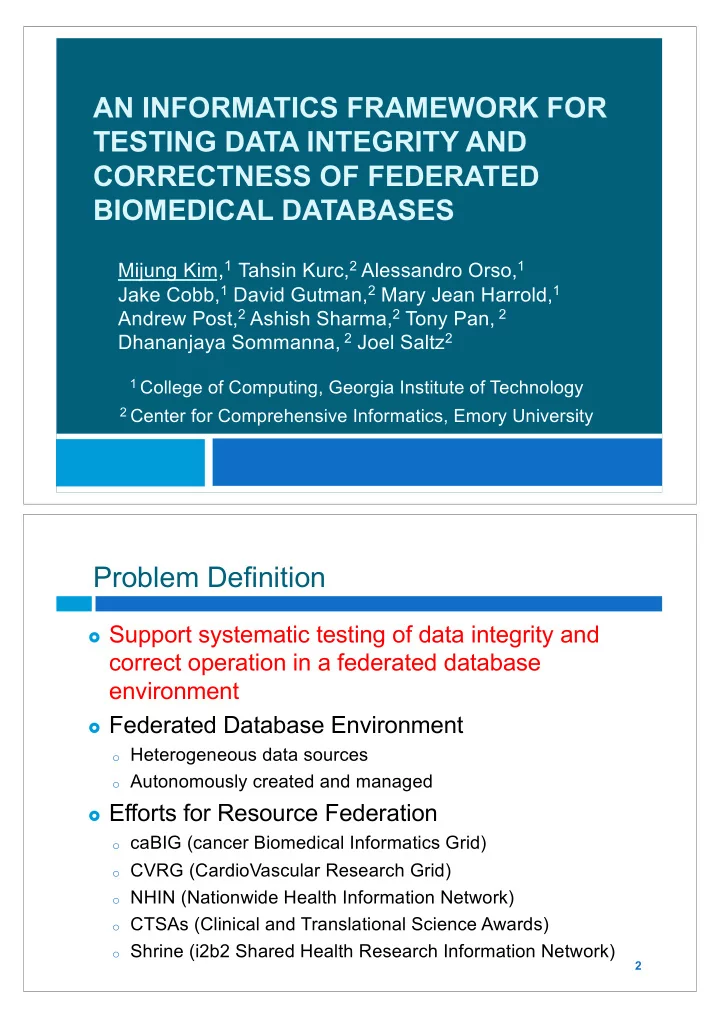
AN INFORMATICS FRAMEWORK FOR TESTING DATA INTEGRITY AND CORRECTNESS OF FEDERATED BIOMEDICAL DATABASES

Mijung Kim,1 Tahsin Kurc,2 Alessandro Orso,1 Jake Cobb,1 David Gutman,2 Mary Jean Harrold,1 Andrew Post,2 Ashish Sharma,2 Tony Pan, 2 Dhananjaya Sommanna, 2 Joel Saltz2

1 College of Computing, Georgia Institute of Technology 2 Center for Comprehensive Informatics, Emory University

Problem Definition

£ Support systematic testing of data integrity and

correct operation in a federated database environment

£ Federated Database Environment

  • Heterogeneous data sources
  • Autonomously created and managed

£ Efforts for Resource Federation

  • caBIG (cancer Biomedical Informatics Grid)
  • CVRG (CardioVascular Research Grid)
  • NHIN (Nationwide Health Information Network)
  • CTSAs (Clinical and Translational Science Awards)
  • Shrine (i2b2 Shared Health Research Information Network)

2

slide-2
SLIDE 2

Federated Environment

3

Metadata, Common Data Elements, and Vocabulary Management Federated Query, Workflow Security

Core Infrastructure

Identifier Framework Testing Image Data Service Research PACS Biospecimen Data Service LIMS Molecular Data Service caArray i2b2 AIW ETL Clinical Data Service @ Emory EHR System i2b2 AIW ETL Clinical Data Service @ Grady EHR System Scientist

Use Case: In Silico Brain Tumor Research Center

£ A research center for in silico study of brain tumors

  • Collaboration among four institutions
  • Goal: Better disease classification and study of

disease progression

  • Initial focus on Gliomas

£ Systematically execute in silico analyses

(experiments) using complementary data types

  • Integration and correlation of clinical data and

analysis results from omics, radiology imaging, and microscopy imaging data

  • Data from TCGA and Rembrandt projects as well as

partner institutions

4

slide-3
SLIDE 3

£ Violation of existence constraints

  • Not all images for slides used in manual annotations

were available

  • Some patients had image data but no mRNA data
  • Data in molecular datasets with patient identifiers was

not in clinical dataset

£ Erroneous update

  • New pathology classification did not match

expected/known progression of disease for some patients

£ Incorrect temporal dependencies

  • Some patients were in one study, then were

recruited to the other study

5

Examples of Issues Encountered

Cause data inconsistencies!!

Testing Framework Overview

6

Federated Environment Federation Middleware Framework Testing Techniques Test Model User-defined rules Domain knowledge Data models & Relationships Study protocols Clinical Anno- tation Image Data Generation Test Execution Test Creation Change Detection

slide-4
SLIDE 4

Test Model

£ User-defined rules £ Domain Knowledge £ Study protocols £ Data models & Relationships 7

  • “days to death” value in Clinical database should not change.
  • (Clinical/Patient/days_to_death) à immutable
  • Stage X should not follow Stage Y for disease A.
  • ∀t2 > t1 ⇒ diseaseA.stage(Clinical/Exam/status)[t1]

< diseaseA.stage(Clinical/Exam/status)[t2] In-silico brain tumor study must contain (1) MR Data, (2) Microscopy Data, (3) Patient survival data, and (4)mRNA data

  • Attribute Gender in Image database has the same value as

Attribute Sex in Clinical database.

  • (Image/Patient/Gender, Clinical/Patient/Sex) à sameValue

Testing Framework Overview

8

Federated Environment Federation Middleware Framework Testing Techniques Test Model User-defined rules Domain knowledge Data models & Relationships Study protocols Data Generation Test Execution Test Creation Change Detection Clinical Anno- tation Image

slide-5
SLIDE 5

Testing Techniques

£ Test Creation £ Data Generation £ Test Execution £ Change Detection 9

  • Analyze the test model
  • Identify relevant data elements
  • Generate testing requirements and test cases
  • Generate synthetic datasets to test critical but rarely-violated

rules and private data

  • Run tests periodically and on demand
  • Report test outcome
  • Detect changes
  • Identify effects of changes
  • Execute relevant test cases

Current State

10

Type of Dataset Data Management System Neuroimaging Data Radiology images Virtual PACS, xNAT Manual annotations AIME Molecular Data mRNA, miRNA, methylation data, gene-expression data in-house developed database with file system for data files Clinical Data Clinical data, specimen data i2b2, in-house developed database Pathology Data Whole slide microscopy images, image metadata caMicroscope Microscopy image analysis results PAIS

slide-6
SLIDE 6

Example Rule (in OWL/SWRL)

£ If a patient has molecular data, the patient must have

clinical data

£ (Molecular/Genomic/patient_id,

Clinical/Patient/patient_id) à existIn

11

<owl:Class rdf:ID=“Molecular.Genomic.patient_id"> <rdfs:subClassOf rdf:resource=“ontology.owl#Column"/> <rdfs:subClassOf> <owl:Restriction> <owl:onProperty> <owl:ObjectProperty rdf:ID=“existIn"/> </owl:onProperty> <owl:someValuesFrom> <owl:Class rdf:about="#Clinical.Patient.patient_id"/> </owl:someValuesFrom> </owl:Restriction> </rdfs:subClassOf> </owl:class>

Conclusion

£ Challenges in federated environments

  • Errors are inevitable
  • Developing customized and one-off solutions is

expensive and inefficient

£ Our work contributes a middleware framework

  • Test Model: High-level, rule-based representation
  • f expected state
  • Testing Techniques
  • Generate test cases using the test model
  • Execute the test cases
  • Detect changes

12

slide-7
SLIDE 7

THANK YOU!!

Acknowledgements:

Partially funded by: Federal funds from the National Cancer Institute; National Institutes of Health Contracts HHSN261200800001E, 94995NBS23, and 85983CBS43; NIH PHS Grants (UL1 RR025008, KL2 RR025009 or TL1 RR025010) from the CTSA program of NCRR; NHLBI R24 HL085343; NIH U54 CA113001; NLM R01LM009239-01A1, and BISTI P20 EB000591; NSF award CCF-0725202.