
SLIDE 1
Monroe County’s Recycle Right Program
Genesee Valley Finger Lakes Chapter of AWMA & Genesee Valley Chapter of NYWEA
February 12, 2020
Adam J. Bello County Executive
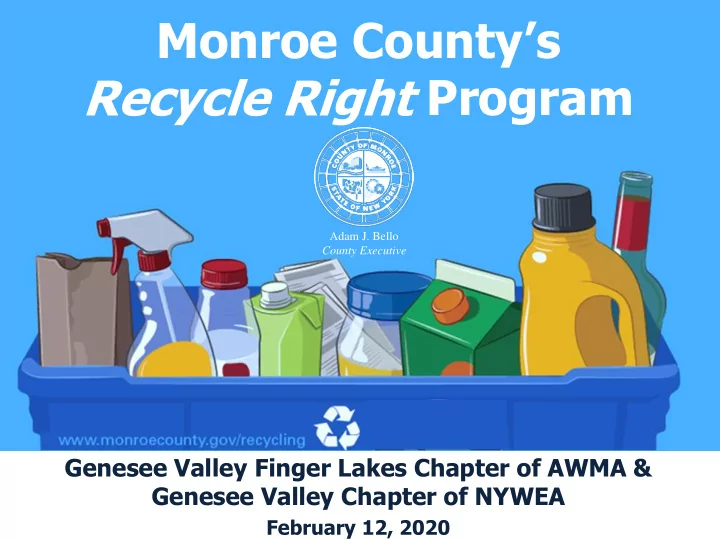
Monroe Countys Recycle Right Program Adam J. Bello County Executive - - PowerPoint PPT Presentation
Monroe Countys Recycle Right Program Adam J. Bello County Executive Genesee Valley Finger Lakes Chapter of AWMA & Genesee Valley Chapter of NYWEA February 12, 2020 Agenda Integrated Solid Waste Management System History of
Genesee Valley Finger Lakes Chapter of AWMA & Genesee Valley Chapter of NYWEA
February 12, 2020
Adam J. Bello County Executive
manages 260,000 tons of municipal solid waste (MSW) and 40,000 tons of recyclables annually
(HHW), pharmaceuticals and hard to handle recyclables managing 5,700 tons of specialty materials since 2011 opening
manage 760,000 tons of MSW with renewable energy recovery
1992 2004 2011 2013
– Food Waste Reduction
Date Ban Goes into Effect
Stores Impacted
required. Plastic Bags Exempt
– Bags made of cloth and other durable materials with handles. – Bags used for uncooked meat, fish or poultry – Bulk items – Sliced or prepared food – Newspaper bags (delivered) – Prescription drugs
Paper Bags
educational institutions, hotels, food processors, correctional facilities, and sports or entertainment venues.
care facilities, and elementary and secondary schools
https://www.rit.edu/affiliate/nysp2i/food/source-reduction
120 Laws of 2018, the New York State Drug Take Back Act (DTB) mandates that manufacturers establish, fund, and manage a New York State approved drug take back program(s) for the safe collection and disposal of unused covered drugs
accepted for recycling and can be disposed in the trash.
in the trash.
– Manufacturers are required by law to provide free collection and recycling. – The ecopark and retailers such as Best Buy, Lowes, Staples, Sprint, Target, Verizon Wireless, Batteries Plus Blubs, and other mail back programs will accept certain types of rechargeable and button batteries for recycling.
To prevent the risk of fire, use clear tape to cover the terminals before dropping them
your recyclable batteries. Check each site's list of accepted items to make sure your battery is accepted. Disposable alkaline and car batteries are generally not accepted.
– https://www.nysar3.org/page/re-clothe-ny-78.html
– Many options are available for donating textiles, furniture, building materials, eyeglasses, etc. – In addition to clothes, most major thrift stores and donation centers will accept footwear, bedding, curtains, stuffed animals, and other items. – Clothes that are no longer wearable can still be
recycled at major donation centers as long as they are clean, dry, and odorless.
Plastic straws, utensils, including “compostable” utensils, plastic plates and plastic cups come in such a wide variety of nonusable, low-grade plastics that it is impossible to identify and separate the recyclables from the non-recyclable look-alikes. Fast food packaging, like utensils, are complicated and are not readily recovered through modern Material Recovery Facilities (MRFs), or by secondary processors who buy MRF bales.
film are accepted curbside (they get tangled in the MRF equipment, breaking or stopping machinery.)
film should go back to a participating retail outlet or grocery store for recycling.
dropped off at the ecopark.
The recycling arrows (Mobius) on a container means it is recyclable at a Material Recovery Facility (MRF)
Only in some cases
codes #1-7 identify the plastic resin out of which the product is made.
products and packaging, and each one has its own unique chemical recipe. Many plastics cannot be made into new products at this time.
Bottles, Jugs, Jars, Tubs
for this, often hybrid material. In fact, there are only a few niche markets for it.
and juice cartons (emptied and rinsed, no pouches or straws) are recyclable.
food or paper liners/doilies) are acceptable. At one point, pizza boxes were made with a wax coating that made them not acceptable. The new pizza boxes (often with a paper doily serving as a moisture barrier) are high potential recyclables and should be included in curbside recycling.
a plastic or waxed coating that does not break down during the re-pulping process at paper mills.
tissues are made of low-grade fiber, and are usually soiled when disposed. They are not recyclable in single stream residential Material Recovery Facilities (MRFs).
middle of the roll of paper towels or toilet tissue can be recycled.
"to-go" containers and cups are made of unrecyclable materials, and cannot be collected curbside.
recyclable either, however some shipping stores will take peanuts back for re-use.
white packing Styrofoam for recycling.
recycling program accepts empty/dry aerosol cans.
they are empty/dry. If they are not, then they could be dangerous.
bowling balls a year and it works out to be 80,000 pounds of bowling balls annually.
US put a bowling ball into their recycle bin
www.monroecounty.gov/recycling www.ecoparkmcny.com