MODELLING COMPACTION EFFECT ON PERMEABILITY OF 3D CARBON - - PDF document

modelling compaction effect on permeability of 3d carbon
SMART_READER_LITE
LIVE PREVIEW

MODELLING COMPACTION EFFECT ON PERMEABILITY OF 3D CARBON - - PDF document

18 TH INTERNATIONAL CONFERENCE ON COMPOSITE MATERIALS MODELLING COMPACTION EFFECT ON PERMEABILITY OF 3D CARBON REINFORCEMENTS XS Zeng*, AC Long, F Gommer, A Endruweit and M. Clifford Division of Materials, Mechanics & Structures, Faculty of


slide-1
SLIDE 1

18TH INTERNATIONAL CONFERENCE ON COMPOSITE MATERIALS

1 Introduction

The relationship between compaction and permeability was investigated for 3D woven carbon

  • reinforcement. The geometry and structural change

under different levels of compression was captured by micro x-ray computed tomography (CT). The imaging technique has been used increasingly for composite material characterization [1-3]. The advances in CT hardware helps improve image resolution and contrast for low absorbing material such as carbon fibre [4]. The 3D image data were then analyzed to characterize the structural deformation and variability. Numerical modelling was performed to predict though-thickness and in- plane permeabiltiy for 3D woven carbon fibre

  • fabrics. This used an automated modelling approach

from TexGen geometry modelling and discretization, to CFD analysis in Ansys CFX. A unit cell representing 3D woven fabric geometry was generated in an automated manner in TexGen from a set

  • f

experimentally determined geometric parameters. After meshing and application

  • f

periodic boundary conditions, through-thickness and in-plane flow were predicted using CFD simulations. The predictions were compared with experimental permeability measurements.

2 Image acquisition by computed tomography

X-ray µCT was performed on a Pheonix Nanotom X-ray scanner (GE Sensing & Inspection Technologies GmbH). In order to achieve high quality images in resolution and contrast for carbon fibre composites, the following configurations were used:

  • Small sample (5 x 5 x 20 mm which is

slightly larger than unit cell size of 3D woven reinforcement)

  • Focus Object Distance as small as possible
  • Focus Detector Distance 200mm
  • Molybdenum Target (high contrast on low

absorbing material, useful in 20-60kV range)

  • Mode 1 or 2 (Mode 1 down to 1.2 microns

voxelsize, Mode 2 from 0.9 to 1.2 microns)

  • All power with modus 1 or 2, Voltage=

40keV and Current = 240µA (low tension and high intensity to increase contrast)

  • Exposure

time 500ms (contrast

  • f

resolution)

  • Exposure average (1500 ms in total)
  • Detector skip (500ms)
  • Min. 2200 projections

3 Image analysis

  • f

3D carbon reinforcements

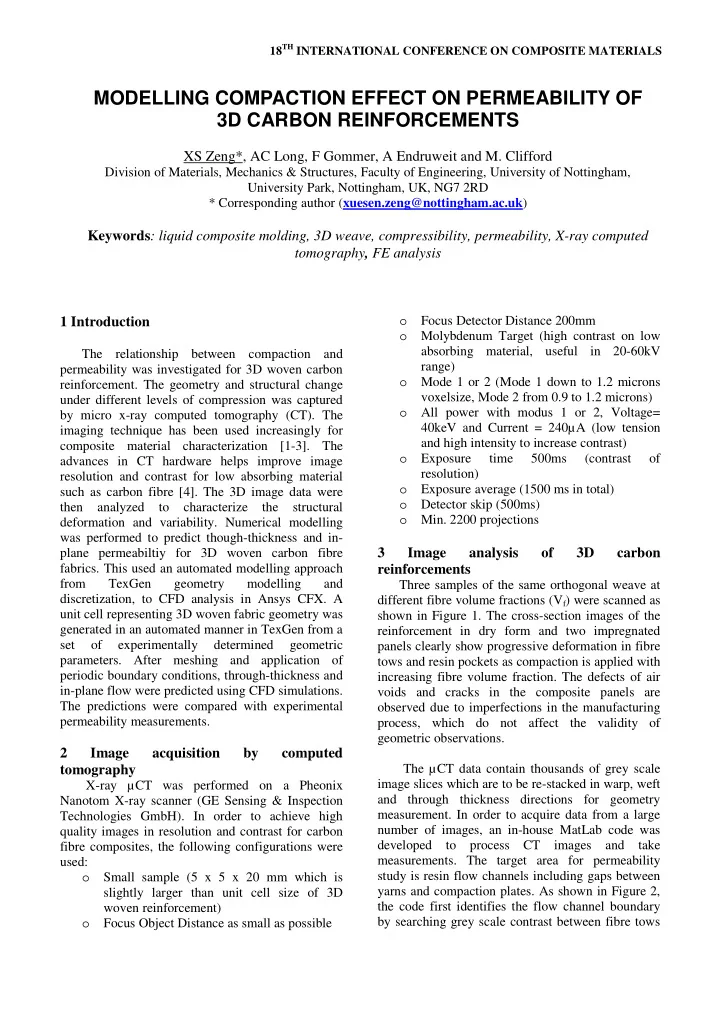
Three samples of the same orthogonal weave at different fibre volume fractions (Vf) were scanned as shown in Figure 1. The cross-section images of the reinforcement in dry form and two impregnated panels clearly show progressive deformation in fibre tows and resin pockets as compaction is applied with increasing fibre volume fraction. The defects of air voids and cracks in the composite panels are

  • bserved due to imperfections in the manufacturing

process, which do not affect the validity

  • f

geometric observations. The µCT data contain thousands of grey scale image slices which are to be re-stacked in warp, weft and through thickness directions for geometry

  • measurement. In order to acquire data from a large

number of images, an in-house MatLab code was developed to process CT images and take

  • measurements. The target area for permeability

study is resin flow channels including gaps between yarns and compaction plates. As shown in Figure 2, the code first identifies the flow channel boundary by searching grey scale contrast between fibre tows

MODELLING COMPACTION EFFECT ON PERMEABILITY OF 3D CARBON REINFORCEMENTS

XS Zeng*, AC Long, F Gommer, A Endruweit and M. Clifford

Division of Materials, Mechanics & Structures, Faculty of Engineering, University of Nottingham, University Park, Nottingham, UK, NG7 2RD * Corresponding author (xuesen.zeng@nottingham.ac.uk)

Keywords: liquid composite molding, 3D weave, compressibility, permeability, X-ray computed tomography, FE analysis

slide-2
SLIDE 2

and resin pockets. Each flow region is labeled so that the continuity of each flow channel in 3D space can be traced. Measurement of area, perimeter and centre coordinates is output in a tabulated data file. The image is then converted to black and white binary format. The image sequence is used to render flow channels in 3D as shown in Figure 3. The warp flow channels are disconnected where binder yarns pass through them. The channel is narrower in the middle of each segment, indicating warp yarn bulges in the middle due to compaction. Each channel shares similarity differences exist between channels. The variability in 3D woven reinforcement is thought to comprise periodic changes such as yarn cross-section variation and stochastic deviation. The measurements from the image analysis allow both systematic variation and deviation probability to be characterised. An example is given for area measurement in Figures 4 and 5. Similar characterization is applied to flow path and cross- section aspect ratio. A lognormal distribution function is used to describe the stochastic behaviour

  • f the flow channel area.

Fig.1. CT images of 3D orthogonal carbon

  • reinforcement. Top, dry textile with no compaction,

Vf = 0.50; middle, composite panel Vf=0.55; bottom, highly compacted composite panel, Vf= 0.64.

݂(ݔ)=

ଵ ሺ௫ିఏሻఙ√ଶగ ݁ିሾౢ౤(ೣషഇ)షഋሿమ

మ഑మ

ǡݔ൐ Ͳ (1) The three parameter form of the lognormal distribution function has parameters σ the shape parameter, µ the median (a scale parameter) and θ as location (shift) parameter.

  • Fig. 2. Image segmentation of flow channel in 3D

carbon reinforcement. Upper, flow channel regions are identified and labeled in original CT image; lower, converted binary image with flow channels.

  • Fig. 3. 3D render of isolated flow channels in warp

direction of carbon composites Vf=0.64.

slide-3
SLIDE 3

Fig.4. Averaged flow cross-section periodic channel length

  • Fig. 5. Probability distribution of ar

from the average value.

4 CFD modeling for permeability

The geometric model of 3D carbon is generated by using TexGen whic source software package for textile mo been developed at the University o The modelling algorithm is detailed The graphical user interface (GUI) pr to major TexGen functions. Alt application programming interface Python scripting language. TexGen model a variety of 3D textiles orie element analysis. The primary definition of any text is to use a centreline describing yar space with superimposed cross sectio establish a predictive model, the geom is not to reproduce all details as obser

  • analysis. Instead, general rules are dra

analysis and then applied in TexGen t variations of yarn path and yarn according to the level of compaction determine what information should be authentic CAD model for analysis. permeability is examined through peri variations.

0.0 0.015 0.010 0.005 0.000

  • 0.005
  • 0.010
  • 0.015

35 30 25 20 15 10 5 Area deviation Frequency 3-Parameter Lognormal

ion area over a th area deviation ue.

lity prediction

bon reinforcement hich is an open

  • modelling. It has
  • f Nottingham.

elsewhere [5]. ) provides access Alternatively an e (API) enables en is capable to riented for finite textile in TexGen arn paths in 3D

  • tions. In order to
  • metry modelling

bserved from µCT drawn from µCT n to describe key rn cross-sections

  • n. The aim is to

be included in an . In this study, periodic geometry After generating a uni TexGen starts generates a hexahedral elements for the The elements are groupe technique as either in flu yarn volumes. Each elem greyscale value. Greyscale elements at flow area and 255 is for sequential separat The voxel mesh data fr to ANSYS CFX pre-proce conditions are set for the v weft and warp directions size of fabric. A pressure warp and top/bottom bounda plane, warp in-plane a

  • permeability. Air at 25 C and

as the medium for steady st

5 Permeability prediction The flow simulation carbon reinforcement wi respectively. The measurements labelled published by Endruweit noted that the measured values are given in the pr which is at an angle to wa The permeability in warp calculated by the conver axial permeability K1 and between the principle ax Equation 2. The voxel mesh appr adaption of the TexGe study the influence

  • f

variations on permeabili looks at changes of yarn path within a unit cell de left, a TexGen geometry

  • rthogonal

weave with compaction. Local geom

  • considered. Binder yarn

governing flow channe section is squashed on the

  • rthogonal weave, while

0.020

Loc

  • 2.405

Scale 0.035 Thresh

  • 0.09

N 1138

 

2 1 2 1

sin cos K K K K

warp weft

   

unit cell geometry model, a voxel mesh with uniform the whole unit cell domain. uped by a local sampling fluid domain or individual ement is identified by its ale value 0 is assigned to nd a value range from 1 to rate yarns. from TexGen are exported

  • cessor. Periodic boundary

he voxel mesh model in both ns to represent the infinite re drop is applied to weft, undaries to predict weft in- and through thickness and 1 atm (dry) is selected state flow through fabric.

ctions

  • n is performed for the

with Vf = 0.55 and 0.64 fabric permeability ed as Fabric 3 were eit and Long [6]. It is sured in-plane permeability he principle material axes, warp and weft directions. arp and weft direction is ersion from the principle and K2, and the angle α axis and weft yarn as in (2) approach enables quick Gen geometry model to

  • f

periodic geometry

  • bility. The current study

rn cross-section and yarn ll definition. In Figure 6 ry model is shown for the ith Vf = 0.55 under geometry variations are rn is the dominant feature

  • nnels. The binder cross-

the surface layers of the hile weft yarns sink in at  

2 2 2 2

cos sin K K 

slide-4
SLIDE 4

the crossovers to form regions with This surface crimp forms an im channel as seen in fig. 6 right. shows 30% of mass flow occyrs i The significance

  • f

local ge permeability is demonstrated by c CFD predictions from varied geom with experimental data shown in base model is assumed to have all with constant cross-sections. geometry changes are incorporated models. As

  • bserved

from permeability in the warp direct lower than that in the weft. It i mainly by binder interaction with w

  • yarns. Through thickness binders

block gaps in the warp direction µCT images while there are space direction shown in Fig 8. A TexGe brick shaped warp yarns simulates

  • f gaps in the warp direction. Afte

these local geometry changes, C gives much closer prediction com experimental measurements. Simil

  • f the orthogonal weave at highe

with Vf = 0.64 is generated in considering local geometry variations,

  • Fig. 9. The prediction from CFD i

experiment as shown in Figure 10. It is noted that TexGen model i approximation

  • f

real mate comparing Figure 6 left and 9 with in Figure 1. Geometric com inconsistency increases whe compaction distorts 3D re

  • significantly. The current study t

that a systematic description variation is feasible to capture t factors while maintaining sufficie for predictive permeability model highly deformed geometry. ith local crimp. important flow

  • ht. CFD analysis

s in this region. geometry

  • n

comparing the eometry models in Figure 7. A all fibre bundles

  • ns.

Then local ted in the rest of experiments, ection is much t is determined h warp and weft nders consistently

  • n as seen from

spaces in the weft Gen model with es the blockage fter considering s, CFD analysis compared with milarly a model her compaction in TexGen by ations, shown in is close to the 10. l is an idealised aterials when ith µCT images

  • mplexity

and when higher reinforcements y tries to show

  • f

geometry e the dominant cient simplicity

  • delling even for

Fig.6. Left, TexGen model right, Velocity streamlines plane warp pe

  • Fig. 7. Permeability sensitiv

variations, 3D orthogona

  • Fig. 8 Cross-sections of thr

3D orthogonal we

0.0E+00 5.0E-11 1.0E-10 1.5E-10 2.0E-10 2.5E-10 3.0E-10 3.5E-10 4.0E-10 4.5E-10 5.0E-10

Weft Permeabilit K (m2)

del of 3D orthogonal weave; nes in CFD prediction for in- permeability. itivity to periodic geometry

  • nal weave at Vf= 0.55.

through thickness binders, weave at Vf=0.55.

Warp Through thickness

experiment CFD-Basic geometry model CFD-Varied binder xsect model CFD-Surface crimp model CFD-Brick shaped warp yarn

slide-5
SLIDE 5
  • Fig. 9. TexGen model of 3D orthogona

0.64

  • Fig. 10. Permeability prediction for 3D

weave at Vf=0.64.

6 Conclusions The µCT imaging technique is analyze internal geometry

  • f

reinforcement at different compa The quality of images is ensured tuned scanning configuration. A process is used to segment CT ima measurements

  • f

target regions. channel in the current study is qua periodic variation and stochastic de Permeability modeling suggests geometry variations are important flow path inside 3D reinforcement changes of binder yarn cross-sect path controls in-plane and throug

  • permeability. In addition, the int

binder, warp and weft yarns unde reshape the flow channels. A sy

0.00E+00 1.00E-11 2.00E-11 3.00E-11 4.00E-11 5.00E-11 6.00E-11 7.00E-11 Weft Permeability K (m2)

Experime CFD comp

  • nal weave Vf=

3D orthogonal

is effective to

  • f

3D carbon paction levels. nsured via a finely An automated images and take

  • ns.

The flow quantified with deviation. sts that local nt to define the

  • ent. Mainly the

section and yarn hrough-thickness interactions of under compaction systematic and parametric description of applied in TexGen geom CFD analysis gives reli

  • n TexGen models.

In future studies to improve and permeability predict needed to describe reali cross-sections and yarn compaction based on µC deviation of geometry assess the impact on perm Acknowledgements

This work was funded by the Physical Science Research C materials were supplied by

References

[1] P Badel, E Vidal-Salle “Simulation and tomogra composite reinforcement mesoscopic scale.” Com technology, 68, 2433-2440, [2] P Latil, L. Oregeas, C. G Rolland du Roscoat. “To characterization of deform within a compressed bundl science and technology, 71, [3] Karahan, M., Lomov, S Mungalov, D. and Verpoe geometry evaluation of no woven carbon fabric compo A, 41, 1301-1311, 2010. [4] T Hemberger, F Siek analysis of textile and compo resolution computed tomogr conference on textile comp 134, 2010 [5] H Lin, X Zeng, M S

  • Clifford. “Automated geom

structures.” Textile Resear 2011 [6] A. Endruweit and A compressibility and perm woven reinforcements.” materials, 44(24), 2833-2862,

Warp

iment

  • mplete unit cell
  • f geometry variation is

geometry modeling. The eliable predictions based prove geometry modeling diction, a simple model is alistic transition of yarn rn path as a function of µCT analysis. Stochastic y will be considered to permeability variation.

the Engineering and h Council (EPSRC). The by Airbus UK. lle, E Maire and P Boisse.

  • graphy analysis of textile

nt deformation at the Composites science and 2440, 2008 . Geindreau, PJJ Dumont, S “Towards the 3D in situ rmation micro-mechanisms bundle of fibres.” Composites 71, 480-488, 2011 , S.V., Bogdanovich, A.E., rpoest, I. 2010. “Internal f non-crip 3D orthogonal mposite,” Composites: Part ieker and O Brunke. “3D mposite materials with high

  • graphy.” 10th International
  • mposites, Lille France, 127-

Sherburn, AC Long, MJ

  • metric modelling of textile

search Journal. Accepted AC Long. “Analysis of rmeability of selected 3D ” Journal

  • f

composites 2862, 2010.