Miyata Lab@JAIST Visual Computing (Procedural Modeling) Immersed - - PowerPoint PPT Presentation

miyata lab jaist
SMART_READER_LITE
LIVE PREVIEW

Miyata Lab@JAIST Visual Computing (Procedural Modeling) Immersed - - PowerPoint PPT Presentation

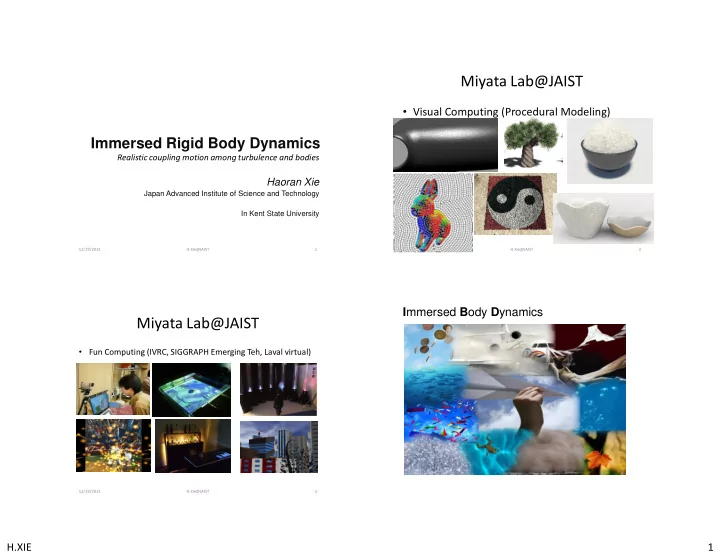
Miyata Lab@JAIST Visual Computing (Procedural Modeling) Immersed Rigid Body Dynamics Realistic coupling motion among turbulence and bodies Haoran Xie Japan Advanced Institute of Science and Technology In Kent State University 12/19/2013


slide-1
SLIDE 1

H.XIE 1

Immersed Rigid Body Dynamics

Haoran Xie

Japan Advanced Institute of Science and Technology In Kent State University

1 H.Xie@JAIST 12/19/2013

Realistic coupling motion among turbulence and bodies

Miyata Lab@JAIST

  • Visual Computing (Procedural Modeling)

12/19/2013 H.Xie@JAIST 2

Miyata Lab@JAIST

  • Fun Computing (IVRC, SIGGRAPH Emerging Teh, Laval virtual)

12/19/2013 H.Xie@JAIST 3

Immersed Body Dynamics

slide-2
SLIDE 2

H.XIE 2 Challenges

Fluid Simulations(e.g. S2013) Rigid-body Simulations(e.g. S2012) Two-way Coupling(e.g. SA2012) Dispersed Flows(e.g. S2010) Turbulent Flows(e.g. SA2010)

Unsteady dynamics of participated objects Vortical loads from the surrounding flow

6

Free Fall

H.Xie@JAIST @picture from Youtube, www-inmagine.com, www-personal.umich.edu/~nori/ 12/19/2013

Phenomena What happened? –from physics view

[YANG et al., J. Comput. Phys., 2012] [ZHONG et al. J. Fluid Mech. (2013)]

slide-3
SLIDE 3

H.XIE 3

An Active and Exciting Topic

  • e.g. in 2013,

– Coins falling in water, arXiv, Fluid Dynamics, (2013.12) – Experimental study of a freely falling plate with an inhomogeneous mass distribution, Physical Review E, (2013.11) – Experimental investigation of freely falling thin disks. Part 2. Transition of three- dimensional motion from zigzag to spiral, J. Fluid Mech., (2013.10) – Flexible body with drag independent of the flow velocity J. Fluid Mech., (2013.10) – Influence of aspect ratio on tumbling plates, J. Fluid Mech., (2013.9) – Bi-stability of a pendular disk in laminar and turbulent flows, J. Fluid Mech., (2013.7) – Numerical simulation of the dynamics of freely falling discs, Physics of Fluids, (2013.4) – Falling styles of disks, J. Fluid Mech., (2013.3) – Experimental investigation of freely falling thin disks. Part 1. The flow structures and Reynolds number effects on the zigzag motion, J. Fluid Mech., (2013.2)

  • Research Groups: Eva Kanso(USC), C. Lee(Peking Uni.), J. Zhang(Cornel), J.

Magnaudet(IMFT, France) , etc.

12/19/2013 H.Xie@JAIST 9

How to achieve Realistic simulations in Realtime?

  • High-Reynolds-number Flow
  • Turbulent Flows
  • Unsteady Forces

In Computer Graphics, Topic 1: Data-driven Approach

Introduction

  • Rigid body motion in viscous flow

– Procedural motion synthesis approach

  • Data-driven motion synthesis techniques
  • Discrete-time Markov chain model
  • Noise-based wind interaction

12 H.Xie@JAIST 12/19/2013
slide-4
SLIDE 4

H.XIE 4 Free Fall: Related Works

  • Physical Research

– From Maxwell,1854

13

ー Chaotic dynamics [FIELD et al. 1997] ー Numerical solution [ANDERSEN et al.2005] ー Motion classification [RAZAVI 2010] ー 3D experiments [ZHONG et al.2011]

H.Xie@JAIST 12/19/2013

Free Fall: Related Works

  • Graphical Research

14

ー Lattice Boltzmann Method [WEI et al. 2004] ー Example-based approach [VAZUQUEZ et al. 2008] ー Sketch-based method [LI et al. 2010] ー Commercial CG tools (LightWave 10 etc.)

H.Xie@JAIST 12/19/2013

System Overview

15

Input parameters Phase Diagram Primitive Motion Synthesis Motion Graph Markov Chain Model Lightweight rigid body simulation

Trajectory Search Tree Trajectory Database

Motion Classification Motion Modeling Motion Synthesis

Wind Field H.Xie@JAIST 12/19/2013

Parameter Redefinition

16 H.Xie@JAIST 12/19/2013

slide-5
SLIDE 5

H.XIE 5 Measured Trajectories

Measured trajectories of six Primitive motions

17

(a) Steady Decent (b) Periodic Fluttering (c) Transitional Chaotic (d) Periodic Tumbling (e) Transitional Helix (f) Periodic Spiral

H.Xie@JAIST 12/19/2013

Phase Diagram

18 H.Xie@JAIST 12/19/2013 19 H.Xie@JAIST 12/19/2013

Force Model of Free Fall in 2D (ODEs*)

20

[TANABE et al. 1994] Force Model

H.Xie@JAIST 12/19/2013

slide-6
SLIDE 6

H.XIE 6 Pre-computed Trajectory Database

  • Segmentation

– Positions: Harmonic functions – Orientations

  • Linear interpolation with the

segments of ODEs

  • Clustering

21

Feature Vector Turning Points

H.Xie@JAIST 12/19/2013

Trajectories of Primitive motions

  • (2D) Fluttering, Tumbling and Chaotic

– Trajectory Search Tree

  • (3D) Helix and Spiral Motion

– Top view of motion prototypes – Unified harmonic function

22

Spiral Helix Descent Tumbling Fluttering Chaotic

H.Xie@JAIST 12/19/2013

Synthesized Trajectories of Motion Prototypes

23

(a) Steady Decent (b) Periodic Fluttering (c) Transitional Chaotic (d) Periodic Tumbling (e) Transitional Helix (f) Periodic Spiral

H.Xie@JAIST 12/19/2013

Motion classification

24 H.Xie@JAIST 12/19/2013

slide-7
SLIDE 7

H.XIE 7 Markov chain Model

25 H.Xie@JAIST 12/19/2013

Hypothesis

26

Group1 Group2 Group3 Group4 Group5 Group6 Group7

H.Xie@JAIST 12/19/2013

Motion Graph with Markov chain

27 H.Xie@JAIST 12/19/2013

Wind-field

28 H.Xie@JAIST 12/19/2013

slide-8
SLIDE 8

H.XIE 8 Wind characteristics

29

Logarithmic wind law:

Kolmogoro's law:

H.Xie@JAIST

p is the wind direction

12/19/2013

Wind characteristics

30 H.Xie@JAIST 12/19/2013

2D Wind field

31 H.Xie@JAIST 12/19/2013

3D Wind field

32 H.Xie@JAIST 12/19/2013

slide-9
SLIDE 9

H.XIE 9 Simulation Results

Japanese one yen coin

33

Ground truth Simulation result

Periodic Fluttering

H.Xie@JAIST 12/19/2013

Simulation Results

Leaf

34

Ground truth Simulation result Steady Decent Periodic Tumbling Transitional Helix motion

H.Xie@JAIST 12/19/2013

Simulation Results

A piece of paper

35

Ground truth Simulation result Periodic Tumbling Periodic Spiral motion

H.Xie@JAIST 12/19/2013

Simulation Results-Wind

Paths in wind

36

3.0m/s 5.0m/s 1.0m/s

H.Xie@JAIST 12/19/2013

slide-10
SLIDE 10

H.XIE 10 Simulation Results

Falling in wind

37

3.0m/s 5.0m/s Original

H.Xie@JAIST 12/19/2013

Simulation Results

Falling in wind

38

3.0m/s 5.0m/s Original

H.Xie@JAIST 12/19/2013

Results:

39 H.Xie@JAIST 12/19/2013

Conclusion

  • A framework for generating free fall animation by data-

driven motion synthesis and pre-computed trajectory database in wind field

  • About the physical details of free fall motions, looking through

physical nature

  • About the motion synthesis of free fall motions
  • Realistic freely falling animation in real-time

40 H.Xie@JAIST 12/19/2013

slide-11
SLIDE 11

H.XIE 11

Topic 2: Stochastic Modeling Related work

  • Two-way Coupling

– Fluid(Euler) + Rigid Bodies (Lagrangian)

  • – Fully Lagrangian meshless method
  • Turbulent Flows

– Wavelet Noise[SIGGRAPH08] – Synthetic turbulence[SA2009]

  • Anisotropic particles[SA2010]
  • Stochastic particles[EG2011]

No work about freely moving bodies in turbulent flows

Measured data of falling parallelograms

[Varshney et al. Physical Review E(2013)]

Related work

  • Motions inside Flow

– Swimming motions[SCA04, TVCG11, SIGGRAPH11] – Flying motions[SCA03,SIGGRAPH03,09] – Bubble dynamics[EG09,SIGGRAPH13]

Steady coefficients in CG (e.g. SIGGRAPH03)

Cannot explain motion’s unsteady nature A sensitive motion Vortex shedding period

Related work

  • Underwater Dynamics

– Underwater rigid-body dynamics[SIGGRPAH12]

  • Kirchhoff tensor due to added-mass effects

– Underwater cloth dynamics[SIGGRPAH10]

  • Fractional derivatives due to Basset forces

For inviscid flows For low-Reynolds-number flows

slide-12
SLIDE 12

H.XIE 12

Previous work

  • Motion Planning

– Rapidly-Exploring Random Trees[TVC2005] – Motion Graphs[TVC2013]

For simple geometries Miss surrounding flow info

Framework

Dynamical Systems Flow Effects

Potential flow Vortex flow

Rigid-body Simulator Turbulent Simulator

Dynamic Equations Dynamic Equations Kirchhoff Tensors Kirchhoff Tensors Vortical Loads Vortical Loads Immersed Rigid-body Dynamics Mean Flow Mean Flow Energy Model Energy Model

Langevin

Precomput ation Runtime

Rigid-body Simulator

  • Kinematic Equations

World frame

Skew Matrix

Rigid-body Simulator

  • Dynamic Equations

– Newton-Euler Equations – Kirchhoff Equations[Lamb,1945] – Generalized Kirchhoff Equations

Kirchhoff Tensors Buoyancy-corrected Gravity Voritical Loads

slide-13
SLIDE 13

H.XIE 13

Rigid-body Simulator

  • Kirchhoff Tensors[Weissmann et al. SIGGRPAH2012]

Potentia l Velocity Neuman n Conditio n where

sj

Normal flux

K is independent of body’s dynamical states One point quadrature

Rigid-body Simulator

  • Other Functional Forces

– Buoyancy-corrected Gravity – Vortical Loads

B G U Fdrag Flift center of buoyancy center of pressure

intermediate velocity

Turbulent-viscosity Model

  • Navier-Stokes Equations
  • Reynolds-Averaged Navier-Stokes Equations

Turbulent Viscosity Energy Transport Equations

Turbulent-viscosity Model

  • Turbulent Viscosity
  • Energy Production

[Pfaff et al. SA2010] Initial Conditio ns

slide-14
SLIDE 14

H.XIE 14

Lagrangian Stochastic Model

  • Generalized Langevin Equations

Drift Function Diffusion Function Wiener process ※For rotational velocities, No drift function.

Implementation

  • Intel Core i7 CPU with 3.20 GHz and 12.0 GB RAM
  • Rigid-body simulator

– A geometric Lie group integrator – Kirchhoff tensors computation: 53 ms (1280 triangles)

  • Turbulent simulator

– Stable fluid solver – Computation cost: 182 ms (32×32×8 MAC)

  • Runtime simulation cost: around 20 ms per time step

Implementation

  • Fractional-step Method
  • 1. Calculate Kirchhoff tensor
  • 2. Integrate Buoyancy-corrected Gravity
  • 3. Calculate base flow
  • 4. Solve energy transport
  • 5. Combine stochastic model
  • 6. Calculate vortical loads
  • 7. Update new velocity

Video

slide-15
SLIDE 15

H.XIE 15

Gliding paper airplane

Captured Motion Simulation result

Falling Rubber Ellipsoid

Captured Motion [SIGGRAPH2012] Our approach

Limitations

  • Sensitive to control parameters

– Controllable simulations is challenging

  • Hard to analysis motion patterns

– Combine with motion planning

  • Accuracy of coupling between flow and bodies

– Handle unsteady forces explicitly

  • For immersed deformable/articulated bodies

Contributions

  • First step towards Immersed Body Dynamics
  • Proposed a stochastic model based on the generalized Langevin

equations of both translational and rotational velocities

  • Proposed a fractional-step method to solve GKE with calculated

vortical loads due to the viscous effect of the surrounding flow.

  • An efficient approach using multi-precompuation steps to compute

Kirchhoff tensor and turbulent energy model

Achieved Realistic simulations in Realtime

slide-16
SLIDE 16

H.XIE 16

Let's Start From Here

  • Data-driven approach
  • Stochastic model

– I have no idea about this, – Unfortunately, nobody did.

12/19/2013 H.Xie@JAIST 61

Thank you for your attention !

62 H.Xie@JAIST 12/19/2013