Mitigating seabird captures on hauling in small-vessel longline - - PowerPoint PPT Presentation

mitigating seabird captures on hauling in small vessel
SMART_READER_LITE
LIVE PREVIEW

Mitigating seabird captures on hauling in small-vessel longline - - PowerPoint PPT Presentation

Mitigating seabird captures on hauling in small-vessel longline fisheries CSP Project MIT2015-02 Johanna Pierre Introduction Seabird bycatch mitigation efforts often focuses on line-setting e.g. tori lines, night-setting,


slide-1
SLIDE 1

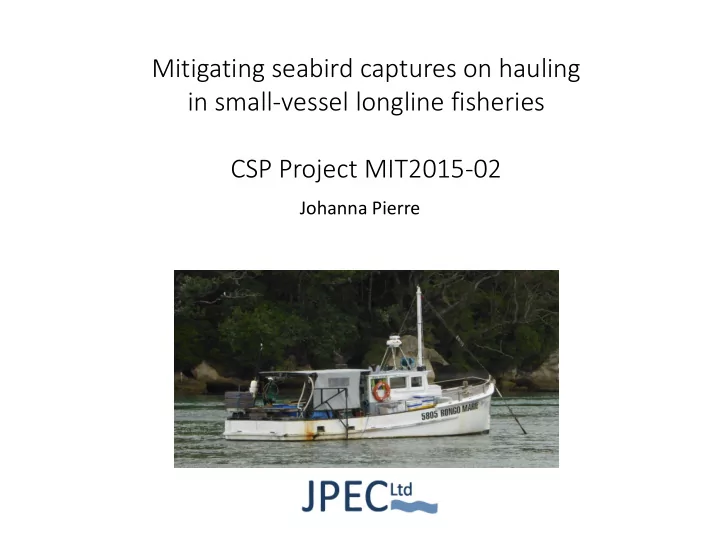
Mitigating seabird captures on hauling in small-vessel longline fisheries CSP Project MIT2015-02

Johanna Pierre

slide-2
SLIDE 2
  • Seabird bycatch mitigation efforts often focuses on

line-setting

  • e.g. tori lines, night-setting, line-weighting
  • Haul captures can be a significant proportion of total

captures

  • Mitigation measures for use during longline hauling not

well developed

  • Factors influencing haul capture rates are not well

understood

  • Growing interest in haul captures amongst bycatch

practitioners

  • Reflected in ACAP research priorities for pelagic

longline fisheries

Introduction

slide-3
SLIDE 3
  • Review approaches to mitigating haul captures in pelagic

and demersal longline fisheries

  • Explore information available on haul captures occurring on

longline gear deployed by New Zealand vessels < 34 m LOA

  • Provide recommendations for future work to characterise

and mitigate haul captures in New Zealand’s smaller-vessel longline fisheries

Scope

slide-4
SLIDE 4
  • Past published and unpublished mitigation reviews
  • Online search of published, grey and conference literature
  • Targeted searches:
  • Regional Fisheries Management Organisations
  • Commission for the Conservation of Antarctic Marine

Living Resources

  • Agreement on the Conservation of Albatrosses and

Petrels

  • Searches using names of haul mitigation measures
  • Contacted mitigation practitioners re work in progress or

not yet reported

Methods: Review

slide-5
SLIDE 5

Methods: Fisher reports

Explored information available on haul captures on longline gear deployed by New Zealand vessels: < 34 m LOA

  • Fisher-reported seabird captures 1 October 2009 onwards
  • Non-Fish and Protected Species Catch Return
  • Assume live captures are most likely to be haul captures
slide-6
SLIDE 6

Methods: Observer reports

Explored information available on haul captures, and mitigation measures in use, on smaller-vessel longliners in New Zealand: < 34 m LOA

  • Observer-reported seabird capture information collected

1 Oct 2009 onwards

  • Assume live captures are most likely to be haul captures
  • Observer trip information for trips starting April 2012
  • Observer diaries
  • Photographic logs
  • Observer information collected for the seabird liaison

programme

slide-7
SLIDE 7

Methods: Recommendations

  • So what?
  • Unanswered questions
  • Improvements to data collection relevant to

haul captures

  • Approaches to reduce captures on hauling
  • What next?
slide-8
SLIDE 8
  • 3 broad categories
  • Physical barriers impeding access
  • Reduced attractiveness of haul area
  • Deterrents

Results: Mitigation approaches

www.afma.gov.au DOC/MPI

slide-9
SLIDE 9

Bird exclusion device:

  • AKA bird curtain, Brickle curtain, bird baffler
  • A range of designs trialled and in use
  • Operational definition developed by CCAMLR.

Device must:

  • effectively deter seabirds from flying into the

area where the line is being hauled

  • prevent seabirds that are sitting on the

surface from swimming into the hauling bay area

  • Research has shown efficacy and habituation
  • May require management to avoid tangling

Physical barriers

www.afma.gov.au

slide-10
SLIDE 10

Tori line:

  • May be shorter than a tori line used on setting
  • May have streamers
  • Has a terminal buoy or string of buoys
  • Efficacy confirmed in research trials

Towed buoy(s):

  • Involves a single terminal buoy or series of buoys
  • Effective but less so than tori line
  • Requires management to avoid tangling

Physical barriers

slide-11
SLIDE 11
  • Retaining used bait, fish discards, processing

waste

  • Effective in reducing seabird captures, and

attacks on returning baits in most (but not all) cases

  • Provision reinforces food – vessel connection
  • Minimum operational standard
  • Retain for batch discharge away from

hauling station

Reducing attraction

DOC/MPI

slide-12
SLIDE 12
  • Water spray
  • Deck hose
  • Acoustic cannon
  • Banging a gaff on the hull
  • Shouting
  • Lasers
  • Fish oil

Deterrents

www.birdstop.co.uk

slide-13
SLIDE 13
  • Information on seabird interactions with gear during

hauling identified in reporting from 133 observed trips

  • 73 BLL
  • 60 SLL
  • Shows a range of measures in use
  • Most measures are operational, not “devices”
  • Variation in practices between trips on a vessel
  • Information recorded qualitatively
  • Not highly standardised
  • Sometimes difficult to interpret definitively

In use on NZ vessels < 34 m

slide-14
SLIDE 14
  • Tori line (1 vessel):
  • 25 m long tori line, no streamers, terminal buoy
  • Bird “baffler” (1 vessel)
  • Deck hose slotted into scupper grill (1 vessel)
  • Swinging a long-handled net (1 vessel)
  • Keeping hooks below the surface during breaks in

hauling (3 skippers)

  • Moving the line constantly to reduce birds’ ability to grab

returning bait/fish (1 vessel)

  • Manoeuvring vessel so haul station is immediately above

incoming line, reducing seabird access (2 trips)

  • Making a lot of noise (2 trips)

In use on NZ BLL vessels < 34 m

slide-15
SLIDE 15
  • Differences in how returned baits, offal and discards were

managed

  • Returned baits (trip reports):
  • Retained some or all of the time during hauling (20)
  • Never retained (9)
  • Discharged at hauling station (9) compared to away (4)
  • Discharged until birds arrive, then retained (2)
  • “Flicked” away from the mainline (2)

In use on NZ BLL vessels < 34 m

slide-16
SLIDE 16

Offal (trip reports):

  • Always or sometimes retained onboard until after hauling, or

batch discharged during hauling (22)

  • Never retained during hauling (4)
  • Discharged at the hauling station (5)
  • Discharged away from the hauling station (9)
  • Timing of discharge influenced by when processing occurred
  • Often processing took place after the haul was complete

In use on NZ BLL vessels < 34 m

slide-17
SLIDE 17

Discards (trip reports):

  • Always or sometimes retained and discarded

after hauling (5)

  • Never retained (4)
  • Dead fish are “popped” before discarding (1)
  • Space constraints led to discarding, e.g. a

high number of SPD caught (1)

In use on NZ BLL vessels < 34 m

slide-18
SLIDE 18
  • Float deployed beside the vessel (1 vessel)
  • Float suspended from a tuna pole swinging out over the haul

area (1 vessel)

  • Deck hose (2 vessels)
  • Water curtain (2 vessels)
  • Hauling as quickly as possible (1 vessel)
  • Jerking the snood constantly to reduce birds’ ability to grab

returning bait/fish (1 vessel)

  • Steep line angle at hauling to reduce seabird access (1 vessel)
  • Deck lighting minimised at haul (1 vessel)

In use on NZ SLL vessels < 34 m

slide-19
SLIDE 19

In use on NZ SLL vessels < 34 m

  • Differences in how returned baits, offal and discards were

managed

  • Returned baits (trip reports):
  • Retained some or all of the time during hauling (21)
  • Never retained (2)
  • Discharged at hauling station (2) compared to away (3)
  • Offal (trip reports)
  • Retained some or all of the time during hauling (9)
  • Never retained (4)
  • Discharged away from the hauling station (7)
slide-20
SLIDE 20

Capture characteristics

Fisher reports Observer reports

# Injured Uninjured BLL 172 8 % 92 % SLL 136 35 % 65 % # Injured Uninjured BLL 78 58 % 42 % SLL 44 82 % 18 %

slide-21
SLIDE 21

Fisher-reported captures: Key BLL target sp.

FMA Target Live and dead captures % of total reported captures in FMA % of fishing effort in FMA % of captures live % live captures that were albatross Seabirds caught alive 1 BNS SNA 58 365 53.2 7.8 81.8 81.0 28.2 XBP (38), XSH (9) XBG (1), XBP (25), XBS (1), XCC (5), XFL (1), XFS (47), XLA (1), XSH (3), XSU (2), XXP (17) 2 BNS LIN 2 12 1.6 44.3 40.7 3 HAP, HPB LIN 8 28 5.6 7.6 80.2 10.7 100 XPB (1), XSA (2) 4 HPB LIN SCH 37 130 12 24.2 28.8 53.0 3 2.7 2.3 100 XXP (1) XPB (2), XSA (1) 5 LIN 13 78.8 6 LIN 8 0.9 99.6 7 HAP, HPB LIN SCH 9 46 3 6.8 16.2 60.9 17.5 4.3 100 XRU (1), XWM (1) 8 BNS GUR HPB SCH 8 18 4 11 5.3 12.3 18.0 18.3 37.9 11.1 25 27.3 100 66.7 XNP (1), XWP (1) XPB (1) XSH (1), XWM (2) 9 BAS BNS SNA 1 3 1 0.6 35.6 17.4 10.3 Unknown LIN 3 0.3 7.0

slide-22
SLIDE 22

Observer Data: BLL

FMA Target species Number of seabird captures (live and dead) % of total observed captures occurring in FMA % of fishing effort (hooks)

  • n observed

vessels % of captures live % live captures that were albatross Seabirds caught alive 1 BAS 1 54.9 3.6 100 XBP (1) BNS 43 2.0 93 XBP (40) KAH 1 5.4 100 XFL (1) SNA 88 2.2 28 XBG (3), XBP (4), XFL (1), XFS (16), XNP (1) TAR 2 1.2 100 XFS (2) 2 LIN 6 2.4 1.8 3 LIN 1 0.4 4.5 4 LIN 45 18.3 2.9 5 LIN 6 2.4 5.8 7 LIN 30 12.2 2.4 20 100 XBM (3), XRA (1), XWM (2) 8 GUR 10 8.9 26.8 20 XNP (1), XWP (1) SNA 7 72.4 Unknow n 5 9 SNA 1 0.4 3.8 100 XBS (1)

slide-23
SLIDE 23

Fisher-reported captures: SLL

FMA Target species Number of seabird captures (live and dead) % of total reported captures

  • ccurring in

FMA % of fishing effort in FMA % of captures live % live captures that were albatross Seabirds caught alive 1 BIG STN SWO 159 26 76 28.8 61.7 31.2 6.9 8.8 7.7 17.1 71.4 100 92.3 XFS (3), XPE (1), XAL (3), XAS (1), XPB (1), XRA (3), XSY (1), XWA (1) XAL (2) XXP (1), XAL (5), XAS (1), XSY (5), XWA (1) 2 BIG BWS STN SWO TOR 52 2 89 9 3 17.1 35.0 0.08 55.7 4.6 3.2 9.6 50 13.5 100 50 91.2 XPB (1), XRA (3), XSA (1) XSA (1) XCP (1), XAL (1), XAS (1), XBM (1), XPB (2), XSY (6) 5 STN 29 3.2 100 6.9 100 XRA (1), XWM (1) 7 STN SWO 394 37 47.5 81.8 18.0 19.0 21.6 67 75 XBP (1), XDP (2), XFS (2), XSH (1), XWP (2), XAL (13), XAS (10), XBM (5), XPB (16), XSA (3), XSY (8), XWA (2), XWM (10) XSH (1), XXP (1), XAL (3), XAS (1), XWM (2) 9 BIG SWO 14 17 3.4 50.1 46.5 21.4 5.9 66.7 100 XXP (1), XAG (1), XAL (1) XSM (1)

slide-24
SLIDE 24

Observer Data: SLL

FMA Target species Number of seabird captures (live and dead) % of total observed captures occurring in FMA % of observed fishing effort (hooks) % of captures live % live captures that were albatross Seabirds caught alive 1 BIG 68 22.3 5.7 5.9 75 XBP (1), XAN (1), XBM (1), XWA (1) STN 12 11.4 8.3 100 XKM (1) SWO 5 6.1 20 100 XWA (1) 2 BIG STN 6 39 11.8 2.3 12.4 16.7 12.8 100 80 XAL (1) XCP (1), XKM (1), XWA (1), XBM (1), XSY (1) 5 STN 29 7.6 57.7 6.9 100 XRA (1), XWM (1) 7 STN 199 55.5 11.5 12.1 91.7 XBM (7), XKM (2), XWA (2), XWM (11), XWP (2) SWO 12 8.5 16.7 100 XWM (1), XAS (1) 9 BIG 9 2.6 7.8 44.4 50 XAN (1), XKM (1), XFS (2) SWO 1 6.1

slide-25
SLIDE 25

Bottom longline

Number of live seabirds caught per fisher-reported trip: 1 Oct 2009 – onwards Vessels < 34 m LOA

Surface longline

slide-26
SLIDE 26

Bottom longline

Number of live seabirds caught per

  • bserver trip:

1 Oct 2009 – onwards Vessels < 34 m LOA

Surface longline

slide-27
SLIDE 27

So what?

  • Still more set than haul captures overall
  • Assumption: haul-caught birds are alive on landing
  • Live captures of both seabird groups occur in surface

and bottom longline fisheries. Very broadly:

  • BLL – more of a petrel/shearwater problem,

dominated by FMA 1 (albatross in other areas)

  • SLL – more of an albatross problem,

FMAs 7, 1 & 2

  • Single live-captures per trip dominate fisher and
  • bserver reports
slide-28
SLIDE 28

Opportunities to:

Reduce risk:

  • Reduce attractiveness of hauling operations to seabirds
  • Make bait retention a standard and consistent part of

hauling practice

  • Discharge away from the hauling station
  • Same for offal, although this is a lesser issue

Better understand risk and mitigation:

  • More data especially in data-poor areas
  • More standardised data collection on risk factors
  • Detailed documentation of devices used on hauling
  • Attempt to explore gear relationships with haul captures
  • Weighting, snood length
slide-29
SLIDE 29

Opportunities to:

Develop mitigation approaches:

  • BLL: Focus on areas that appear to have particularly a high

incidence of haul captures

  • Based on available data
  • SLL: HMS species and a smaller more mobile fleet
  • Fleet-wide approach
  • Devices that keep birds away from the hauling station
  • Towed/dangled buoy devices

Reduce captures:

  • If most haul capture events are single birds, mitigation

measures must be in place before a single capture occurs

slide-30
SLIDE 30

Acknowledgements

  • CSP team
  • MPI Research Data Management
  • MPI Observer Services Unit
  • Observers who collected the information
  • Fishers who reported captures
  • Bycatch practitioners who provided information
slide-31
SLIDE 31

Questions?