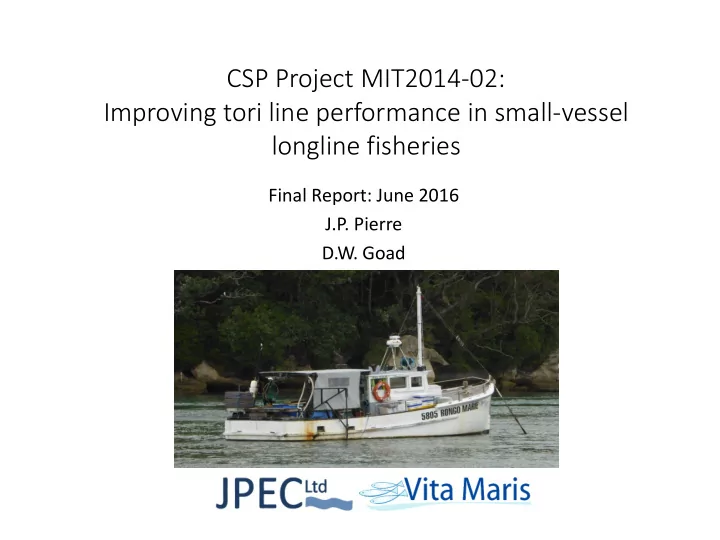
longline fisheries Final Report: June 2016 J.P. Pierre D.W. Goad - - PowerPoint PPT Presentation
CSP Project MIT2014-02: Improving tori line performance in small-vessel longline fisheries Final Report: June 2016 J.P. Pierre D.W. Goad Introduction Small vessel longline fisheries: particularly high risks to some seabird populations +
- Small vessel longline fisheries: particularly high risks to some seabird
populations + high uncertainty in capture extent
- Proven mitigation strategies available for these fisheries
- Ongoing controversy about efficacy and operational feasibility of tori lines
amongst some fishers CSP project MIT2014-02 Overall Objective:
- To develop improved tori lines which are specifically optimised for safe and
effective use on small longline vessels
Introduction
Methods
- Workshop and literature review
- to identify issues and
possible solutions
- On-land testing to refine
approach to at-sea work
- At-sea testing on four different
fishing vessels
Photo: J. Pierre
Issues identified:
- Vessel setting speed
- Attachment height of tori line
- Attachment method
- Weak links to be incorporated
- Drag requirement
- Weight of tori line
- Storage
- Availability of materials
Methods - Workshop
- Three backbones
- 3 mm monofilament,
3 mm Dyneema, 3 mm Ashaway
- Three deployment heights
- 5 m, 7 m, 9 m
- Fibretube pole
- Streamers of 9 mm Kraton (or
equivalent weight)
- Every 2.5 m or 5 m
- 5 to 0.5 m in length
- Variable numbers of shark clips
- Drag (kg) for every 10 m aerial
extent, 40 m – 80 m
Methods – On-land testing
- Five sets of at-sea trials
- Preliminary drag testing
- FV Royal Salute
- FV Moonshadow
- FV Coastal Rover
- FV Kotuku
- Structured testing with respect to
setting speeds, e.g.
- 2.2 – 5 kn snapper
- 1.8 – 5.1 kn bluenose
- 2.6 – 4.1 kn ling
- 6 – 8 knots (or more) SLL
Methods – At-sea testing
- Drag measured at 2.6, 4.2, 6.5 kn
- 16 test sections, e.g.
- Rope + road cone
- Series of gillnet floats
- Cone + float combinations
- etc.
- Test sections held at 1.5 m high
- Drag measured using Salter scales
Methods – Drag testing
- Tori lines clipped into variable
tension link
- Lazy line as backup to secure TL to
vessel
- Hoisted using ‘flagpole method’
- Fibretube poles
- Range of vessel speeds
- Drag measured
- Tori line released
- Aerial extent measured alongside
marked rope
- Weather conditions (wind speed and
direction, sea state) recorded
- Photos and video taken
Methods – Fishing vessel tests
- FV Royal Salute
- Dec 2015
- Test speeds: 2.7, 4, 6 kn
- Pole Mk 1 (42 mm diameter)
- Tori line:
- 6-m deployment height
- 70 m aerial section
- single streamers 2.5 or
5 m apart
- streamers 9-mm or
5-mm plastic tubing
- 9 in-water drag sections
Methods – Fishing vessel tests
- FV Moonshadow
- March 2016
- Test speeds: 3.5, 5, 7 kn
- Pole Mk 2 (52 mm diameter)
- Vessel’s own tori line
- Test tori line:
- 6-m deployment height
- 70 m aerial section
- single streamers 3.5 apart
- streamers 5-mm plastic
tubing
- 8 in-water drag sections
- One tori line design tested at 7 m deployment height
Methods – Fishing vessel tests
- FV Coastal Rover
- April 2016
- Test speeds: 2.7, 3.5, 4, 6, 7 kn
- Pole Mk 2 (52 mm diameter)
- Test tori line:
- 6-m deployment height
- 70 m aerial section
- single streamers 3.5 apart
- streamers 5-mm plastic
tubing
- 12 in-water drag sections
- One tori line design also tested at 3, 4, and 5 m
deployment height
Methods – Fishing vessel tests
- FV Kotuku
- April 2016
- Test speed: 3.5 kn
- Drag test only
- One in-water section
Methods – Fishing vessel tests
- Drag required to achieve aerial extents increased with
deployment height
- Drag on the pole caused bending
Results – On-land testing
Backbone:
- Monofilament sagged and
stretched most (black dots)
- required most drag to achieve
aerial extent
- Ashaway (grey) and Dyneema
(black circles) performed better Streamers:
- Streamer weight increased drag
required to achieve aerial extent
- Shark clips less important
Results – On-land testing
Preliminary drag testing:
- Most designs tested did not
generate sufficient drag for 70-m aerial extent
- Low speeds worst
- Back to the drawing board!
Results – Drag testing
- FV Royal Salute:
- 23 tests conducted
- 2.7 knots:
- aerial extents 45 – 70 m
- drag 4.5 – 12 kg
- 4 knots:
- aerial extents 50 – 70 m
- drag 2.7 – 13 kg
- 6 knots:
- aerial extent 55 – 75 m
- drag 5.8 – 9.5 kg
- Some in-water sections gave
inconsistent drag at higher speeds
Results – Fishing vessel tests
- FV Moonshadow:
- 30 tests conducted
- 3.5 knots:
- aerial extents 30 – 65 m
- drag 2.5 – 7 kg
- 5 knots:
- aerial extents 50 – 75 m
- drag 5 – 13 kg
- 7 knots:
- aerial extent 60 – 90 m
- drag 5.5 – 26 kg
- At 3.5 and 5 knots, increasing height 1 m added 5 m aerial extent
- Crew preferred simpler designs with less to catch gear on
Results – Fishing vessel tests
- FV Coastal Rover:
- 34 tests conducted
- 2.7 – 3.5 knots:
- aerial extents 65 – 70 m
- drag 6 – 12 kg
- 4 knots:
- aerial extents 65 – 70 m
- drag 12 – 23 kg
- 6-7 knots:
- aerial extent 60 – 120 m
- drag 5 – 30 kg
- FV Kotuku drag test
- 3.5 knots, 7.5 – 9.5 kg drag
Results – Fishing vessel tests
- Tori line storage and attachment
Results – Fishing vessel tests
New materials
- Pole Mk2 worked well (52 mm
diameter)
- Weak link recommended for safety
and operational reasons
- Numerous designs achieve 70 m aerial
extent
- Drag is the most difficult to refine
- must minimise tangling risk
- 3 mm Dyneema the preferred
backbone, at least 70 m
- 5-mm diameter plastic tubing
streamer preferred
- Rule of thumb: 15 kg drag should give
70 m aerial extent
Discussion
Discussion
2.7 – 3.5 knots
100-m length of 8 – 10 mm diameter rope with knots ~1-m apart 360-mm diameter surface longline float covered in trawl netting three medium-sized road cones at the start, middle and end of a 50 m length of 10-mm trawl braid 100 m of 5-mm diameter monofilament followed by one medium or large-size road cone
Discussion
4 – 5 knots
- ne large road cone
50 small gillnet floats spaced equally along 50 m of 10-mm diameter trawl braid followed by a large road cone three large flutterboards at each end and the centre of a 50 m length
- f 10-mm diameter trawl braid
100 m of 5 mm diameter monofilament, plus either 50 large gillnet floats spaced equally along 50 m of 10-mm diameter trawl braid, or a 360-mm diameter float covered with net
Discussion
6 – 7 knots
a 200-m (or longer) length of 5-mm diameter monofilament a 100-m length of 8 - 10 mm diameter braided rope 100 m of 5-mm diameter monofilament plus 50 large gillnet floats spaced equally along 50 m of 10-mm diameter trawl braid Key trade-off – A less ‘catchy’ drag section means a much longer tori line
- Endless design options
- Light materials best
- new streamer material will be
made commercially available
- Deployment poles essential on some
smaller vessels
- expensive (~$450) but durable
- generally easy to attach
- Test designs identified in diverse
weather conditions when fishing
- On-vessel sessions for fishers
recommended to promote effective design and operation
Discussion
Acknowledgements
- FINZ: R. Wells
- DWG: R. Wells, J. Cleal
- Kilwell Sports Ltd: N. Podmore
- Supply Services Ltd
- Beauline International Ltd: W. Beauchamp, R. Deck
- CSP: I. Debski, K. Ramm