Mechanism of Drag Reduction by Dimples on a Sphere Colin Smith ME - - PowerPoint PPT Presentation

mechanism of drag reduction by dimples on a sphere
SMART_READER_LITE
LIVE PREVIEW

Mechanism of Drag Reduction by Dimples on a Sphere Colin Smith ME - - PowerPoint PPT Presentation

Picture F.N.M. Brown Mechanism of Drag Reduction by Dimples on a Sphere Colin Smith ME 801 Nov 23, 2010 The Big Ideas Previous experiments have found: Dimpled spheres to have up to 50% reduction of drag of smooth spheres The drag on


slide-1
SLIDE 1

Colin Smith ME 801 Nov 23, 2010

Mechanism of Drag Reduction by Dimples on a Sphere

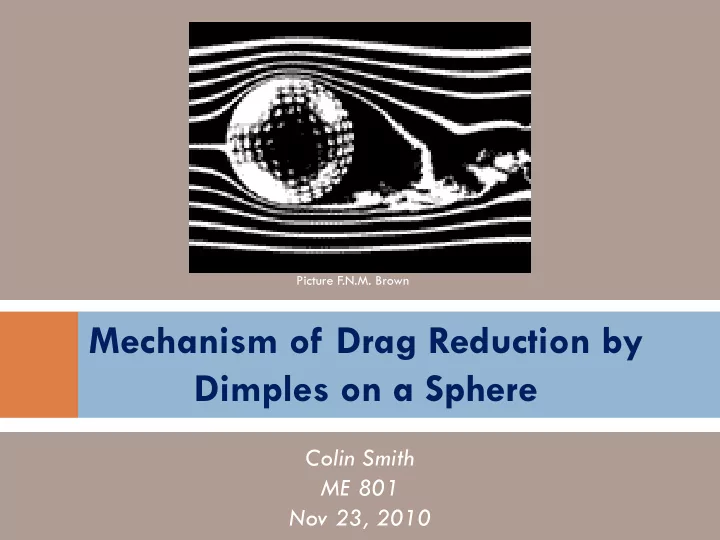
Picture F.N.M. Brown
slide-2
SLIDE 2

10/18/2011 Colin Smith Slide 2 of 20

The Big Ideas

Previous experiments have found:

 Dimpled spheres to have up to 50%

reduction of drag of smooth spheres

 The drag on a ball to become constant

above certain Reynolds' Numbers (Ball Speeds)

slide-3
SLIDE 3

10/18/2011 Colin Smith Slide 3 of 20

Basics of Drag

Skin Friction: Viscous shear stresses on surface

  • f the object

Form Drag: Pressure difference

  • n the object

P P

F

F F

slide-4
SLIDE 4

10/18/2011 Colin Smith Slide 4 of 20

Pressure Coefficient over a Sphere

http://qm-aerospace.blogspot.com/2007/03/why-do-golf-balls-have-dimples.html

Potential flow solution predicts no drag due to pressure [D’Alembert’s Paradox] (dotted line) When viscosity is accounted for, separation occurs and the flow is no longer symmetric (solid line)

slide-5
SLIDE 5

10/18/2011 Colin Smith Slide 5 of 20

Boundary Layer Separation

Separation occurs when the pressure gradient

  • vercomes the momentum
slide-6
SLIDE 6

10/18/2011 Colin Smith Slide 6 of 20

Laminar vs Turbulent Boundary Layers

slide-7
SLIDE 7

10/18/2011 Colin Smith Slide 7 of 20

Motivation

Dimples induce a turbulent boundary layer, which has

higher momentum and thus delays separation

At Re>104, the majority of drag on a sphere is due to

pressure difference, not skin friction

http://www.sciencebuddies.org/science-fair-projects/project_ideas/Sports_p012.shtml

slide-8
SLIDE 8

10/18/2011 Colin Smith Slide 8 of 20

 Dimples reduce drag on a sphere as much as

50% when compared to a smooth surface

 The drag coefficient remains constant over a

range of Reynolds numbers

 Turbulent boundary layer is caused by

separation bubbles in dimples

Findings

slide-9
SLIDE 9

10/18/2011 Colin Smith Slide 9 of 20

Definitions

Drag Coefficient

Reynolds Number

D= Drag Force A=Cross Sectional Area ρ= Density Uo= Free Stream Velocity d= sphere diameter Uo= Free Stream Velocity ν= kinematic viscosity

slide-10
SLIDE 10

10/18/2011 Colin Smith Slide 10 of 20

Experimental Setup

Tiger Woods ball speed 185mph=83m/s

Free stream velocities varied from 5-28 m/s Reynolds numbers 0.5x10⁵- 2.8x10⁵ Maintains laminar boundary layer over smooth sphere

(Choi J, Jeon WP , Choia H) (Jeon S, Choi J, Jeon WP , Choi H, Park J)

slide-11
SLIDE 11

10/18/2011 Colin Smith Slide 11 of 20

Flow Over a Smooth Cylinder

The separation angle over a smooth golf ball sized sphere was measured at 82o for 0.5x10⁵≤ Re ≤2.8x10⁵

slide-12
SLIDE 12

10/18/2011 Colin Smith Slide 12 of 20

Visualization of Flow Separation

 Separation is delayed to ϕ=110o  Separation angle constant for Re≥ 0.9x10⁵  The trailing edge of the tested sphere is smooth to better show separation

(Choi J, Jeon WP , Choia H)

slide-13
SLIDE 13

10/18/2011 Colin Smith Slide 13 of 20

Measured Drag Coefficient

Drag Coefficient constant for Re≥ 0.9x10⁵

(Choi J, Jeon WP , Choia H)

slide-14
SLIDE 14

10/18/2011 Colin Smith Slide 14 of 20

Effect of Dimples

(Choi J, Jeon WP , Choia H)

slide-15
SLIDE 15

10/18/2011 Colin Smith Slide 15 of 20

Smoke Wire Test

Shows no vortices are ejected

(Choi J, Jeon WP , Choia H)

slide-16
SLIDE 16

10/18/2011 Colin Smith Slide 16 of 20

Velocity Profile at Re=1.0x10⁵

(Choi J, Jeon WP , Choia H)

slide-17
SLIDE 17

Re=1.5x10⁵

slide-18
SLIDE 18

10/18/2011 Colin Smith Slide 18 of 20

Velocity Profiles at Increasing Re

Re= 1.0x10⁵

First Separation at Dimple III (80O)

Re= 1.5x10⁵

First Separation at Dimple II (71O)

Re= 2.0x10⁵

First Separation at Dimple I (63O)

If Re> 0.9x10⁵ flow always separates from the surface after dimple V

(Choi J, Jeon WP , Choia H)

slide-19
SLIDE 19

10/18/2011 Colin Smith Slide 19 of 20

Conclusion

(Choi J, Jeon WP

, Choia H)

slide-20
SLIDE 20

10/18/2011 Colin Smith Slide 20 of 20

References

Choi J, Jeon WP , Choia H. “Mechanism of Drag Reduction by Dimples on a Sphere.” Physics

  • f Fluids. Vol.18 4 041702. 2006

Jeon S, Choi J, Jeon WP , Choi H, Park J, “Active control of flow

  • ver a sphere at a sub-critical Reynolds number,” J. Fluid Mech. 517, 113

2004. Olson, A. “A Cure for Hooks and Slices? Asymmetric Dimple Patterns and Golf Ball flight.”

  • 2007. http://www.sciencebuddies.org/science-fair-projects/project_ideas/Sports_

p012.shtml Scott, Jeff. “Why do Golf Balls Have Dimples.” 2005. http://qm- aerospace.blogspot.com/2007/03/why-do-golf-balls-have-dimples.html

slide-21
SLIDE 21

10/18/2011 Colin Smith Slide 21 of 20

Questions?