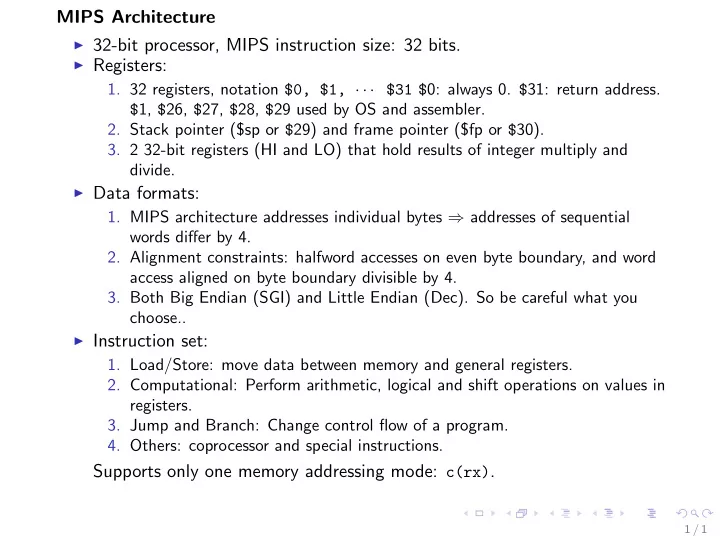
SLIDE 1 MIPS Architecture
◮ 32-bit processor, MIPS instruction size: 32 bits. ◮ Registers:
- 1. 32 registers, notation $0, $1, · · · $31 $0: always 0. $31: return address.
$1, $26, $27, $28, $29 used by OS and assembler.
- 2. Stack pointer ($sp or $29) and frame pointer ($fp or $30).
- 3. 2 32-bit registers (HI and LO) that hold results of integer multiply and
divide.
◮ Data formats:
- 1. MIPS architecture addresses individual bytes ⇒ addresses of sequential
words differ by 4.
- 2. Alignment constraints: halfword accesses on even byte boundary, and word
access aligned on byte boundary divisible by 4.
- 3. Both Big Endian (SGI) and Little Endian (Dec). So be careful what you
choose..
◮ Instruction set:
- 1. Load/Store: move data between memory and general registers.
- 2. Computational: Perform arithmetic, logical and shift operations on values in
registers.
- 3. Jump and Branch: Change control flow of a program.
- 4. Others: coprocessor and special instructions.
Supports only one memory addressing mode: c(rx).
1 / 1
SLIDE 2 Assembly Programming
◮ Naming and Usage conventions applied by assembler. Use #include
<regdefs.h> in order to use names for registers.
◮ Directives: pseudo opcodes used to influence assembler’s behavior. You
will need to generate these directives before various parts of generated code.
- 1. Global data segments: data segments partitioned into initialized,
uninitialized, and read-only data segments:
◮ .data: Add all subsequence data to the data section. (No distinction
about the segment in which data will be stored.)
◮ .rdata: Add subsequent data in read-only data segment. ◮ .sdata: Add subsequent data in uninitialized data segment. ◮ .sbss: Add subsequent data in initialized data segment.
- 2. Literals: Various kinds of literals can be added to various data segments
through the following directives:
◮ .ascii str: store string in memory. Use .asciiz to null terminate. ◮ .byte b1, ..., bn assemble values (one byte) in successive locations.
Similarly .double, .float, .half, .word.
2 / 1
SLIDE 3 Directives - cont’d.
◮ Code segments: A code segment is specified by the .text directive. It
specifies that subsequent code should be added into text segment.
◮ Subroutines: The following directives are related to procedures:
◮ .ent procname: sets beginning of procname. ◮ .end procname: end of procedure. ◮ .global name: Make the name external.
◮ .align n: align the next data on a 2n boundary.
A typical assembly program
.rdata .byte 0x24,0x52,0x65 .align 2 $LC0: .word 0x61,0x73,0x74,0x72 .text .align 2 .globl main .ent main main: .frame $fp,32,$31 subu $sp,$sp,32 $L1: j $31 .end main
3 / 1
SLIDE 4
Data Transfer Instructions
◮ Load instruction: lw rt, offset(base). The 16-bit offset is
sign-extended and added to contents of general register base. The contents of word at the memory specified by the effective address are loaded in register rt. Example: Say array A starts at Astart in heap. g, h, i stored in $17, $18,
$19.
Java−− code:
g = h + A[i];
Equivalent assembly code:
lw
$8, Astart($19)
# $8 gets A[i] add
$17, $18, $8
# $17 contains h + A[i]
◮ Store instruction: sw rt, offset(base)
Example: Java−− code:
A[i] = h + A[i];
Equivalent assembly code:
lw
$8, Astart($19)
# $8 gets A[i] add
$8, $18, $8
# $8 contains h + A[i] sw
$8, Astart($19)
# store back to A[i]
◮ MIPS has instructions for loading/storing bytes, halfwords as well.
4 / 1
SLIDE 5 Computational Instructions
◮ Perform Arithmetic, logical and shift operations on values in registers. ◮ Four kinds:
1.1 Add immediate: addi rt, rt, immediate 1.2 And immediate: andi rt, rt, immediate
- 2. 3-operand Register type instruction
2.1 Add: add rd, rs, rt 2.2 Subtract: sub rd, rs, rt 2.3 AND, OR etc.
3.1 Shift Left logical: sll rd, rt, shamt 3.2 Shift Right Arithmetic: sra rd, rt, shamt
- 4. Multiply/Divide instructions:
4.1 Multiply: mult rs, rt 4.2 Divide: div rs, rt 4.3 Move from HI: mfhi rd 4.4 Move from LO: mflo rd
5 / 1
SLIDE 6
Decision Making Instructions
◮ beq: similar to an if with goto
beq register1, register2, L1
Example: Java−− code:
if ( i != j) f = g + h; f = f - i;
Assume: f, g, h, i, j in registers $16 through $20. Equivalent Assembly code:
beq
$19, $20, L1
# L1 is a label add
$16, $17, $18
# $16 contains f + h L1: sub
$16, $16, $19
# f := f-1
◮ bne: bne register1, register2, L1. Jump to L1 if register1 and
register2 are not equal. Example: Java−− code
if ( i = j) f = g + h; else f = g - h;
Assume: f, g, h, i, j in registers $16 through $20.
bne
$19, $20, Else
# L1 is a label add
$16, $17, $18
# $16 contains g + h j Exit # skip else part Else: sub
$16, $17, $18
# f := g - h Exit:
instruction j: unconditional jump.
◮ Note that addresses for labels generated by assembler.
6 / 1
SLIDE 7 Instructions -cont’d.
◮ Using conditional and unconditional jumps to implement loops:
while (save[i] == k) { i = i + j; }
Assume a) i, j, k in registers $19 through $21; b) Sstart contains the address for beginning of save; c) $10 contains 4.
Loop: mult $9, $19, $10 # $9 = i * 4 lw
$8, Sstart($9)
# $8 = save[i] bne
$8, $21, Exit
# jump out of loop add
$19, $19, $20
j Loop Exit:
◮ Compare two registers: slt
slt $8, $19, $20: compare $8 and $9 and set $20 to 1 if the first
register is less than the second. An instruction called blt: branch on less than. Not implemented in the
- machine. Implemented by assembler. Used register $1 for it. So DO NOT
use $1 for your code generation.
7 / 1
SLIDE 8
Branch Instructions - cont’d.
◮ jr: jump to an address specified in a register. Useful for implementing
case statement. Example:
switch(k) { case 0: f = i + j; break; case 1: f = g + h; break; case 2: f = g - h; break; case 3: f = i -j; break; }
Assumption: JumpTable contains addresses corresponding to labels L0,
L1, L2, and L3. f, g, h, i, j: in registers $16 through $20. $21 contains value 4.
Loop: mult $9, $19, $21 # $9 = k ∗ 4 lw
$8, JumpTable($9)# $8 = JumpTable[k]
jr
$8
# jump based on $8 L0: add
$16, $19, $20
# k = 0 j exit L1: add
$16, $17, $18
# k = 1 j exit L2: sub
$16, $17, $18
# k = 2 j exit L3: sub
$16, $19, $20
# k = 3 Exit:
8 / 1
SLIDE 9 Procedures
◮ jal: jump to an address and simultaneously save the address of the
following instruction (return address) in $31: jal ProcedureAddress
◮ Assume A calls B which calls C
◮ A is about to call B:
- 1. Save A’s return address (in $31) on stack
- 2. Jump to B (using jal)
- 3. $31 contains return address for B.
◮ B is about to call C:
- 1. Save B’s return address (in $31) on stack
- 2. Jump to C (using jal)
- 3. $31 contains return address for C.
◮ Return from C: jump to address in $31 ◮ On returning from B: restore B’s return address by loading $31 from stack.
◮ MIPS assembly code:
A: : jal B : B: : add $29, $29, $24 sw
$31, 0($29)
# save return address jal C # call C + save ret addr in $31 lw
$31, 0($29)
# restore B’s return address sub $29, $29, $24 # adjust stack jr
$31
C: : jr
$31
: 9 / 1
SLIDE 10 Procedures
◮ Two kinds of routines:
- 1. Leaf: do not call any other procedures
- 2. Non-leaf: call other routines
Determine type of your routine
◮ How does the generated procedure look? Leaf procedure Non−leaf procedure
Function Body Prologue Epilogue func: .ent func .end func j ra Function Body func: .ent func .end func j ra
◮ How does stack frame look?
frame
Virtual frame Pointer ($fp) Argument n : : Argument 1 local and temps saved registers argument build : High Memory Low Memory Stack Pointer ($sp) : framesize 10 / 1
SLIDE 11 Parameter Passing
◮ General registers $4 – $7 and floating point registers $f12 and $f14 used
for passing first four arguments (if possible).
◮ A possible assignment: Arguments Register Assignments (f1,f2,...) f1→$f12, f2→$f14 (f1,n1,f2, ...) f1→$f12 n1→ $6,f2→stack (f1,n1,n2, ...) f1→$f12, n1→ $6,n2→$f7 ( n1,n2,n3,n4,...) n1→$f4, n2→ $5, n3→$f6, n4→$f7 ( n1,n2,n3,f ...) n1→$f4, n2→ $5, n3→$f6, f1→stack (n1,n2,f1) n1→$f4, n2→ $5, f1→($6, $7)
Prologue for procedure
◮ Define an entry for procedure first
.ent proc proc:
◮ Allocate stack space:
subu $sp, framesize
framesize: size of frame required. Depends on
◮ local variables and temporaries ◮ general registers: $31, all registers that you use. ◮ floating point registers if you use them ◮ control link
11 / 1
SLIDE 12
Prologue for procedure - cont’d.
◮ Include a .frame psuedo-op:
.frame framereg, framesize, returnreg
Creates a virtual frame pointer ($fp): $sp + framesize
◮ Save the registers you allocated space for
.mask bitmask, frameoffset sw reg, framesize+frameoffset-N($sp)
.mask: used to specify registers to be stored and where they are stored.
One bit in bitmask for each register saved.
frameoffset: offset from virtual frame pointer. Negative.
N should be 0 for the highest numbered register saved and then incremented by 4 for each lowered numbered register:
sw
$31, framesize+frameoffset($sp)
sw
$17, framesize+frameoffset-4($sp)
sw
$6, framesize+frameoffset-8($sp)
◮ Save any floating point register:
.fmask bitmask, frameoffset s.[sd] reg,framesize+frameoffset-N($sp)
Use .fmask for saving register
◮ Save control link (frame pointer) information ◮ Save access link/display information (if any).
12 / 1
SLIDE 13
Epilogue of a procedure
◮ Restore registers saved in the previous step
lw reg, framesize+frameoffset($sp)
◮ Restore floating point registers ◮ Restore control link information ◮ Restore access link/display information ◮ Get return address
lw
$31, framesize+frameoffset($sp)
◮ Clean up stack:
addu $sp, framesize
◮ Return:
j
$31
13 / 1
SLIDE 14
Example Pascal and MIPS assembly program
Pascal Program
Program test; procedure p(x: integer); begin end begin p(1); end.
Equivalent Assembly
.text .align 2 .globl main .ent main main: subu $sp, 24 sw $31, 20($sp) .mask 0x80000000, -4 .frame $sp, 24, $31 li $4, 1 addu $2, $sp, 24 jal p move $2, $0 lw $31, 20($sp) addu $sp, 24 j $31 .end main .text .align 2 .ent p p: subu $sp, 8 sw $4, 8($sp)
14 / 1