Instruction Encoding Mini-MIPS From Weste/Harris CMOS VLSI Design - - PDF document

instruction encoding
SMART_READER_LITE
LIVE PREVIEW

Instruction Encoding Mini-MIPS From Weste/Harris CMOS VLSI Design - - PDF document

Instruction Encoding Mini-MIPS From Weste/Harris CMOS VLSI Design CS/EE 3710 Based on MIPS Fibonacci C-Code In fact, its based on the multi-cycle MIPS from Patterson and Hennessy Your CS/EE 3810 book... 8-bit version 8-bit


slide-1
SLIDE 1

1

Mini-MIPS

From Weste/Harris CMOS VLSI Design

CS/EE 3710

Based on MIPS

In fact, it’s based on the multi-cycle MIPS from Patterson and Hennessy

Your CS/EE 3810 book...

8-bit version

8-bit data and address 32-bit instruction format 8 registers numbered $0-$7 $0 is hardwired to the value 0 CS/EE 3710

Instruction Set

CS/EE 3710

Instruction Encoding

CS/EE 3710

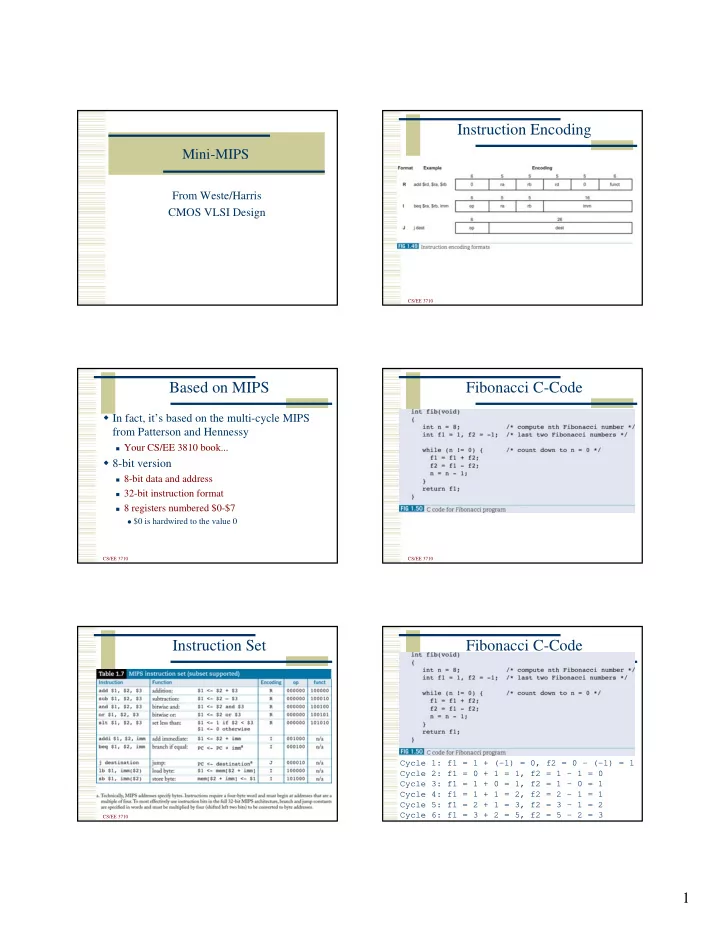
Fibonacci C-Code

CS/EE 3710

Fibonacci C-Code

Cycle 1: f1 = 1 + (-1) = 0, f2 = 0 – (-1) = 1 Cycle 2: f1 = 0 + 1 = 1, f2 = 1 – 1 = 0 Cycle 3: f1 = 1 + 0 = 1, f2 = 1 – 0 = 1 Cycle 4: f1 = 1 + 1 = 2, f2 = 2 – 1 = 1 Cycle 5: f1 = 2 + 1 = 3, f2 = 3 – 1 = 2 Cycle 6: f1 = 3 + 2 = 5, f2 = 5 – 2 = 3

slide-2
SLIDE 2

2

CS/EE 3710

Fibonacci Assembly Code

Compute 8th Fibonacci number (8’d13 or 8’h0D) Store that number in memory location 255

CS/EE 3710

Fibonacci Machine Code

101000

4

Assembly Code Machine Code

CS/EE 3710

Architecture

CS/EE 3710

Architecture

CS/EE 3710

Another View

CS/EE 3710

Control FSM

slide-3
SLIDE 3

3

CS/EE 3710

Connection to External Memory

CS/EE 3710

External Memory from Book

// external memory accessed by MIPS module exmemory #(parameter WIDTH = 8) (input clk, input memwrite, input [WIDTH-1:0] adr, writedata,

  • utput reg [WIDTH-1:0] memdata);

reg [31:0] RAM [(1<<WIDTH-2)-1:0]; wire [31:0] word; // Initialize memory with program initial $readmemh("memfile.dat",RAM); // read and write bytes from 32-bit word always @(posedge clk) if(memwrite) case (adr[1:0]) 2'b00: RAM[adr>>2][7:0] <= writedata; 2'b01: RAM[adr>>2][15:8] <= writedata; 2'b10: RAM[adr>>2][23:16] <= writedata; 2'b11: RAM[adr>>2][31:24] <= writedata; endcase assign word = RAM[adr>>2]; always @(*) case (adr[1:0]) 2'b00: memdata <= word[7:0]; 2'b01: memdata <= word[15:8]; 2'b10: memdata <= word[23:16]; 2'b11: memdata <= word[31:24]; endcase endmodule

Notes:

  • Endianess is fixed here
  • Writes are on posedge clk
  • Reads are asynchronous
  • This is a 32-bit wide RAM
  • With 64 locations
  • But with an 8-bit interface...

CS/EE 3710

Exmem.v

module exmem #(parameter WIDTH = 8, RAM_ADDR_BITS = 8) (input clk, en, input memwrite, input [RAM_ADDR_BITS-1:0] adr, input [WIDTH-1:0] writedata,

  • utput reg [WIDTH-1:0] memdata);

reg [WIDTH-1:0] mips_ram [(2**RAM_ADDR_BITS)-1:0]; initial $readmemb("fib.dat", mips_ram); always @(posedge clk) if (en) begin if (memwrite) mips_ram[adr] <= writedata; memdata <= mips_ram[adr]; end endmodule

  • This is synthesized to

a Block RAM on the Spartan3e FPGA

  • It’s 8-bits wide
  • With 256 locations
  • Both writes and reads

are clocked

CS/EE 3710

Exmem.v

module exmem #(parameter WIDTH = 8, RAM_ADDR_BITS = 8) (input clk, en, input memwrite, input [RAM_ADDR_BITS-1:0] adr, input [WIDTH-1:0] writedata,

  • utput reg [WIDTH-1:0] memdata);

reg [WIDTH-1:0] mips_ram [(2**RAM_ADDR_BITS)-1:0]; initial $readmemb("fib.dat", mips_ram); always @(posedge clk) if (en) begin if (memwrite) mips_ram[adr] <= writedata; memdata <= mips_ram[adr]; end endmodule

This is synthesized to a Block RAM on the Spartan3e FPGA Note clock!

CS/EE 3710

Block RAM

Byte-wide Block RAM is really 9-bits – parity bit... (Actually dual ported too!)

CS/EE 3710

Our Block Ram

Read-first or Write-first?

always @(posedge clk) if (en) begin if (memwrite) mips_ram[adr] <= writedata; memdata <= mips_ram[adr]; end

slide-4
SLIDE 4

4

CS/EE 3710

Read_First Template

CS/EE 3710

Write_First Template

CS/EE 3710

Read_First waveforms

CS/EE 3710

Write_First Waveforms

CS/EE 3710

Block RAM Organization

Each block is 18k bits... Block RAM is Single or Dual ported

CS/EE 3710

Recall – Overall System

Clock Clk

Clk

slide-5
SLIDE 5

5

CS/EE 3710

Recall – Overall System

Clock Clk

Clk

So, what are the implications of using a RAM that has both clocked reads and writes instead of clocked writes and async reads? (we’ll come back to this question...)

CS/EE 3710

mips Block Diagram

CS/EE 3710

mips.v

// simplified MIPS processor module mips #(parameter WIDTH = 8, REGBITS = 3) (input clk, reset, input [WIDTH-1:0] memdata,

  • utput

memread, memwrite,

  • utput [WIDTH-1:0] adr, writedata);

wire [31:0] instr; wire zero, alusrca, memtoreg, iord, pcen, regwrite, regdst; wire [1:0] aluop,pcsource,alusrcb; wire [3:0] irwrite; wire [2:0] alucont; controller cont(clk, reset, instr[31:26], zero, memread, memwrite, alusrca, memtoreg, iord, pcen, regwrite, regdst, pcsource, alusrcb, aluop, irwrite); alucontrol ac(aluop, instr[5:0], alucont); datapath #(WIDTH, REGBITS) dp(clk, reset, memdata, alusrca, memtoreg, iord, pcen, regwrite, regdst, pcsource, alusrcb, irwrite, alucont, zero, instr, adr, writedata); endmodule CS/EE 3710

Controller

State Codes Useful constants to compare against State Register

CS/EE 3710

Control FSM

CS/EE 3710

Next State Logic
slide-6
SLIDE 6

6

CS/EE 3710

Output Logic

Continued for the other states... Very common way to deal with default values in combinational Always blocks

CS/EE 3710

Output Logic

Why AND these two? Two places to update the PC pcwrite on jump pcwritecond on BEQ

CS/EE 3710

ALU Control

CS/EE 3710

ALU

Invert b if subtract... add is a + b sub is a + ~b +1 subtract on slt then check if answer is negative

CS/EE 3710

zerodetect

CS/EE 3710

Register File

What is this synthesized into?

slide-7
SLIDE 7

7

CS/EE 3710

Synthesis Report

CS/EE 3710

Synthesis Report

CS/EE 3710

Synthesis Report

Two register files? Why?

CS/EE 3710

Datapath

Fairly complex... Not really, but it does have lots of registers instantiated directly It also instantiates muxes... Instruction Register

CS/EE 3710

Datapath continued

Flops and muxes... RF and ALU

CS/EE 3710

Flops and MUXes

slide-8
SLIDE 8

8

CS/EE 3710

Back to the Memory Question

What are the implications of using RAM that is clocked on both write and read?

Book version was async read So, let’s look at the sequence of events that

happen to read the instruction

Four steps – read four bytes and put them in four

slots in the 32-bit instruction register (IR)

CS/EE 3710

Instruction Fetch

CS/EE 3710

Instruction Fetch

CS/EE 3710

Instruction Fetch

  • Memread, irwrite, addr, etc are set up just after clk edge
  • Data comes back sometime after that (async)
  • Data is captured in ir0 – ir3 on the next rising clk edge
  • How does this change if reads are clocked?

CS/EE 3710

mips + exmem

One of those rare cases where using both edges

  • f the clock is useful!

mips is expecting async reads exmem has clocked reads

CS/EE 3710

Memory Mapped I/O

Break memory space into pieces (ranges)

For some of those pieces: regular memory For some of those pieces: I/O That is, reading from an address in that range results

in getting data from an I/O device

Writing to an address in that range results in data

going to an I/O device

slide-9
SLIDE 9

9

CS/EE 3710

Mini-MIPS Memory Map

I/O Switches/LEDs Code/Data Code/Data Code/Data 00 3F 40 7F 80 BF C0 FF 64 bytes Top two address bits define regions 8-bit addresses 256 bytes total! 0000 0000 0011 1111 0100 0000 0111 1111 1000 0000 1011 1111 1100 0000 1111 1111

CS/EE 3710

Enabled Devices

Only write to that device (i.e. enable it) if you’re in the appropriate memory range. Check top two address bits!

CS/EE 3710

MUXes for Return Data

Use MUX to decide if data is coming from memory

  • r from I/O

Check address bits!

CS/EE 3710

Lab2 in a Nutshell

Understand and simulate mips/exmem

Add ADDI instruction Fibonacci program – correct if 8’0d is written to

memory location 255

Augment the system

Add memory mapped I/O to switches/LEDs Write new Fibonacci program Simulate in ISE Demonstrate on your board CS/EE 3710

My Initial Testbench...

CS/EE 3710

My Initial Results