Minutes of the National Statistics Harmonisation Group (NSHG) Meeting - - PDF document

minutes of the national statistics harmonisation group
SMART_READER_LITE
LIVE PREVIEW

Minutes of the National Statistics Harmonisation Group (NSHG) Meeting - - PDF document

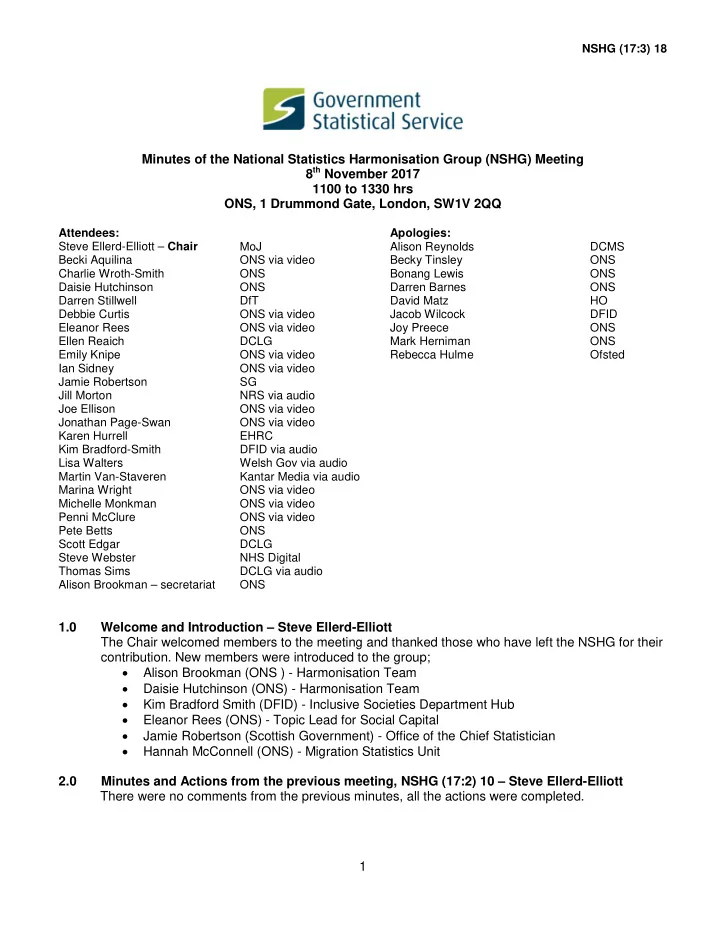
NSHG (17:3) 18 Minutes of the National Statistics Harmonisation Group (NSHG) Meeting 8 th November 2017 1100 to 1330 hrs ONS, 1 Drummond Gate, London, SW1V 2QQ Attendees: Apologies: Steve Ellerd-Elliott Chair MoJ Alison Reynolds DCMS


slide-1
SLIDE 1

NSHG (17:3) 18

1 Minutes of the National Statistics Harmonisation Group (NSHG) Meeting 8th November 2017 1100 to 1330 hrs ONS, 1 Drummond Gate, London, SW1V 2QQ

Attendees: Apologies: Steve Ellerd-Elliott – Chair MoJ Alison Reynolds DCMS Becki Aquilina ONS via video Becky Tinsley ONS Charlie Wroth-Smith ONS Bonang Lewis ONS Daisie Hutchinson ONS Darren Barnes ONS Darren Stillwell DfT David Matz HO Debbie Curtis ONS via video Jacob Wilcock DFID Eleanor Rees ONS via video Joy Preece ONS Ellen Reaich DCLG Mark Herniman ONS Emily Knipe ONS via video Rebecca Hulme Ofsted Ian Sidney ONS via video Jamie Robertson SG Jill Morton NRS via audio Joe Ellison ONS via video Jonathan Page-Swan ONS via video Karen Hurrell EHRC Kim Bradford-Smith DFID via audio Lisa Walters Welsh Gov via audio Martin Van-Staveren Kantar Media via audio Marina Wright ONS via video Michelle Monkman ONS via video Penni McClure ONS via video Pete Betts ONS Scott Edgar DCLG Steve Webster NHS Digital Thomas Sims DCLG via audio Alison Brookman – secretariat ONS

1.0 Welcome and Introduction – Steve Ellerd-Elliott The Chair welcomed members to the meeting and thanked those who have left the NSHG for their

  • contribution. New members were introduced to the group;
  • Alison Brookman (ONS ) - Harmonisation Team
  • Daisie Hutchinson (ONS) - Harmonisation Team
  • Kim Bradford Smith (DFID) - Inclusive Societies Department Hub
  • Eleanor Rees (ONS) - Topic Lead for Social Capital
  • Jamie Robertson (Scottish Government) - Office of the Chief Statistician
  • Hannah McConnell (ONS) - Migration Statistics Unit

2.0 Minutes and Actions from the previous meeting, NSHG (17:2) 10 – Steve Ellerd-Elliott There were no comments from the previous minutes, all the actions were completed.

slide-2
SLIDE 2

NSHG (17:3) 18

2 3.0 Update on Harmonisation Work a. Verbal Update, NSH SG / GSS SPSC Meeting Report – Steve Ellerd-Elliott The main points were:

  • NSH SG
  • the communication plan was discussed including what projects the Harmonisation

team should be involved in

  • the next meeting will take place on 17th January 2018
  • GSS SPSC
  • the last meeting was held on 27th October 2017- report to be circulated
  • the next GSS SPSC meeting will take place on 11 January 2018
  • The meeting included a ‘deep dive’ of the harmonisation programme led by Jen

Woolford (Chair of the National Statistics Harmonisation Steering Group). This focused on:

  • the importance and impact of harmonisation with special consideration to the

Digital Economy Act and the increase in data sharing opportunities were discussed

  • topic leads; do our topic leads need greater support from senior managers so

that they can have a greater influence? And what senior engagement exists and is there buy in within departments

  • updates to data systems within Government departments and the administrative data

systems in use:

  • we need to be more proactive and try to influence system changes when they

are being developed

  • it is recommended that the NSHG ensure participation at the earliest
  • pportunity, this may be achieved through developing relationships and

identifying opportunities for involvement; It is important that when members are able to participate at the early stages, that they are effective and facilitate the process where possible; being engaged with the IT development projects Action 1: Topic Leads to identify what support is needed from senior managers and inform the Harmonisation Team

  • Agreement that harmonising administrative data should be a high priority.

harmonisation should be integrated into the Government Data Service’s (GDS) Better use of data agenda

  • making sure they recognise what harmonisation means and where they slot in
  • Charlie has spoken to the GDS, talks have begun on how the NSHG can

influence their standards; GDS were keen and it is important to use this

  • ptimism to drive the necessary discussions
  • David Fry - adding a Harmonisation update to the NS Executive sub-committee group

update in January

  • John Pullinger will raise awareness at the senior management level and at the Analytical

Function Board

  • ‘Harmonisation by default’ as well as ‘digital by default’ to be encouraged
  • Julie Brown is due to take up her new post in December as head of Best Practice and

Impact (BPI) Division.

  • Focus in particular on:
  • harmonisation in a context of administrative data
  • identifying the challenges the Harmonisation Team have
slide-3
SLIDE 3

NSHG (17:3) 18

3

  • Data as a Service (DaaS) have commissioned some work on coherences and vacuity

across key administrative resources, it is an important resource we should access with relation to key sources used in statistics; Charlie is communicating with DaaS, the project

  • ffers a lot of value with regards to harmonising administrative data
  • b. NSHG (17:3) 11, Review of the NSHG Workplan – Becki Aquilina
  • ‘Social Capital’ has a new topic lead Eleanor Rees who is being supported by Dani Evans
  • ‘Consumer Durables’ requires a new lead
  • ‘Internet access’ is to become its own topic
  • previous agreement to no longer differentiate between primary and secondary principles;

this has now been completed across all documents within the harmonisation pages on the GSS website

  • attention drawn to the possibility of a harmonised language question
  • c. Verbal Update, Business Harmonisation – Ian Sidney

Ian presented his update and the following additional points were discussed: Update:

  • two Business Task & Finish Group Meetings have been held since the last NSHG
  • additional meetings with Northern Ireland & Scotland
  • collaborative work seems to be developing due to these meetings
  • currently two harmonised principles are being developed hope to be ready to circulate to

NSH SG for approval shortly:

  • 1. Value in change of stocks
  • 2. Capital acquisitions and disposals
  • d. NSHG (17:3) 12, Communications Plan – Becki Aquilina

Becki presented the Communication Plan.

  • members were asked to email Becki with communication tactics for 2018, the following

suggestions were raised:

  • open communication with other departments to prevent waste through ‘duplicated

processes’. Departments who ‘overlap’ with the NSHG include, for example:

  • liaising with local government and specific profession e.g GSR, reaching out to

GDS regarding their question development which often occurs in parallel with the NSHG’s work.

  • reaching out to data scientists
  • ‘Health and the NHS’ component of a recent meeting attended by Daisie, they have

reached out wishing to find out how harmonisation works and how we can facilitate the process

  • suggestion to use National Days, such as ‘National Disability Day’ to launch initiatives

and identify stakeholders ACTION 2 – Members to consider suggestions for communication ideas and platforms and inform the Harmonisation Team 4.0 Census Topic Update – Michelle Monkman on behalf of Helena Rosiecka

  • Michelle gave an overview of progress across the different census topics which are

possibly having revisions. These include potential new topics and the potential to simplify questions on existing topics

slide-4
SLIDE 4

NSHG (17:3) 18

4

  • ONS has yet to formulate its recommendations for the 2021 Census. Once it has done so

the Government will bring forward a White Paper which will include the census questions 5.0 Update on Scotland Census – Jill Morton

  • ‘Harmonisation agreement’ has been struck across the devolved nations
  • differences have been identified across Scottish surveys and those in England and Wales.

However these have been reviewed and vary for reasons of user needs and respondent understanding

  • testing of the Scottish census program to continue until March 2018
  • Jamie Robertson talked about the three large population surveys in Scotland and how

harmonised is apparent across these 6.0 NSHG (17:3) 13, Benefits and Tax Credits – Agreement of amended Principle - Thom Sims

  • Members were asked to review the document and agree the amendments, the proposed

revisions include changes to the name and qualifying period(s) of:

  • allowances/payments for Bereavement Allowance (formally Widows Pension),
  • Widowed Parents Allowance (formally Widowed Mothers Allowance)
  • Bereavement Support Allowance/Payment (formally Bereavement Allowance)
  • driven by changes to the Welfare system. As these are legislative changes it is not open to

interpretation.

  • The full amended harmonised principle will be sent to members for agreement via

correspondence

  • a query was raised regarding the introduction of the Universal Credit and how the

harmonised concepts capture the transition period. ACTION 3 – Becki to re-circulate documents to NSHG members for agreement to revised principle, providing two weeks to respond. If no objections are raised, the amendment will be agreed by NSHG and circulated to the NSH SG for final approval. 7.0 NSHG (17:3) 14, Homelessness - Agree the need - Ellen Reaich (DCLG)

  • members were asked to ‘Agree the Need’ for a new topic to be developed for

Homelessness

  • data collected to measure homelessness varies significantly, as do the sampling

approaches and the methods utilised

  • the definitions of the different type of ‘homelessness’ and the inclusion and exclusion are

different in each survey as well as in the academic literature and the legislation.

  • data gaps exist across the topic but in particular ‘rough sleeping’; for example; A&E intake

forms offer ‘no fixed abode’ while mental health approaches is more detailed and includes ‘suitable accommodation’ to capture those who live in sub-standard conditions

  • members agreed there is a need to develop harmonised questions for homelessness

ACTION 4 – Ellen with Daisie’s support to consider what administrative data is available for homelessness ACTION 5 – Ellen with Daisie’s support recruit members for the group from the Devolved Administrations ACTION 6 - Scott Edgar to refer members from the housing topic groups

slide-5
SLIDE 5

NSHG (17:3) 18

5 ACTION 7 – Ellen with Daisie’s support to contact Laura Keys from the Survey of Living Conditions (SLC) 8.0

NSHG (17:3) 15, Migration, Country of Birth and Citizenship - Agree definitions – Penni

McClure

  • members were asked to review the document and agree the definitions for Migration,

Country of Birth and Citizenship.

  • currently contains 26 target concepts, including ‘refugee’ which has been added as per

Home Office guidance.

  • members agreed the definitions presented
  • Becki to circulate documents to NSH Steering Group for final approval, once approved the

definitions will be disseminated across the GSS

  • Penni will be replaced by a new topic lead whilst she is on maternity leave – post meeting

note, this will be Hannah McConnell (ONS) ACTION 8 – Becki to circulate the agreed principles to the NSH SG for final approval of the definitions 9.0

NSHG (17:3) 16, Internet Access – Agree the need for revision – Daisie Hutchinson (ONS)

  • members were asked to review the document and agree the need for the current principle

to be revised. It is proposed that the current harmonised concept is currently out of date and has been removed from the list of available harmonised Principles on the GSS website; mode of access in particular does not account for the newer technologies available. Also the time frames provided as response options are no longer precise enough considering the current use of the internet in work and social activities.

  • Grant Blank from Oxford University has been approached to provide topic expertise ; his

department has three large internet related surveys

  • topic group representatives have been identified and met this month, a second meeting is

planned for December. Due to the varying user need, survey size and topics included,

  • it has been suggested that attendees bring to the next meet approximately a dozen

questions that are ‘key’ from their perspective

  • it is necessary to ensure that this topic group contains representatives from the

Devolved Administrations

  • members agreed there is a need to revise the current harmonised Principle
  • Becki to circulate relevant documents to NSH Steering Group for final approval to

amend the current principle for Internet Access

  • once the principles have been revised and agreed by the topic group, the relevant

documents are to be brought back to the NSHG for agreement ACTION 9 – Daisie to revise Internet Access questions with the Topic Group documents to be brought to the NSHG in a future meeting for agreement. ACTION 10 – Daisie to ensure that a government department takes ownership for internet Access harmonised principle – potentially DCMS 10.0 NSHG (17:3) 17, NSHG Topic Lead Updates – Topic Group Leads The Chair thanked the topic leads for their reports. Benefits and Tax Credits – Thom Sims Thom presented a report and there were no further comments or questions.

slide-6
SLIDE 6

NSHG (17:3) 18

6 Consumer Durables New topic lead is being sought. Crime and Anti-Social Behaviour – Fiona Aitchison A revised set of questions possibly to be submitted for the March 2018 NSHG meeting. Demographic Information – Emily Knipe Consultations to be completed regarding the inclusion of same sex marriage; these will include focus groups and opinion testing. Economic Activity – Debbie Curtis Debbie Curtis is likely to be the new topic lead. Euro standards have changed, several meetings planned to discuss the changes and how they relate to Harmonisation. Education – Julian Austin/Tony Clarke Continued liaison with Census Topic Group for education for update on research and testing of qualification questions for 2021 Census and coherence with the principal EILR – Becki Aquilina (temp) Harmonisation team researching whether there is a user need for developing a harmonised language principle. If a user need is established then the proposed new harmonised principle for language will be brought to the next NSHG for ‘agree the need’ step of the Harmonisation Process. Gender Identity – Michelle Monkman Workshop with data users to test the current questions. This report will be circulated when

  • appropriate. Census update is due shortly.

Health, Disability and Carers – Steve Webster Next topic group meeting is planned for January. Housing and Tenure – Scott Edgar Proposed use of ‘leasehold tenure’ to resolve issues in the current question. Revised questions will be brought to the group and a paper presented when appropriate. Income – Mathew Minifie There was nothing to report for this period. Migration, Country of Birth and Citizenship – Penni McClure Penni presented a report and there were no further comments or questions. Pensions – Bonnie Lewis There was nothing to report for this period. Personal Well-being – Matthew Steel There was nothing to report for this period. Social Capital – Eleanor Rees Due to the lack of established harmonisation principles for Social Capital other users have taken

  • n the task, for example, Scotland has created their own but is willing to contribute to the review

and update of the existing principle. Dani Evans to take over as the new lead due to Eleanor’s

slide-7
SLIDE 7

NSHG (17:3) 18

7 maternity leave early next year, however to allow a smooth transition Dani is to be involved in the topic with immediate effect. 10.0 Any Other Business

  • Karen Hurrell wished to raise awareness of a newly published EHRC framework which

identifies a set of measures for equality and human rights.

  • Steve Ellerd-Elliott discussed the Race Disparity Audit and publication of the Ethnicity facts

and figures (https://www.ethnicity-facts-figures.service.gov.uk/). The content is being reviewed and we will monitor for potential harmonisation issues. 11.0 Next Meetings Date of the next meetings is:

  • 12th March 2018, 1100 to 1330 hrs at ONS Drummond Gate

ACTIONS 11 – Members are requested to let the Secretariat (harmonisation@ons.gov.uk) know if they have any items for inclusion on the agenda for the next NSHG meeting Annexes: A. List of Actions B. Presentation Slides

slide-8
SLIDE 8

NSHG (17:3) 18

8 ANNEX A ACTIONS FROM THE NSHG MEETING – 8 November 2017 No Para Action Responsible Status

1 3.0 Topic Leads to identify what support is need and inform the Harmonisation Team. Topic Leads 2 3.0 Members to consider suggestions for communication ideas and platforms and inform the Harmonisation Team (harmonisation@ons.gov.uk). All Members 3 6.0 Becki to re-circulate documents to NSHG members for agreement to revised principle, providing two weeks to

  • respond. If no objections are raised, the amendment will be

agreed by NSHG and circulated to the NSH SG for final approval. Becki Aquilina Complete 4 7.0 Ellen with Daisie’s support to consider what administrative data is available for homelessness. Ellen Reaich & Daisie Hutchinson 5 7.0 Ellen with Daisie’s support to recruit members for the group from the Devolved Administrations. Ellen Reaich & Daisie Hutchinson 6 7.0 Scott Edgar to refer members from the housing topic groups. Scott Edgar 7 7.0 Ellen with Daisie’s support contact Laura Keys from the Survey of Living Conditions (SLC). Ellen Reaich & Daisie Hutchinson 8 8.0 Becki to circulate the agreed principles to the NSH SG for final approval of the definitions for Migration, Country of Birth and Citizenship. Becki Aquilina 9 9.0 Daisie to revise Internet Access questions with the Topic

  • Group. Documents to be brought to the NSHG in a future

meeting for agreement. Daisie Hutchinson 10 9.0 Daisie to ensure that a government department takes

  • wnership for the Internet Access harmonised principle –

potentially DCMS. Daisie Hutchinson 11 11.0 Members are requested to let the Secretariat know if they have any items for inclusion on the agenda for the next NSHG meeting. All Members

slide-9
SLIDE 9

NSHG (17:3) 18

9 ANNEX B

slide-10
SLIDE 10

Harmonised Principle: Internet Access

slide-11
SLIDE 11

Harmonisation Process

Stage B: Agree the Need:

  • Harmonised Principle is out of date
  • Principle needs to be revised
  • See template: Agree the need for revision
slide-12
SLIDE 12

Background

  • Internet Access topic is out of date and needs renewing:

DCMS inquired about an updated Harmonised Principle for internet access

  • Topic Group has been formed
  • Topic Expert has been found (Grant Blank)
  • First topic group meeting held: 18th October 2017
  • Discussions regarding the need for harmonisation were

discussed and possible challenges that need to be overcome.

  • Second meeting has been scheduled for the 1st December 2017
slide-13
SLIDE 13

S takeholders

  • 1. Living Costs and Food Survey (ONS)
  • 2. Family Resource Survey (ONS)
  • 3. Labour Force Survey (ONS)
  • 4. Taking Part Survey (Department for Culture Media and Sport)
  • 5. British Social Attitudes Survey (BSA)
  • 6. Oxford Internet Survey (Oxford Internet Institute)
  • 7. Eurostat Recommendations
  • 8. BEIS Business Surveys (Department for Business, Energy and

Industrial Strategy)

  • 9. Financial Capability Survey (Money Supermarket)
slide-14
SLIDE 14

Outcome from TG Meeting

  • There is a need for harmonisation as there are many surveys

asking internet access questions

  • Looking at higher level questions that all surveys will be able

to use

  • Possibility of lower level questions that can be taken for use in

required

  • Topic group members are now formulating a list of core

questions for each survey which will be discussed at the next meeting

slide-15
SLIDE 15

Timeline for Principle

There is not a specific timeline in mind, however, it is not expected that the principle will take that long to develop as it is not too complex. Below is a rough guide of the process: Nov 17: NSHG agreement for principle to be developed NSH SG approval for principle to be developed (correspondence) Dec 17: Next topic group meeting Start the development of the revised principle Use current questions as a starting point for revision Jan 17: Hold a third topic group meeting Discuss high and low level questions Discuss any challenges March/ April 18: Create the revised set of internet access questions Take to NSHG for agreement of revised harmonised principle

slide-16
SLIDE 16

Potential Harmonised Principle: Homelessness

slide-17
SLIDE 17

Harmonised Process

Stage A: Establish the Need:

  • DCLG enquired about developing a Harmonised Principle for

Homelessness

  • Starting at the very initial stage to understand if there is even

a need for a Harmonised Principle on Homelessness

  • See template A: Establish the Need
slide-18
SLIDE 18

Background

  • The Harmonisation Team have been working with DCLG to

establish whether there is the need to create a Harmonised Principle for Homelessness

  • Initial meeting to understand the purpose of creating a

Harmonised Principle (Sept 17)

  • Topic Expert found (Ellen Reaich, DCLG)
  • Establish the need meeting to discuss stakeholders and

benefits of creating a Harmonised Principle (Oct 17)

  • Template A: Establish the need has been created and ready for

the NSHG

slide-19
SLIDE 19

Potential S takeholders

  • 1. Department for Communities and Local Government
  • 2. Ministry of Justice
  • 3. Pathways
  • 4. Homeless Link
  • 5. Home Office
  • 6. Public Health England
  • 7. Department for Health
  • 8. Department for Education
  • 9. Department for Work and Pensions
slide-20
SLIDE 20

Next S teps

1. Gain agreement from the NSHG 2. Gain approval from the NSH SG via correspondence 3. Form topic group with homelessness stakeholders 4. Identify the need for homelessness as a Harmonised Principle 5. Create template B: Agree the Need 6. Take template B to NSHG

slide-21
SLIDE 21

Timeline

There is a rough timeline in mind, however this can be altered with unexpected: Nov 17: NSHG agreement for establish the need NSH SG approval for establish the need (correspondence) Dec 17: Begin formulating topic group members Create a list of stakeholders Jan 18: Hold the first topic group meeting Set out challenges and next steps March 18: Begin developing principle