
SLIDE 1
The leading video entertainment platform in Africa
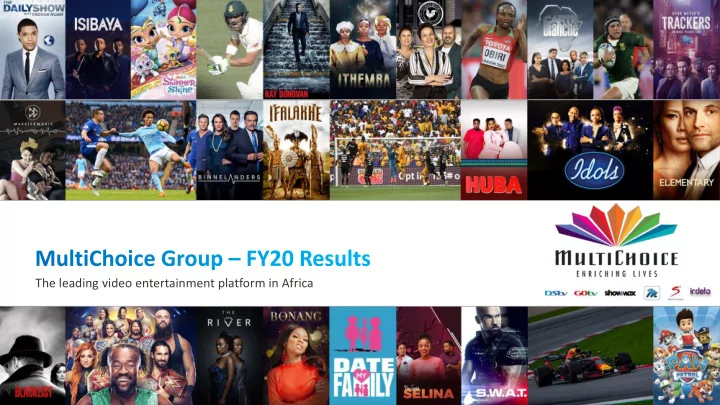
The leading video entertainment platform in Africa 1 Overview 2 - - PowerPoint PPT Presentation
The leading video entertainment platform in Africa 1 Overview 2 Strategic update 3 Operational update 4 Financials 5 COVID-19 update and outlook 2 Delivered on our FY20 commitments to shareholders FY20 Commitments FY20 Highlights
The leading video entertainment platform in Africa
2
Strategic update Operational update Financials Overview
COVID-19 update and outlook
3
FY20 Commitments FY20 Highlights
Note: Refer to Glossary of terms page for explanation of acronyms (1) Based on 90-day active subscribers, defined as all subscribers that have an active primary/principal subscription within the 90-day period on or before reporting date (2) Transaction whereby shareholders in Phuthuma Nathi were given the option to exchange up to 20% of their shares in Phuthuma Nathi for shares in MCG at a defined exchange ratio. The offer closed on 28 October 2019
Drive subscriber growth Deliver solid financials Invest more in local content Optimise cost base Shareholder alignment
Increased subscriber base(1) by 5% YoY to 19.5m 39% YoY growth in monthly active Connected Video (OTT) users Achieved solid growth despite tough environment in many markets Revenue up 3% YoY to R51.4bn; Trading profit up 14% YoY to R8.0bn; 2pp margin expansion Core headline earnings up 38% YoY to R2.5bn (+57% excluding PN minority impact) Free cash flow up 59% to R5.2bn Produced 3 850 additional hours of local content Local content library now exceeds 56 800 hours Local content accounted for 40% of total GE content spend (41% in constant currency) Delivered annual cost savings of R1.4bn Achieved 5pp positive operating leverage (growth in revenue > growth in costs) Reduced losses in RoA by 22% (47% organically) Completed PN ‘flip-up’ transaction(2) (MCG now owns 76.4% of MCSA) Declared R2.5bn maiden dividend Share buy-back programme returned an additional R1.7bn to shareholders Revised remuneration policy (with shareholder input) to be tabled at AGM
4
5
1985 1996 2005 M-Net launches as single channel 1994 SuperSport channel added to fold DStv launches, aggregates channels from around the world First PVR decoder launched Showmax launched and integrated into Explora DStv Now launched
“I will pay for better quality content” “I want more variety content” “I want the best local and global content in a single place” “I want to watch my shows on my
“Let me binge watch at my leisure” “I want to watch anytime, anywhere” “There is too much content in too many places. Help me consolidate it”
Customer need addressed 2014 2015 2020
Our innovation journey
Extension of aggregator strategy…
6
Leading platform in Africa
Access to 19.5m subscribers across the continent
Tech capabilities
Trusted to successfully integrate and protect partner content
Operational expertise
Tailored approach to cater for Africa’s unique business environment
We are an attractive partner given our:
Customers to benefit from increased access to different content in a convenient way
… …
7
Source: Omdia Informer (1) Western Europe includes Austria, Belgium, Cyprus, Denmark, Finland, France, Germany, Greece, Ireland, Italy, Netherlands, Norway, Portugal, Spain, Sweden, Switzerland and UK
Varying pay-TV growth trends globally Pay-TV has been growing in Africa Penetration rates suggest upside
2%
US UK Germany Spain
Change in pay-TV penetration: 2017-2019 Change in Africa pay-TV penetration: 2017-2019 Pay-TV penetration (% of TV households)
42% 33% 22% 20% 15% 71% 67% 66% 56% 39% US CEE Asia Pacific WE LatAm 1% 4% 2% 4% 8%
(1)
8
OTT penetration levels in Africa low at present New technologies will be adopted
SVOD overlaps with our core focus and represents a good opportunity
Current OTT penetration (% of TV households) % overlap between pay-TV and/or SVOD
4% 82% 69% 39% 37% 34% Latin America Sub- Saharan Africa North America Asia Pacific Eastern Europe Western Europe Sub-Saharan Africa North America
2019
Sub-Saharan Africa North America
2025
2G 5G 3G 4G
% of connections with:
0% 10% 20% 30% 40% 50% 60% 70% 80% 90% 100% France UK Global avg SA USA
SVOD Only Pay-TV/Pay-TV + SVOD
Graphic 1 (from left to right): Source: Digital TV Research Graphic 2: Source: GSMA The Mobile Economy 2019 Graphic 3: Based on 33 000 respondents in 16 markets. Q1 2019. All television service combinations may include free TV Source: Ampere Consumer
9
Source: MCG internal calculations, Digital TV Research
Growing linear business Emerging OTT
Pay-TV OTT Our target addressable market: 2023
Paid video entertainment services
19.5m (FY20)
MCG subs
OTT
Pay-TV
10
Leverage scale and enhance ecosystem
Lead in content; differentiate in local and sport Drive growth and retention Accelerate OTT capabilities Maintain operational excellence & cost reduction Pursue global digital platform security leadership
11
Lead in content; differentiate in local and sport Leverage scale and enhance ecosystem Maintain operational excellence & cost reduction Accelerate OTT capabilities Drive growth and retention Pursue global digital platform security leadership
Hours of local content produced
Signed distribution deals with 2 SVOD providers
Net 90-day active subscriber additions
YoY growth in active users
Cost savings Tier-1 customer wins from competitors (in past 2 years)
12
13
(1) Changed methodology to exclude advertising minutes and dubbed content. Restating the FY19 number on this basis would equate to 4 050 hours as opposed to 4 600 disclosed before. Decrease YoY driven by change in content utilisation strategy (2) GE content spend refers to general entertainment content spend, excluding sport. This number has remained at 40% due to FX impact on international GE costs – in constant currency would have been 41%
Hours of local content produced(1)
Total hours in content library
Local content as % of GE content spend(2)
FY20 highlights FY21 pipeline
Local content continues to drive audiences Produced 28 local dramas, 13 telenovelas and 17 comedies Launched new proprietary reality formats Success with local scripted series New local channels launched 4 new local content channels to be launched 2 new co-productions
Substantial ramp up in local content production
Trackers: 1st local co-production
FY20 shows, including Game
+ Numerous FTAs Owned Third-party
Agreement to co-own reality format “Love in the Wild” with an international format developer
Local content share
minutes Local content share
minutes
22% 24% 32% 38% +14% FY20 FY19
Better leveraging of local content
Launched localised version
The River in Kenya
Rolled out in Uganda
10 countries with dedicated local channels FY20 FY22
14
FY20 highlights FY21 pipeline
Live events broadcast
Productions annually
Broadcasted 3 major sporting events Acquired majority interest in School Sport Live to target youth audience 21 new channels launched Launched permanent WWE channel Improved sport content discovery 3rd party channels increase local content offerings Created 6 pop-up channels Fresh series and movies Launch of action movie channel Enhancements to digital properties (e.g. SuperSport app) Curation of #RELIVE content until live sport resumes
Sport International
15
(1) Based on 90-day active subscribers, defined as all subscribers that have an active primary/principal subscription within the 90-day period on or before reporting date
Driving growth Improve retention Maintain operational excellence
despite tough environment
drove upgrades from Compact bouquet to Compact Plus
bouquet with wider variety of content drove healthy growth
model by leveraging more digital properties in addition to linear
strategy: targeted offers, incentives
through active promotion of VAS
all bouquets
box sets, additional movies and 30% more content
ecosystem:
Streaming product
Amazon to integrate service onto new Explora decoder
service and DStv App – self service channels now field 66% of customer interactions
decoder (30% lower cost), decoder accessory cost-down, contract renewals and tight cost control
triggered lower call volumes
business: Discontinued minor bouquets and closed VAST business, after unsuccessful attempts to turn around
16
302 290 Blended 82 292 594 88 298 588 Mass market Premium Mid market 3.5 4.0 2.9 2.9 1.6 1.5 FY19 FY20 8.0 8.4
+6%
44% 48% 36% 34% 20% 18% FY20 FY19
Subscriber base (m): 90-day active(1)
290 284 FY19 FY20
Key ARPU drivers Active days(4) Subscriber mix Price increases(3)
0% 16%
FY19 FY20 FY21 Premium 2.7% 0.3% 1.4% Mid 5.5% 3.6% 0% Mass 0.6% 5.2% 4.2%
Mix shift to mass market +7% +2%
FY20 FY19 Premium(2) Mid market(2) Mass market(2)
(2)
Premium(2) Mid market(2) Mass market(2)
(2) (2)
ARPU(5) (ZAR per month)
(1) Defined as all subscribers that have an active primary/principal subscription within the 90-day period on or before reporting date. Note: our primary metric for reporting subscribers has changed effective 1 April 2019 from active at the reporting date to 90-day active (2) Premium includes Premium and Compact Plus bouquets; mid market includes Compact and Commercial bouquets and mass market includes Family, Access and Easyview bouquets (3) Price increases represent the weighted average increase per segment, based on the number of subscribers at the effective date of the increase (1 April of each year) (4) Active days considers all subscribers that were active at any point in the last 12 months, and measures the average number of days that the subscribers were active in the period out of the total days they could potentially have been active (5) ARPU calculated by dividing average monthly subscription fee revenue for the period by the average number of 90-day active subscribers at the beginning and at the end of the period
17
Improve retention Maintain operational excellence
Maisha Magic Plus in Kenya
campaign in Q4 FY20:
increased reconnections and improved activity by offering free upgrade to the next tiered bouquet
rewards program in 7 markets, available to customers paying accounts on time
decoder (30% lower cost)
11 markets, with >4m downloads and 1.3m monthly active users
self-service to 12 markets
website functionality (login, payments, voting, design etc.)
centre system enabled remote customer service
solutions in major markets
4% YoY (1) in challenging conditions
achieved higher growth than any of preceding eight years
Mozambique) triggered upgrades by ~60% of Access bouquet customers
(3 DStv, 2 GOtv) enhanced local positioning; will be migrating customers to new packs in early FY21
Drive growth
(1) Based on 90-day active subscribers, defined as all subscribers that have an active primary/principal subscription within the 90-day period on or before reporting date
18
(1) Based on 90-day active subscribers, defined as all subscribers that have an active primary/principal subscription within the 90-day period on or before reporting date (2) Based on active subscribers, defined as all subscribers that have an active primary/principal subscription on the reporting date (or day of measurement)
Nigeria Kenya Zambia Angola Zimbabwe Successes Challenges
in subscription revenues
1H FY21 migration will drive movement to higher price points YoY subscriber growth(1)
8% 0%
increases totalling 38% and 9% VAT increase
in FY20, negligible cash in-country at present
fully compensated by subscriber growth
(excl. GOtv Lite)
government employees + food and travel inflation = negative impact on consumer spend
currency weakness
bottom end of DTT market (GOtv Lite) negatively affecting
(~18 hrs/day) drove 104k(1) disconnects YoY
depreciation (-47% YoY)
environment mainly due to low oil price
mainly due to general economic collapse:
active and contributing to RoA fixed cost base
relief to power outages
Nov lows, at peak of power crisis
for hydro power supply
19
78% FY19 FY20 80% 114 110 Blended 56 197 477 57 196 417 Premium Mass market Mid market
Subscriber base (m) – 90-day active(1) Key ARPU drivers Active days(5) Subscriber mix Price changes (FY20)(4) ARPU(6) (ZAR per month)
Premium 0% 39%
Mid 0% 39%
Mass 0% 36%
190 FY19 FY20 179
Premium(3) Mid market(3) Mass market(3)
(3)
Premium(3) Mid market(3) Mass market(3)
(3) (3)
FY20 FY19 11% 9% 11% 11%
(1) Defined as all subscribers that have an active primary/principal subscription within the 90-day period on or before reporting date. Note: our primary metric for reporting subscribers has changed effective 1 April 2019 from active at the reporting date to 90-day active (2) FY20 subscriber numbers and ARPU by segment have been normalised for the impact of the #DStvStepUp campaign, which provided customers with free upgrades. Segmental ARPU growth rates reflected in brackets are also normalised for the impact of the campaign (3) Premium includes Premium and Compact Plus bouquets; mid market includes Compact and Commercial bouquets and mass market includes Family, Access, Lite, GOtv Max, GOtv Plus, GOtv Value and GOtv Lite bouquets (4) Price changes reflect the weighted average local currency price increases per segment until 31 March 2020. These occurred at various dates throughout FY20 (5) Active days considers all subscribers that were active at any point in the last 12 months, and measures the average number of days that the subscribers were active in the period out of the total days they could potentially have been active (6) ARPU calculated by dividing average monthly subscription fee revenue for the period by the average number of 90-day active subscribers at the beginning and at the end of the period
8.7 8.9 1.2 1.2 1.2 1.0 1.2 1.0 11.1 FY20 8.4 FY19 FY20 normalised 10.6 11.1
+4%
1% 3% 23%
5% 6%
(2)
+2% (1%2)
20
Strategic objectives
paying subs after stepping up performance marketing
enhancements to customer conversion process
More users Watching more often For longer
+39% YoY
monthly active users(1)
+85% YoY
play events(2)
+18% YoY
average hours watched(3)
Operational update
(1) Measured as at 31 March YoY (2) Measured as the total play events for FY20 vs FY19 (3) Measured as the 3-month moving average at 31 March YoY. YoY increase relates to Showmax viewership only as DStv Now data for comparative period not available
component of Showmax
boasts >50% local content
strong performance
average ratings improved to 4.4 stars from 2.2 last year
Showmax offering in South Africa (previously available in Kenya and Nigeria only)
~20% of Showmax net additions
FY19 FY20
Paying subs YoY
Showmax Kids section (content curated per age bracket, kids profiles and parental control added)
Capturing growth opportunity Leveraging local content assets New product launches Tech enhancements
21
Media security services:
Increased market share
now 2nd largest global provider by volume 3 customers in Asia launched Irdeto-secured Android boxes in 2H FY20 3 long-term agreements for
sports OTT security
(DRM) gaining traction
Growing new revenue contribution
FY20 sees
record volumes
for software CA and internet video products
Critical services to MCG
accounts for 50% of Irdeto revenues
FY20 14% FY19 13%
New service lines
FY20 28% 66% 72% FY19 34%
Traditional broadcasting Well positioned to cater for
emerging trends Another long-term win
with one of world’s largest automotive suppliers Now have 2 agreements with major OEMs (one in production)
Also increased investment in SafeRide Technologies
2 new offerings launched Trusted home
securing home IP environment
Connected heath
medical devices and monitoring systems Some of our customers:
22
23
Modest revenue growth in challenging conditions Tight cost control underpins margin expansion Substantial growth in free cash flow Strong balance sheet to weather uncertainties Healthy momentum in core headline earnings
24
(1) Percentages reflect year-on-year growth. Numbers in brackets represent year-on-year organic growth (in constant currency, excluding M&A) on a like-for-like basis (2) Percentage reflects year-on-year growth. Number in brackets represents year-on-year growth in core headline earnings on a like-for-like basis, i.e. excluding the impact of the additional 5% allocated to the PN shareholders in March 2019 (3) Free cash flow defined as trading profit + depreciation & amortisation + non-cash adjustments – change in net working capital – cash taxes – capex – transponder lease repayments (including interest) – the capital portion of all other lease repayments
3.3 5.2 FY20 FY19
Revenue (ZARbn)(1) Core headline earnings (ZARbn)(2) Free cash flow (ZARbn)(1,3) Trading profit (ZARbn)(1)
3% (2%) 14% (29%) 59% 50.1 51.4 FY19 FY20 7.0 8.0 FY20 FY19 1.8 2.5 FY19 FY20 38% (57%)
25
27.7 28.4 13.5 14.3 FY19 FY20 42.8 41.2
+4% (3%)
8.0 8.4 10.6 11.1 18.6 FY19 FY20 19.5
+5%
90-day active subscribers (m)(1)
(1) Defined as all subscribers that have an active primary/principal subscription within the 90-day period on or before reporting date. Note: our primary metric for reporting subscribers has changed effective 1 April 2019 from active at the reporting date to 90-day active (2) Percentages reflect year-on-year growth. Numbers in brackets represent year-on-year organic growth (in constant currency, excluding M&A) on a like-for-like basis
6% 4%
South Africa Rest of Africa Group
more modest growth than prior years
lockdowns too late in March to translate into meaningful revenue growth South Africa
YoY, partially offset by mass market price increases and subscriber growth Rest of Africa
power interruptions in Zimbabwe and Zambia
prices in Nigeria, price downs in East Africa and price increases in Angola, Zambia and Ghana
resulted in a higher comparative base
Subscription revenue (ZARbn)(2)
3% 6%
South Africa Rest of Africa
26
33.7 34.2 14.8 15.5 FY19 FY20 50.1 51.4
+3% (2%)
3.2 3.7 41.2 3.2 FY20 50.1 FY19 4.1 42.8 51.4
+3% (2%)
Revenue by type (ZARbn)(1)
(1) Percentages reflect year-on-year growth. Numbers in brackets represent year-on-year organic growth (in constant currency, excluding M&A) on a like-for-like basis (2) Other revenue includes gross set-top box decoder sales, installation fees, licensing and production revenue and reconnection fees
Revenue by business segment (ZARbn)(1)
1% 4% 12% 4% 1%
Technology
US$8m once-off project revenue in 1H
media security revenues due to weaker US pay-TV performance in 2H
(inter-group revenue of R1.8bn eliminated upon consolidation) Advertising revenues
prior year event-related revenue, offset by solid growth in RoA off low base Other
hardware sales in both SA (macro environment) and RoA (non-recurring FWC)
financial difficulties at the South African public broadcaster, offset by other sub- licensing revenues Subscription fees Advertising Other (2) South Africa Rest of Africa Technology
12%
Technology 1.8 1.8 1.6 1.6
27
(1) Represents year-on-year organic growth (in constant currency, excluding M&A) on a like-for-like basis
6% 2% 2%
933 772 318 686 FY18 518 513 FY19 FY20 1 004 1 290 1 446
Operating leverage (organic)(1) Cost savings (ZARm)
Revenue growth Opex growth FY19 FY20
leverage given tough macro environment
consolidated supply and lower unit costs
costs, and renegotiation of contracts
year restructures in various divisions
programmes, reduction in consultant spend (bringing in- house), contract renegotiations etc.
business
place for FY21 to counter uncertainty and potential business impact of COVID-19
+4% +5%
Fixed Variable
3%
% of cost base
3% 2%
28
10 199
550 10 259
690 South Africa Rest of Africa Technology
Group trading profit (ZARm)
(1) Percentages reflect year-on-year growth. Numbers in brackets represent year-on-year organic growth (in constant currency, excluding M&A) on a like-for-like basis (2) Segmental trading margin calculated based on external revenue
Trading profit by business segment (ZARm)
30% 30%
39% 35%
Margin(2) (%) FY19 7 014 FY20 8 028
+14% (+29%)
16% 14%
Margin (%)
(1)
FY19 FY20 South Africa
events during the year (i.e. Cricket World Cup, Rugby World Cup and AFCON)
Video (engineering capacity previously funded by Naspers, performance marketing, expansion into new markets and product enhancements) Rest of Africa
expansion through R814m (R1.8bn organic) in reduced losses Technology
momentum, combined with focus on costs
29
(3 735) (1 966) (2 921) (334) (955) 560 974 569
RoA trading loss bridge (FY19 – FY20, ZARm)
Uncontrollable subscriber losses(1) Trading loss FY19 FX Subscriber wins Trading loss FY20
R334m drag on profitability due to uncontrollable subscriber losses in Zambia and Zimbabwe (electricity crisis and general macro-economic collapse in Zimbabwe)
(relative to USD) trimmed improvement to 22% YoY:
currency decline YoY
currency decline YoY
R213m, spread across various markets
RoA business from USD to ZAR for reporting purposes (ZAR 8% weaker)
normal currency depreciation; hedging of remittances (12-13 months out) provide certainty for FY21
Organic trading loss FY20(3)
22% 47%
YoY change vs prior year reported loss (%)
Other savings Net savings in event-dependent costs(2)
(1) Relates to loss of subscribers in Zimbabwe and Zambia driven by electricity crisis and general economic collapse in Zimbabwe (2) Including FIFA World Cup investment in subsidy, marketing and content costs of R734m in prior year (3) Excludes the impact of FX depreciation
30
FY19 FY20 FY20 ex-PN gift 1 800 2 477 2 827
+38%
Core headline earnings (ZARm)
+57%
Contribution to core headline earnings (ZARm)
3.6% increase in minority shareholding in profitable MCSA (i.e. additional 5% allocation to PN as part of MCG unbundling, offset by a 1.4% reduction in PN shareholding due to “Flip Up” transaction(1))
now 76.4% (since October 2019)
segments amounted to R677m:
normalised basis, driven by realised FX gains
strong operating performance FY19 FY20
(1) “Flip Up” transaction wherein PN shareholders were given the opportunity to exchange up to 20% of their share in PN for shares in MCG at a defined exchange ratio
South Africa Rest of Africa Technology 5 860 5 900 6 250 +1%
427
543 +12% +27% +7% FY20 ex-PN gift
31
FY19 3 267 FY20 5 184
+59%
Free cash flow (ZARm)(1) Free cash flow reconciliation: FY19 – FY20 (ZARm)(1)
3 267 (815) 1 251 2 196 (571) (144) 5 184
Free cash flow FY19 Angola cash extraction in PY(2) Cash EBITDA increase Other(3) Free cash flow FY20
improved operating performance
depending on the timing of events and content rights payments
extraction from Angola in prior year
lease repayments largely due to the end of payment holiday on SA satellite from October 2019 (R309m) and FX impact on payments
averages due to non-recurring licensing and DTT transmission spend in the prior year. Includes a R180m investment as part of a multi-year programme to futureproof the group’s customer service, billing and data capabilities
(1) Free cash flow defined as trading profit + depreciation & amortisation + non-cash adjustments – change in net working capital – cash taxes – capex – transponder lease repayments (including interest) – the capital portion of all other lease repayments (2) Angola was converted from an agency to a subsidiary in Feb 2019 and is now consolidated (i.e. cash remittances no longer occur through working capital) (3) Relates largely to capex savings, offset by increased tax payments in current year
Lease repayments Working capital management
32
Liquidity position: FY20
(FY19: R6.7bn) Cash position
(FY19: R3.5bn) Undrawn facilities
Planned cash commitments
Remaining liquidity
Total available funds
MCG year-end dividend
Settlement of PN dividend
33
34
R118M FINANCIAL RELIEF
to safeguard local production industry Paid salaries of cast, crew, and creatives for March and April (R94m), also guaranteed the incomes of SuperSport freelancers (R24m)
TRAVEL BANS
Instituted from end January, and restriction on suppliers coming on site
SPORT REMOTE WORKING
Commenced on 17 March before measures were set in place nationally
TV BROADCASTING
Our business remains operational and essential staff in the playout and call centres continue work on premises during lock down
HYGIENE SAFEGUARDING
Onsite nurses, thermal scanning of staff, social distancing measures, masks and gloves distributed and Uber transport
CONTENT PEOPLE COMMUNITY
cancellation of live sport
already back with others (e.g. football) recommencing in June/July
pay” clauses
channels to keep customers entertained
sporting events in history, live in-studio discussions with celebrated guests, greatest sport movies of all times
lockdown conditions in SA
shows recommenced with easing of lockdown restrictions as SA moved to L4 (e.g. The River, Gomora and Isibaya)
postponement of production
freely available to public
more customers at no additional costs
channels across SA and RoA
BoxOffice, free movies
LOCAL CONTENT GENERAL ENTERTAINMENT R43M DONATION OF PPE
Supported public health efforts by teaming up with two of SA’s leading football teams (Kaizer Chiefs and Orlando Pirates), to donate personal protective equipment (R28m) Also made R15m donations in some
ONLINE LEARNING
Launched various online learning
35
POSITIVE FACTORS
NEGATIVE FACTORS
SUBSCRIBER BASE
RETURN OF LIVE SPORT
OTT SERVICES
DIGITAL CARE
adoption SUBSCRIBER MIX
disruptions (e.g. live sport) and consumer pressure COMMERCIAL
restrictions
impact
ADVERTISING
programming and postponement of others (timing impact)
36
83% 11% 6% Subscription revenue Other revenue Advertising revenue
Robust business model
low reliance on advertising
Scale and diversity
large diverse customer base and footprint
Sought after product
as people spend more time at home
Implications of COVID-19 uncertain and uncontrollable, but…
Strong balance sheet
security to weather the macro storm
(+R5bn in undrawn facilities) Cash position
We are pursuing an accelerated cost savings programme to counter potential impact
Content negotiations Set-top box subsidies Contract renegotiations, efficiencies from digitisation, reduced travel costs, etc.
37
Lead in content; differentiate in local and sport Leverage scale and enhance ecosystem Maintain operational excellence & cost reduction Accelerate OTT capabilities Drive growth and retention Pursue global digital platform security leadership
Substantial ramp up in local content production Maintain and grow subscriber base in context of challenging consumer environment Pursue new product opportunities; complete integration of 3rd party OTT services onto Explora decoder Continue to drive Showmax paying subscriber base; launch DStv Streaming product Strategic programmes to enhance critical systems and AI capabilities, coupled with rigorous cost saving agenda Focus on new customer wins and progress in connected industries
38
Dividend (FY20)
Opportunistic repurchases through share buy-back programme
(10.1m shares) Total yield (1) Share buy-backs to fund share scheme
(5.5m shares)
Honouring our FY20 commitment …plus additional value delivered Looking ahead 565c per share Committed to paying dividends Highly cash-generative business Prudent to not make specific commitments for FY21 $ …But in these extra-ordinary circumstances
(1) Total yield includes value of dividend and share buy-backs. Market cap based on MCG share price of ZAR87.00 as at closing on 1 June 2020
39
40
7.4 7.9 7.7 7.8 FY19 FY20 15.7 15.1
+4%
8.0 8.4 10.6 11.1 FY19 FY20 18.6 19.5
+5%
322 159 241 South Africa Rest of Africa Blended 309 154 231
(1) Refers to active subscribers, i.e. all subscribers that were active on the measurement day (i.e. at a point in time) (2) Defined as all subscribers that have an active primary/principal subscription within the 90-day period on or before reporting date. This provides a better reflection of the activity on our base (3) ARPU calculated by dividing average monthly subscription fee revenue for the year by the average number of subscribers at the beginning and at the end of the year
Previous basis: Active at reporting date(1) Current basis: 90-day active(2)
Subscribers (m)(1) ARPU (ZAR per month)(3), FY19 vs FY20 Subscribers (m)(2) ARPU (ZAR per month)(3), FY19 vs FY20
302 114 197 110 187 South Africa Rest of Africa Blended 290
South Africa Rest of Africa FY20 FY19
3% 6% 4% 6%
41
Nigeria subscription revenue (ZARbn)(1) RoA subscription revenue (ZARbn)(1) RoA subscription revenue by country (%)(1)
(1) Refers to subscription revenue only, excluding hardware sales, advertising revenue and other revenues
13.5 14.3 FY19 FY20
+6%
4.6 5.6 FY19 FY20
+22%
8% 11% 39% FY19 10% 34% 11% 45% 42% FY20 Nigeria Kenya Zambia Other
42
Content Hardware costs Sales & marketing Transponder Other Staff
COPS and SG&A costs (ZARbn)(1,2)
2% 8%
YoY organic growth
cost savings and a decline in sales volumes (due to non- recurring FWC)
marketing strategies around specific events
conversion of contract staff (recorded in Other costs) to permanent at lower cost
costs changed e.g. we no longer pay a management fee to Naspers (historically included in Other costs), but now carry a larger corporate staff complement in Staff costs
efficiency gains, coupled with the above-mentioned shift of certain items to staff costs
(4)
(1) Percentage above the chart reflects nominal YoY growth (2) Numbers in circles, as well as in the commentary box, reflect YoY organic growth (in constant currency, excluding M&A) on a like-for-like basis (3) Hardware costs refer to set top box costs (4) Comprised of depreciation and interest (5) Other includes items such as payment collection fees, IT costs, administration costs, communication and network costs and non-transponder depreciation
5.4 17.7 43.1 FY19 6.1 2.6 2.5 8.9 18.8 4.9 2.4 5.9 2.6 8.8 FY20 43.4
+1%
(3) (5)
43
16 793 17 715 18 764 FY18 FY19 FY20
Content costs over time(ZARm)
– cost savings through contract renegotiations and termination of non-performing content, –
(AFCON, Cricket World Cup, Rugby World Cup) during the year, net of savings from prior year FWC, – impact of new EPL (English Premier League) contract
hedging rates over time. Content costs are hedged up to 36 months out (see comments on slide 46 & 47)
years (i.e. 6% nominal CAGR(1)) As % of subscription revenues 43%
Decoder subsidies (ZARm)
(1) Calculated as the annualised growth in content costs from FY18 to FY20
– lower unit costs and – lower volumes sold, both in SA (consumer affordability) and RoA (non-recurring FWC investment) 44% 44%
2% 3% 6% 5%
YoY organic growth: YoY nominal growth: Hardware FY18 FY19 FY20 Organic growth FY19-FY20 Revenue 1.8 2.0 1.4
Costs (5.4) (6.1) (4.9)
Net subsidies (3.6) (4.1) (3.5)
44
Reconciliation of (organic) trading profit growth
YoY organic trading profit growth accelerated from 27% to 29% South Africa trading profit remained stable, with modest revenue growth and cost savings offset by:
Cup, Rugby World Cup, AFCON), and
capacity, marketing, expansion into new markets, product enhancements) Rest of Africa improved operating performance materially with a 47% reduction in losses (organic), despite macro challenges and uncontrollable country-specific factors Technology delivered strong growth in organic trading profit, driven by:
Trading profit (ZARm) FY18 reported(1) FY19
FY19 organic growth FY19 reported(1) FY20
FY20 organic growth South Africa 10 446 10 211
10 199 10 259 1% Rest of Africa (4 591) (2 717) 41% (3 735) (1 966) 47% Technology 466 562 21% 550 772 40% Trading profit 6 321 8 056 27% 7 014 9 065 29%
(1) As reported in the consolidated annual financial statements (2) Calculated after adjusting reported values for: (a) changes in FX rates and (b) M&A activity
45
Group 10 290 South Africa Technology Rest of Africa 12 101 12 120 11 496
617 839
+12%
(1) Adjusted EBITDA, calculated according to the reconciliation reflected above (2) Segmental margins calculated based on external revenue (3) Excludes ZAR82m of other operating gains which are included in both Adjusted EBITDA and operating profit. As part of the transitional services and separation agreements with the group’s previous legal owner, certain once-off operating costs were reimbursed during the year amounting to R82m
EBITDA(1) by business segment (ZARm)
35% 36%
48% 39%
Margin(2) (%)
22% 21%
FY19 FY20
Reconciliation of operating profit to EBITDA(1)
ZARm FY19 FY20 Operating profit 7 363 8 267 Add: Depreciation and amortization 2 704 2 883 Less: Other operating gains/(losses) - net(3) 33 2 Add back: share-based compensation 189 344 EBITDA 10 290 11 496
46
lower than first half (1H)
‒ higher content costs associated with the football seasons in Northern Hemisphere (note: the full costs for March 2020 were expensed despite COVID-19 suspension of matches from early March) ‒ higher STB subsidies and sales and marketing costs linked to Festive Season/Easter Holiday campaigns
compared to 44% in FY19
lower contribution can be attributable to: ‒ weaker 2H revenue performance compared to prior years, driven by soft consumer environment, country specific challenges in RoA and non-recurrence of 1H project revenue in the technology segment ‒ higher costs associated with the new EPL contract, relative to cost of Cricket World Cup, AFCON, and part
‒ R80m costs for COVID-19 relief incurred during the year (with a further R238m subsequent to year end) FY19 FY18 FY20 3 762 2 559 3 096 3 918 4 781 3 247 1H 2H
Trading profit 1H vs 2H (ZARm)
60: 40 56: 44 59: 41
% split
1H: 2H
47
South Africa
Rest of Africa South Africa Technology
‒ international sport and GE content rights ‒ satellite transponder leases ‒ set-top box purchases
(i.e. content costs), these are paid in full by SA and recovered from RoA (in ZAR)
months out Forward cover Foreign suppliers Pay USD Buy USD, sell ZAR Rest of Africa recharged for its share of costs SA receives ZAR (no FX exposure); RoA pays ZAR but hedges FX exposure
12-24 months out
from subsidiary companies in markets where feasible and economically viable (i.e. hedging instruments available at reasonable cost)
months out (13 in the case of Nigeria) Forward cover (costs) Buy ZAR, sell USD Hedging of remittances RoA Markets Earn cash in local currencies (NGN, KES etc.) Sell NGN, KES etc. Buy USD ZAR functional currency USD functional currency Forward cover Foreign suppliers USD functional currency Sell USD, buy EUR, GBP etc. Pay EUR, GBP etc.
Group Treasury
ensure rate efficiencies, i.e. SA and RoA hedges are executed as a net position
realised losses/gains on SA hedges are partially offset by gains/losses on RoA hedges
headline earnings adjustments, as SA gains/losses also adjusted for tax and minorities
48
USD 43% Local 50% EUR, GBP 7% USD 8% Non-USD 92%
Currency distribution (% FY20)
Period USDm ZAR hedged rate Month 1-12 895 15.12 Month 13-24 551 15.92 Month 25-36 63 15.86 Cost base (group(1))
FX maturities: SA cover(3) FX exposure: RoA cover
Revenue (RoA)(4) Market (5) % hedged FY21 hedged rate (to USD) Nigeria 92% NGN 366 Kenya 76% KES 108 Zambia 43% ZMK 17.08 Uganda 90% UGX 3 999 Botswana 95% BWP 11.36 Ghana 24% GHC 6.01
(1) Excludes Irdeto, given that Irdeto’s foreign cost base is matched to USD revenues. Including Irdeto the hard currency input costs would be 53% of Group cost base (2) Includes ZAR and local currencies in RoA (3) This represents ‘gross’ cover taken out on SA foreign currency costs – from a group perspective, the net position is lower as part of these costs are recharged to RoA and hedged back into USD (4) Relates to subscription fee revenue only and is shown as a proxy for cash flows, the latter being hedged (5) Hedging cover in Zambia and Ghana <100% due to decision not to hedge in these markets given uneconomic forward rates (in accordance with hedging policy) (6) All RoA hedged markets are covered 12 months out, except for Nigeria, which is 13 months
1H FY20 (46% of base) due to foreign content costs being skewed towards 2H given the timing of Northern Hemisphere football seasons, the impact of the new EPL deal and reductions in local operating costs due to COVID-19 (e.g. travel, local productions, projects)
– foreign-denominated costs (USD, EUR and GBP) hedged up to 36 months out, but MCG not active in excessively volatile markets
– 8% of USD-denominated revenue (no need to hedge) – non-USD cash remittances are fully hedged 12 months out(6) in markets where feasible (i.e. FECs available at reasonable cost) – equates to ~70% of overall RoA revenue(4) if these markets are 100% hedged (effectively ~56% at present due to lower hedging %) – this implies that effectively ~36% of revenue is exposed to FX fluctuations at this point in time – Zambia and Ghana currently not hedged as rates not economical (in accordance with hedging policy)
– earns primarily USD revenues to cover its USD cost base – non-USD operating costs (mainly EUR associated with Dutch
(2)
49
Core headline earnings FY20 Net unrealised forex/fair value losses Amortisation of intangibles and acquisition- related costs
Reconciliation: headline earnings to core headline earnings (ZARm)
trading profit performance
fair value adjustments are reversed in the calculation of core headline earnings, since they are unrealised, they do not reflect the underlying performance of the business
driven primarily by: ‒ translation of SA transponder lease liabilities due to ZAR currency weakness (vs USD) at end of year (23% movement in closing rate YoY) ‒ translation of inter-company loans held in Nigeria due to weakening of NGN vs USD (loans eliminated on consolidation but losses remain) 0.1
Headline earnings FY20
555 2 477 337 1 474 111
Equity settled share-based compensation
50
− positive working capital movement driven by increase in provision for expected credit losses arising from conservative COVID-19 accounting treatment. FY19 inflow due to cash extraction from Angola
− relatively stable YoY − R1.4bn of FY20 outflow associated with the reclassification of certain liabilities to programme and film rights − excluding this, the YoY reduction driven by increased deferred income associated with higher reconnections close to year end, and higher staff-related accruals
− net inflow of R1.4bn associated with the reclassification of certain liabilities to programme and film rights − increase in amortisation consistent with increase in content costs
− stable stock levels in current year in light of lower decoder sales and FY19 stock build up
Net working capital movements (ZARm)
FY19 FY20 Trade & other receivables 898 222 Payables & accruals (1 774) (1 895) Net movement in programme & film rights(1) (248) 1 348
11 929 12 780
(12 177) (11 432) Inventories (599) (16) Change in net working capital (1 723) (341)
Working capital movements history (ZARm)
FY17 FY18 FY19 FY20 Average: R1.4bn
(1) Working capital movement in programme and film rights now disclosed on a gross basis in the AFS. For the purpose of consistency, we will continue to include the net movement, but also disclose the gross components thereof
51
617 626 294 163 830 FY19 FY20 978
Capital expenditure (ZARm)(1)
years
recurring licensing and DTT transmission spend in the prior year – includes a R180m investment as part of a multi-year programme to futureproof the group’s customer service, billing and data capabilities
% of revenues 1.6%
(1) Capital expenditures defined as PP&E acquired – proceeds from sale of PP&E + intangible assets acquired – proceeds from sale of intangible assets
2.0% South Africa Rest of Africa Technology 67 41
52
Cash taxes paid (ZARm)
South Africa
previous years
corporate shareholder costs included in SA segment Rest of Africa
income tax (FY20 equates to ~5% of revenue) Technology
the new Dutch fiscal unity structure (following unbundling) plus FX impact due to timing of payments in the latter stages of the year
rate of 25%)
– ability of Irdeto to claim certain R&D allowances for tax purposes in key markets such as the Netherlands – historic tax losses available in other markets for offset against current profits – recognition of associated deferred tax assets can impact effective tax rate YoY
between 10% to 20% of profit before tax for the foreseeable future FY19 FY20 South Africa Cash taxes, ZARm 2 818 2 989 Effective tax rate, % 40%(1) 29% Rest of Africa Cash taxes, ZARm 855 862 Effective tax rate, % n.m. n.m. Technology Cash taxes, ZARm 21 137 Effective tax rate, % n.m. 8% 3 694 3 988 FY19 FY20
(1) Includes effect of empowerment transaction. Excluding this, effective tax rate would have been 28%
53
8 028 11 496 5 184 2 069 3 468 947 182
Finance leases repayments Trading profit EBITDA Non-cash adjustments and other
Cash taxes Capex Changes in net working capital FCF PN and other NCI dividends Share buy-backs Other Retained FCF
FY20 ongoing improvement in profitability driving cash flow growth (ZARm)
Ongoing margin expansion Stable capex (fully invested)
(3)
(1) Includes depreciation and interest on transponder leases (2) Includes non-cash adjustments and other investment income (i.e. dividends received) (3) Includes all transponder finance lease repayments (including interest) and the capital portion of all other finance lease repayments (4) Free cash flow before M&A and dividend payments (5) Includes net interest received and other cash movements
(2)
Depreciation & amortisation(1)
(4)
Cash retained for growth Returns to shareholders Strong FCF growth
(5)
54
South Africa Nigeria Other FY20 NCI profit allocation
Before February 2019: 20% Changed to 25% from March 2019 due to increase in PN ownership as part of unbundling
due to impact of “Flip Up” transaction(1)
24.4% for FY20 21% minority allocation Small NCI profit allocation to local entities, many of which are commission-earning (i.e. non-principal operations). These are generally profitable as bulk of costs are incurred at corporate level Principal operations such as Namibia, Angola, and several GOtv entities are unlikely to have a meaningful NCI impact for the foreseeable future as many have small or immaterial NCI holdings from an economic perspective
Immaterial
Note: Conceptual framework applicable for current business structure (1) “Flip Up” transaction wherein PN shareholders were given the opportunity to exchange up to 20% of their share in PN for shares in MCG at a defined exchange ratio
55
Full expensing of March 2020 costs for sporting events that were postponed Recoverability of programme and film rights assessed and found recoverable - supported by contractual protection or airing through deferred broadcasting Sporting events that have not been formally cancelled continue to be classified as programme and film rights Events arising post reporting period in respect of C-19 are considered to be adjusting subsequent events No adjusting events were noted in the post-balance sheet period Donation and relief initiatives undertaken by MCG subsequent to year end (with a total financial impact
be adjusting subsequent events Largely prepaid business, so limited risk of recoverability
losses on commercial subscribers were conservatively provided for. Inventory still considered recoverable through sale, as limited disruption to business operations to date There are no deferred tax assets associated with unutilised tax losses that would require a recoverability assessment Forecast transactions are associated with the following season’s sporting events Unless formally cancelled, these are still considered to meet the highly probably criteria for hedge accounting
Programme and film rights Subsequent events Recoverability of assets Hedge accounting for uncertain sports rights
COVID-19 has had limited disruptions on business
Management of the Group has reasonable expectations that MultiChoice has resources for the continued
a going concern Strong financial position to weather C-19 impacts
Going concern
56
Adjustments for acquisitions or disposals of subsidiaries made in both current and prior year For mergers, adjustment includes a portion of the prior year results of the entity with which the merger takes place No M&A activity has impacted organic growth calculations for FY20
Calculated by translating the current year’s results at the prior year’s average FX rates (average of the monthly exchange rates for that year) Average exchange rates used for translation, relative to ZAR(1):
Adjustment 1: Changes in foreign exchange rates
Adjustment 2: Changes in group composition (M&A)
R
₦
(1) USD exchange rate presented as 1USD = ZAR, all other currencies presented as 1ZAR = FC
13.82 26.28 20.54 7.33 0.81 14.99 24.37 27.92 6.86 0.93
Angolan kwanza US dollar Nigerian naira Kenyan shilling Zambian kwacha FY19 FY20
57
Single class of shares(1)
Shareholders JSE listed: MCG
25%(2) Trading on EESE 75%(2) South Africa
Major subsidiaries include:
Electronic Media Network (Pty) Ltd (M-Net)
Major subsidiaries include:
Major subsidiaries include:
Operations are housed within:
Africa
BEE
100% 100% 100% 5.7%
PN1 and PN2 have been combined into 1 entity
(1) Foreign voting rights are capped at 20% due to broadcasting licence requirements in South Africa (2) MCG’s combined direct and indirect effective interest in MCSA is 76.4%, while PN shareholders own the remaining 23.6% of MCSA (3) MCG acquired an additional 5% in MultiChoice Uganda during the year, bringing the total shareholding to 100% Note: Organogram depicts major group entities. Subsidiary shareholdings are 100% unless otherwise indicated
58
AGM Annual general meeting IT Information technology AI Artificial intelligence JSE Johannesburg Stock Exchange ARPU Average revenue per user M&A Mergers and acquisitions B-BBEE Broad-Based Black Economic Empowerment MCG MultiChoice Group C-19 COVID-19, or the coronavirus pandemic NCI Non-controlling interests Capex Capital expenditure OEM Original equipment manufacturer (automotive context) CAGR Compound annual growth rate Opex Operating expenses COPS Cost of providing services OTT Over-the-top media services DTH Direct-to-Home Television PN Phuthuma Nathi DTT Digital Terrestrial Television PP&E Property, plant and equipment EBITDA Earnings before interest, tax, depreciation and amortisation PY/CY Prior year/Current year EESE Equity Express Securities Exchange PVR Personal video recorder FCF Free cash flow RoA Rest of Africa FEC Forward exchange contract SA South Africa FX Foreign exchange SG&A Selling, general and administration expenses FWC FIFA World Cup STB Set top box FY Financial year SVOD Subscription video on demand GE General entertainment US United States 1H/2H First half/second half of the financial year VAS Value-added services HD High Definition VAT Value-Added Tax IFRS International Financial Reporting Standards YoY Year-on-year
59
Meloy Horn Head of Investor Relations meloy.horn@multichoice.com investorrelations@multichoice.com +27 82 772 7123 +27 11 289 3320