Minimal Spanning Tree JohnsonBaughs Algorithms , Section 7.3 (page - - PowerPoint PPT Presentation

minimal spanning tree
SMART_READER_LITE
LIVE PREVIEW

Minimal Spanning Tree JohnsonBaughs Algorithms , Section 7.3 (page - - PowerPoint PPT Presentation

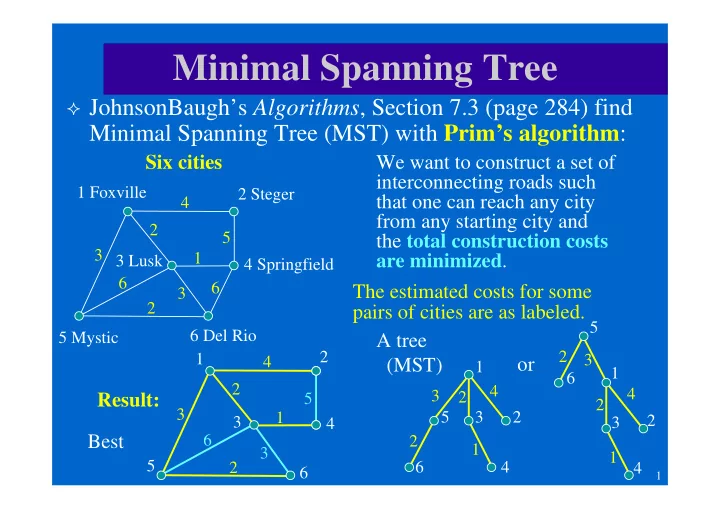
Minimal Spanning Tree JohnsonBaughs Algorithms , Section 7.3 (page 284) find Minimal Spanning Tree (MST) with Prims algorithm : Six cities We want to construct a set of interconnecting roads such 1 Foxville 2 Steger that one can


slide-1
SLIDE 1

1

3 5 6 3 5 4 1 6 3 2 3 2 6

The estimated costs for some pairs of cities are as labeled.

Minimal Spanning Tree

 JohnsonBaugh’s Algorithms, Section 7.3 (page 284) find

Minimal Spanning Tree (MST) with Prim’s algorithm:

1 Foxville 2 Steger 4 Springfield 3 Lusk 6 Del Rio 5 Mystic

Six cities We want to construct a set of interconnecting roads such that one can reach any city from any starting city and the total construction costs are minimized.

2 4 1 2 1 2 4 3 6 5

Result: A tree (MST)

4 1 2 3 2 1 2 4 3 6 5 4 1 2 3 2 1 2 4 3 6 5

  • r

Best

slide-2
SLIDE 2

2

Prim’s MST (1/7)

 Prim’s algorithm: starting with vertex 5 (Mystic)

5 4 1 6 3 2 3 2 6 1 Foxville 2 Steger 4 Springfield 3 Lusk 6 Del Rio 5 Mystic 5 4 2 4 1 2 3 2 1 2 4 3 6 5 6 3 3 6 1 4 3

2+3+4+2+1=12

4 1 6 2 4 1 4 3 6 5

2+3+2+1=8

6 5 1 3 6 5

2+3+2=7

2 3 1 4

2 4 6 3 6 2 4 3

2

6 5 1

2+3=5

slide-3
SLIDE 3

3

Prim’s MST (2/7)

Adjacency matrix:

2 6 3 6 2 6 3 5 6 1 5 4 3 6 1 2 3 5 4 2 3 2 4 1 6 5 4 3 2 1 5 4 1 6 3 2 3 2 6 1 2 4 3 6 5 4 6

2 4 3

6 5 1

MST={1,5,6}

2

h h: a list of vertices v not in the MST and its minimum weight to MST (weight of the edge from v to the vertex parent[v]) parent[v]: (v, parent[v]) is an edge of the minimal spanning tree 2 3 4 4 2 6 v minimum weight from v to MST 1 1 6 parent[v]

slide-4
SLIDE 4

4

Prim’s MST (3/7)

 Adjacency list adj: 2 6 3 6 2 6 3 5 6 1 5 4 3 6 1 2 3 5 4 2 3 2 4 1 6 5 4 3 2 1

2 4 2 4 3 2 1 4 5 3 4 5 6 3 5 6 4 1 1 2 1 2 3 6 4 5

slide-5
SLIDE 5

5

Prim’s MST (4/7)

h 1 2 3 4 5 6      v minimum weight from v to MST      parent[v]

2 5 4 1 6 3 3 2 6 1 2 4 3 6 5

MST={}

2 3 6

3 5 6 5 2 5  MST={5}

5 1

h 1 2 3 4 6      v minimum weight from v to MST      parent[v]

2 4 3 6

slide-6
SLIDE 6

6

6 3 4 2

2 1 4 1 

3 6

Prim’s MST (5/7)

6 5

MST={5,6}

6 6 2 4 3

5 6 5 4 3 2 1

parent

5 1 5 6 5 4 3 2 1

parent

1 6 5

MST={5,6,1} h 2 3 4  3 6 v minimum weight from v to MST  6 6 parent[v] 

5

1 2 4 3

h 1 2 3 4 3  6  v minimum weight from v to MST 5  5  parent[v]  6 6  3 6

slide-7
SLIDE 7

7

1

1 3 

Prim’s MST (6/7)

6 4 2 4 5 1 3 6

MST={5,6,1,3}

4

MST={5,6,1,3,4}

1 4 3 6 5

h 2 4 v minimum weight from v to MST 1 parent[v]

5 3 1 1 5 6 5 4 3 2 1

parent

5 3 1 5 6 5 4 3 2 1

parent

2

h 2 4 4 6 v minimum weight from v to MST 1 6 parent[v] 

2

MST={5,6,1,3,4,2} 

slide-8
SLIDE 8

8

Prim’s MST (7/7)

h is an abstract data type that supports the following operations h.init(key, n): initializes h to the values in key h.del(): deletes the item in h with the smallest weight and returns the vertex h.isin(w): returns true if vertex w is in h h.keyval(w): returns the weight corresponding to vertex w h.decrease(w, new_weight): changes the weight of w to new_weight (smaller) prim(adj, start, parent) { n = adj.last for i = 1 to n key[i] =  key[start] = 0 parent[start] = 0 h.init(key, n) for i = 1 to n { v = h.del() ref = adj[v] 6 3 3 6 1 4 3 6 5

v

2

4 2

w=3, w MST ref.weight=2 h.keyval(w)=3 v=1 (5,3) (3,2) (2,4)

ref

while (ref != null) { w = ref.ver if (h.isin(w) && ref.weight < h.keyval(w)) { parent[w] = v h.decrease(w, ref.weight) } ref = ref.next } } }

slide-9
SLIDE 9

9

Implementation Hints

  • 1. Write a function to read the file to an adjacency matrix
  • 2. Write a function to convert the matrix to an adjacency list
  • a. Define the list node structure (vertex, weight, next)
  • b. Define a pointer array adj[] for list heads
  • c. Write an insert() function to insert a node to a specified list
  • d. Write a freeList() function free all lists
  • 3. Define the structure of container h to store all nodes currently not in MST
  • a. An array vertices[] to store nodes
  • b. An array keys[] to store the minimal distance of vertices[] to the MST
  • 4. Define the array parent[] to store the MST
  • 5. Write a C function for the Prim algorithm of previous page
  • 6. Write an init() function to initialize the container h from key[]
  • 7. Write a del() function to find the node with minimal keyvalue in h and delete that

node/key

  • 8. Write an isin() function to test if a node is currently in MST
  • 9. Write a keyvalue() function to return the key value of specified node in h
  • 10. Write a decrease() function to modify the keyvalue fields for all neighboring

nodes of the node being deleted from h