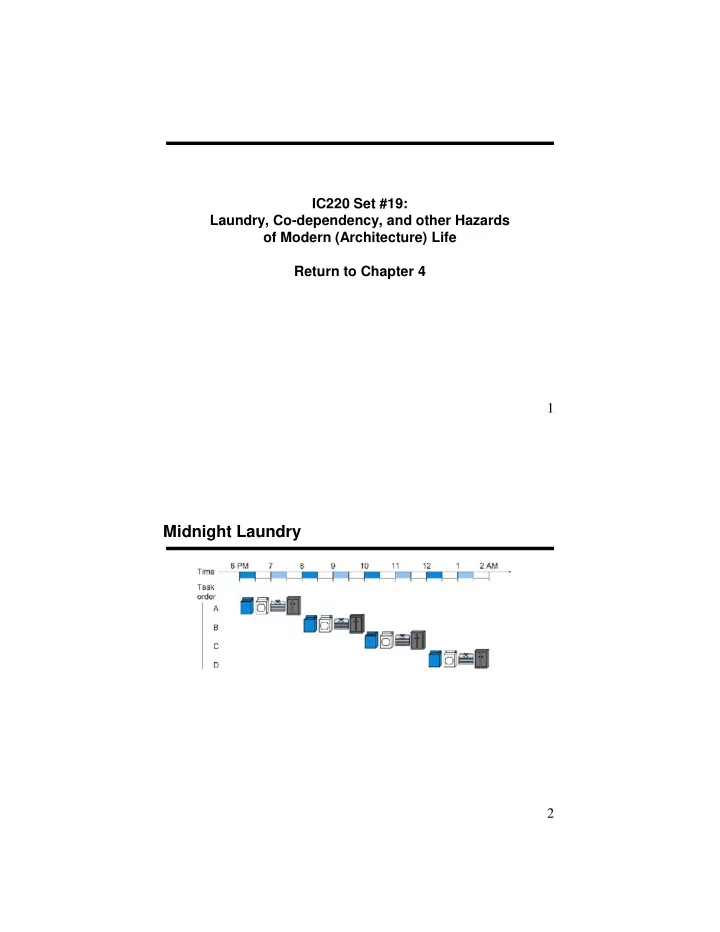
Midnight Laundry 2 Smarty Laundry 3 Pipelining Improve - - PDF document

midnight laundry
SMART_READER_LITE
LIVE PREVIEW

Midnight Laundry 2 Smarty Laundry 3 Pipelining Improve - - PDF document

IC220 Set #19: Laundry, Co-dependency, and other Hazards of Modern (Architecture) Life Return to Chapter 4 1 Midnight Laundry 2 Smarty Laundry 3 Pipelining Improve performance by increasing instruction throughput Ideal speedup is


slide-1
SLIDE 1

1 IC220 Set #19: Laundry, Co-dependency, and other Hazards

  • f Modern (Architecture) Life

Return to Chapter 4 2

Midnight Laundry

slide-2
SLIDE 2

3

Smarty Laundry

4

Pipelining

  • Improve performance by increasing instruction throughput

Ideal speedup is number of stages in the pipeline. Do we achieve this?

slide-3
SLIDE 3

5

Basic Idea

6

Pipelined Datapath

slide-4
SLIDE 4

7

Pipeline Diagrams

add $s0, $s1, $s2 sub $a1, $s2, $a3 add $t0, $t1, $t2

Assumptions:

  • Reads to memory or register file in 2nd half of clock cycle
  • Writes to memory or register file in 1st half of clock cycle

What could go wrong?

Clock cycle: 1 2 3 4 5 6 7

8

  • Problem with starting next instruction before first is finished

Problem: Dependencies

sub $s0, $s1, $s2 and $a1, $s0, $a3 add $t0, $t1, $s0

  • r $t2, $s0, $s0

Dependencies that “go backward in time” are ____________________ Will the “or” instruction work properly? Clock cycle: 1 2 3 4 5 6 7 8

slide-5
SLIDE 5

9

Use temporary results, don’t wait for them to be written

Solution: Forwarding

sub $s0, $s1, $s2 and $a1, $s0, $a3 add $t0, $t1, $s0

  • r $t2, $s0, $s0

Clock cycle: 1 2 3 4 5 6 7 8 Where do we need this? Will this deal with all hazards?

10

Problem?

lw $t0, 0($s1) sub $a1, $t0, $a3 add $a2, $t0, $t2

Clock cycle: 1 2 3 4 5 6 7

Forwarding not enough…

When an instruction tries to ___________ a register following a ____________ to the same register.

slide-6
SLIDE 6

11 Solution: “Stall” later instruction until result is ready

lw $t0, 0($s1) sub $a1, $t0, $a3 add $a2, $t0, $t2

Clock cycle: 1 2 3 4 5 6 7

Why does the stall start after ID stage?

12

Assumptions

  • For exercises/exams/everything assume…

– The MIPS 5-stage pipeline – That we have forwarding …unless told otherwise

slide-7
SLIDE 7

13

Exercise #1 – Pipeline diagrams

  • Draw a pipeline stage diagram for the following sequence of instructions.

Start at cycle #1. You don’t need fancy pictures – just text for each stage: ID, MEM, etc.

add $s1, $s3, $s4 lw $v0, 0($a0) sub $t0, $t1, $t2

  • What is the total number of cycles needed to complete this sequence?
  • What is the ALU doing during cycle #4?
  • When does the sub instruction writeback its result?
  • When does the lw instruction access memory?

14

Exercise #2 – Data hazards

  • Consider this code:
  • 1. add $s1, $s3, $s4
  • 2. add $v0, $s1, $s3
  • 3. sub $t0, $v0, $t2
  • 4. and $a0, $v0, $s1
  • 1. Draw lines showing all the data dependencies in this code
  • 2. Which of these dependencies do not need forwarding to avoid stalling?
slide-8
SLIDE 8

15

Exercise #3 – Data hazards

  • Draw a pipeline diagram for this code. Show stalls where needed.
  • 1. add $s1, $s3, $s4
  • 2. lw $v0, 0($s1)
  • 3. sub $v0, $v0, $s1

16

Exercise #4 – More Data hazards

  • Draw a pipeline diagram for this code. Show stalls where needed.
  • 1. lw $s1, 0($t0)
  • 2. lw $v0, 0($s1)
  • 3. sw $v0, 4($s1)
  • 4. sw $t0, 0($t1)

HW: 4-81 to 4-82

slide-9
SLIDE 9

17

The Pipeline Paradox

  • Pipelining does not ________________ the execution time of

any ______________ instruction

  • But by _____________________ instruction execution, it can

greatly improve performance by ________________ the ________________

18

Structural Hazards

  • Occur when the hardware can’t support the combination of

instructions that we want to execute in the same clock cycle

  • MIPS instruction set designed to reduce this problem
  • But could occur if:
slide-10
SLIDE 10

19

  • What might be a problem with pipelining the following code?

beq $a0, $a1, Else lw $v0, 0($s1) sw $v0, 4($s1) Else: add $a1, $a2, $a3

Control Hazards

  • What other kinds of instructions would cause this problem?

20

Control Hazard Strategy #1: Predict not taken

  • What if we are wrong?
  • Assume branch target and decision known at end of ID cycle. Show a

pipeline diagram for when branch is taken. beq $a0, $a1, Else lw $v0, 0($s1) sw $v0, 4($s1) Else: add $a1, $a2, $a3

slide-11
SLIDE 11

21

Control Hazard Strategies

  • 1. Predict not taken

One cycle penalty when we are wrong – not so bad Penalty gets bigger with longer pipelines – bigger problem 2. 3.

22

Branch Prediction

With more sophistication can get 90-95% accuracy Good prediction key to enabling more advanced pipelining techniques!

slide-12
SLIDE 12

23

Code Scheduling to Improve Performance

  • Can we avoid stalls by rescheduling?

lw $t0, 0($t1) add $t2, $t0, $t2 lw $t3, 4($t1) add $t4, $t3, $t4

  • Dynamic Pipeline Scheduling

– Hardware chooses which instructions to execute next – Will execute instructions out of order (e.g., doesn’t wait for a dependency to be resolved, but rather keeps going!) – Speculates on branches and keeps the pipeline full (may need to rollback if prediction incorrect)

24

Dynamic Pipeline Scheduling

  • Let hardware choose which instruction to execute next

(might execute instructions out of program order)

  • Why might hardware do better job than programmer/compiler?

lw $t0, 0($t1) add $t2, $t0, $t2 lw $t3, 4($t1) add $t4, $t3, $t4 sw $s0, 0($s3) lw $t0, 0($t1) add $t2, $t0, $t2 Example #1 Example #2

slide-13
SLIDE 13

25

Exercise #1

  • Can you rewrite this code to eliminate stalls?
  • 1. lw $s1, 0($t0)
  • 2. lw $v0, 0($s1)
  • 3. sw $v0, 4($s1)
  • 4. add $t0, $t1, $t2

26

Exercise #2

  • Show a pipeline diagram for the following code, assuming:

– The branch is predicted not taken – The branch actually is taken

lw $t1, 0($t0) beq $s1, $s2, Label2 sub $v0, $v1, $v2 Label2: add $t0, $t1, $t2

HW: 4-86 to 4-87

slide-14
SLIDE 14

27

Exercise #3 – Stretch

  • This diagram (from before) has a serious bug. What is it?

28

  • Generate control signal during the ________ stage
  • _________ control signals along just like the __________

Pipeline Control

Execution/Address Calculation stage control lines Memory access stage control lines Write-back stage control lines Instruction Reg Dst ALU Op1 ALU Op0 ALU Src Branch Mem Read Mem Write Reg write Mem to Reg R-format 1 1 1 lw 1 1 1 1 sw X 1 1 X beq X 1 1 X

slide-15
SLIDE 15

29

Details on Control

30

Implementing Pipelining

  • What makes it easy?

– all instructions are the same length – just a few instruction formats – memory operands appear only in loads and stores

  • What makes it hard?

– data hazards – structural hazards – control hazards

  • What make it really hard?

– exception handling – Improving performance with out-of-order execution, etc.