MIDDLE SCHOOLS (Grades 5-8) MIDDLE SCHOOLS (Grades 5-8) ELEMENTARY - - PowerPoint PPT Presentation

middle schools grades 5 8 middle schools grades 5 8
SMART_READER_LITE
LIVE PREVIEW

MIDDLE SCHOOLS (Grades 5-8) MIDDLE SCHOOLS (Grades 5-8) ELEMENTARY - - PowerPoint PPT Presentation

PLAINVIEW-OLD BETHPAGE CENTRAL SCHOOL DISTRICT Dr. Guy A. Lodico, Director of Technology Where We Would Like to Go: Strategic Long-Range Technology Plan/Needs Assessment W here W e W ould L ike to G o: S trategic L ong- R ange T echnology P lan/ N


slide-1
SLIDE 1

Plainview-Old Bethpage Central School District / Where We Would Like to Go: Strategic Long-Range Technology Plan/Needs Assessment FY 2014 - 2017 (022715) - Page 1 of 5 Guy A. Lodico, Ph.D., Director of Technology / www.pobschools.org

PLAINVIEW-OLD BETHPAGE CENTRAL SCHOOL DISTRICT

  • Dr. Guy A. Lodico, Director of Technology

Where We Would Like to Go: Strategic Long-Range Technology Plan/Needs Assessment

FY 2007-2008 FY 2008-2009 FY 2009-2010 D I S T R I C T

HIGH SCHOOL (Grades 9-12)

  • Upgrade (617) classroom/computer lab, administrative computers

including operating system upgrade to MS Windows 8.1

Note: Art labs (58) refreshed in 2013-14 (990-core-i7-8g-ram-64-bit)] Science Rm-240 (25) refreshed in 2013-14 Research (17) World Language (32) refreshed in 2013-14

  • High School Wireless/Mobile Devices to Support Content Areas:

Purchase additional wireless tablet devices on (2) carts to bring total carts to (4) [Lease/purchase].

  • High School Library e-books: Purchase HP Stream 7 tablets to

refresh Nook e-readers (25)

  • Secondary Base-Wireless BYOD Infrastructure: Completed in

2012/13. Review status/needs to support future expansion

  • High School Math Computer Coding/Programming Lab Refresh

VB6, JAVA 5, Microsoft Visual C++ (17)

  • H.S. Library Follett Destiny Automation System Support
  • High School Interactive/Multimedia Classrooms:
  • Ceiling Mounted DLP Projectors Refresh (31)
  • Interactive Whiteboard Refresh (5)
  • Peripherals: (31) printers,(1) large format,
  • (1) business lab plotter
  • Pilot z-Space mobile lab
  • Assistive Technology
  • Scholastic Read 180 Next Generation
  • Review e-Spark/iPads
  • Stream WPOB online for 40th Anniversary
  • Pilot Microsoft Office 365/DreamSpark
  • Classlink/Launch Pad Pilot
  • STEAM Initiatives
  • Hour-of-Code Implementation
  • Robotics
  • Independent Research/SPSS (Statistical Analysis)
  • 3D Printer (1) Rm. 168B
  • Larger Format Plotter (4) Business and Research Classes
  • Provide Professional Development to support Windows 8.1

upgrade and instructional/administrative technology initiatives

  • Xerox Copier Upgrade Implementation
  • Review Building-wide Security Camera/Access Control Upgrades

HIGH SCHOOL (Grades 9-12)

  • Purchase (4) additional wireless tablet carts to bring total

wireless content area targeted carts to (8)

  • Review Wireless BYOD infrastructure enhancements to

support (1) wireless access point per classroom

  • Instructional DLP Projector refresh (15)
  • Instructional Interactive Whiteboard refresh (5)
  • Printer/peripheral upgrades/refresh
  • High School Instructional Device Totals: (754)

[Comprised of ASUS (240), Desktop computers (514)] HS Projected Student Grade Level Enrollment (379)

  • High School Library e-books/e-readers: Review status/needs
  • High School Interactive/Multimedia Classrooms and

STEAM initiatives: Review status/needs. [Current: Interactive Whiteboards (90), DLP Projectors (101)]

  • Implement Microsoft Office 365/DreamSpark
  • Classlink/Launch Pad
  • Review upgrade to Windows 10 and provide instructional

professional development to support instructional /administrative technology initiatives

  • Implement z-Space initiative
  • Assistive Technology
  • Scholastic Read 180 Next Generation
  • Implement e-Spark/iPads
  • Classlink/Launch Pad Pilot
  • STEAM Initiatives
  • Hour-of-Code Implementation
  • Robotics
  • Independent Research/SPSS (Statistical Analysis)
  • Provide Professional Development to support Windows 8.1

upgrade and instructional/administrative technology initiatives

  • Xerox Copier Upgrade Implementation
  • Implement Building-wide Security Camera/Access Control

Upgrades HIGH SCHOOL (Grades 9-12)

  • Secondary Wireless Infrastructure: Review

Status/Needs

  • High School Wireless Mobile Devices: Review

status/needs and continue BYOD initiatives.

  • High School Computer Art Lab Refresh (3)
  • High School Instructional Device Totals:
  • Projected Student Grade Level Enroll (TBD)
  • Total High School Computers (--)

[Comprised of (--) wireless devices and (--) lab computers.]

  • Implement Windows 10 and provide professional

development to support instructional /administrative technology initiatives

  • Review building-wide Security Camera/Access

Control Systems

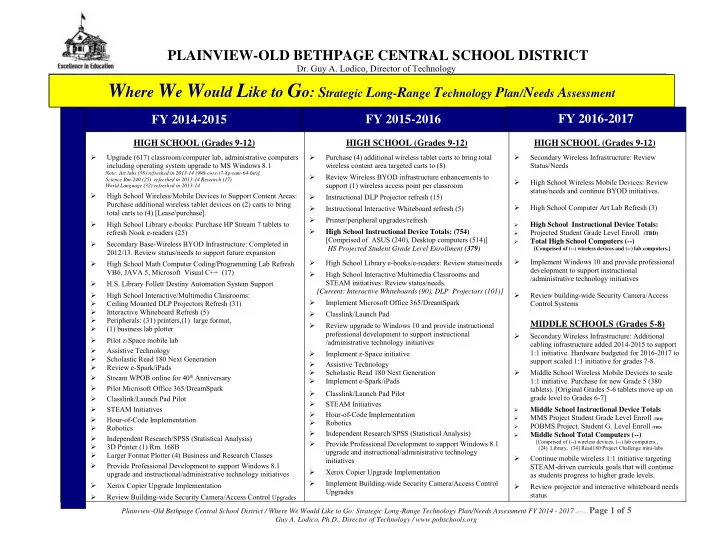
MIDDLE SCHOOLS (Grades 5-8)

  • Secondary Wireless Infrastructure: Additional

cabling infrastructure added 2014-2015 to support 1:1 initiative. Hardware budgeted for 2016-2017 to support scaled 1:1 initiative for grades 7-8.

  • Middle School Wireless Mobile Devices to scale

1:1 initiative. Purchase for new Grade 5 (380 tablets). [Original Grades 5-6 tablets move up on grade level to Grades 6-7]

  • Middle School Instructional Device Totals
  • MMS Project Student Grade Level Enroll (TBD)
  • POBMS Project. Student G. Level Enroll (TBD)
  • Middle School Total Computers (--)

[Comprised of (--) wireless devices, (--) lab computers.,

(24) Library, (34] Read180/Project Challenge mini-labs

  • Continue mobile wireless 1:1 initiative targeting

STEAM-driven curricula goals that will continue as students progress to higher grade levels.

  • Review projector and interactive whiteboard needs

status

Where We Would Like to Go: Strategic Long-Range Technology Plan/Needs Assessment

FY 2014-2015 FY 2015-2016 FY 2016-2017

slide-2
SLIDE 2

Plainview-Old Bethpage Central School District / Where We Would Like to Go: Strategic Long-Range Technology Plan/Needs Assessment FY 2014 - 2017 (022715) - Page 2 of 5 Guy A. Lodico, Ph.D., Director of Technology / www.pobschools.org

  • Review Adobe Creative Cloud Licenses and annual subscription

model

MIDDLE SCHOOLS (Grades 5-8)

  • Upgrade (508) classroom/computer lab, administrative computers

including operating system upgrade to MS Windows 8.1

  • Middle School Mobile Wireless Devices to Support Content

Areas: Purchase (4) new ASUS carts [Lease/Purchase]. Current Netbook carts (4) to be relocated in 2015-2016

  • 5th Grade Middle School 1:1 Pilot Initiative: Purchase (160

Amplify tablets) based on collaborative team exploring Board of Education goal

  • 1:1 Wireless Infrastructure Enhancement Initiative:

Base–system implemented in 2010 + school years. Additional cabling infrastructure added 2014-2015 to support 1:1 initiative. Hardware budgeted for 2015-2016 to support scaled 1:1 initiative for grades 5-6.

  • M.S Library Follett Destiny Automation System updates
  • Middle School Interactive/Multimedia Classrooms:
  • Projector refresh (10) Interactive Whiteboard (10)
  • Middle School Library e-books: Review pilot status/needs
  • Assistive Technology
  • Scholastic Read 180 Next Geneation
  • Review e-Spark/iPads to support AIS
  • Pilot Microsoft Office 365
  • Classlink/Launch Pad Pilot
  • Provide Professional Development to support Windows 8.1

upgrade

  • MMS 3D Printer (Tech-C)
  • POBMS 3D Printer (111)

ELEMENTARY SCHOOLS (Grades K-4)

  • Upgrade (632) classroom/computer lab, administrative computers

including operating system upgrade to Windows 8.1

  • Base-wireless Infrastructure Initiative: All elementary schools to

be completed by Spring 2015

  • ASUS Wireless Mobile Device Carts Grades 1- 4 (4)
  • M.S Library Follett Destiny Automation system support
  • Elementary School Interactive/Multimedia Classrooms:
  • Pas (2) Rms. Resource/Lib - Strat (1) Rm. 306 + Total Refresh

All Elementary (5)

  • Peripheral needs/refresh all schools (TBD)
  • Pilot Microsoft Office 365
  • Review/implement Adobe Creative Cloud Licenses and

annual subscription model

MIDDLE SCHOOLS (Grades 5-8)

  • Purchase (4) additional ASUS wireless tablet carts to bring

total to (8) [Total of (4) existing carts per middle school]

  • Middle School Wireless Mobile Devices to scale 1:1

initiative for Grade 5: Purchase (380) and Grade 6 (258) Amplify tablets. [Based on 378 - 120 pilot units that moved up one grade level]

  • 1:1 Wireless Infrastructure Upgrade: Hardware budgeted for

2015-2016 to support scaled 1:1 initiative for grades 5-6 [Additional cabling infrastructure added 2014-2015 to support 1:1 initiative]

  • Middle School Instructional Device Total: (1,326)

[Comprised of Asus (240), Amplify (638), Desktop (448) MMS Projected Student Grade Level Enrollment (209) POBMS Project. Student Grade Level Enrollment (203)]

  • Instructional DLP Projector refresh (10)
  • Instructional Interactive Whiteboard refresh (10)
  • includes: MMS Rm# SeminarA N.HackerESL

POBMS Rm# 311A F.Mandel

  • Middle School Interactive/Multimedia Classrooms: Review

refresh status/needs. [Current: Interactive Whiteboards (141) DLP Projectors (149)

  • Implement z-Space initiative
  • 3D Printers add (1) per middle school [Note: total of 2 per

middle school]

  • MS Music Studio
  • Technology Labs
  • Hour-of-Code Implementation
  • STEAM Initiatives
  • Implement Microsoft Office 365
  • Classlink/Launch Pad
  • Assistive Technology
  • Scholastic Read 180 Next Generation
  • Implement e-Spark/iPads to support AIS
  • Review upgrade to Windows 10 and provide instructional

professional development to support instructional /administrative technology initiatives

ELEMENTARY SCHOOLS (Grades K-4)

  • Elementary School Wireless Mobile Devices: Purchase (10)

additional mobile wireless carts [Note: provides (2) carts per elementary school.

  • Elementary School Instructional Device Total: (994)

[Comprised of ASUS (420), Desktop (574)]

  • Implement Windows 10 and provide professional

development to support instructional /administrative technology initiatives

ELEMENTARY SCHOOLS (Grades K-4)

  • Implement Elementary Base-wireless infrastructure

upgrade to one access point per classroom: Review status/needs

  • Elementary School Wireless Mobile Devices:

Review status/needs

  • Review Elementary School Instructional Device

Totals: Including wired and wireless mobile devices based on 2015-2016 projections.

  • Implement Windows 10 and provide professional

development to support instructional /administrative technology initiatives

  • Building-wide Security Camera/Access Control

Systems

DISTRICT-WIDE K-12

  • Review Internet Bandwidth Needs to

maintain/support high-speed Internet access for

  • nline state assessments, instructional Web-based

resources, video streaming/ videoconferencing/distance learning instructional resources/activities.

  • Network Architecture: Inter-Chasis redundancy

at Single Data Center. Install two new chassis to create a true device-redundant core in NOC. Benefit: Will improve current 99.95% to 99.9% which equals 52.56 minutes of downtime per SLA (Service Level Agreement). This upgrade will also future-proof the district with 400% more processing power with a rating of 280-Gbps switching capacity with 225 million packets (Mbps) of throughput.

  • Internet Redundancy: Add a secondary ISP at the

datacenter to provide Internet fail-over redundancy

  • f Internet service.
  • Evaluate Software Infrastructure Plan/Licensing

implementation.

  • Review Smart Card Technology.
  • Review SIF (Schools Interoperability Framework)

implementation to link district-wide database- driven information systems such as Library Automation, Transportation, and Pupil Personnel

slide-3
SLIDE 3

Plainview-Old Bethpage Central School District / Where We Would Like to Go: Strategic Long-Range Technology Plan/Needs Assessment FY 2014 - 2017 (022715) - Page 3 of 5 Guy A. Lodico, Ph.D., Director of Technology / www.pobschools.org

  • Classlink/Launch Pad Pilot
  • Provide Professional Development to support Windows 8.1

upgrade

  • Hour-of-Code
  • Assistive Technology
  • Scholastic Read 180 Next Geneation
  • Review e-Spark/iPads to support AIS

DISTRICT-WIDE K-12

  • Professional Development:
  • Model Schools Days included in BOCES lease purchase

agreements

  • Amplify Tablet Training – ongoing
  • Office of Curriculum Budget
  • BOCES AOS (Administrative Office Support)
  • Upgrade (103) administration desktop computers including
  • perating system to MS Windows 8.1
  • Wireless Networks: Continue implementing district-wide

networks to support BYOD (Bring Your Own Device) access and STEAM (Science, Technology, Engineering, Arts, Math) curricula-driven instructional activities.

  • Classroom Projector/Interactive Whiteboard Refresh:

Assess classroom locations that require projectors and interactive whiteboards to be refreshed/upgraded to support instructional initiatives and activities.

  • Network Environmental: Generator: Implement a natural gas

fired generator system to support NOC and mission critical MDF closets during electrical outages in addition to maintaining network operation stability. - Upgrade district-wide uninterruptable power supplies and begin wiring closet restructuring for POBJFKHS, POBMS, and MMS. – Identify power outage and phase electrical related issues at Pasadena ES, Stratford Rd, and POBMS.

  • Network Performance Assessment: Perform detailed network

performance assessment with specialized tools to establish a performance baseline to determine key network parameters such as network latency (core and edge), bandwidth consumption on key interfaces, and IP flow data of entire network in order to provide a holistic view of areas that may require improvement. This assessment is designed to support a bond issue that can provide the funding required to prepare our network to meet the 21st centric digital needs of our students, teachers, and staff.

  • Student Information Management System: (Infinite Campus)

Continue Infinite Campus Parent Portal Initiative Grades K-12 to enable remote parent/guardian access to student attendance, grades, etc.

  • Evaluate Wireless Device implementations and status of

emerging technology tablet devices such as the apple/ipad, android, pc tablet, ms-surface, etc OB Projected Student Grade Level Enrollment (93) PKWY Project Student Grade Level Enrollment (89) PAS Project Student Grade Level Enrollment (89) STRAT Project Student Grade Level Enrollment (103)

  • Elementary Base-wireless Infrastructure completed: Review

infrastructure expansion needs to include cabling, patch panels, and network switches in every classroom

  • Instructional DLP Projector refresh (15)
  • Instructional Interactive Whiteboard refresh (10)
  • Includes:

PAS- Rm. #s 30 P.Schaumburg- 26B G.Winter – 22A J.Greenblatt K-Center- Rm #225 D.Edwards/J.Rilling Old Bethpage- Rm # 22R M.O’Neill – Rm. 27 OT/PT Stratford Rd. Rm # 306 and ArtRoom? K-Center: ABA Rm. Computer Norells extra in office

  • Elementary School Interactive/Multimedia Classrooms:

Review refresh status/needs. [Current: Interactive Whiteboards (128,) DLP Projectors (145)

  • z-Space initiative, STEAM, e-spark/iPads, Special Ed
  • Implement Microsoft Office 365
  • Classlink/Launch Pad
  • Assistive Technology
  • Scholastic Read 180 Next Generation
  • Implement e-Spark/iPads to support AIS
  • Upgrade to Windows 10 and provide instructional

professional development to support instructional /administrative technology initiatives

DISTRICT-WIDE K-12

  • Review Internet Bandwidth Needs: To maintain/support

high-speed Internet access for online state assessments, instructional Web-based resources, video streaming/ videoconferencing/distance learning instructional resources/activities.

  • Network Architecture: In-Chasis redundancy and

dedicated core switch. Backup supervisor engine for data center in active/standby mode to enhance core network

  • redundancy. Purchase and install second fiber card. Benefit:

Will improve current 99.8% to 99.95% SLA (Service Level Agreement)

  • Network Environmental: Perform wiring closet

restructuring for Stratford/K-Center, Pasadena, Old Bethpage, and Parkway elementary schools. – Install IP based cameras at all wiring closets to monitor equipment space for an enhanced level of security. – Install (2) additional quad outlets to support current and future network

  • equipment. – Install (1) new 24 strand 50 micron OM3 link

between POBJFKHS and MMS to support proposed redundant data center at POBJFKHS. – Upgrade any existing Systems, etc.

  • Re-evaluate Document Imaging Implementation to

reduce paper usage/expenditures and create a searchable repository of mission critical documents, daily file sharing, and archiving of federal/state mandated records

  • Re-evaluate IP Telephony /unified messaging

solution status/needs/reduced costs Note: New System Implemented 2012-2013

  • Virtualization/Cloud Computing Project:

Evaluate project status and user experience to continue implementation of private cloud into instructional networks to enhance computer performance and reduce computer hardware, management and electrical expenditures.

  • Evaluate Wireless Device implementations and

status of emerging technology tablet devices such as the apple/ipad, android, pc tablet, ms-surface, etc.

  • Review Strategic TCO budget implications
  • Review Emergency Management Technology Plan

initiatives.

  • Evaluate professional development plan /

mandatory 18 hour curricular-driven sessions

  • Evaluate Software Infrastructure Plan/Licensing

standardization implementation to reduce expenditures and network incompatibility issues.

  • Evaluate District-wide IP-based Security Camera

System consolidation

  • Continue to review/upgrade district-wide network

security systems and Internet Safety procedures in alignment with auditor recommendations.

  • Continue to Implement centralized file storage

FAS system (Storage Area Network / Network Attached Storage) - to meet the growing instructional /administrative data storage needs of the district and to provide a redundant backup site for disaster recovery (Phase three of project 100% completed).

  • Review disaster recovery site needs and

recommendations

  • Evaluate K-12 Library Automation System

(Follett Destiny)

  • Evaluate Transportation Management System

(Transfinder)

  • Evaluate Substitute Management System (AESOP)
slide-4
SLIDE 4

Plainview-Old Bethpage Central School District / Where We Would Like to Go: Strategic Long-Range Technology Plan/Needs Assessment FY 2014 - 2017 (022715) - Page 4 of 5 Guy A. Lodico, Ph.D., Director of Technology / www.pobschools.org

  • Point-of-Sale NutriKids: Continue support and assess needs
  • Network Infrastructure/SAN/Replication/Disaster Recovery:

Content Filter Redundancy – E-mail Archive – Redundant Mail Server – Print Servers – Redundant ASA Firewall/Security – Citrix Remote Access/BYOD

  • Website/Communication:

(Schoolwires) Review content creation, navigation, and user friendliness to enhance digital communication opportunities with parents, community members, and district-wide personnel. Website management and digital communication features for this system include: a) editorial control and workflow; b) online content authoring; c) integrated and customizable calendars; d) Website analytics; e) e-alerts, and content subscriptions; f) multimedia including podcasts, premium photo gallery, and clip art; g) forms and surveys including online surveys, quizzes and registrations, and f) RSS services.

  • District App (Pobschools on iTunes and Google-play):

Continue support of student developed District App to enhance communication for parents and community members to access POB News, Twitter, Calendar, Menus, First Alert, Teacher Pages, School Holidays, MySchoolBucks, Map and About POB

  • Twitter: Continue Twitter as a real-time communication medium

to update parent and community members on the district news and events

  • Emergency Phone/E-mail Communication: (SchoolMessenger)

Review upgrade options to include attendance calling, general building-based announcements to enhance the district’s ability to communicate with parents about district programs, information, and website content. Continue evaluating and reviewing Emergency Management Technology Plan initiatives to maintain continuity of educational programs in the unfortunate event of a national and/or local pandemic, for example.

  • Virtualization/Cloud Computing Project: Continue Cloud

Computing initiative to enhance computer performance and reduce computer hardware, management and electrical

  • expenditures. Review MS Office 365 and GOOGLE Apps
  • Data Warehouse: Continue the development of district Data

Warehouse capabilities and provide comprehensive staff data analysis training to inform instruction.

  • Professional Development: Continue staff professional

development to enhance technology utilization in supporting teaching and learning environments and the development of 21st Century skills integrated into mandatory 18 professional hour sessions.

  • Network Security/Internet Safety: Review/upgrade district-

wide network security systems and Internet Safety procedures in alignment with federal mandates and auditor mandates

  • FAS (Fabric Attached Storage Area Network / Network

Attached Storage): Evaluate ongoing Implement centralized file storage needs to meet the growing instructional /administrative data storage needs of district and to provide redundant backup site for disaster recovery. 62.5 micron fiber optic cable to the new 50 micron OM3 6 strand cable between all wire closets to future-proof up to 10Gps speeds.

  • Document Imaging: Implement solution for Guidance

Office to reduce paper usage/expenditures and create a searchable repository of mission critical documents, daily file sharing, and archiving of federal/state mandated records

  • Scale Remote Access: To provide students with Citrix

remote access. Implement Citrix Netscaler to DMZ off CISCO ASA.

  • Student Information Management System: (Infinite

Campus) Evaluate new modules and data integration features

  • Evaluate: Wireless Device implementations via status of

post radio mapping tests grades K-12.

  • Evaluate: Emerging technology tablet devices such as the

apple/ipad, android, pc tablet, ms-surface, etc.

  • Emergency Phone/E-mail Communication:

(SchoolMessenger) Evaluate upgrade options to include attendance calling, general building-based announcements to enhance the district’s ability t communicate with parents about district programs, information, and website content. Continue evaluating and reviewing Emergency Management Technology Plan initiatives to maintain continuity of educational programs in the unfortunate event of a national and/or local pandemic, for example.

  • Data Warehouse: Continue the development of district Data

Warehouse capabilities and provide comprehensive staff data analysis training to inform instruction.

  • Professional Development: Continue staff professional

development to enhance technology utilization in supporting teaching and learning environments and the development of 21st Century skills integrated into mandatory 18 professional hour sessions.

  • Review district-wide use of information technology

resources to better manage and reduce expenditures. Assess the use and implementation of district-wide printers to better leverage the network, and redeploy. Assess the use of printer supplies, ink, toner, etc.

  • Evaluate refresh needs status of Interactive/Multimedia Enriched

Presentation System comprised of: Computer/DVD/cloud streaming player/recorder, visual presenter, student response system, large group instruction projector device and screen/or interactive whiteboard; videoconferencing, video streaming, and audio/sound field classroom speaker technologies designed to enhance curricula-driven learning environments to meet the diverse learning modalities and multi-sensory needs of all students. Specialized network hardware/software designed to streamline teacher instructional work flow/presentation; professional development to ensure curriculum infusion; and technical support will be key budgeted components of this implementation.

  • Evaluate Strategic TCO budget implications
  • Review all status of student to device ratio to meet potential

PARCC needs and evaluate MS Office 365 cloud-based solutions.

  • Review core network transmission capabilities to

enhance Instructional and Administrative applications.

  • Review centralized NOC file servers to support

instructional and administrative building implementations.

slide-5
SLIDE 5

Plainview-Old Bethpage Central School District / Where We Would Like to Go: Strategic Long-Range Technology Plan/Needs Assessment FY 2014 - 2017 (022715) - Page 5 of 5 Guy A. Lodico, Ph.D., Director of Technology / www.pobschools.org Item Description Year 1 Year 2 Year 3 to 5 1 Network Architecture 2 Secondary Supervisor Line card include install X 3 Secondary Fiber line card include install X 4 Cisco 3750XStackable LAN switched POE include install X 5 Cisco 4507R+E Bundle x2 (replace existing 4507R)include install X 6 Cisco ASA 5540 IPS (pair), include install X 7 Additional ISP router X 8 Cisco 4507R+E Bundle, include install X 9 Cisco ASA 5540 IPS (single), include install X 10 Additional Server and Storage Components X 11 ISP Router X 12 Network Performance Assessment - Professional Services X 13 Network Performance Assessment - Enterprise Network and system Performance Tools X 14 Citrix XenApp repositioning X 15 Enterprise level NAC X 16 Cloud base security X 17 Sub total $142,995.00 $228,190.00 $918,000.00 18 5 Year Total CAPEX $1,289,185.00 19 Network Infrastructure/Environmental 20 Access Control at all IDF entrances where doors are present at all building locations X 21 IDF Closet Cleanup - HS, Matlin, POB Middle School X 22 Cabinet/Rack Install - HS, Matlin, POB Middle School X 23 UPS Upgrade X 24 IDF Closet Elem. Schools X 25 Cabinet/Rack Install - Elementary Schools X 26 Cameras X 27 Passadena E.S, Stratford E.S. and P.O.B. Middle School - Power Study X 28 Electrical Upgrades X 29 Climate monitoring X 30 AC Units X 31 Redundant fiber link between Matlin and HS X 32 Additional tech support 33 Cooling fans X 34 DC build out at HS X 35 Upgrade fiber optic cable X 36 Sub total $245,119.00 $299,712.00 $234,200.00 37 5 Year Infrastructure Plan $779,031.00 38 39 Sub Total $388,114.00 $527,902.00 $1,152,200.00 40 Grand Total $2,068,216.00

slide-6
SLIDE 6

Plainview-Old Bethpage Central School District - Where We Are Today: Strategic Long-Range Technology Plan, Fiscal Years 2001-2012 (5-17-12)

Page 1 of 4

PLAINVIEW-OLD BETHPAGE CENTRAL SCHOOL DISTRICT

District-wide Educational Technology Status Report

Guy A. Lodico, Director of Technology,

www.pobschools.org

Where We Are Today: Strategic Long-Range Technology Plan, Fiscal Years 2001-2002 to 2007-2008

In a Nutshell: Summary of Instructional Computer Technology Status:

A) POBJFKHS: Average building-wide student to Network/Internet accessible computer/device /ratio is 3:1. A LAN (Local Area Network) provides each

classroom with a total of (4) CAT6 (Category 6 rated cable) network drops and clean electrical power to support current and future growth of instructional and administrative educational technology needs. Computers/devices connect to the LAN via a 100/1000 Megabit (Mbps) Ethernet switched connection to a building-wide Gigabit Ethernet Fiber Optic Backbone connected to a Gigabit Ethernet 12-strand Fiber Optic Wide Area Network (WAN). Wireless 802.11 a/b/g/n access points and devices provide targeted instructional programs secure network access to district-wide digital resources including home directories, research databases, the Internet, etc. In addition, the district provides authorized user Bring Your Own Device (BYOD) access to the Internet for the library, department offices, and other instructional locations. Instructional programs are supported with classroom computers connected to Interactive Whiteboards, Digital Projectors, networked printers/other interactive peripherals/devices in addition to a total of (19) specialized content-area related computer labs/clusters. Specialized content-area instructional labs/minilabs and multimedia enriched learning environments include:

  • (3) Computer Graphic/Media Arts labs (Refresh of 73 computers scheduled for 2012-2013)
  • (1) Technology Lab
  • (1) Technology A+ Computer Repair Lab
  • (1) LOTE (Languages Other Than English) Lab ((Refresh of 37 computers scheduled for 2012-2013)
  • (1) Music Lab
  • (2) Business Labs
  • (2) English Classroom Perimeter Labs
  • (1) Research Lab
  • (1) Science Lab
  • (1) Reading Instruction Lab (Read180)
  • (2) Library Media Center Labs with access to (8) Web-based Research Databases
  • (1) Follett Destiny Library Automation System with student OPACs and Web Portal for home-to-school online catalogue access
  • (2) Social Studies Classroom Perimeter Labs
  • (1) Math Computer Programming Lab
  • (88) Classroom Multimedia Presentation Systems (LCD/DLP Projectors, audio systems, DVD players); (9) Mobile Projector Systems ((+ 14 for 2012-2013)
  • (76) Interactive whiteboards (SmartBoards) + (1) Mobile Interactive Whiteboard Cart ((+ 7 for 2012-2013)
  • (1) Radio Station (WPOB 88.5 FM is a share time station with WKWZ Syosset and broadcasts Monday to Friday from 7:30 am to 2:30 pm)
  • (1) Television Studio (multi-camera studio/set, linear and non-linear editing, digital cameras)
  • (5) Content Area Department Office Computer Mini Clusters including BYOD (Bring Your Own Device) Wireless Access to the Internet
  • Special Education Teacher IEP-Direct access and Special Education Assistive/Adaptive Technology Computer Clusters and Specialized Software
  • Guidance Office Naviance Information System
  • (1) Guidance Office CSE Conference Room Data Projection System and Student College Research/Essay/Resume Mini Computer Cluster
  • Wireless Instructional Netbooks/Cart, Wireless Staff and Student BYOD (Bring Your Own Device) access, Wireless Security Guard devices

Where We Are Today: Strategic Long-Range Technology Plan

H I G H S C H O O L In a Nutshell: Summary of Current Educational Technology Resources:

slide-7
SLIDE 7

Plainview-Old Bethpage Central School District - Where We Are Today: Strategic Long-Range Technology Plan, Fiscal Years 2001-2012 (5-17-12)

Page 2 of 4

B) MIDDLE SCHOOLS (GRADES 5-8): Average building-wide student to Network/Internet accessible computer ratio is 4:1. A LAN and WAN

(identical to the aforementioned POBJFKHS high school technical network design specifications) support all instructional and administrative technology

  • applications. In addition Wireless 802.11 a/b/g/n access points and devices provide targeted instructional programs secure wireless network access to

district-wide digital resources including home directories, research databases, the Internet, etc. In addition, the district provides authorized user Bring Your Own Device (BYOD) access to targeted areas in each building. Instructional programs are supported with classroom computers connected to Interactive Whiteboards, networked printers, and other interactive peripherals/devices in addition to the following educational technology resources:

  • (1) Library Media Center Networked Computer Lab per middle school
  • (1)Follet Destiny Library Automation Systems + student Computer Cluster OPACs and Web Portal for home-to-school online catalogue access in

addition to (6) Web-based Research Databases; centralized network resources and Internet access per middle school

  • (2) Networked Computers/printer per classroom per middle school (One computer per classroom refresh scheduled for 2012-2013)
  • (2) Computer Labs with LCD projector presentation systems per middle school;
  • (1) Project Challenge Computer Cluster Lab per middle school
  • (64) Wireless Netbooks per middle school (Total of 128 wireless devices in addition to pilot i-Pad initiatives in targeted locations)
  • (132) Classroom Presentation Systems (LCD/DLP Projectors) with pending computer-based DVDs; ((+ 9 for 2012-2013)
  • (10) Mobile Projector Systems; (70) Audio Support Systems
  • (113) Interactive whiteboards (SmartBoards) ((+ 8 for 2012-2013)
  • Special Education Teacher IEP-Direct access / Assistive/Adaptive Technology Computer Clusters and Specialized Software Applications
  • Read180 Minilabs in specialized locations
  • Special Education CSE Conference Room Data Projection System/ Computer Access
  • New Guidance Office Naviance Information System

C) ELEMENTARY SCHOOLS (GRADES K-4): Average student to Network/Internet accessible computer ratio is 4:1. A building-wide LAN a

and WAN (identical to the high school and middle school specifications listed above) support all instructional and administrative technology applications. Instructional programs are supported with classroom computers connected to Interactive Whiteboards, networked printers, and other interactive peripherals/devices in addition to the following educational technology resources:

  • (1) Follett Destiny Library Automation System with student OPACs and Web Portal for home- to-school online catalogue access

in addition to (5) Web-based Research Databases per elementary school.

  • (1) Library Media Center Networked Computer Lab/LCD presentation system with centralized resources / Internet access per elementary school.
  • (3) Networked Computers/printer per classroom (district-wide Grade Level 3 and 4 classroom computers/printers were installed as funded by a Dell

Computer Corporation Grant and special pricing negotiation initiatives. Computers labs were upgraded in 2007 migrating existing computer lab computers to Grade Levels 1 and 2. ((One computer per classroom refresh scheduled for 2012-2013)

  • (113) Classroom Presentation Systems (LCD/DLP Projectors) with computer-based DVDs; ((+ 11 for 2012-2013)
  • (14) Mobile Presentation Systems;
  • (65) Audio Support Systems
  • (96) Interactive whiteboards (SmartBoards) (+ 11 for 2012-2013)
  • Special Education Teacher IEP-Direct access / Assistive/Adaptive Technology Computer Clusters and Specialized Software Applications
  • Read-180/System44 Minilabs and specialized locations
  • Special Education CSE Conference Room Data Projection System/Computer Access
  • Installation of Earobics Learning System for K-Center

M I D D L E & E L E M E N T A R Y S C H O O L S

slide-8
SLIDE 8

Plainview-Old Bethpage Central School District - Where We Are Today: Strategic Long-Range Technology Plan, Fiscal Years 2001-2012 (5-17-12)

Page 3 of 4

I

1) Implemented a district-wide assessment of existing technology resources, student needs, staff needs, instructional and administrative needs, technical infrastructure needs, technical support personnel needs; budget implications/needs; 2) Implemented technology teams to provide on-going enhanced communication of building technology needs; 3) Created and implemented a secure Central Office of Technology NOC (Network Operation Center) and server farm to provide the required foundation to support short and long-term district-wide instructional and administrative network resource/application needs, goals, and emerging technology initiatives. The current network is 100 Base-T operating over a Gigabit Ethernet backbone and is comprised of a core CISCO 4507 multilayer network switch; 3750 multilayer network switches, and 3550 network switches. Dynamic VLANS are implemented in all buildings. The network is secured by a CISCO PIX firewall. The primary operating system used in the district is Windows Server 2000/2003. Computer Associates Threat Manager has been implemented for virus/spyware control. 4) Implemented a preliminary NOC technical support personnel infrastructure to maintain an average of (175) administrative mission critical computers, (1,486) instructional computers, (750) peripherals, (38) software applications/suites and (158) network devices with: (1) director of technology, (1)

  • ffice secretary, (1) part-time higher-level network technician position, (3) full-time field technicians, and (1) 1/2 –time technician as of FY 2008-09.

The current support technician to computers/infrastructure ratio is 1:651.75 5) Created and implemented district-wide building-based Computer Technology Teacher Aide positions to provide basic maintenance and first-line instructional technology support for teachers and staff. High School (2) positions; Middle Schools (1) position per building; Elementary Schools Grades K-4 (1) position per building. 6) Implemented the installation and upgrade of district-wide administrative LANs (Local Area Network) located at Central Administration and Annex, POBJFKHS, Mattlin MS, POBMS, Parkway ES, Stratford ES, Pasadena ES, Old Bethpage ES, and Kindergarten-Center; 7) Began the implementation of an administrative/instructional Computer Hardware/Software Infrastructure Plan initiative to support cost-effective district-wide standardization goals to provide for the ongoing development of grade-level curricula-driven software application alignment with state/national standards, technology skill benchmarks, and software relevant professional development workshop opportunities for all staff members. The long-term goal of this initiative is to provide district-wide equity of technology budget resources to reduce legacy OS (Operating System) and software version incompatibilities; instructional and administrative computer crashing/downtime, viruses, loss of data; incompatible hardware/software related technical support troubleshooting, incompatible software purchasing waste, and software licensing costs; 8) Installed and implemented a district-wide Gigabit Ethernet Fiber Optic WAN (Wide Area Network) to support and provide Centralized Network Resource and Internet connectivity to all buildings; 9) Implemented a district-wide computer hardware/software and printer upgrade for all central administration and building-based offices, guidance counselors, social workers and nurses; 10) Implemented the infrastructure to support the installation of a new e-mail system for teachers and administrators with remote web-based applications to enhance and support communication between buildings; 11) Installed/implemented a new centralized Financial & Human Resource Management system and provided district-wide user application training; 12) Implemented the capital project design, bid specifications, project management, and installation of district-wide Instructional LANS (Local Area Networks) for classroom grades 1 through 8 at Mattlin MS, POBMS, Parkway ES, Stratford ES, Pasadena ES, and Old Bethpage ES comprised of (4) CAT6 copper data lines to the desktop, fiber optic backbone, network switches, and clean electrical power. In addition, this installation provides the prerequisite wiring required to implement wireless technology classroom carts and building-wide access points for future growth;

D I S T R I C T In a Nutshell: Summary of District-wide Information Technology Action Item Status:

slide-9
SLIDE 9

Plainview-Old Bethpage Central School District - Where We Are Today: Strategic Long-Range Technology Plan, Fiscal Years 2001-2012 (5-17-12)

Page 4 of 4

13) Implemented district-wide building-based IDF (Intermediate Distribution Frames) and MDF (Main Distribution Frame) infrastructure with UPS (Uninterruptible Power Supply) to support newly installed network switches, routers, and patch panels; 14) Implemented a centralized disaster recovery infrastructure system to provide daily district-wide file server backup and virus scanning/definition updates, and UPS (Uninterruptible Power Supply) emergency backup power and surge protection; 15) Implemented a Data Warehouse to provide a repository of instructional testing data elements organized for optimal disaggregated and longitudinal analysis/gap reporting to help inform instructional needs and implemented content-area related district-wide Data Warehouse Analysis Teams; 16) Implemented a district-wide Technology Communications Teams to evaluate emerging web-based Student Information Management Systems; 17) Implemented the infrastructure to support a new web-based Office of Pupil Personnel IEP data management system; Office of Curriculum web-based Professional Development and Curriculum Mapping applications; Buildings & Grounds web-based Maintenance/Repair Request & Tracking System; Central Office of Technology web-based Maintenance Request/Repair and Tracking System; and Office of Personnel web/phone-based Substitute Employee Management System; 18) Created and developed a K-12 Computer Technology Curriculum Guide; 19) Implemented district-wide instructional technology Professional Development workshops into required 18 hour training for certified teaching staff; 20) Implemented district-wide clerical software application training support workshops to migrate from Corel Word Perfect to MS Word, financial/human resource management systems, student management systems, etc. 21) Implemented Metro Ethernet solution to replace T-1 line and legacy ISDN circuits, and consolidation of Intellipath Consortium telephone circuits; 22) Redeveloped District Web Site to provide timely information including the addition of a Parent-Information-Link; Daily Event Calendar; Emergency School Closing, Snow Days and Delayed Opening Alerts; School Contact Numbers and First Alert, Board of Education Meetings and Agendas; Lunch Menus; Online Access to School Library Catalogues and Research Database Resources; BOE Policies, Counseling Center/Guidance cite, and special program schedules for athletics, cultural arts and music; 23) Implemented new Library Media Center Computer Labs at all buildings K-12 24) Implemented Library Automation Systems at all buildings K-12; 25) Continued implementation of instructional LCD/DLP multimedia classroom projector presentation systems; 26) Implemented and installed an Instructional LAN (Local Area Network) at POBJFKHS and Kindergarten Center comprised of (4) CAT6 data lines, fiber optic backbone, network switches, and clean electrical power. In addition, this installation provides the prerequisite wiring required to implement wireless technology classroom carts and building-wide access points for future growth; 27) Implemented a computer refresh cycle. To date 100% of all classrooms, computer labs/clusters, and Library Media Centers have been upgraded to the Dell Optiplex GX Enterprise Series model specifications. 28) Installed new Storage Area Network (SAN) / Networked Attached Storage (NAS) / Fabric Attached Storage (FAS) type solution . 29) Implemented Off-site Disaster Recovery Site 30) Implemented a new Parent Emergency Notification System. 31) Implemented a new Student Information Management 32) Implemented a new Transportation System 33) Implemented a new Library Automation System 34) Implemented new Security/Camera Systems 35) Piloted virtualization solution for servers and desktops – administrative desktop implementation in progress. Instructional lab pilots in progress. 36) Evaluate, design, and implement Internet Protocol Telephony System to support digital communication goals and provide switch upgrades for wireless

D I S T R I C T

slide-10
SLIDE 10

2015-16 Technology Budget March 2, 2015

slide-11
SLIDE 11

Techno hnolog logy y Point nts of P f Pri ride de

 District-wide Microsoft Windows 8.1 and

computer/tablet upgrade including Professional Development

 1:1 Middle School Amplify Pilot

 Streaming of WPOB (40th anniversary)  Elementary Base-wireless network

initiative (Spring 2015)

 District-wide Tech Tools/Resources:

  • Interactive Whiteboards
  • Projectors
  • Mobile Wireless Devices
  • Document/Video Conferencing Cameras

 Scholastic Read-180 Next Generation  HS Graphic Art Labs/ADOBE CS6  World Language Tandberg Lab

 High School Math/Computer

Programing lab refresh

 Hour-of–Code initiative  Robotics  Digital Communication:

  • Parent/Guardian Emergency

Notification System (School-Messenger)

  • District/School Website (Schoolwires)
  • Twitter
  • District App
  • Board Docs

 ClassLink/Launchpad  Microsoft Office 365/DreamSpark  Security Cameras/Access Control  Point-of-Sale Cafeteria System

Grades K-12 (Nutrikids)

 Generator fail-over for NOC

slide-12
SLIDE 12

Bu Budg dget et Su Support pports s

 MS 1:1 Initiative/Wireless:

  • Expansion of Amplify Tablets Grades 5-6
  • Network Equipment

 Mobile Device Carts:

  • High School (4) SS, English, Science, Math
  • Middle Schools (2/2) Building-wide
  • Elementary (2 per building-wide) Grades K-4

 K-12 Instructional Equipment

  • Document Cameras
  • Video Conference Cameras
  • Printers
  • Scanners

 K-12 Instructional Upgrades/Adds/Refresh:

  • Interactive Whiteboards
  • DLP Projectors
slide-13
SLIDE 13
slide-14
SLIDE 14

Distri trict ct-wi wide de Bu Budget et Initiativ tiatives

 e-Spark/iPads: AIS Support  Technology Labs:

  • 3D Printers (2) - One per Middle School
  • CNC Routers

 MS Music Studio  Research Equipment

 Z-Space  Professional Development:

  • Model Schools Days
  • Amplify Tablet Professional Development
  • Office of Curriculum
  • BOCES Administrative Office Support

 Technical Support Staffing:

  • (7) Network Technicians
slide-15
SLIDE 15

District-wide Futuring

 District BOND Referendum

  • Network Architecture/Infrastructure
  • Network Switch Upgrades
  • Network Redundancy
  • Network Security
  • Network Environmental
  • Network MDF/IDF Clean-up
  • UPS (Uninterruptible Power Supplies)
  • Disaster Recovery

 Smart Schools Bond Act

  • Wireless Connectivity
  • Mobile Wireless Devices
  • Computer Servers
  • Planning/Response to Building

Level Instructional Technology Initiatives

slide-16
SLIDE 16

POB Schools: A Smart Investment